

Will My Blind Pet Be Happy? Quality of Life and What to Expect
Alastair Greenway
BVM&S MRCVS
The question I'm asked most after a blindness diagnosis isn't about the eyes at all. It usually comes a few weeks in, once the appointments are done and the house has gone quiet. "Will she still be happy?" And underneath it, almost always, the one nobody says out loud: am I keeping them going for me?
That question deserves a straight answer, and here are two. Asking it is not a betrayal of your pet, it's the opposite, and I'd be more worried about the owner who never asked. And the evidence-led answer is a hopeful one: most pets who lose their sight go on to have a genuinely good quality of life, and the dread of it is usually far worse than the reality. Let me show you why I can say that with a straight face, and give you a real way to check it for your own pet.
What the people who've lived it actually say
The strongest evidence we have comes from a hard place, and that's exactly what makes it reassuring. Researchers followed 100 dogs that had gone suddenly and permanently blind from SARDS, an irreversible loss of sight in dogs (there's a separate piece on SARDS the condition if you want it), and asked the owners how life had turned out. These were owners dealt about the worst hand going: no warning, no time to prepare, nothing to save, often an older dog. And still, looking back, 95% said they would discourage euthanasia of a dog with SARDS, and 37% reported that their relationship with their dog had actually improved after the diagnosis (Stuckey et al., 2013). Most rated their dog's quality of life as good, around 80% scoring it good to excellent (Stuckey et al., 2013), a figure echoed by an academic ophthalmology service at roughly 80% moderate-to-excellent quality of life, with 87% reporting moderate-to-excellent navigation around the house (Colorado State University, n.d.).
Sit with that. The people who feared the worst, then actually lived it, overwhelmingly say they were glad they carried on. Because this is the sudden, no-warning version, it sets a floor, not a ceiling: if owners of dogs that lost everything overnight feel this way, an owner whose pet faded gradually, or kept one eye, or has a treatable cause behind it can take real heart. It's not a study of every blind pet that ever lived, but it doesn't stand alone. The wider profession lands in the same place, because pets were never as dependent on their eyes as we are. "Many dogs adapt remarkably well to gradual vision loss and can continue to live happy, fulfilling lives with some adjustments" (University of Pennsylvania, Ryan Veterinary Hospital, n.d.), making up for the lost sense "by relying on other senses such as smell, taste and touch, which often become keener over time" (Vahrenwald, n.d.). And "for the average family dog, blindness does not seem to be as significant an issue as it is in a person", because dogs "rely heavily on other senses, such as smell and sound, and are able to move around fairly well" (Gibeault, 2023). A blind pet doesn't know it's missing anything. It simply gets on with reading a world it already largely takes in by nose and ear.
When a pet does find it hard
Here's where I have to be careful, because reassurance that ignores the exceptions isn't trustworthy. "Most do well" is not "all do well". The Royal Veterinary College runs a dedicated research project on this exact question, and rather than assuming seamless adaptation, it states plainly that the impact of vision loss on a dog's quality of life is "poorly understood", and that "the limited available evidence suggests that they may experience similar physical and emotional effects to humans with vision-loss" (Royal Veterinary College, n.d.), which in people includes frustration, anxiety and even depression. So let me say it without dressing it up: a minority of pets genuinely struggle, particularly in the first few weeks, or in a noisy, ever-changing, hazardous home, or when there's pain in the mix.
I'm not telling you that to frighten you, but because it hands you the levers. Almost every one of those struggles is fixable, and knowing what to fix is far more useful than a blanket "they'll be fine". So let's get specific, in both directions: what a good life actually looks like in a blind pet, and what quietly erodes it.
What a good day looks like
"Good quality of life" is easy to say and hard to picture, especially when you're anxious and watching your pet for signs you're not sure how to read. So I'd point you to the same yardstick vets use, Dr Alice Villalobos's quality-of-life scale, which scores seven everyday things from 0 to 10: Hurt (is pain well managed), Hunger (are they eating), Hydration, Hygiene, Happiness (do they "express joy and interest", are they responsive to family and toys, or "depressed, lonely, anxious, bored or afraid"), Mobility (can they get about), and whether there are "more good days than bad", with a total over 35 taken as an acceptable quality of life (Villalobos, 2004/2007).
Notice something about that list: sight isn't on it. Vision feeds into just two of the seven items, Mobility and Happiness, and most blind pets still score well right across the board. They eat keenly, follow you from room to room, light up for a sniffy walk or a favourite person at the door, sleep soundly, and, once the map of the house is learned, potter about it with real confidence. The arithmetic matters far less than the checklist, so don't get hung up on the total. Just look at your pet against the everyday markers below and ask how many they still tick.
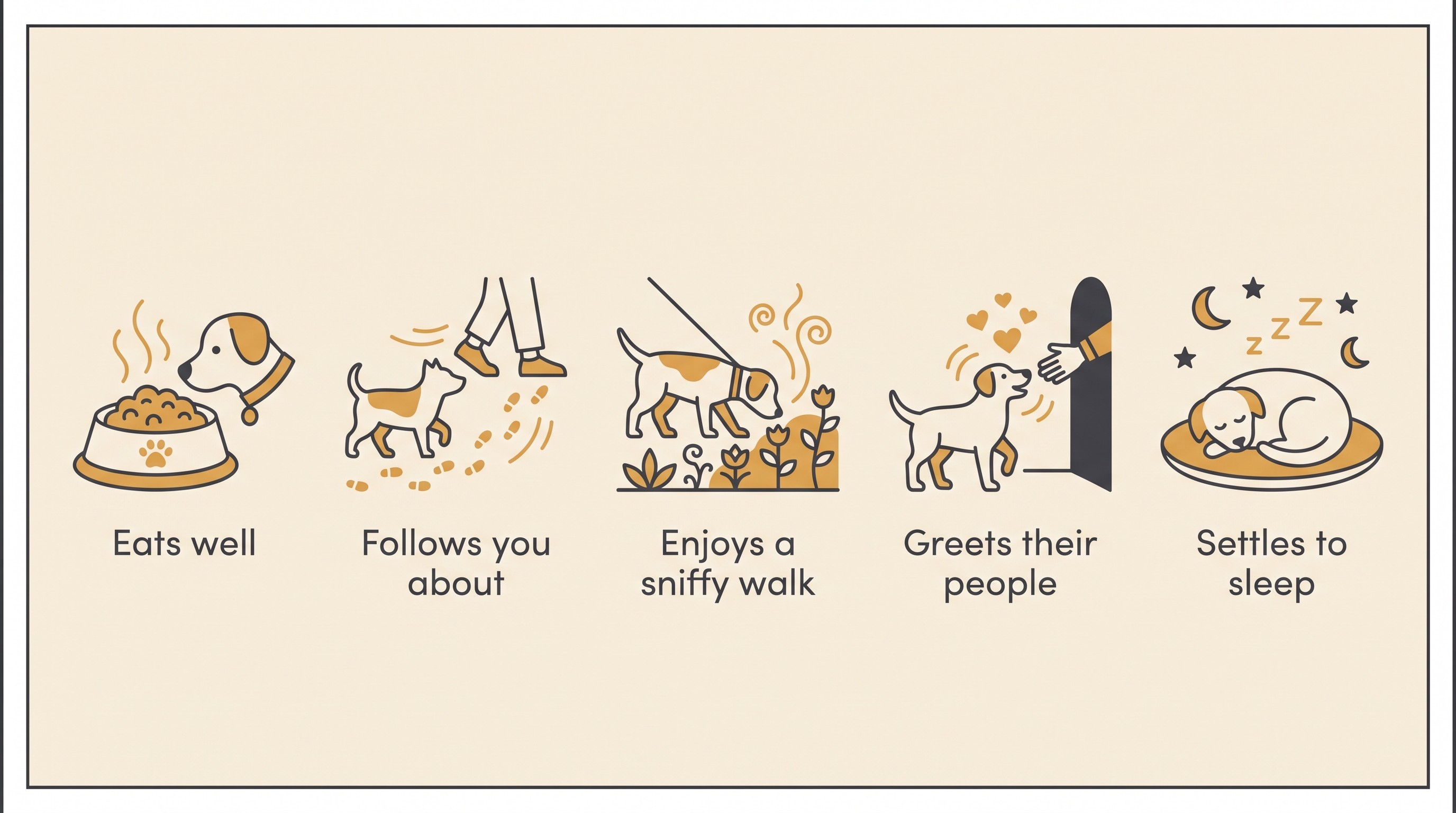
If your pet ticks most of these, the reassurance isn't me being kind. It's what the scale measures, and it's telling you they're doing well. If they tick fewer than you'd like, that's not a verdict either: it's usually a signpost to something fixable, which is the next part.
What genuinely flattens it, and how to fix it
When a blind pet seems flat, withdrawn or nervous, owners often read it as the blindness itself, as proof their pet is suffering for the loss. Far more often, it's one of three things, and each has a fix you can reach for.
Pain comes first, always. Villalobos puts "Hurt" at the very top of the scale precisely because pain trumps everything else: "adequate pain control ... is of top concern" (Villalobos, 2004/2007). Now, the crucial distinction for you: blindness itself doesn't hurt. But the disease that caused it sometimes does, and an eye that is both blind and painful, most often from glaucoma, is the single commonest hidden reason a blind pet seems flat or quietly miserable. Pets are stoical and hide eye pain well, so it's easy to miss (if you want the signs, spotting eye pain lays them out). And here's the encouraging part: a blind, painful eye is a very fixable problem, often by removing the eye altogether. That sounds drastic and it isn't. It's one of the kindest things we do, the pain relief is the entire point, and pets do extremely well afterwards. If pain is anywhere in your picture, read removing a blind, painful eye.
Anxiety and low confidence come next, and they answer to routine. A blind pet that bumps about, hesitates and hides is usually not suffering. It's a pet whose home and routine haven't yet caught up with how it now needs to live. The medicine is consistency: a predictable day, calm handling, and people who announce themselves before they touch. The full method, the cue words, the "talk before you touch" habit, getting the whole household doing it, belongs to communicating with a blind pet, and it's where the confidence is rebuilt. Hold the principle here: nervousness in a newly blind pet is a stage to work through, not a sentence.
A home that keeps changing comes third. The "single most important thing you can do for your blind pet is to keep your home environment consistent", because "rearranging furniture ... will confuse your pet and can cause accidents and injury" (Vahrenwald, n.d.). Your blind pet navigates by a memorised map, layered with scent and sound, so a moved sofa or a bag left in the hallway can turn a confident pet back into an anxious one overnight. Keep the layout still, keep them active and "mentally stimulated", and ask visitors to "alert them before petting" (MedVet, 2024). The room-by-room detail is owned by home-proofing for a blind pet, with the blind-pet home checklist as a handy one-pager. A stable home is not a small kindness, it's a load-bearing one.
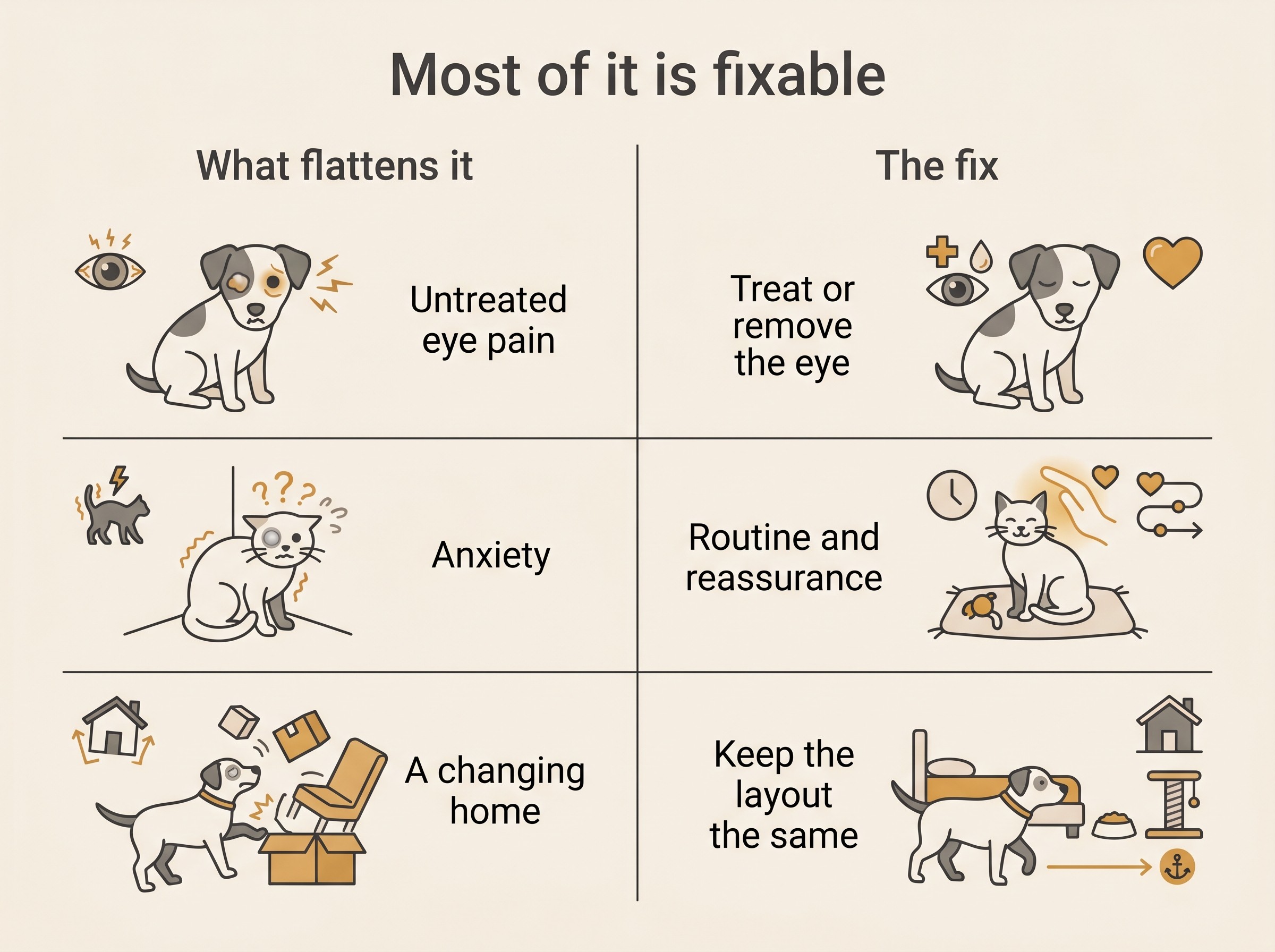
None of this asks you to be a clinician. It asks you to notice which lever applies and pull it, and in most homes, getting the routine right and ruling out pain is enough to bring the spark back.
The harder conversation, named plainly
There's one situation that genuinely changes this, and I'd be doing you a disservice to skate over it, because naming it plainly is itself a kindness.
A bright, otherwise-well pet that happens to be blind is, on all the evidence above, very likely to have a good quality of life. Blindness alone is almost never a reason to consider euthanasia, and the weight of the evidence runs hard the other way. But a pet that is already frail, painful elsewhere, declining from serious systemic illness, and newly blind is a different situation, and a fair one to name. There, the blindness can be the straw that tips a balance that was already hard. This is exactly why the Villalobos scale weighs the whole animal, pain, appetite, mobility and "more good days than bad" together, rather than sight in isolation (Villalobos, 2004/2007). Sometimes the bigger picture is an illness with its own space on this site to lean on, advanced kidney disease or an overactive thyroid in an older cat, or diabetes in a dog, and your vet will help you see the whole pet rather than just the eyes.
So hold both truths at once, calmly. Blindness on its own is not a reason to let a pet go. Blindness as one more burden on a pet already suffering for other reasons is a legitimate part of a wider, whole-animal quality-of-life conversation, one to have openly with your vet rather than alone at night.
A note for cat owners
Everything above holds for cats just as squarely, and if anything, cats often adapt at least as readily as dogs, because so much of how a cat reads its world is already whisker, scent and memory rather than sight. They "adapt so well to their environment and find ways to get done what they need to get done", to the point that a cat born blind can go unnoticed for a long time (Donohue, 2025). The practicalities differ, vertical space, a fixed cat-tree and litter layout, indoor safety, and those belong to blind cats. But the answer to the question you came with is the same for your cat as for any dog: yes, they can be happy. (One caveat: a cat that goes blind suddenly is an urgent, blood-pressure emergency for another day, not the settled question of a pet who is already blind.)
So, will they be happy?
Come back to the question you opened with. Wanting to ask "is my pet happy?" is not a failure of nerve, it's responsible ownership, and for the great majority of newly blind pets the answer the evidence gives is genuinely hopeful. The owners who walked this path before you didn't regret carrying on (Stuckey et al., 2013), and time and again the diagnosis turns out to be harder on the human than on the pet, who simply gets on with it (Gibeault, 2023). A UK nursing review devoted to maintaining quality of life in blind dogs makes the same case from the clinical side: with a steady routine, a consistent home and the other senses leaned on, a blind dog's quality of life is very much worth maintaining (Hedges, 2016).
The most useful tool I can leave you with isn't a number, it's watching the right things over time. Rather than scanning your pet for suffering each day and frightening yourself, track their navigation and confidence in a structured way with the At-Home Vision Check, built on a validated owner vision questionnaire (Rogers et al., 2023). Used week by week, it lets you see the adaptation happening, fewer bumps, more confidence, the map being learned, and if a bigger picture is ever in play you'll have an objective record to bring to that whole-animal conversation with your vet.
If you're only days into this, the early-weeks dip and the day-by-day emotional arc are owned by the first 30 days with a newly blind pet and the first-30-days toolkit, and that's the next place to go. For now, hold the headline: keep them comfortable, keep the layout still, talk before you touch, and watch. The flat, uncertain version of your pet in front of you tonight is very often the middle of the story, not the end of it. Most come through, find their feet, and one ordinary morning surprise you by being entirely themselves again.
References
- Colorado State University Veterinary Health System (CSU Ophthalmology). (n.d.). Sudden Acquired Retinal Degeneration Syndrome (SARDS) in Dogs.
- Donohue, L. (2025). Seeing The Bright Side: Helping Pets Adjust To Vision Loss. Texas A&M School of Veterinary Medicine & Biomedical Sciences, VMBS News (Pet Talk), 4 September 2025.
- Gibeault, S. (2023). Progressive Retinal Atrophy (PRA) in Dogs: What to Know (quoting J. Klein DVM). American Kennel Club, updated 22 August 2023.
- Hedges, S. (2016). Maintaining quality of life for deaf and blind dogs. The Veterinary Nurse, 7(4), 213-221.
- MedVet. (2024). Caring for Your Blind Pet: Nine Tips to Improve Their Quality of Life. MedVet, 21 February 2024.
- Rogers, C. M., Salzman, M. M., Li, Z., Merten, N., Russell, L. J., Lillesand, H. K., & Mowat, F. M. (2023). Subjective vision assessment in companion dogs using dogVLQ demonstrates age-associated visual dysfunction. Frontiers in Veterinary Science, 10, 1244518.
- Royal Veterinary College. (n.d.). The impacts of vision-loss on dog and owner Quality of Life. RVC research project.
- Stuckey, J. A., Pearce, J. W., Giuliano, E. A., Cohn, L. A., Bentley, E., Rankin, A. J., Gilmour, M. A., Lim, C. C., Allbaugh, R. A., Moore, C. P., & Madsen, R. W. (2013). Long-term outcome of sudden acquired retinal degeneration syndrome in dogs. Journal of the American Veterinary Medical Association, 243(10), 1425-1431.
- Vahrenwald, M. K. (n.d.). Living with a Blind or Deaf Pet: Tips from the Vet. American Animal Hospital Association (AAHA).
- Villalobos, A. E. (2004/2007). Quality of Life Scale (The HHHHHMM Scale). Originally "Quality of Life Scale Helps Make Final Call", Oncology Outlook, Veterinary Practice News, September 2004; revised in Canine and Feline Geriatric Oncology: Honoring the Human-Animal Bond, Blackwell Publishing, 2007.
- University of Pennsylvania, Ryan Veterinary Hospital (Ophthalmology). (n.d.). Progressive Retinal Atrophy. School of Veterinary Medicine, University of Pennsylvania.
Keep track of how your pet is doing
The owners who cope best are the ones who notice changes early. A simple health log shows you what is working, and what is not, before the next vet visit.
Start tracking, freeYou're not doing this alone
Compare treatment journeys and talk to owners managing vision & eye health. Free to join.
Join PetsLikeMine