

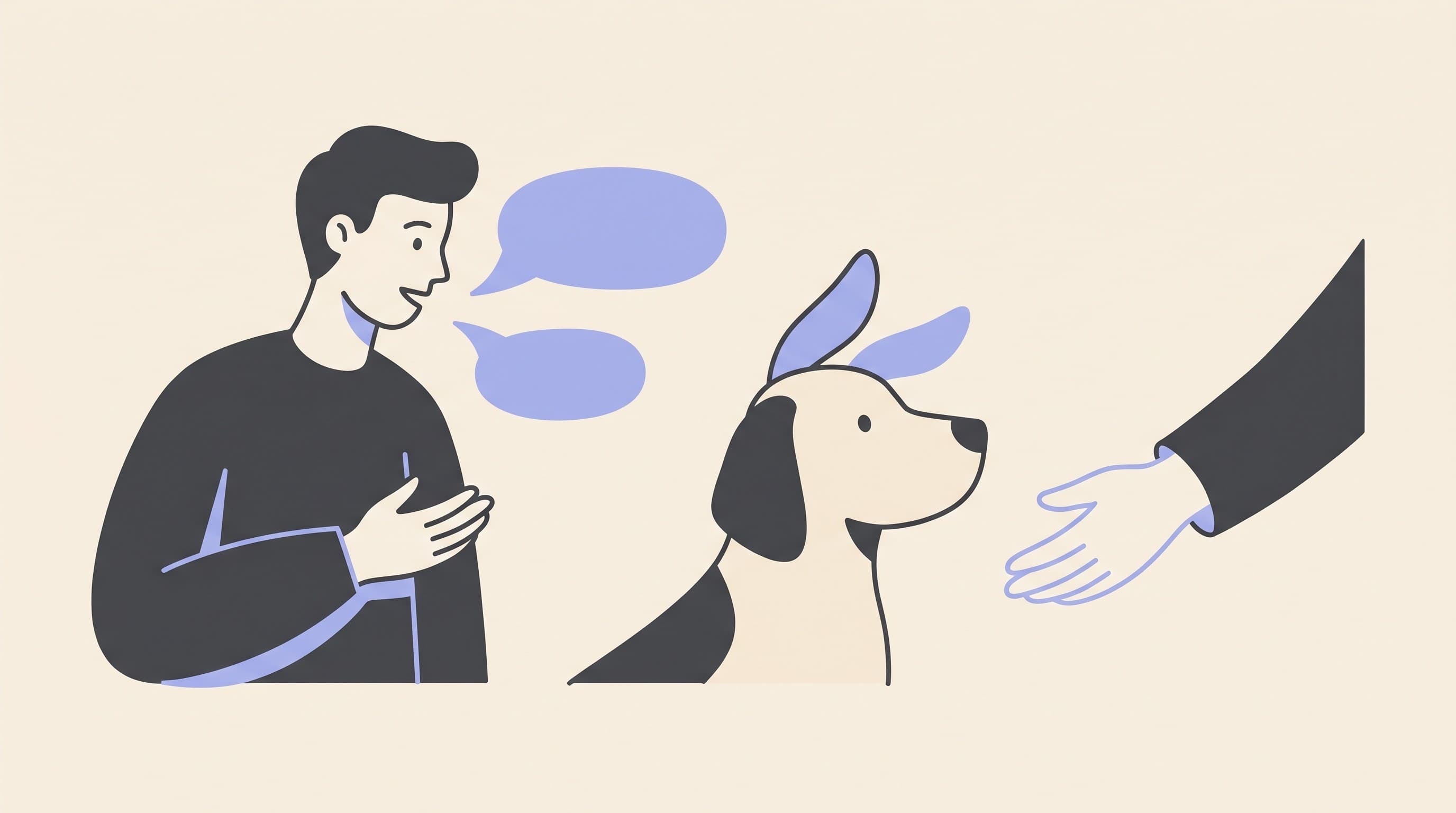
Talk Before You Touch: Communicating With a Blind Pet
Alastair Greenway
BVM&S MRCVS
A newly blind pet will often flinch, snap or scramble up in a panic when a familiar hand reaches in to stroke them in their usual spot. Owners describe this to me again and again, and it catches them off guard, because nothing has changed in their kindness. What has changed is that their pet can no longer see the hand coming.
When a pet loses their sight the rules of contact change overnight, and the new rule is simple, free and works straight away: announce yourself with your voice before you make contact. Talk before you touch. It's the founding habit of living well with a blind pet. This is the communication piece of the picture: setting the home up physically belongs to home-proofing your home for a blind pet, and the emotional settling-in of those first weeks to the first 30 days with a newly blind pet. Here, I want to give you the words and the habits.
The one rule that changes everything
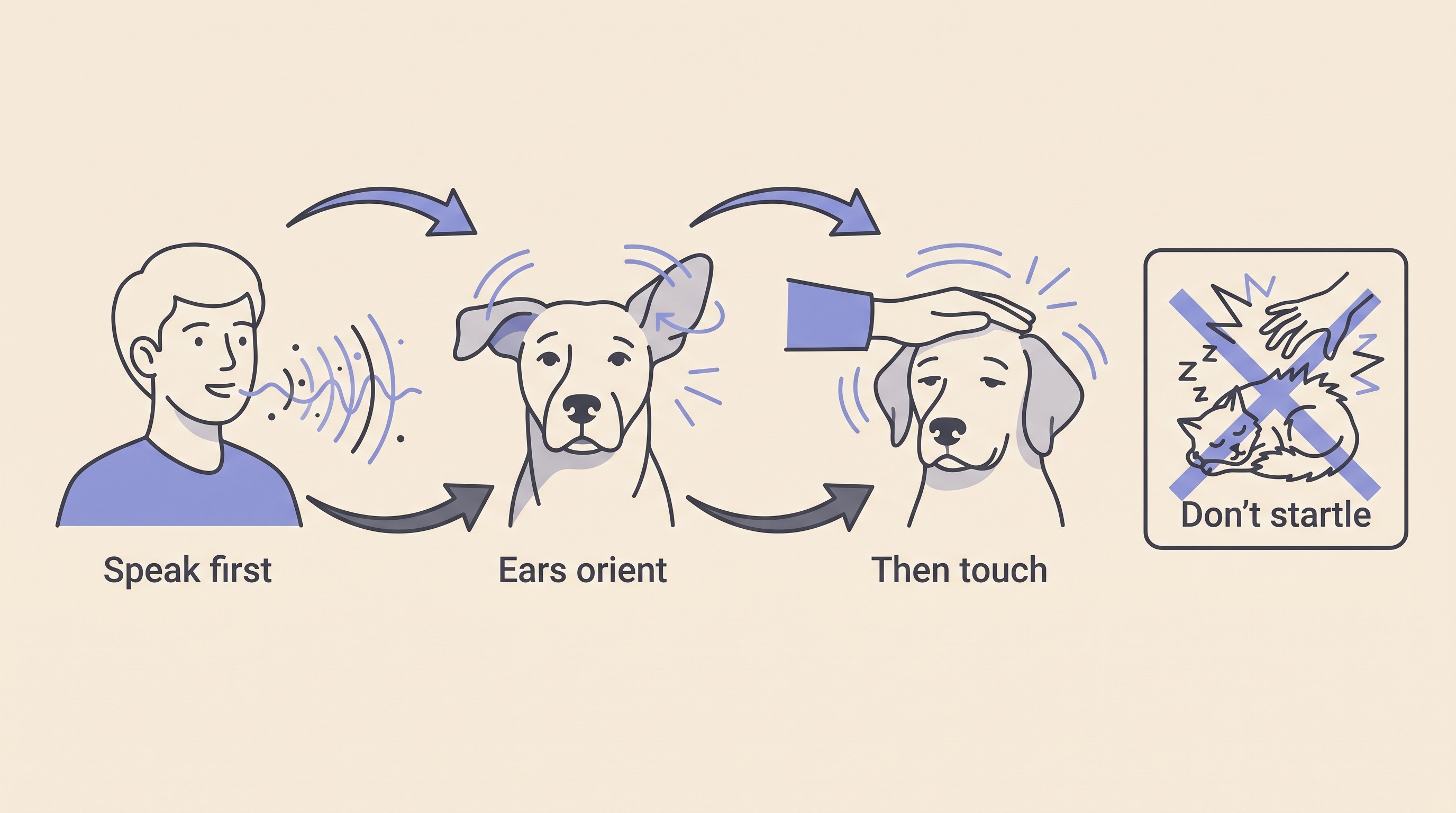
If you take nothing else away, take this. To avoid startling your pet, speak as you approach to touch them, especially if they're asleep (Best Friends Animal Society, n.d.). It's the single most repeated instruction in every reputable blind-pet resource I know, and it applies to dogs and cats alike. Battersea put it as a flat rule: always talk to your dog before you touch them, so you don't scare or startle them (Battersea, 2026). If your pet is sound asleep and a soft word doesn't rouse them, gently shake their bed before you reach in, rather than touching them cold (Humane World for Animals, n.d.).
Why does it matter more than it first appears? A sighted pet sees your hand coming and braces for it. A blind pet doesn't, so a touch out of nowhere is genuinely frightening, and a frightened animal is the one that jumps, bolts or, occasionally, bites. None of that is your pet turning nasty. It's a startle reflex in a creature that has lost its early-warning system, and your voice is now that system.
The part owners most often miss is that this has to be a whole-household rule, not just yours. Children, partners, the friend who pops round, the relative who has the dog at weekends: every one of them has to learn to speak first, because a single silent touch from one well-meaning person can undo weeks of rebuilt trust in an afternoon. Say it out loud to visitors, the way you'd warn them about a step. It is worth being almost theatrical about it for the first few weeks, a cheerful "say hello first, he can't see you" at the door, until it becomes the household's reflex rather than yours alone.
Building a small, shared vocabulary
Beyond general chatter, blind pets cope beautifully with a handful of consistent cue words. The words themselves matter far less than picking a few and using them identically, every time, across the whole household.
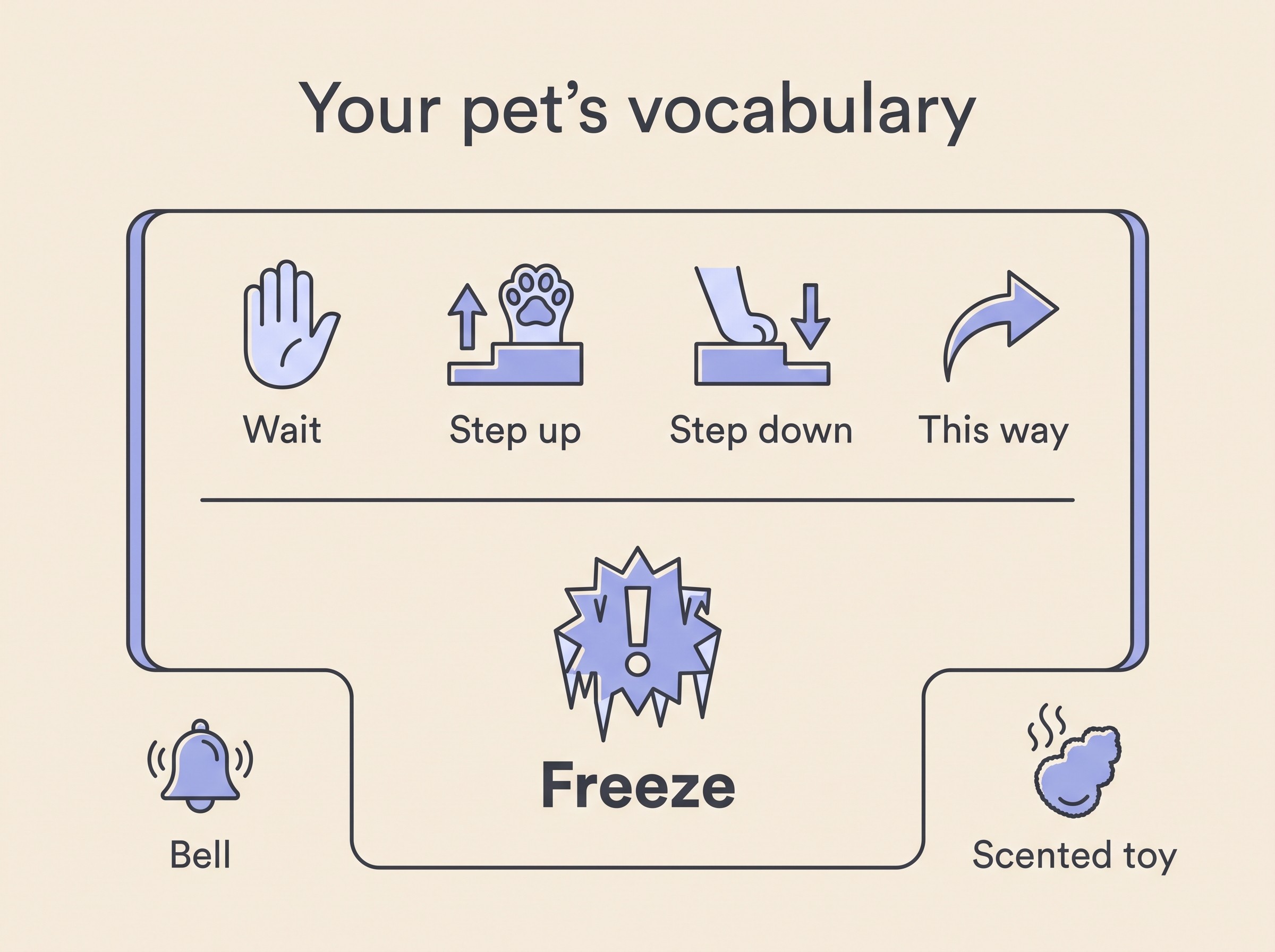
For dogs, the most widely taught cues are short and practical. "Watch" warns them they're about to bump into something so they can slow or change course, and "step up" and "step down" tell them a kerb or stair is coming (Best Friends Animal Society, n.d.). The UK working set used by Battersea is the same idea with British phrasing: "wait" announces you're about to stop walking, "walk on" that you're setting off again, "hup" for a step up or kerb and "step" for a step down, "this way" and "that way" for turns, and "who's this?" to announce that a new person or dog has arrived (Battersea, 2026). Pick the ones that fit your life, write them on the fridge so everyone uses the same words, and be consistent. Verbal cues work well here precisely because they don't rely on a visual signal your pet can no longer see (Patterdale, 2026).
Teaching a new word to a pet that can't see you is more straightforward than people expect, because you pair the word with the thing rather than with a hand signal. To install "step up", for instance, you say it in the same calm tone every time, just before the front paws meet the step, and reward the moment they make it. Do that consistently and within a week or two the word starts to arrive a half-second ahead of the obstacle in your pet's mind, which is exactly the head start you want. If your pet still has some sight and you can see this coming, there is a real advantage to teaching the core cues early, while the words can be matched to something they can still partly see. That prepare-early angle is its own topic in preparing for a pet's blindness; the cues themselves, and how to use them, live here.
If you teach only one cue first, make it a danger word. A single agreed word, "wait", "stop" or "careful", that means "freeze, something's wrong" is the one most worth having, because it lets you halt your pet at the top of an unseen step or away from a hazard while you reach them (Humane World for Animals, n.d.). It's the verbal equivalent of a hand on the collar, and it is the cue you'll be most grateful for on the day something unexpected happens.
A quick word on tone, because re-teaching a blind pet asks for a particular gentleness. Always use reward and reassurance, and never punish, hit or shout (Humane World for Animals, n.d.). A pet that bumps a doorframe or hesitates at a step isn't being slow or stubborn, it's navigating a world it can't see, and the right response is a calm cue and a treat. That keeps your pet brave rather than anxious, and a confident blind pet is a safe one. Keeping up gentle training and games gives a blind pet a job and a win too, and that engagement builds the self-confidence that matters so much when vision is gone (Patterdale, 2026).
Turning sound and scent into signposts
Because your blind pet listens and sniffs their way through the world, you can hand them deliberate sound and scent cues to follow, one of the kindest and cheapest tricks there is.
Sound first. A small bell on your shoe or trouser leg turns you into something your pet can hear coming and track around the house, and a bell on any other pet's collar does the same for them (Best Friends Animal Society, n.d.). If your blind pet startles when a sighted housemate appears out of nowhere, that bell on the other animal's collar is the fix (Humane World for Animals, n.d.). And toys that squeak, rattle or make a noise as they move give a blind dog something to home in on, so a game of fetch is still very much on the table (Patterdale, 2026).
Scent works as a signpost in the same way. A strong-smelling treat rubbed onto a toy before you throw it lets your pet sniff it out where they can't see it land (Battersea, 2026), and subtle, pet-safe scent cues can help them read which room they're in (Donohue, 2025). The full scent-marking system, placing a "safe" scent and a "danger" scent around doorways and steps so your pet can read the layout, is part of setting the home up, and that lives in home-proofing your home for a blind pet. Smell and sound are languages your pet still speaks fluently, so use them to say "I'm here", "this is yours" and "find it".
Confidence is built on predictability
Newly blind pets often go through a wobble: confused, anxious, clingy or withdrawn for a while, and the strongest antidote isn't fuss, it's predictability. Consistency matters enormously, and keeping things familiar helps a blind pet get to grips with their world (Battersea, 2026). Stick to a schedule, because consistent feeding times, walks and routines let your pet know what to expect and genuinely help them adjust (Humane World for Animals, n.d.).
This is where communication and confidence join up. You rebuild a frightened pet's nerve less by smothering them and more by being utterly reliable: the same cue words, the same daily rhythm, the same announced approach, delivered calmly, day after day. Keep up the activities they love, simply adapted to their new way of sensing the world, and with patience and routine most pets adapt within a few months and get back to normal life (Donohue, 2025). Expect it to be uneven rather than a straight line, a good day followed by a clingy one, a confident week then a setback after something changes, and don't read a wobble as a step backwards. The fuller emotional arc and the week-by-week timeline of those early weeks belong to the first 30 days with a newly blind pet, and the deeper "is my pet still happy?" question to a blind pet's quality of life. The thread here is that your steady, predictable communication is itself the confidence-building work, the part you do without even noticing you're doing it.
The household, helpers and a four-legged friend
A couple of things widen the circle beyond you and your pet. Sighted pets in the home often sense something is different about a blind companion, and many quietly take on the role of a "seeing-eye friend", another reason a bell on their collar helps so much (Best Friends Animal Society, n.d.). Introductions in a multi-pet home are covered in adapting life for a blind cat. And the talk-before-touch rule travels out of the front door: anyone who handles your pet, the groomer, the dog walker, the boarding kennel, needs the heads-up, and a "blind dog" lead sleeve tells the world to approach gently (Patterdale, 2026). Walks and telling strangers are their own subject, in out and about with a blind pet.
One short note for cat owners, because the core method is shared. Talk to your cat before you stroke or lift them, exactly as you would a dog (Best Friends Animal Society, n.d.; Cats Protection, n.d.). Cats orient strongly by voice and scent and feel their way with their whiskers, so never trim a blind cat's whiskers, and keep their layout, bowls and litter tray exactly where they were. The full feline picture lives in adapting life for a blind cat. A cat that went blind suddenly, overnight, is a different and urgent story, usually about blood pressure, and one for the sudden-blindness articles, not this one. This piece is about living well with an established blind pet.
If your pet still has some useful sight left, it's worth tracking how much, and how their navigation confidence holds up over time, with the at-home vision check. It tells you which cues are still being seen and which are now doing the heavy lifting, so you can lean on the right ones.
The words you choose today become the voice your pet steers by tomorrow. Pick a small handful, agree them with everyone who shares your home, teach the danger word first, and say them the same way every time. Within a few months of consistent talking and a predictable routine, most pets find their feet and get on with the business of being themselves. When you're ready to make the home itself easy to read, home-proofing your home for a blind pet is the next thing to set up, and the first 30 days with a newly blind pet covers the wider settling-in.
References
- Battersea Dogs & Cats Home. (2026). Blind dog care and training. Battersea (published 4 December 2023, updated 20 April 2026).
- Best Friends Animal Society. (n.d.). Blind dog and blind cat care. Best Friends Animal Society.
- Cats Protection. (n.d.). Blind cats. Cats Protection.
- Donohue, L. (2025). Seeing the bright side: helping pets adjust to vision loss. Texas A&M School of Veterinary Medicine & Biomedical Sciences, VMBS News (4 September 2025), quoting Dr Laura Donohue.
- Humane World for Animals. (n.d.). How to care for and train blind dogs or cats. Humane World for Animals (formerly the Humane Society of the United States).
- Patterdale, S. (2026). Supporting a blind dog: helping dogs adjust to vision loss. American Kennel Club (updated 27 April 2026).
Keep track of how your pet is doing
The owners who cope best are the ones who notice changes early. A simple health log shows you what is working, and what is not, before the next vet visit.
Start tracking, freeYou're not doing this alone
Compare treatment journeys and talk to owners managing vision & eye health. Free to join.
Join PetsLikeMine