

Out and About: Walks, Safety and Telling Other People
Alastair Greenway
BVM&S MRCVS
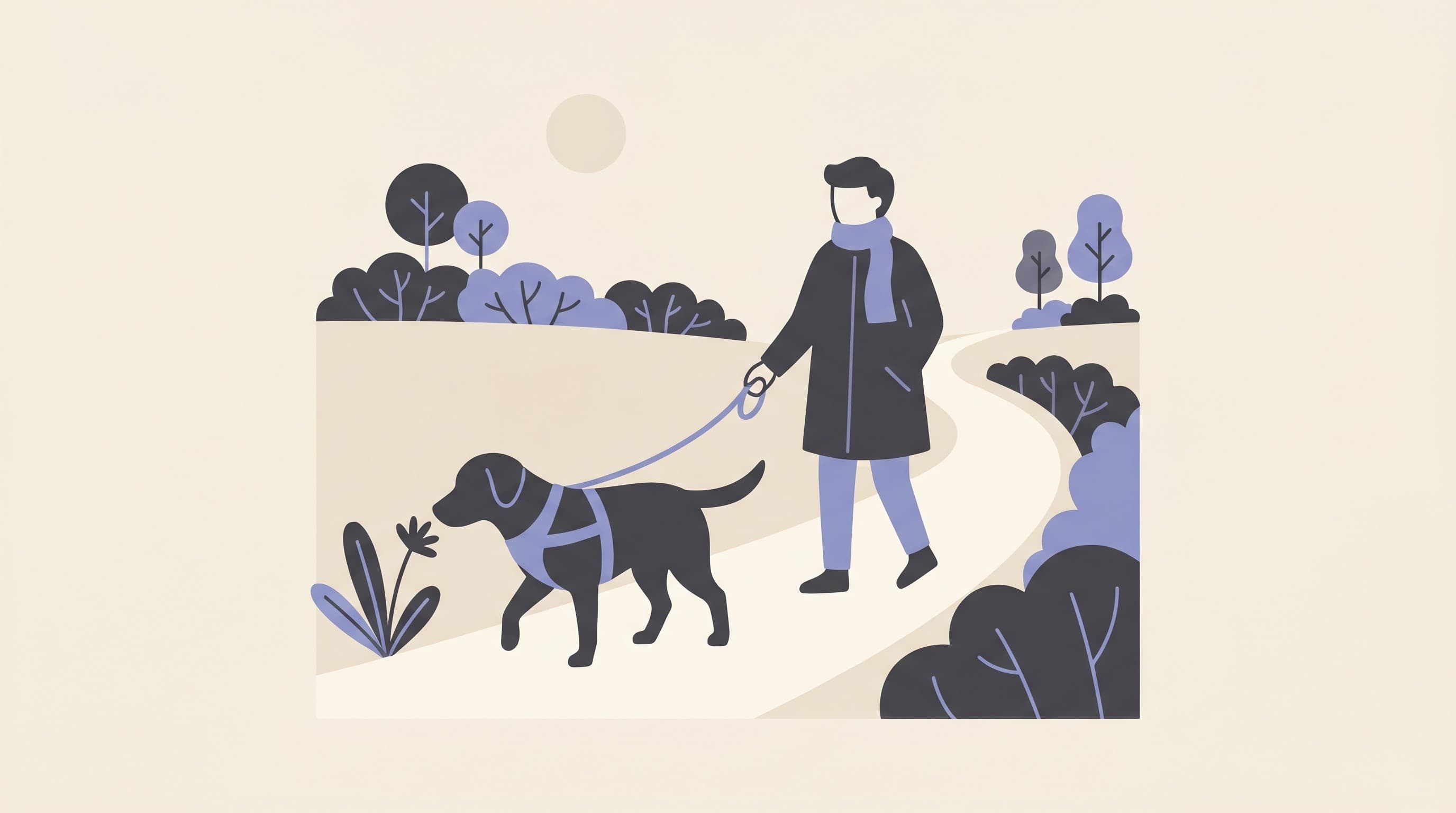
One of the first questions I'm asked, once the shock of the diagnosis has settled, is some version of "can he still go for walks?" The answer is yes, wholeheartedly. A blind dog can have a full, busy, joyful life outdoors: parks, new places, the smell of next door's barbecue, the lot. The world doesn't shrink to the size of your living room just because your dog has stopped seeing it, and with patience and a settled routine most pets adapt within a few months and get back to normal activities, walks very much included (Donohue, Texas A&M).
What changes is how you do it, not whether you do it. The balance at the heart of life outside is to keep it full and not wrap them in cotton wool, while respecting the real hazards your dog can no longer see coming. The home and the gear have their own guides; here, I want to do the outside properly.
Walks done well
The single golden rule outdoors is the lead. Keep a blind dog on a lead whenever you're out, even on familiar ground, so you can stop them walking into things or getting hurt (Patterdale, AKC). At home your dog navigates by a memorised map, but that map doesn't exist out in the world, which is why a specialist veterinary ophthalmologist calls the lead "an important safety tool," kept short "whenever outside of his/her home range" (Plummer DACVO, Vision for Animals Foundation). While you're at it, swap the collar for a well-fitted harness, which gives "somewhat more control" and lets your dog "use your body as a guide," with less strain on the neck and eyes (Plummer DACVO, Vision for Animals Foundation; Pets4Homes; Best Friends). You get close control, no yanking, and you become the steering wheel.
That doesn't mean a blind dog never gets to be off the lead. It means off-lead is for fully enclosed, secure spaces only, never open or hazardous ground: go off-lead only "when you're in an enclosed area" (Best Friends), or "if you're in a safe and securely fenced area" once you've checked it's genuinely secure (Woodgreen; Pets4Homes). A securely fenced field gives real freedom safely. An open park, a clifftop path or anywhere near a road or water does not.
Routes matter too. Familiar, low-hazard routes let a blind dog build confidence, so using the same route helps them navigate (Envision Eye Vet; Humane World), ideally one with "minimal hazards such as obstacles, uneven surfaces, or traffic" (Pets4Homes). That isn't a sentence to the same dull loop forever, since a blind dog still benefits from variety done safely (Best Friends); just walk somewhere new with them first to show them the obstacles (Patterdale, AKC; Battersea), and watch for changes on familiar ground too (Pets4Homes).
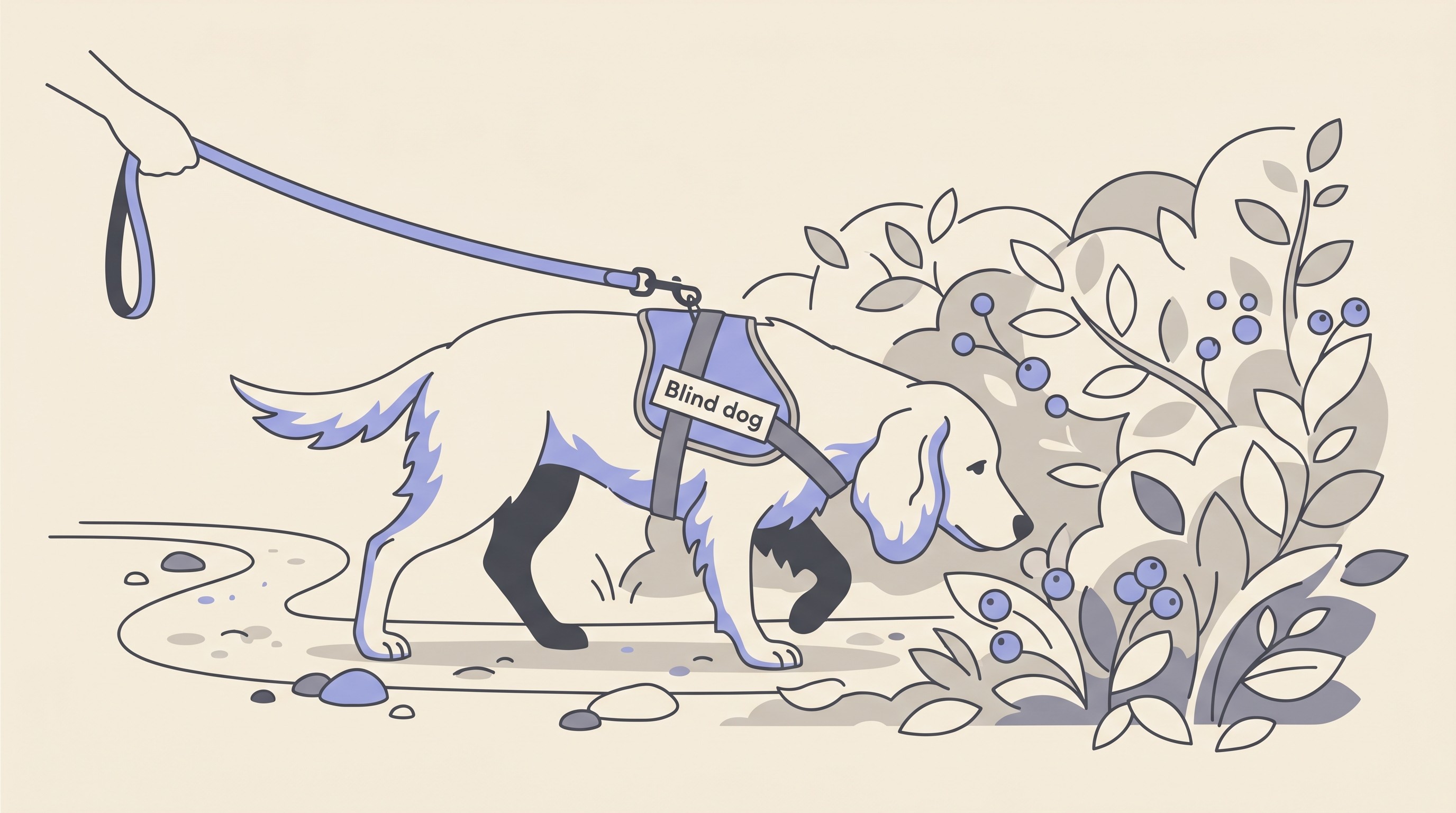
This next part turns a careful walk into a genuinely good one, so do let it stick. Let them sniff and map. A dog experiences the world largely through smell, so a sniff walk lets them explore it through their most prominent sense, and it's real mental exercise that "activates their brain" and tires a dog out much as physical exercise does (Berst VMD, Zoetis Petcare). For a blind dog, scent is now the primary way they read the world, so this isn't a nice-to-have, it's the main event: where it's safe, let them lead the way and enjoy it through their nose (Berst VMD, Zoetis Petcare). A slow, sniffy amble that covers half your old distance is not a lesser walk. For your dog, it may well be the better one.
Telling the world your dog is blind
A blind dog looks like any other dog, so a stranger reaches down to pat them or another dog barrels up to say hello, and a dog that "could easily be startled if approached without warning" (Patterdale, AKC) gets ambushed. The fix is to tell people, by signalling it visibly.
A "blind dog" lead sleeve, harness, vest, tag or bandana announces the situation before anyone gets close. The ophthalmology guidance is explicit: a tag stating "I'm blind" is a good idea, and vests and bandanas can be bought or made that say the same, because "it is important to make others aware that the pet is visually impaired" (Plummer DACVO, Vision for Animals Foundation; Envision Eye Vet). I'm deliberately not pointing you at any particular product, since the wearable gear sits with our aids and equipment guide; what matters is the why, not the brand. A useful add-on is the yellow "give me space" signal, a community-awareness convention started by the dog trainer Tara Palardy as the Yellow Dog Project, in which a yellow ribbon, sleeve or bandana asks people not to let their dog rush up without asking first (Grzyb DVM, PetMD). It isn't a formal scheme for blind dogs specifically, but a dog that startles easily and can't see another dog coming is exactly the kind of dog it's meant to protect. The catch is that it only works where the other person recognises the colour, so treat it as a back-up to, not a replacement for, explicit "blind dog" wording.
The job doesn't stop at strangers, either. The people who handle your dog need to know: your groomer, walker, boarder, sitter and the vet team all do their jobs better when they understand, and the AKC advice is specifically to inform the people who interact with your dog, such as groomers and dog walkers, because the dog could be startled if approached without warning (Patterdale, AKC). Grooming earns a special word, since the clipper is noisy and arrives out of nowhere. It's reasonable to ask your groomer to let the dog smell and hear the clipper for a moment before it touches them, to keep a steady hand on the dog so it always knows where they are, and to leave the facial whiskers alone, because a blind dog leans on those whiskers to feel its way more than a sighted one ever did. A boarded or sat dog also does best somewhere familiar, with its routine written down. The everyday cues you'll lean on, the "wait" and "step up" and "this way," are covered in talking to a blind pet.
Out there safely
Here is a short list of the real outdoor hazards, so you can respect them without becoming a bundle of nerves about every walk.
Water is the one every source flags first, and rightly. A blind dog can't see the edge of a pond, a pool, a canal or a fast river, so choose routes with water in mind and keep the lead on near any open water you can't fence off. At home, an in-ground pool or fish pond needs fencing off (Best Friends; Humane World), and the full garden setup belongs to home-proofing for a blind pet; here, just give your own garden a quick once-over for water, gaps and anything sticking out at dog height (Woodgreen). Traffic, kerbs and drops are handled by that same lead and a sensible route.
Low branches and the face. A dog at nose-height meets branches their eyes would once have spared them. If yours is prone to bumping their face, soft bumpers or protective "doggles" are an optional aid for low-branch walks (Best Friends; Pets4Homes), and the gear sits with aids and equipment.
Other dogs, the hazard owners most underestimate. Your dog can't read another dog's body language, the warning signals dogs normally trade before they interact, so they're flying blind socially as well as physically, and supervision around unfamiliar dogs is necessary (Plummer DACVO, Vision for Animals Foundation; Envision Eye Vet). Manage encounters actively: favour smaller, calmer parks and quieter times over busy ones, lean on regular meetings with familiar dogs and owners, and keep new introductions calm, letting your dog approach in their own time (Pets4Homes). Telling other dog owners your dog is blind, so they watch theirs (Pets4Homes), is where that visible "blind dog" signal earns its keep.
Keeping life full, not cotton wool
The one trap I'd steer you away from is loving your dog into a smaller life than they need. The ophthalmology guidance warns that the carer should ideally "not become a crutch," because the pet "must be allowed to negotiate the surroundings in order to learn and regain a sense of self and confidence" (Plummer DACVO, Vision for Animals Foundation). Put more bluntly: supervise and encourage, but let your pet make their own small mistakes (Envision Eye Vet). A blind dog allowed to bump a bush and recover learns the world; one carried everywhere never gets the chance. So keep up the activities they loved, adjusted as needed: many blind dogs happily return to what they enjoyed before (Patterdale, AKC), and as one veterinary specialist puts it, even after a pet goes blind she'd keep up all their favourite activities and simply adjust them (Donohue, Texas A&M). Fetch still works with a ball that rattles or smells. None of it has to go. It just gets a tweak.
The deeper emotional side of all this, the early wobble and the way confidence returns in stages, belongs to the first 30 days as a blind pet, and the bigger "is my pet happy?" question to quality of life with a blind pet. To watch your dog's confidence out and about rebuild over the weeks, the at-home vision check trends it for you, and our blind pet home and safety checklist is there to print.
A note for cats
The principles are the same for cats, but the risk outdoors is higher, so a blind cat is safest kept indoors or to a secure, supervised outdoor space, because a blind cat is easily disoriented and shouldn't be allowed to roam loose outdoors (Best Friends). That isn't a sad sentence, it's a safe one. A confident cat can still get fresh air: a harness and lead lets a willing cat enjoy the garden under supervision and doubles as a safety anchor if they spook and bolt, and a secure catio or screened space lets a cat soak up outdoor scents and sounds without the risks (Best Friends; Humane World). The deeper feline picture, how cats navigate by whiskers, use vertical space and cope in multi-cat homes, is owned by living with a blind cat.
The big life still waiting
I'd rather leave you with a real dog than a platitude. There's a blind Rat Terrier called Nikki who competes in scent work alongside fully sighted dogs and earns qualifying scores, because she "hunts purely by scent" and her blindness simply doesn't come into it. Her handler's description says it all: "stairs, new environments, new challenges are all in a day's experience for her. She has no fear of moving around and taking on new things" (Green, AKC). That's a blind dog living large.
Your dog can have a version of that, scaled to who they are. The lead and harness, the familiar routes and secure fields, the visible "blind dog" signal and the long, glorious sniff: none of it shrinks their world, it's the scaffolding that keeps it big. So pick a quiet path you both know, clip on the lead, and let that nose get to work. The walk is still there. It just smells better than ever now.
References
- Battersea Dogs & Cats Home. Blind dog care and training. battersea.org.uk (published 4 December 2023; updated 20 April 2026).
- Berst, H. E. (MA, VMD), Zoetis Petcare. Sniff Walks for Dogs: An Alternative to Scent Training. zoetispetcare.com.
- Best Friends Animal Society. Blind Dog and Blind Cat Care. bestfriends.org.
- Donohue, L. (featured), Texas A&M College of Veterinary Medicine & Biomedical Sciences (VMBS News, Pet Talk). Seeing The Bright Side: Helping Pets Adjust To Vision Loss. 4 September 2025.
- Envision More Veterinary Ophthalmology. What Disability? How to Help Your Blind Pet Live a Fulfilling Life. envisioneyevet.com.
- Green, R., American Kennel Club (AKC). Blind Dog Is Totally Focused When It Comes to Scent Work. akc.org.
- Grzyb, K. (DVM, reviewer), PetMD. What Does a Yellow Ribbon on a Dog Mean? petmd.com (reviewed for accuracy 12 March 2019).
- Humane World for Animals (formerly The Humane Society of the United States). How to care for and train blind dogs or cats. humaneworld.org.
- Patterdale, S. (CPDT-KA, CTDI), American Kennel Club (AKC). Supporting a Blind Dog: How to Help Them Adjust. akc.org (updated 27 April 2026).
- Pets4Homes (UK). Safely walking and socialising a blind dog: Expert tips. pets4homes.co.uk (25 March 2026).
- Plummer, C. E. (DVM, Diplomate ACVO), reviewed by Pike, A. L. (DVM, Diplomate ACVB). Caring for a Blind Pet. Vision for Animals Foundation (visionforanimals.org).
- Woodgreen Pets Charity (UK). Caring for your blind dog. woodgreen.org.uk.
Keep track of how your pet is doing
The owners who cope best are the ones who notice changes early. A simple health log shows you what is working, and what is not, before the next vet visit.
Start tracking, freeYou're not doing this alone
Compare treatment journeys and talk to owners managing vision & eye health. Free to join.
Join PetsLikeMine