

Home-Proofing for a Blind or Low-Vision Pet
Alastair Greenway
BVM&S MRCVS
The diagnosis is settled, your dog or cat is losing its sight, and now you're home with the practical question: what do you actually do here? This is my favourite part to answer, because it's the part you control. The diagnosis was out of your hands. The home isn't. With a weekend of small, sensible changes you can turn an ordinary house into a place a blind pet moves through with real confidence.
And they do adapt. Let me say that plainly before anything else, because the internet will have already frightened you. Pets rely on sight far less than we do, and most adjust remarkably well, usually finding their feet within about six to eight weeks and getting much of their old confidence back over the following few months (Donohue, Texas A&M VMBS, 2025). The college of veterinary ophthalmologists puts it well: some pets take weeks to settle and a few never skip a beat, but the great majority adjust remarkably well (ACVO). It takes patience and a bit of work, and there may be grief mixed in. But the destination is good, and what you set up at home is most of how you get there.
This is the practical article. It assumes the diagnosis is settled and does a single job: making your home safe to navigate and easy to learn. The emotional side of the first few weeks lives in the first 30 days, and the human-voice side, how to talk to a pet who can't see you coming, is its own piece, communicating with a blind pet. Here, we're proofing the building.
Don't move the furniture
A blind pet isn't navigating moment to moment by smell alone. It's working from a memorised map of your home, a mental floor plan built from memory, scent and sound, and it gets astonishingly good at moving around once that map has set (Donohue, Texas A&M VMBS, 2025). The whole of home-proofing flows from protecting that map.
Which makes the golden rule simple to state and surprisingly hard to keep: leave the furniture where it is. Keep your furniture in the same place so your dog can get used to where everything is (Dogs Trust). A sofa shifted half a metre, a chair pulled out and not pushed back, a bag dropped just inside the door, any of these becomes a collision your pet never saw coming, and collisions don't just bruise a shin, they dent confidence (Best Friends Animal Society). So the rule has a second half: keep the floor clear of clutter on the routes your pet uses. Pick up shoes and toys from the common pathways (Holmberg, DACVO), and don't leave obstructions on the floor (Best Friends Animal Society).
Someone always asks: what if I genuinely have to move something, or we're moving house? You can, and your pet will recover, but do it kindly. Move only one piece at a time, so the map updates gradually rather than all at once (Humane World for Animals). And resist the bigger urge entirely: a new diagnosis is not the moment to redecorate or rotate the furniture round (AAHA; International Cat Care). The kindest environment for a pet learning to live without sight is a stable, predictable one (Dogs Trust).
One companion rule belongs to the talking side of all this, so I'll state it once and hand it on: announce yourself before you touch a blind pet, with your voice or a gentle nudge of the bed, so you never startle them out of nowhere (Humane World for Animals; Hohenhaus, AMC). A startled blind pet can snap or bolt, not from temper but from fright. The full vocabulary for this is covered in communicating with a blind pet.
Set up a home base, then guide with texture
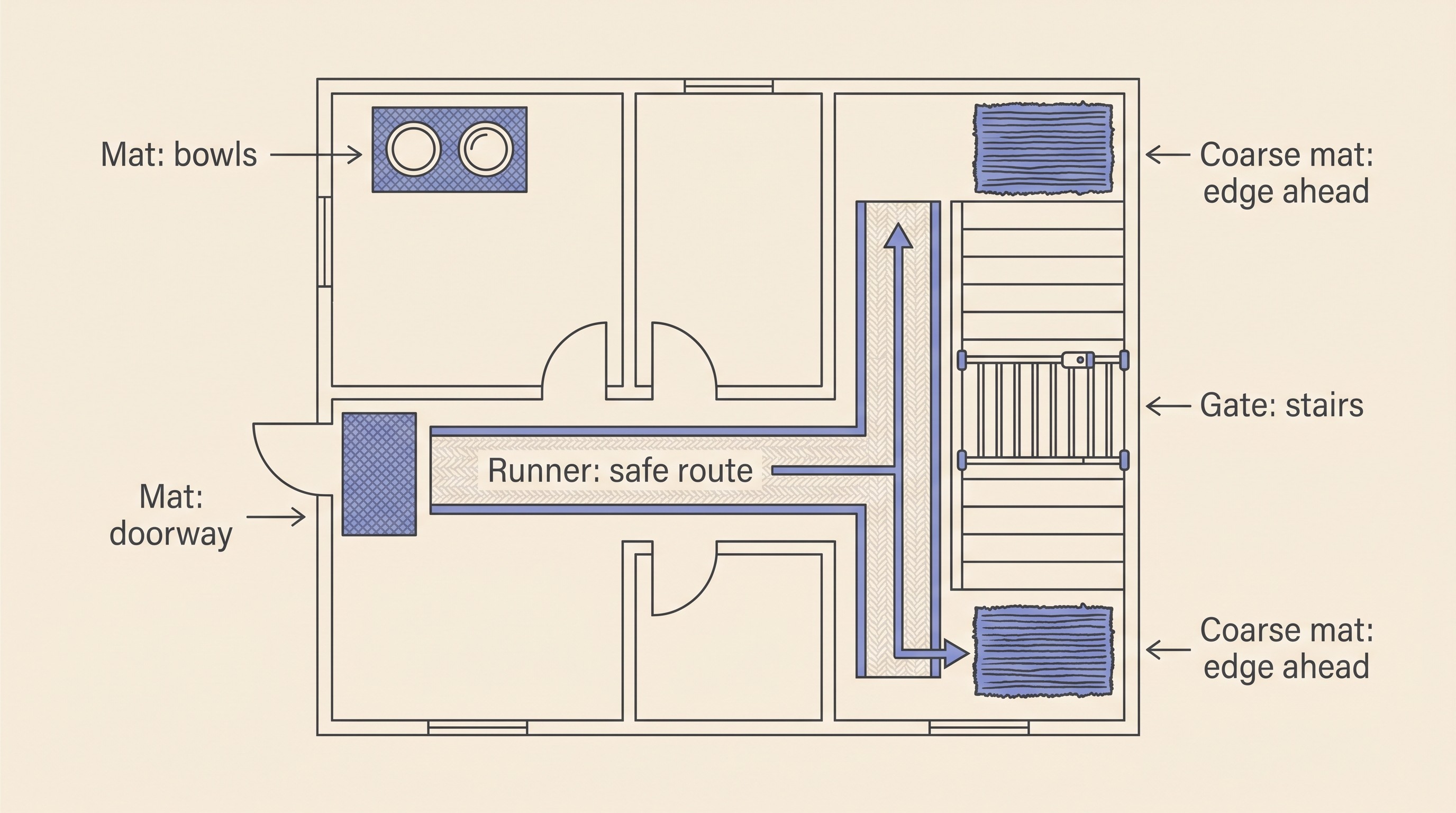
The first things to fix in place are the essentials. Keep the food and water bowls, the bed and, for cats, the litter tray in set locations. This gives your pet a "home base", a few known anchor points it can always relocate to, so if it does get briefly disorientated, re-orientation is much easier (ACVO; AAHA). For cats especially, keep food, water, litter and a comfortable bed easy to reach and exactly where they've always been (International Cat Care).
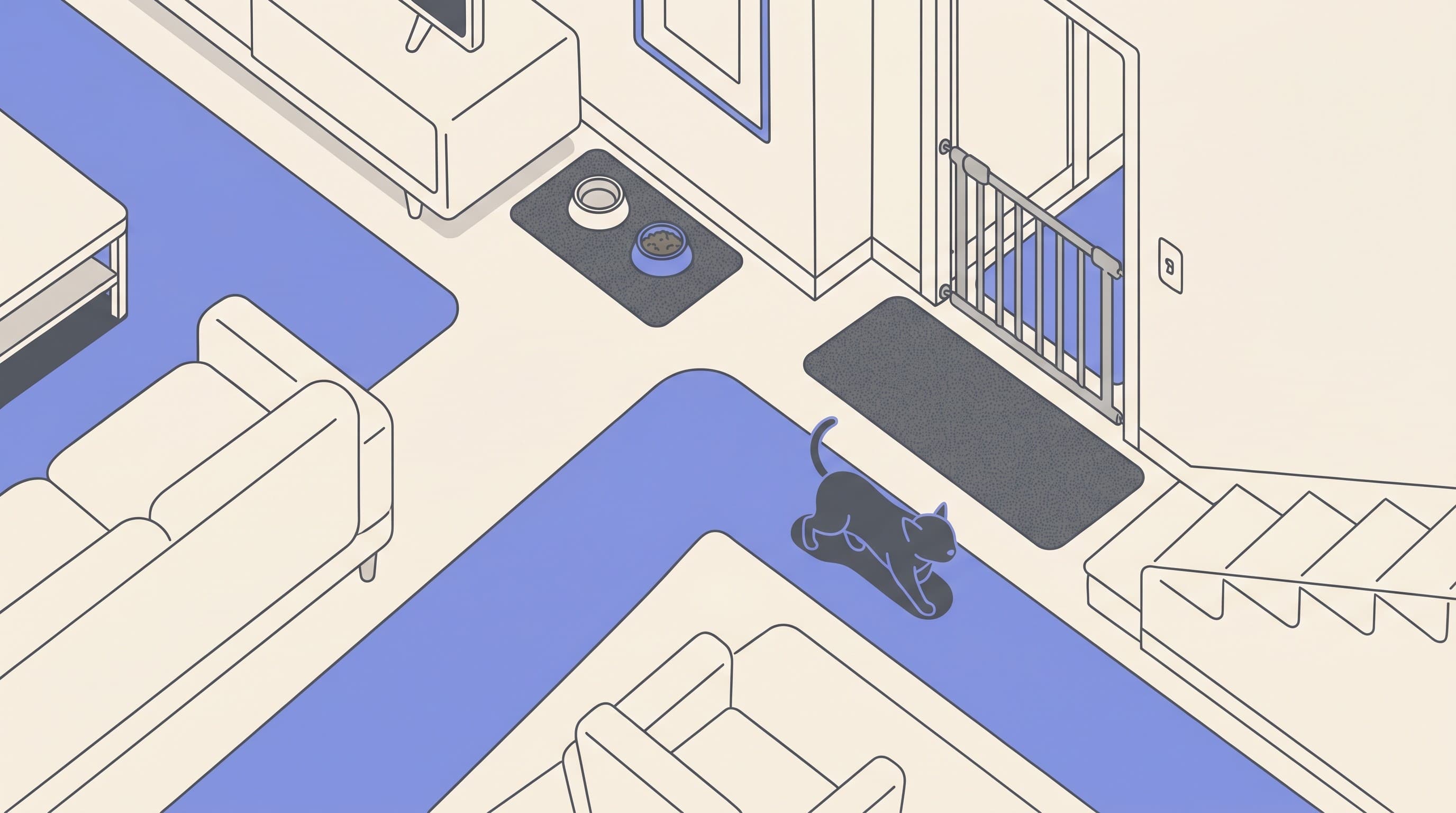
Now the single most useful trick, and the one almost nobody mentions: build a navigation system out of texture. Your pet reads the floor through its paws, so different surfaces become signposts. Lay carpet runners along the routes you want your pet to use and they become felt pathways, guiding the pet through safe areas because it can feel the rug underfoot (Best Friends Animal Society; Holmberg, DACVO). Put a textured mat or rug under each food and water bowl and in front of the litter tray, and the bowl announces itself by a change in texture before your pet reaches it (Best Friends Animal Society; Humane World for Animals). Place mats at the entrances and exits of rooms so your pet learns to feel for these doorways with its feet (Dogs Trust), and add a throw rug near the sofa so the texture reminds your pet where the furniture is (Humane World for Animals).
The most valuable place for texture, though, is the stairs. A distinct, coarse mat at the very top and bottom of a staircase gives a clear underfoot warning, an "edge ahead, careful here" cue a pet can feel before it commits a paw to a drop. Cats build the same kind of map from surfaces, leaning on the difference between, say, carpet and tile to tell one part of the home from another (ACVO).
Scent and sound: extra landmarks
Texture tells your pet where the floor changes. Scent and sound fill in the rest.
A light, pet-safe scent can turn a doorway, room or hazard into a smellable landmark. The trick is to use one scent consistently for "this way, safe" and a different one for a place to be careful, and to give different rooms their own faint signature (Best Friends Animal Society). A genuinely useful application is to dab a little scent on the legs of the furniture your pet keeps clipping, so it learns that corner is coming (Holmberg, DACVO; MedVet), and a different scent at the top of the stairs versus the bottom helps a pet tell which end it's at (Holmberg, DACVO). You can also add a scent to a favourite toy or a particular area to aid navigation (ACVO; AAHA).
One caution, because this is where well-meaning advice tips over: keep it light and pet-safe. The sources name everyday scents like vanilla, citrus or pine as examples (Best Friends Animal Society), but those are examples, not a clinically tested prescription, so treat them as a faint dab at nose height rather than a perfumed house. Cats especially live by their noses and a heavy scent can overwhelm rather than guide. The aim is a hint your pet can choose to read, not a fog it can't escape.
Sound works the same way, as landmarks and trackers. The classic tip is to attach a small bell to your own shoe or trouser leg, and to the collar of any other pet in the house, so your blind pet can follow you around and won't be ambushed by a housemate it didn't hear coming (Best Friends Animal Society; MedVet). Wind chimes by an exterior door help steer a pet toward the right threshold (Humane World for Animals), and toys that squeak or chirp give a blind pet something to find and play with by ear (ACVO; Best Friends Animal Society). One cue catches a lot of people out: constant background noise from fans and air conditioners can mask the very sounds your blind pet navigates by, so give them quiet when they're finding their way (Hohenhaus, AMC). For how your voice becomes your pet's main beacon, see communicating with a blind pet.
Hazard-proofing the danger points
Most of a blind pet's home is simply learnable. A few parts can hurt, and those are where you spend your safety effort.
Stairs come first. An unguarded staircase is the commonest serious hazard indoors. Fit a baby gate across the doorway leading to steps, top and ideally bottom, while your pet is still learning the layout, exactly as you would for a toddler (Best Friends Animal Society; ACVO; AAHA). Pair the gate with that coarse mat cue and you've turned the most dangerous feature in the house into a manageable one.
Sharp corners. Coffee tables, hearth edges and the corners of low units sit at exactly head height for a dog learning a room. Pad them with soft packing material or bubble wrap during the learning phase (Dogs Trust; Best Friends Animal Society). It looks daft for a few weeks. It saves a sore face.
Water is the standout outdoor danger, and it earns its own rule: never leave a blind pet unattended near a pool, pond, lake or any drop. Blind animals shouldn't be left unsupervised around bodies of water or near cliffs and edges (ACVO). If you have a garden pool or a wildlife pond, fence it off or cover it (Humane World for Animals; MedVet; AKC). Keep the garden routes clear too, removing protruding branches and anything a pet could walk into (Humane World for Animals).
For the learning weeks, a wearable bumper aid, the padded hoop that sits around a pet's head and meets an obstacle before the face does, can take the sting out of the inevitable early bumps and is a sensible option (AAHA; AKC). I'll name it once, because which aid, and whether you need one at all, is covered neutrally in halos and other aids.
Out in new or open spaces the memorised map doesn't exist yet, so the rules change. Keep a blind dog on a lead in unfamiliar places, which cuts the risk of it getting hurt, lost or confused (Dogs Trust), and when you introduce somewhere new, walk your dog carefully around it to show them the obstacles (AKC). In your own garden you can extend the texture idea outdoors, using tactile paths of mulch, bark chips, sand or landscaping stone to mark routes and edge off the parts you'd rather they avoided (Best Friends Animal Society; Humane World for Animals). The wider world beyond the gate, proper walks and telling other people, is handled in out and about with a blind pet.
A few things not to do
Two well-intentioned instincts actually make life harder for a blind pet. The first is carrying them everywhere. It feels protective, but it robs your pet of the chance to walk and rehearse the very map it needs, and being set down in an unexpected spot can leave it disorientated. Let your pet walk where it safely can, and set it down only in familiar places (Best Friends Animal Society; Williams, VIN). The second is redecorating. The urge to "make things nicer" for a pet that's struggling is understandable and almost always counterproductive while the map is still setting (International Cat Care; AAHA). The genuinely kind move is the boring one, a stable home and a predictable daily routine, which is exactly what a blind pet needs to feel secure (Dogs Trust).
A note for cat owners
Most of the above reads dog-first, but it all applies to cats, with a few feline twists worth getting right.
Cats navigate up as well as along. They route onto sofas, beds, windowsills and shelves, so keep the approaches to their favoured high spots stable, and don't be surprised if a blind cat starts climbing rather than leaping, feeling its way up to a height it remembers (Best Friends Animal Society). Whiskers matter enormously: they're a primary navigation tool, letting a cat sense an object before it bumps into it, so they must never be trimmed (Best Friends Animal Society; International Cat Care). For the same reason, many feline charities suggest a wide, shallow food bowl so a blind cat can reach its food without pressing those sensitive whiskers against the sides; it's a small, cheap change some cats clearly prefer, and easy to try. Keep a blind cat indoors or closely supervised, and resist picking it up unnecessarily, for the same map-walking reason as dogs (Best Friends Animal Society; International Cat Care). The encouraging part is that cats are often the quickest of all to adapt, leaning so smoothly on smell, hearing and those whiskers that usually very little needs doing to help them (International Cat Care). The deeper feline guide, vertical navigation and multi-cat households in full, is blind cats.
Keep their world rich, not just safe
Where I'd actually leave you is on this, because home-proofing is about confidence at least as much as safety. A blind pet doesn't need a padded, shrunken life. It needs a world it can read, and then it needs that world to stay interesting.
So keep up your pet's favourite activities, just adapted (Donohue, Texas A&M VMBS, 2025). Scent-tracking games, hiding a few treats around a familiar room for your pet to sniff out, make brilliant enrichment that needs no eyesight at all (Humane World for Animals). A game of tug requires no vision whatsoever, and fetch works perfectly well with a scented or noisy ball thrown on a clear, level patch of ground (Holmberg, DACVO). These aren't consolation games. They're how a blind pet stays mentally sharp, engaged and like itself.
The single best thing you can do next is make the changes concrete, room by room, this weekend. We've put together a room-by-room home checklist you can print and work through so nothing gets missed, and as your pet settles you can track its recovering navigation over time with the at-home vision check. If you want the wider reassurance that a blind pet can have a genuinely good life, blind pet quality of life takes that question on squarely. Most pets, given a stable home and a few weeks, find their feet and get on with the business of being a dog or a cat. Your job is mostly to hold the map steady and keep the world worth exploring, and that is very doable indeed.
References
- American Animal Hospital Association (AAHA); Vahrenwald, M. K. Living with a Blind or Deaf Pet: Tips from the Vet. AAHA.
- American College of Veterinary Ophthalmologists (ACVO). Tips on Adjusting to Your Pet's Blindness. ACVO Public.
- American Kennel Club (AKC); Patterdale, S. Supporting a Blind Dog: How to Help Them Adjust. AKC Expert Advice.
- Best Friends Animal Society. Blind Dog and Blind Cat Care.
- Dogs Trust. Tips for Owning a Deaf or Blind Dog. Dog Advice.
- Donohue, L. (featured). Seeing the Bright Side: Helping Pets Adjust to Vision Loss. Texas A&M College of Veterinary Medicine & Biomedical Sciences (VMBS News, Pet Talk), 4 September 2025.
- Hohenhaus, A. E. Caring for Blind Pets: Tips and Resources for Dog and Cat Owners. The Animal Medical Center (AMC), New York, 31 July 2024.
- Holmberg, B. J. Management of a Blind Dog. bradholmberg.com.
- Humane World for Animals (formerly The Humane Society of the United States). How to Care for and Train Blind Dogs or Cats.
- International Cat Care (iCatCare). Blindness in Cats.
- MedVet. Caring for Your Blind Pet: Nine Tips to Improve Their Quality of Life. MedVet Team, 21 February 2024.
- Williams, K. (and VIN editorial). Living With Blind Dogs and Cats. VIN Veterinary Partner.
Keep track of how your pet is doing
The owners who cope best are the ones who notice changes early. A simple health log shows you what is working, and what is not, before the next vet visit.
Start tracking, freeYou're not doing this alone
Compare treatment journeys and talk to owners managing vision & eye health. Free to join.
Join PetsLikeMine