

Blind Cats: Why They Often Cope Brilliantly
Alastair Greenway
BVM&S MRCVS
Here's the one sentence I most want a worried cat owner to hear, because it tends to get buried under the panic. A blind cat can live a full, happy, ordinary life, and most do. The UK charities that see thousands of these cats say it plainly: "blind cats can live a full life and still make excellent pets and companions" (Cats Protection, n.d.), and most cats "adapt really well and continue to live happy lives" after losing their sight (PDSA, n.d.). A referral ophthalmologist puts it the same way: "blind dogs and cats can continue to live full, happy lives" (Donohue, 2025). If someone has already told you the kindest thing is to put a newly blind cat to sleep, please don't let that be the last word. For the great majority of cats, it isn't true.
I'd rather explain why it's true than just reassure you, because once you understand how a cat reads its world, the good news stops sounding like a platitude. Cats are unusually well-built to manage without sight, in some ways better-built than dogs, and the job you have, while real, is smaller than you'd fear.
Why cats cope so well
Start with what surprises people most: cats never relied on their eyes the way we rely on ours. The feline eye is a superb low-light motion detector, not a high-definition camera, so a cat reads movement and shape brilliantly in near-darkness but was never reading the small print (the full physiology lives in how pets see). When a cat loses its sight, it loses a sense it leaned on less heavily than a person would, which is much of why the adjustment goes so smoothly.
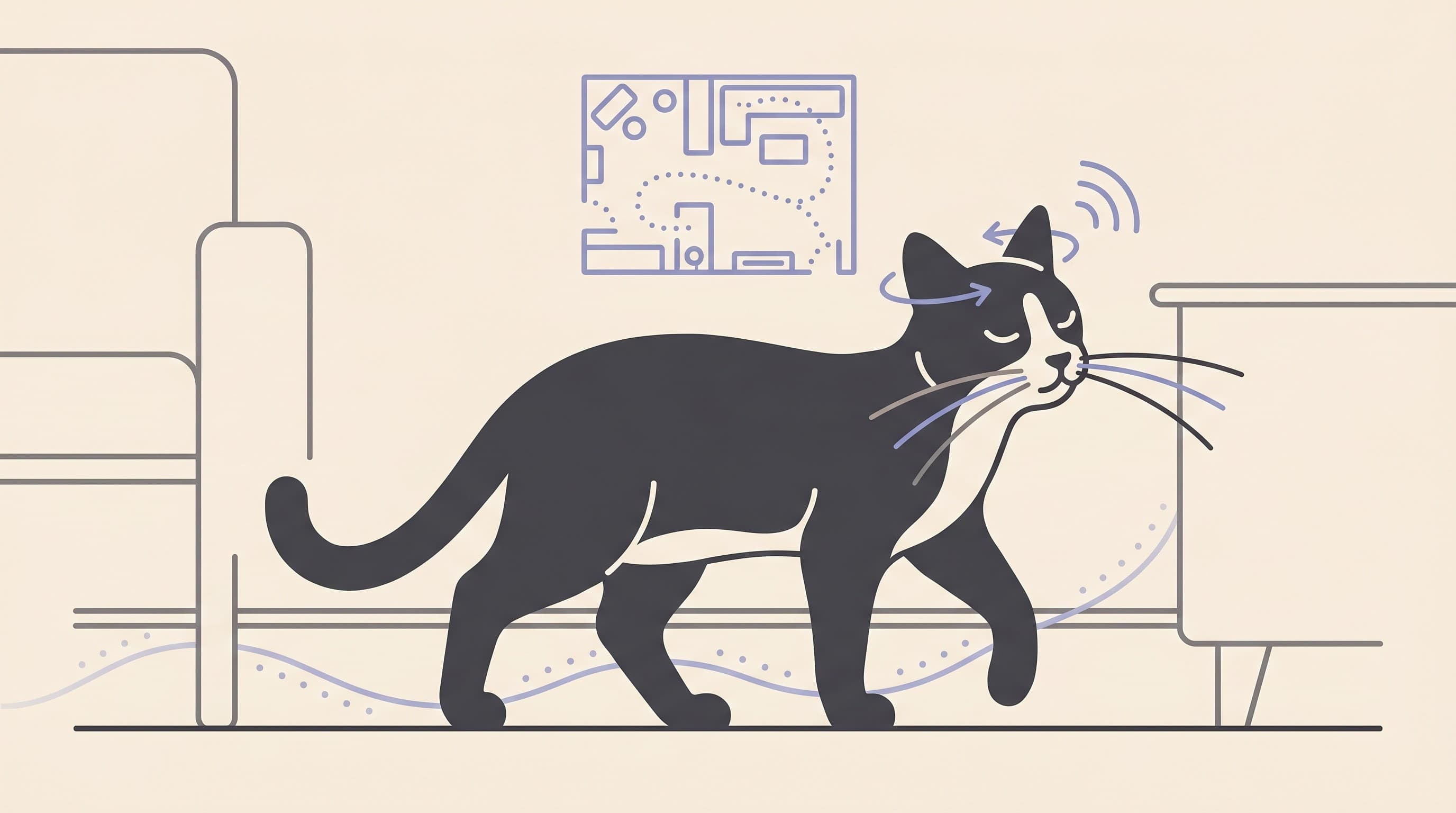
Then there are the whiskers, the single most reassuring, most cat-specific fact I can give you. A peer-reviewed analysis of whisker physiology states that the role of facial vibrissae in mammals is "principally as a supplement or substitute for short-distance vision," with neural processing that allows "high accuracy discriminations of object distance, direction, and surface texture" (Williams and Kramer, 2010). For a cat that has lost its eyes, that short-distance sense is doing more of the work than ever. The long muzzle whiskers roughly span the width of the cat's own body, a built-in gauge for whether a gap is wide enough to slip through, which is why a blind cat will often pause at a doorway, take a read, and slide through cleanly. Owner guidance agrees: cats "use their whiskers to judge distance" (Cats Protection, n.d.) and "to prevent bumping into objects" (International Cat Care, n.d.). One caveat, because the internet overstates this: whiskers are not echolocation and not sonar. They map the world by direct touch and by reading air currents, the slight shift in airflow as the cat nears a wall. That's remarkable enough without the myth.
Scent and sound make up the third pillar. Cats have excellent smell and hearing and lean harder on both when sight fades (International Cat Care, n.d.; PDSA, n.d.). The scent glands in a cat's paws lay down a faint, invisible trail as it walks, letting it "leave a trail of scent that they can follow" to keep familiar ground familiar (Cats Protection, n.d.). That's the real reason behind a piece of advice that surprises owners: let a blind cat walk rather than carrying it everywhere. Lifting and carrying your cat resets its starting point and bypasses that trail, so it has to re-find its bearings. Walking keeps the map intact.
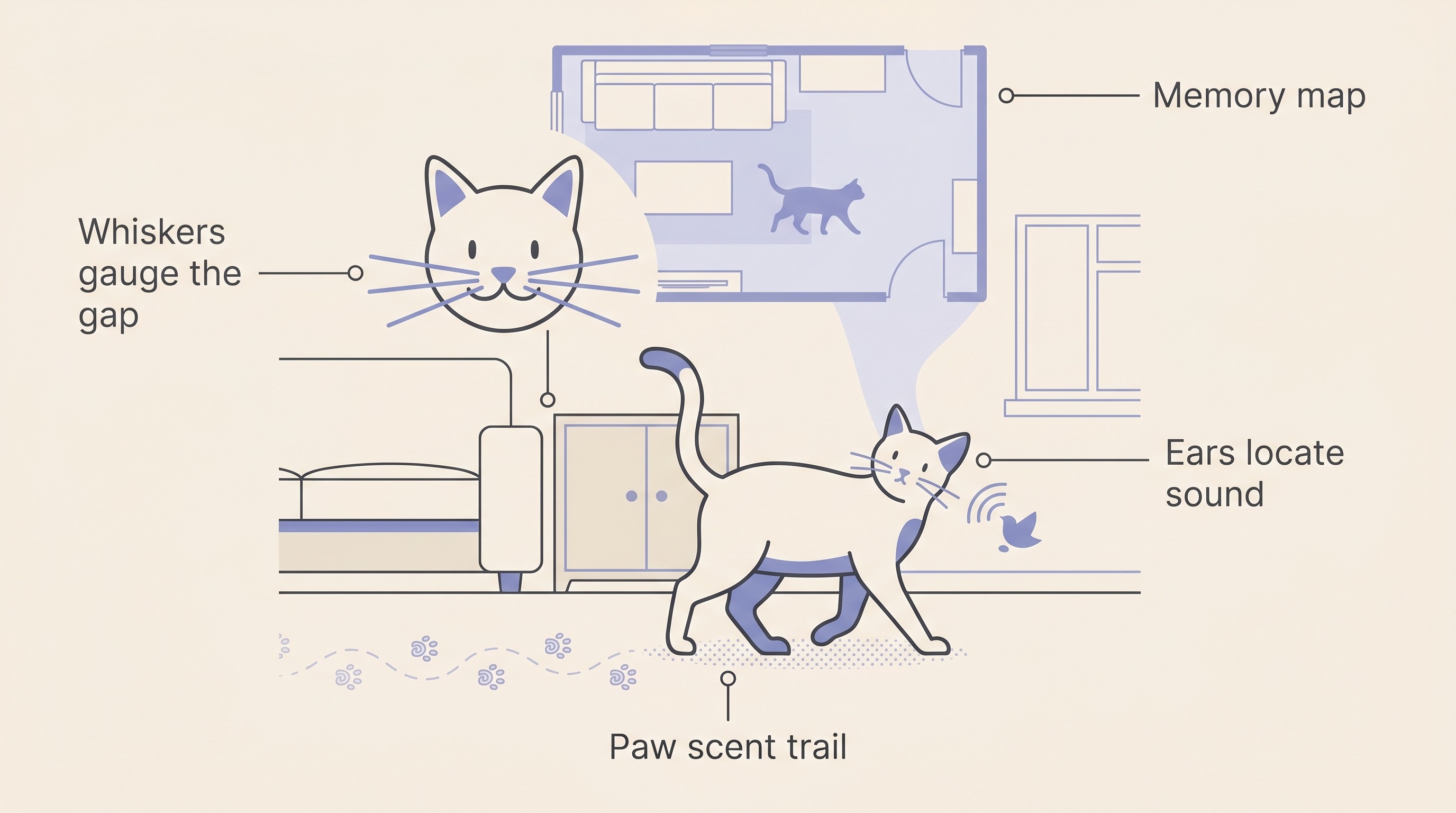
That memory map is the thread running through everything that follows, and it leads to the single most important instruction.
Don't move the furniture, and talk before you touch
A blind cat navigates a familiar room from memory, and the rule that follows is the kindest and the easiest you'll read here: keep the layout fixed. As the ophthalmologist puts it, "don't move around your furniture much, because your pet will make a mental map and be able to navigate through things very well once they get adjusted" (Donohue, 2025). The charities say the same in their own words: "avoid moving furniture, toys and litter trays" (Cats Protection, n.d.); "keep their litter trays, food, and water bowls in the same places" (PDSA, n.d.).
I'd single out the litter tray, because a misplaced tray is one of the few things that turns a coping cat into a distressed one. A blind cat that "can't find" its toilet isn't being difficult, it's been moved off its map. Keep the tray, food, water and bed in exactly the same spots, and resist tidying them into "better" places. Trailing cables, new furniture in a walkway, a bag dropped at the bottom of the stairs: those are the real hazards, because they appear on a route the cat thought it knew. Any change you must make, make gradually.
The companion rule is talk before you touch. With sight gone and hearing doing more of the work, a blind cat startles easily, so announce yourself. International Cat Care advises never to sneak up on or suddenly touch a sleeping blind cat, but to talk softly so it knows you are there, and to avoid stomping and slamming doors, because hearing is often heightened when vision is impaired (International Cat Care, n.d.). The vet advice matches: "make noise when you approach them so that they can hear you coming, especially if they are sleeping" (Donohue, 2025); "when you approach your cat, talk to them to avoid startling them" (Cats Protection, n.d.). Get the whole household into the habit, children most of all, because a startled cat that lashes out is frightened, not aggressive. The full vocabulary, and how to settle a sighted companion alongside, is covered in communicating with a blind pet. Here the headline is enough: keep the map fixed, and use your voice.
Where cat advice parts ways from dog advice
This is where a blind cat genuinely differs from a blind dog, and where transplanted dog advice falls short.
Cats live in three dimensions, and that's the first difference. Beds on the wardrobe, cat trees, windowsills, the banister: a cat's world goes up, and a blind cat can misjudge a height or a landing in a way a floor-bound dog never has to. The answer isn't to ban climbing. Many blind cats keep leaping and climbing with real confidence along familiar, unchanged routes, because whiskers and memory carry them. The answer is consistency plus sensible caution at genuine drops: keep cat-tree and shelf layouts as fixed as the floor furniture, and be careful around balconies, stairwells and open upstairs windows. The charities are blunt about one habit: "beware of lifting your blind cat onto raised surfaces in case they fall" (Cats Protection, n.d.), because a cat placed somewhere it didn't climb to has no map of how to get down. This vertical dimension is the biggest reason a blind cat needs slightly different proofing from a blind dog. The general room-by-room system, textured mats, scent markers and hazard-proofing, lives in home-proofing a blind pet, with the blind-pet home checklist as a companion.
The second point is harder, and I'll be honest about it: a blind cat is usually safest kept indoors. A cat that can't see can't spot and flee a car, a dog or a hostile cat, and can't easily find its way home if it strays. UK guidance is clear: "keep your blind cat indoors, ensuring they have access to a safely-fenced garden or run if necessary. Making sure they are microchipped is essential" (Cats Protection, n.d.); "keeping your blind cat indoors will ensure they avoid any outdoor dangers" (PDSA, n.d.). For a cat that has always roamed, this is a real loss and I won't pretend it costs nothing, but the outdoor risk is genuine, and a well-enriched indoor life can be a good one. A secure garden or an enclosed run, a "catio", is a lovely middle path where it's possible. Microchipping has been a legal requirement for owned cats in England since 10 June 2024, so most readers will already be covered, and it is the one thing that brings a strayed cat home.
Building a rich indoor life
An indoor blind cat still needs a full, interesting life, and we don't have to guess at how to provide one. The gold-standard framework, the AAFP and ISFM Feline Environmental Needs Guidelines, sets out five "pillars" of a healthy cat environment, and every one maps neatly onto blind-cat care (Ellis et al., 2013): a safe place to retreat to; multiple and separated key resources (food, water, toileting, scratching, rest and play); the chance to play and express predatory behaviour; positive, consistent, predictable interaction with people; and an environment that respects the cat's sense of smell. In practice that means a predictable safe base it can always find, resources in fixed and separate spots, play through sound and scent (toys that rustle, a wand toy dragged so it can be heard, catnip, puzzle feeders that turn dinner into a hunt), and not flooding the house with strong cleaning smells that scrub away its scent landmarks. Cats Protection echoes the play pillar, advising owners to "keep things interesting with toys and puzzle feeders to keep boredom at bay" (Cats Protection, n.d.). The point isn't to do more, it's to do the right things.
In a multi-cat home, the same thinking earns its keep again. A blind cat can't read the others, no returning stare, no slow blink, no turn-away to signal "back off", and it can't easily tell when a housemate has gone tense, so a little friction is common and it usually isn't anyone's fault. The fix is the "multiple and separated resources" pillar applied with extra care: enough food stations, water points and litter trays in separate places, so the blind cat never has to run a gauntlet past a tetchy companion to eat or toilet (Ellis et al., 2013). The other widely-recommended measures are sensible rather than evidence-heavy: feed the cats apart, and consider a soft bell on a sighted companion so the blind cat can hear it coming. For real, persistent tension a qualified behaviourist beats a forum thread.
One medical caveat: sudden blindness is different
Almost everything above is about a cat that has lost its sight gradually and coped, which is the usual story. Cats Protection notes that for most cats "loss of sight is very gradual" and many owners "aren't aware of how bad their pet's eyesight has become until they are checked over by a vet" (Cats Protection, n.d.).
But there's one exception you must know, and it's urgent. If your cat goes blind suddenly, over hours or a day or two, bumping into things, disoriented, often with wide pupils that don't shrink in bright light, that is not a "give it time" situation. It's most often an emergency. The commonest cause is a retina detached by very high blood pressure, usually driven by kidney disease or an overactive thyroid, and it needs the blood pressure checked today, because caught quickly it can sometimes be treated and some sight restored. Cornell's specialists are exact: "ocular problems are the most common target organ injury seen in cats with hypertension, ranging from retinal detachment causing blindness to more subtle signs," and the links to underlying disease run deep, with "at least 60% of cats diagnosed with hypertension also" showing signs of CKD and "about 20% of cats diagnosed with hyperthyroidism" being "diagnosed with hypertension as well" (Cornell Feline Health Center, n.d.). The hopeful part is that the drug amlodipine "may allow a retina to reattach itself, and the cat can get some of its vision back" if treatment starts early (Cornell Feline Health Center, n.d.). The full feline sudden-blindness story lives in your cat's gone blind suddenly: check the blood pressure today, and if you're unsure how urgent the signs are, the eye-emergency triage tool will help. The one thing not to do with sudden feline blindness is wait and see.
What adaptation actually looks like
What you should expect depends on whether the loss was gradual or sudden, and both paths are normal. A gradually-blind cat has often done most of its adjusting before you even noticed, which is why the loss took you by surprise. Cornell describes these cats as seeming to "realize that something has been going on for quite a while," coping quietly, "more relaxed, albeit blind" (Cornell Feline Health Center, n.d.). A suddenly-blinded cat is a harder first picture: Cornell describes recently-blinded cats as appearing "very confused, bewildered, and fearful," sometimes simply freezing in place rather than running or shying away (Cornell Feline Health Center, n.d.). That is not a sign of a bad outcome, it's a normal early stage. With a stable home and patience, the fearful fortnight passes, and "most pets adapt within a few months and resume normal activities" (Donohue, 2025).
Your part is small but it genuinely matters: keep the map fixed, announce yourself, make the home safe (heights and outdoors above all), and keep life enriched. The emotional side, the grief and guilt and the early dip, deserves more room than I've given it and has its own home in the newly blind pet: the first 30 days. And if you find yourself quietly asking the bigger question, is my cat actually happy, or am I keeping it going for me, that's fair and important, and a blind pet's quality of life is written to help you weigh it calmly rather than in a panic.
What I can tell you is what I've watched happen again and again, in cats whose owners were once as frightened as you might be now. They find the litter tray. They climb their favourite chair by the route they always took. They come for a fuss at the sound of your voice, chase a rustling toy across the floor, and sleep in their patch of sun. To keep an eye on how your cat is getting on over the coming months, the at-home vision check gives you a simple, repeatable way to track its confidence and flag any change worth a vet's attention. Keep the world steady around your cat, and far more often than not, it will get on with the business of being a cat.
References
- Cats Protection (UK). "Blind cats." Cats Protection Help and Advice, Health, Disabled cats.
- Cornell University College of Veterinary Medicine, Cornell Feline Health Center. "Hypertension (High Blood Pressure in Cats)." Feline Health Topics.
- Cornell University College of Veterinary Medicine, Cornell Feline Health Center. "Sudden Blindness" (featuring Thomas Kern, DVM). Feline Health Topics.
- Donohue, L. (2025). "Seeing The Bright Side: Helping Pets Adjust To Vision Loss." Pet Talk, Texas A&M University School of Veterinary Medicine and Biomedical Sciences, 4 September 2025.
- Ellis, S. L. H., Rodan, I., Carney, H. C., Heath, S., Rochlitz, I., Shearburn, L. D., Sundahl, E., & Westropp, J. L. (2013). AAFP and ISFM Feline Environmental Needs Guidelines. Journal of Feline Medicine and Surgery, 15(3), 219-230.
- International Cat Care (iCatCare). "Blindness in cats."
- PDSA (People's Dispensary for Sick Animals). "Blindness in cats." PDSA Pet Health Hub.
- Williams, C. M., & Kramer, E. M. (2010). The Advantages of a Tapered Whisker. PLoS ONE, 5(1), e8806.
Keep track of how your pet is doing
The owners who cope best are the ones who notice changes early. A simple health log shows you what is working, and what is not, before the next vet visit.
Start tracking, freeYou're not doing this alone
Compare treatment journeys and talk to owners managing vision & eye health. Free to join.
Join PetsLikeMine