

How Sight Works in Dogs and Cats (and How It Differs From Ours)
Alastair Greenway
BVM&S MRCVS
I've spent more than twenty years looking into the eyes of dogs and cats, and they still amaze me. Not because they see better than we do, because in most of the ways we tend to value sight, they don't. They amaze me because they see the world so differently, and because the eye turns out to be only one of the instruments they use to find their way around. Once you understand how your pet actually sees, the everyday stuff makes more sense, like why the dog ignores the still rabbit and explodes after it the instant it bolts. There's something gentler in it too: it's the reason so many pets cope far better with failing sight than their owners ever expect.
For once, this is a piece with no emergency in it. Let me show you the world through your pet's eyes, and then why those eyes matter a little less to them than yours do to you.
A world built from blues and yellows
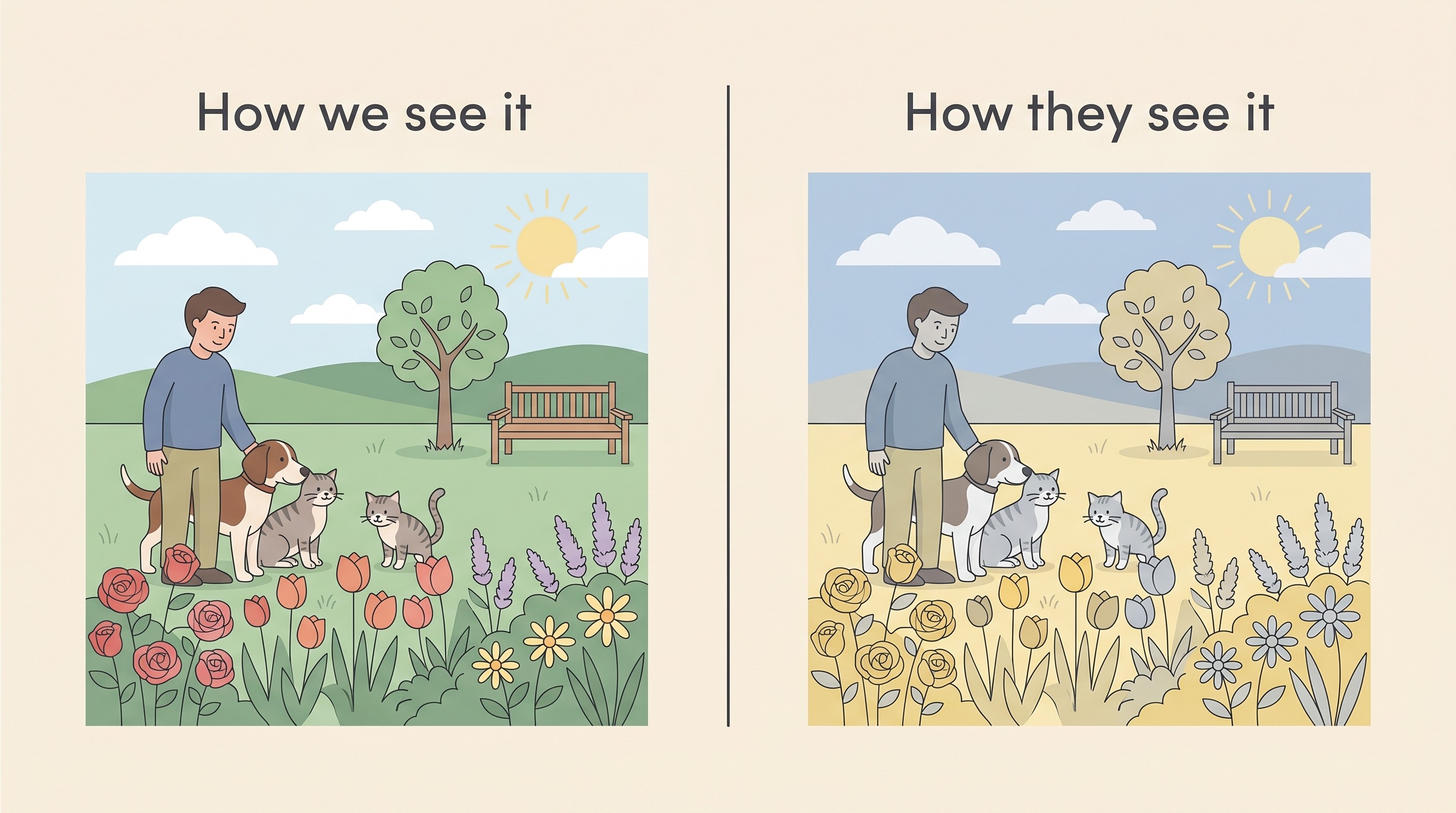
The question I'm asked most is whether dogs and cats are colour-blind. The answer is no, not quite, but their colour world is genuinely smaller than ours. We're trichromats: we have three types of cone, the cells that detect colour, and from those three our brains build the full rainbow. Dogs and cats are dichromats, with only two cone types, so they see a reduced palette much like a person with red-green colour blindness (Neitz et al., 1989; ACVO, n.d.).
In dogs we actually know the precise tuning. Their two cone pigments peak at about 429 nanometres, in the blue-violet, and about 555 nanometres, in the yellow-green (Neitz et al., 1989; Byosiere et al., 2018). Put plainly, a dog sees blues and yellows clearly, while the reds, oranges and greens that light up our world look muddy or grey to them (ACVO, n.d.). That bright red ball you throw onto the green lawn is, to your dog, a dull thing on a duller background, tracked by movement and smell far more than by colour.
Cats are dichromats too, with two cone types and a "neutral point", a wavelength they can't tell from grey, at around 505 nanometres (Clark & Clark, 2016; Miller, 2001). Their colour vision is real but muted, weighted again towards blues and yellows. You'll occasionally see an article claim cats see the full spectrum like we do, but that isn't supported by the biology or the behavioural testing, so I'd treat it as a curiosity rather than a fact. Both species live in a softer, bluer, yellower world than ours.
Made for moonlight
In dim light, our pets leave us standing. A cat's eye can detect light at a threshold roughly six to seven times lower than ours, meaning a cat needs only about a sixth to a seventh of the light we do to make out its surroundings (Miller, 2001). Dogs aren't far behind. The deep dusk that has us reaching for a torch is comfortable working light to them.
This isn't magic. It comes down to engineering, and to two features in particular. The first is the make-up of the retina, the light-sensing film at the back of the eye. Ours is rich in cones for daylight detail and colour. Theirs is overwhelmingly built from rods, the cells that handle dim light, movement and a black-and-white picture. In dogs, only around 3% of the retinal cells are cones, and even the small patch of sharpest vision, the area centralis, is rod-dominated, with something like 23 rods for every cone there and around 41 to 1 out in the periphery (Mowat et al., 2008; Byosiere et al., 2018). A retina stacked that heavily with rods is, in effect, a low-light instrument.
The second feature is the one you've seen glowing back at you in headlights or a camera flash. Behind the retina, dogs and cats have a reflective layer called the tapetum lucidum, in effect a mirror that bounces any light the retina missed back through it for a second chance to be caught. It reflects far more light than the human eye can, and that eerie green-gold shine is simply your pet's night-vision system catching the light twice (Miller, 2001; ACVO, n.d.). Cats have the most dramatic version of all this, which is why a cat can pick its way confidently across a pitch-dark landing while you're feeling for the wall.
Built to catch movement
There's a trade in all of this, and it's a revealing one. A rod-heavy eye is brilliant at noticing the slightest movement and far less good at resolving fine, still detail. Dogs and cats are much better at spotting a moving object than a stationary one (ACVO, n.d.; Byosiere et al., 2018). This is the rabbit problem exactly: a hare sitting motionless in the grass can be almost invisible to a dog that would launch after the same animal the moment it ran. Stillness is a hiding place from eyes built for motion.
Their fine detail, what an optician would call visual acuity, is genuinely soft compared with ours. Best estimates put a typical dog at around 20/75 on the human eye-chart scale, and a cat softer still, around 20/100 to 20/150 (Miller, 2001; Byosiere et al., 2018; Veterinary Vision, n.d.). Detail you could make out clearly from 75 or even 150 feet away, your pet would need to be about 20 feet from to see with the same clarity. So even before any disease, your pet's picture of the world is a softer, lower-resolution one than yours.
Two other differences are worth a smile. Their internal "refresh rate" is faster than ours: dogs resolve flicker up to about 70 to 80 cycles a second and cats up to roughly 100, against about 60 in us, which is part of why an old-style television could look as though it was flickering to them while it held steady to us (Miller, 2001; Byosiere et al., 2018; Veterinary Vision, n.d.). And their field of view is far wider. Eyes set more to the side of the head give a dog a panorama of around 240 degrees and a cat around 200, where we manage about 180, though the central zone of sharp, overlapping vision that gives crisp depth perception is narrower than ours (Miller, 2001; ACVO, n.d.). They've traded our pin-sharp central focus for a wide, motion-sensitive lookout: prey-and-predator eyes, doing a prey-and-predator job.
The senses that do the heavy lifting
Now to the part that matters most. For us, vision is the dominant sense, and losing it costs us our main channel to the world. For a dog or a cat, sight is one instrument in a much larger orchestra, and arguably not even the lead. Smell, above all, is the dog's master sense. A dog has more than 100 million scent receptors in its nose, against roughly 6 million in ours, and the part of the brain devoted to making sense of smell is around 40 times larger, proportionally, than the equivalent in us (VCA, n.d.). A dog doesn't just sniff its world, it reads it in fine, layered detail, the way we read a page. Cats have a far keener nose than we do as well.
Then there are the whiskers. Those stiff hairs on the muzzle, properly called vibrissae, aren't decoration. They're a precision short-range touch sense, each one a finely tuned sensor wired to detect the lightest contact and even shifts in the air. This matters because dogs and cats focus poorly close up. A cat can't bring anything nearer than about 25 centimetres into sharp focus, and a dog rather less, so the few centimetres right in front of the face, the bit a human would simply look at, your pet maps largely by whisker (Miller, 2001; VCA, n.d.). It's how a cat judges whether a gap is wide enough, and how a pet finds the food bowl without seeing it clearly at all. Add fine hearing and a detailed memorised map of home, and you have an animal navigating on at least four channels at once.
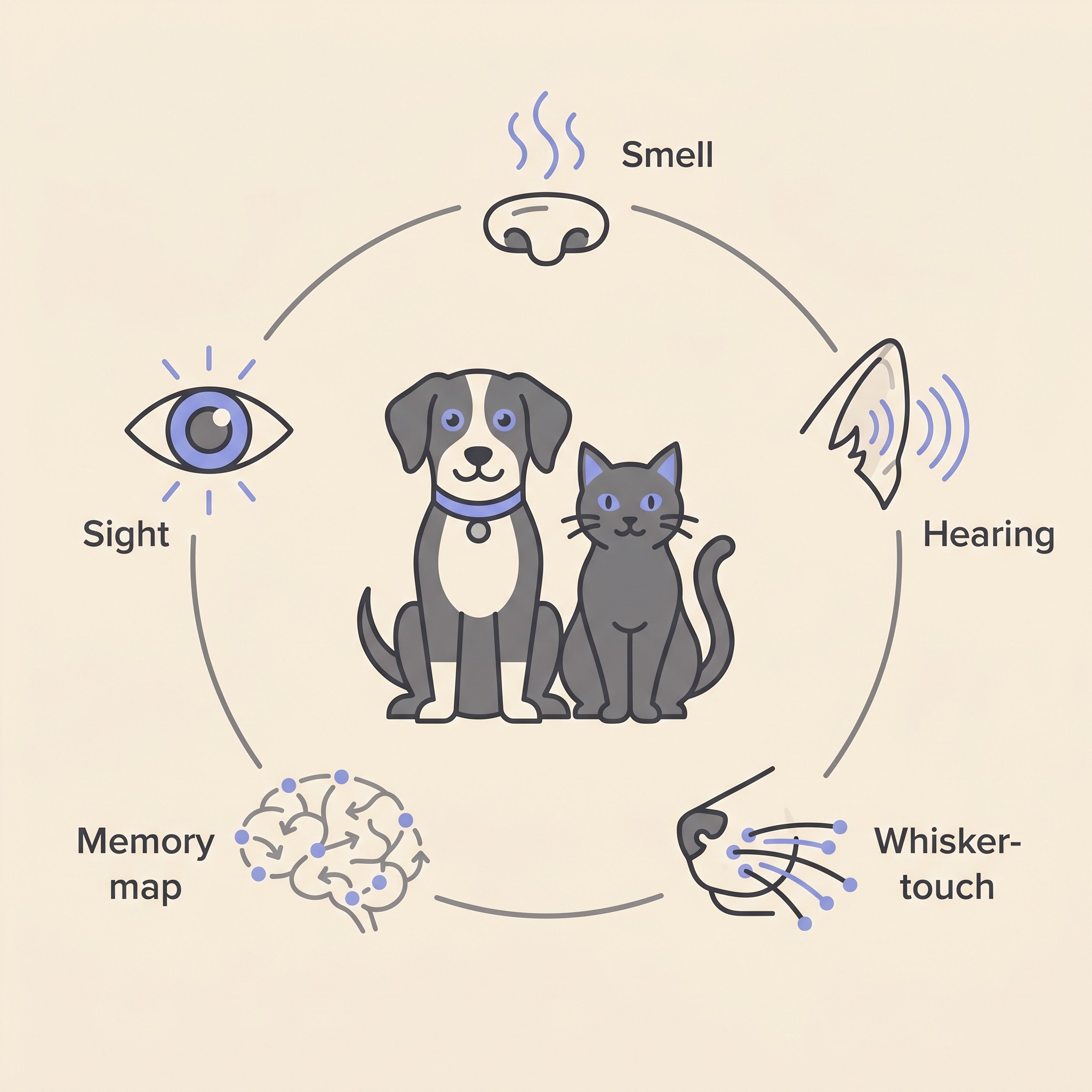
This is the quiet point the whole piece is for. Because dogs and cats already run on smell, hearing, whisker-touch and memory, they have, in a real sense, a lot of spare navigation built in (ACVO, n.d.; Gelatt, 2018; VCA, n.d.). It's exactly why a slow, gradual loss of sight is so often tolerated remarkably well, and why a pet can lose a good deal of vision before anyone notices, leaning on the other senses to carry on as normal (Gelatt, 2018). I don't want to overstate it. Sight loss is still a real change, and adapting to it asks something of both pet and owner. But the foundation under that adaptation, the reason most pets cope better than their families fear, is the multi-sensory animal I've just described.
So how is your pet's sight, really?
A fun thing to try is one of the "see what your dog sees" filter apps. They apply a fixed colour shift and a blur to mimic that 20/75, blue-and-yellow world, and they're a nice way to picture the science on this page. Just hold them lightly: they show a generic dog's or cat's vision, not your individual pet's, and most carry their own disclaimer to that effect. They're an educational toy, not a test.
If you've finished this wondering how well your own dog or cat is actually seeing, that's the right question, and there's a proper way to ask it. Our At-Home Vision Check gives you a simple, repeatable way to gauge your pet's sight and track it over time, and Signs Your Dog or Cat Is Losing Their Sight walks you through the quiet, easy-to-miss tells a check might pick up. And if sight ever does begin to fail, everything you've just read is the reassurance underneath what comes next: the spare capacity in all those other senses is precisely why so many pets find their feet again. The First 30 Days With a Newly Blind Pet is where that story goes, and for cats especially, who lean so hard on whiskers and low-light vision, Helping a Blind Cat Adjust picks it up. The eyes are remarkable, but they were never the whole of how your pet knows the world, and that turns out to be very good news.
References
- American College of Veterinary Ophthalmologists (ACVO). (n.d.). Vision in pets. ACVO Public Resources.
- Byosiere, S.-E., Chouinard, P. A., Howell, T. J., & Bennett, P. C. (2018). What do dogs (Canis familiaris) see? A review of vision in dogs and implications for cognition research. Psychonomic Bulletin & Review, 25(5), 1798-1813.
- Clark, D. L., & Clark, R. A. (2016). Neutral point testing of color vision in the domestic cat. Experimental Eye Research, 153, 23-26.
- Gelatt, K. N. (2018). Disorders of the lens in dogs. MSD Veterinary Manual, Pet Owner Version.
- Miller, P. E. (2001). Vision in animals: what do dogs and cats see? Waltham/OSU Symposium, Small Animal Ophthalmology. Hosted on VIN.
- Mowat, F. M., Petersen-Jones, S. M., Williamson, H., Williams, D. L., Luthert, P. J., Ali, R. R., & Bainbridge, J. W. (2008). Topographical characterization of cone photoreceptors and the area centralis of the canine retina. Molecular Vision, 14, 2518-2527.
- Neitz, J., Geist, T., & Jacobs, G. H. (1989). Color vision in the dog. Visual Neuroscience, 3(2), 119-125.
- VCA Animal Hospitals (Hunter, T., Llera, R., & Buzhardt, L.). (n.d.). How dogs use smell to perceive the world. VCA Know Your Pet.
- Veterinary Vision. (n.d.). How animals see the world. Veterinary Vision Pet Owner Resources.
Keep track of how your pet is doing
The owners who cope best are the ones who notice changes early. A simple health log shows you what is working, and what is not, before the next vet visit.
Start tracking, freeYou're not doing this alone
Compare treatment journeys and talk to owners managing vision & eye health. Free to join.
Join PetsLikeMine