

Signs Your Dog or Cat Is Losing Their Sight
Alastair Greenway
BVM&S MRCVS
Owners almost always apologise when they bring me a pet whose sight has been quietly failing. "I feel terrible, I only just noticed." "She's been bumping the corner of the sofa for weeks and I put it down to clumsiness." There's usually a thread of guilt in it, the worry that a good owner would have caught it sooner.
I'd like to take that weight off you straight away, because missing gradual sight loss isn't carelessness. It's the single most predictable thing about it. Dogs and cats lean heavily on hearing, on smell, and on a remarkably detailed memorised map of home, so they carry on managing the stairs, the food bowl and the route to the back door long after their eyes have started to fail (VCA, n.d.; Gelatt, 2018). The obvious signs we all picture, walking into furniture or hunting blindly for a toy, often don't appear until vision is almost entirely gone, leaving owners only subtle early tip-offs to go on (VCA, n.d.). It doesn't help that those tip-offs overlap with so much else about getting older: a dog that's slower on the stairs could be losing its sight, its hearing, or just having a stiff, arthritic morning (VCA, n.d.). So if you feel you should have known, please let that go. Pets are built to hide this, and noticing now is the useful part.
The everyday tells
Once you know what you're looking for, the early signs are surprisingly readable. None on its own proves anything, but a cluster of them, especially in an older pet, is worth taking seriously.
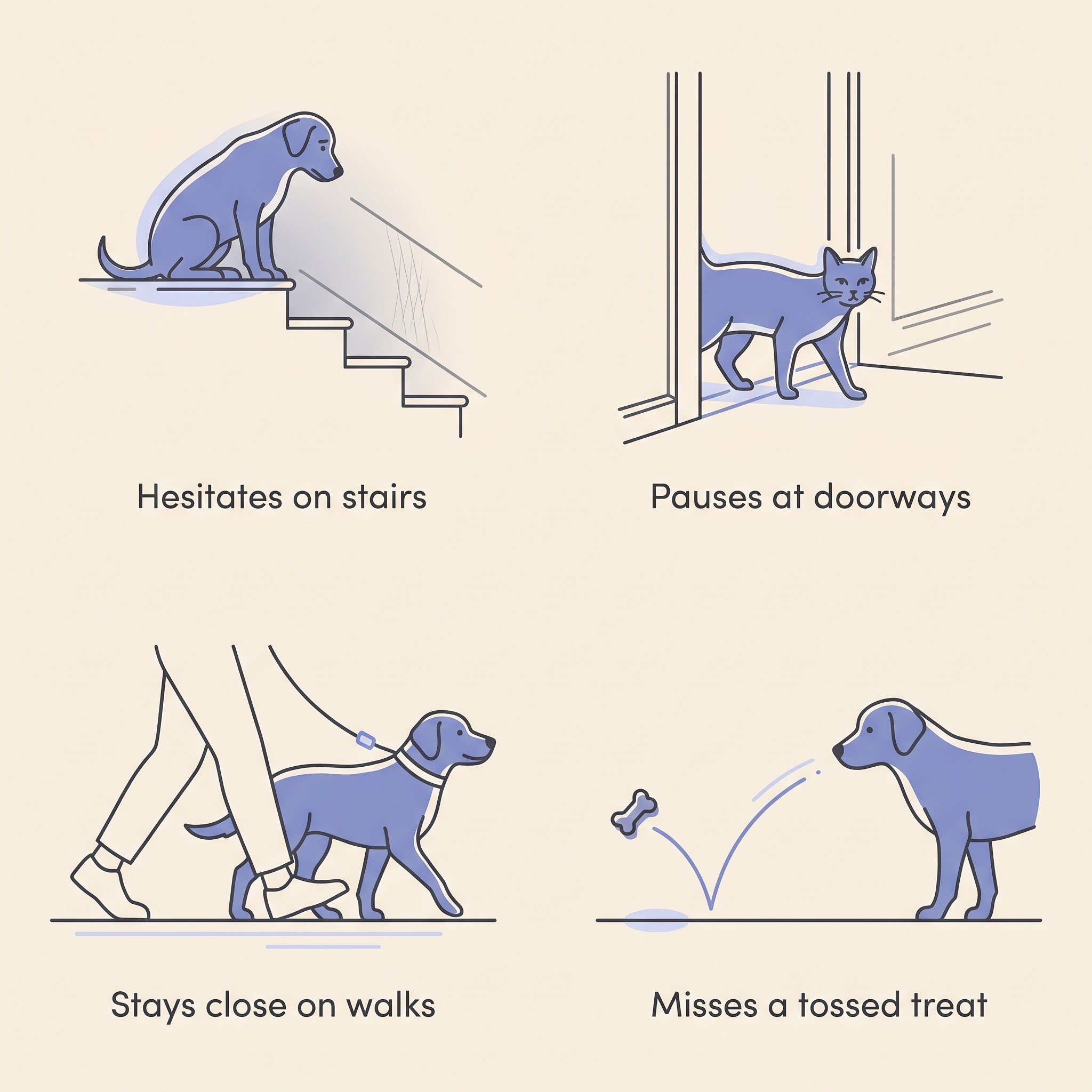
In dogs, the changes tend to show up as a new caution. A dog losing its sight often moves more carefully and stays closer than usual to your leg, with slower walks and play and a new hesitation at the top of the stairs, at a kerb, or about jumping onto the sofa or down from the car (Gelatt, 2018; Rogers et al., 2023; VCA, n.d.). Some startle when touched, occasionally even snapping, simply because they didn't see the hand coming (VCA, n.d.). Others stop making eye contact when called, no longer fix on a treat held up in your hand, or miss a treat you toss to them, small failures of vision easily read as a dog being aloof or unhungry, and some seem to get lost in a space they know perfectly well (Rogers et al., 2023; Donohue/Texas A&M, 2025).
Cats write the same story in a slightly different hand. A cat losing its sight may turn hesitant about heights, reluctant to take a jump it used to make without thinking, or start missing a familiar perch. It might lose confidence finding the food bowl or litter tray, and some cats grow quieter, withdrawn and reclusive as the world gets harder to read (Cornell FHC, n.d.). The classic feline tell is bumping into things, tellingly into furniture that's been moved, often most obvious at night or in low light (Cats Protection, n.d.). The eyes themselves may look different too: cloudier, a changed colour, or pupils that stay wide and don't shrink in bright light (Cats Protection, n.d.).
Two patterns deserve singling out, because they're such reliable clues.
Dim light first. Vision in low light and near-darkness tends to fade first and soonest, so the earliest real-world signs often turn up at dusk, in an unlit room, or on the stairs at night (Rogers et al., 2023). In one validated owner study, the modelled onset of vision decline came noticeably earlier for near-dark conditions than for bright light, and what owners reported about their dog's behaviour in the dark genuinely tracked its measured retinal function (Rogers et al., 2023). So a dog that's suddenly unsure on dim stairs but fine in daylight may be telling you something real, and progressive retinal atrophy is the textbook example of this night-vision-first pattern (Plummer, 2016), covered properly in progressive retinal atrophy. One caveat the other way: some pets struggle more in bright light than dim depending on the cause, so don't expect one fixed pattern (Gelatt, 2018).
The moment the map stops working. A pet navigating by memory copes beautifully until the memory is wrong, so the reveal is very often a change to its surroundings: a house move, rearranged furniture, a dimmer room, a stay somewhere unfamiliar (Donohue/Texas A&M, 2025; VCA, n.d.). Cats Protection put it plainly, describing cats bumping into things "particularly furniture that has been moved" and most apparent "at night or in low light" (Cats Protection, n.d.). If your pet seemed fine until the day you shifted the sofa and then couldn't cope, that's no coincidence. It's one of the clearest clues there is. It's also why the single most useful piece of living-with advice is "don't move the furniture", and the home-setup detail lives in newly blind: the first 30 days.
How the change arrives is itself a clue. A pet that lost its sight overnight is bewildered and fearful, sometimes frozen to the spot, while one that faded slowly often seems to have quietly known something was up for a while and stays "more relaxed, albeit blind", as Cornell describes the gradually-blind cat (Cornell FHC, n.d.). That behavioural fork is a useful handle, and the full "sudden versus suddenly noticed" story, which matters for both guilt and urgency, is owned by sudden versus suddenly noticed blindness.
Gentle checks you can try at home
First, some reassurance backed by evidence rather than just kindness: owner observation is a real signal, not anxious imagination. When researchers compared what owners reported about their dogs' vision against an objective measure of retinal function, the two genuinely tracked each other, and that questionnaire was built specifically to catch subtle, early impairment, because more advanced loss is already obvious enough to send people to the vet (Rogers et al., 2023). The correlations weren't perfect, so this isn't a test that hands you a diagnosis, but if you think your pet isn't seeing as well as it used to, you're probably right.
You can put a little structure on that hunch with a few simple checks. Do them kindly, on a relaxed pet, and read the results with a pinch of salt, because every one of them can be fooled.
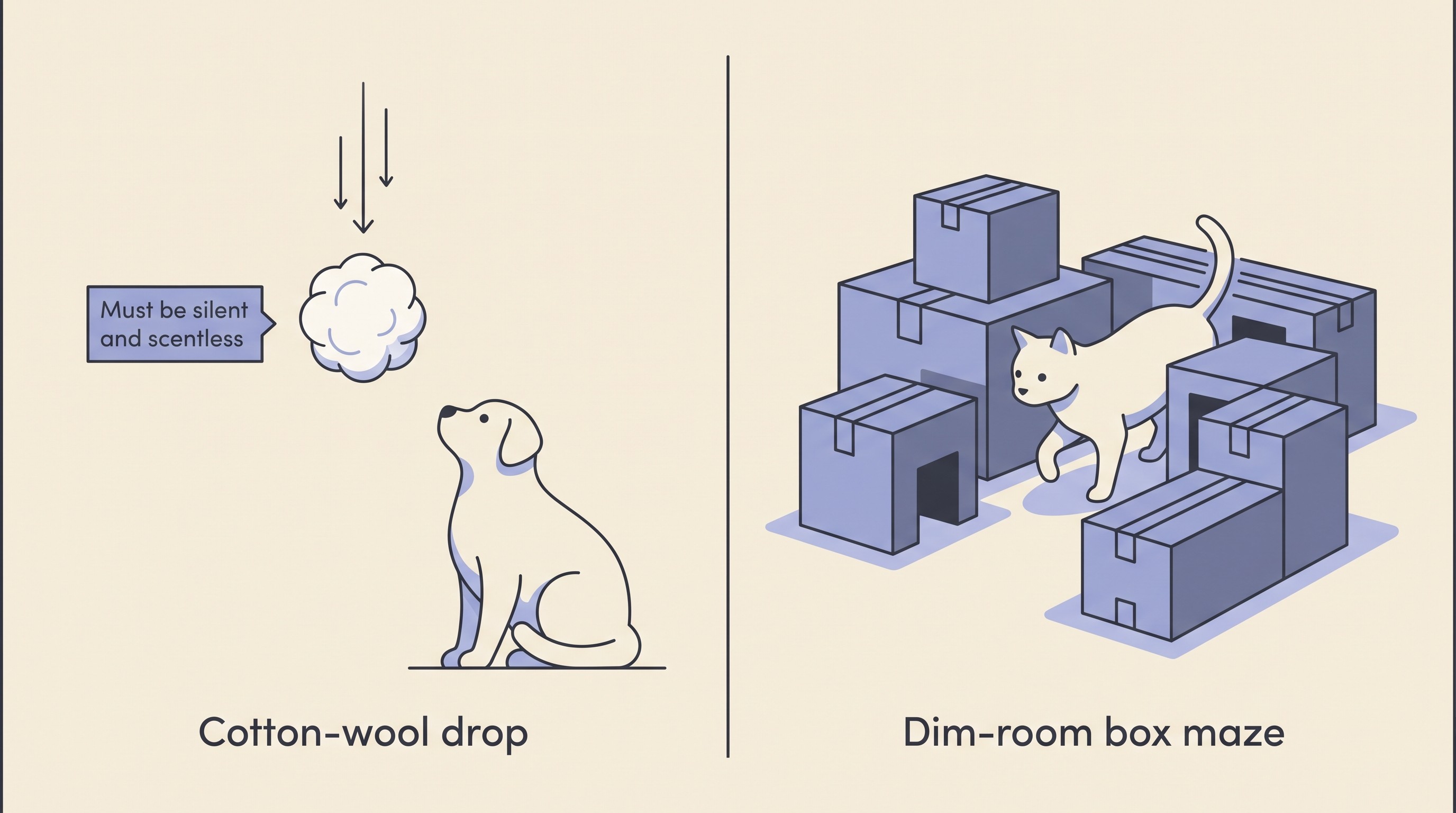
The dropped cotton-wool ball. Drop a ball of cotton wool, or some other silent, scentless object, into your pet's field of view and watch whether the eyes follow it down (Plummer, 2016). The catch is in the word "silent": it has to make no sound and have no smell, or your pet tracks it by ear or nose and looks for all the world like it saw it, when it didn't (Plummer, 2016).
The blink-to-threat (menace) check. Move a hand or a silent object towards the eye and watch for a blink or flinch (Plummer, 2016). Two cautions worth heeding. First, don't let your hand touch the whiskers (the vibrissae) or make a puff of air, because both trigger the sense of touch rather than sight and give a false pass (Plummer, 2016). Second, this reaction is a learned response, not a reflex, so it isn't reliable in puppies and kittens until around three to four months of age, and it can be incomplete even in a perfectly normal adult: in one study of healthy cats, around 40% failed to show a full response when the other eye was covered, though every cat reacted with at least one technique (Quitt et al., 2019; Barnes Heller, 2020). So a missed blink on its own proves very little.
The low-light obstacle walk. Set up a gentle "maze" of cardboard boxes and watch your pet pick a path through it, first in good light and then in dim (Plummer, 2016; Grognet, 2026). The American Kennel Club describes the dim version nicely: turn the lighting down to where you can only just see, put a few boxes in the hallway, and if your dog walks into one, it may have a vision problem (Grognet, 2026). Have whoever's calling the dog use its name only once, so it's finding its way rather than homing in on a repeated voice (Plummer, 2016).
The bottom line on all of these is the same: they suggest, they don't diagnose. They turn a vague worry into a concrete one you can take to your vet, but they're no substitute for an eye exam. If you'd like a structured, scored version you can repeat over time and watch for a trend, that's exactly what our At-Home Vision Check is built for, with a printable vision check sheet to go alongside it.
One quick word on cloudy eyes, since it comes up constantly and it's a slightly different question. A bluish or greyish haze in an older pet's eye is, more often than not, a benign change of ageing that doesn't block vision rather than a sight-stealing cataract (Grognet, 2026). The catch is that you genuinely cannot tell the two apart just by looking, even as a vet, without the right light and a proper exam. So don't panic at a bit of haze and don't dismiss it either, just get it checked once. The full differential lives in is that cloudy eye something to worry about?.
When to act, and how fast
The speed of your response depends entirely on the speed of the change. Any sudden change in your pet's vision is urgent and should be seen the same day, especially with redness, cloudiness, signs of pain, widely dilated pupils, or a pet that seems unwell in itself (Plummer, 2016; Cornell FHC, n.d.). Sudden sight loss can mean a genuine emergency where acting in hours protects what vision is left, so it isn't a wait-and-see. The acute "what to do right now" belongs to sudden blindness: what to do, and our eye-emergency triage will help you judge an urgent eye fast. One specific flag for cat owners: in cats, sudden blindness is most often caused by very high blood pressure detaching the retina, usually driven by kidney disease or an overactive thyroid, so a cat that's suddenly lost its sight needs its blood pressure checked today, and prompt treatment can sometimes let the retina reattach (Cornell FHC, n.d.). That whole feline journey is owned by cat sudden blindness and blood pressure; for now, just treat it as a today problem, not a tomorrow one.
A gradual change is a different tempo, but it still earns a proper eye exam rather than a shrug, because "my pet is slowly going blind" has a long list of possible causes, some treatable and some not, that only an exam can sort out, and the cause guides everything that follows (Plummer, 2016). Book the appointment, mention the specific things you've noticed, and if a thirstier, hungrier or otherwise off-colour older pet also has clouding eyes, flag that too, because a few causes of sight loss come bundled with whole-body conditions worth catching.
Here's the reassurance I'd genuinely leave you with, and it's earned rather than a pat on the head. Pets cope with sight loss far better than their owners expect, especially when it's come on slowly. Most adapt within a few months and get back to their normal activities, and cats in particular are remarkable at it, falling back on hearing, smell, their whiskers and those memorised routes to lead a contented life (Donohue/Texas A&M, 2025; Cats Protection, n.d.). There's real work and real grief in it, I won't pretend otherwise, but a blind pet is very far from a pet with a poor life. So if the signs in this piece sound like yours, the next steps are calm and concrete: use the scored At-Home Vision Check for a baseline to compare against, book an exam for any gradual change, treat any sudden change as a same-day call, and when you're ready to help a pet whose sight is genuinely fading, newly blind: the first 30 days is written for exactly that moment, furniture left right where it is.
References
- Barnes Heller, H. (2020). Menace Response Deficit: What does it mean? Barnes Veterinary Specialty Services, 17 November 2020.
- Cats Protection. (n.d.). Blind cats: how to look after blind cats. Cats Protection.
- Cornell Feline Health Center. (n.d.). Sudden Blindness (quoting Thomas Kern, DVM). Cornell University College of Veterinary Medicine.
- Donohue, L. (2025). Seeing The Bright Side: Helping Pets Adjust To Vision Loss. Texas A&M School of Veterinary Medicine & Biomedical Sciences, Pet Talk, 4 September 2025.
- Gelatt, K. N. (2018). Disorders of the Lens in Dogs. MSD Veterinary Manual, Pet Owner Version (reviewed/revised June 2018; modified April 2026).
- Grognet, J. (2026). Age-Related Hearing and Vision Loss in Dogs: What to Know. American Kennel Club, updated 23 February 2026.
- Plummer, C. E. (2016). Diagnosing Acute Blindness in Dogs. Today's Veterinary Practice, November/December 2016.
- Quitt, P. R., Reese, S., Fischer, A., Bertram, S., Tauber, C., & Matiasek, L. (2019). Assessment of menace response in neurologically and ophthalmologically healthy cats. Journal of Feline Medicine and Surgery, 21(6), 537-543.
- Rogers, C. M., Salzman, M. M., Li, Z., Merten, N., Russell, L. J., Lillesand, H. K., & Mowat, F. M. (2023). Subjective vision assessment in companion dogs using dogVLQ demonstrates age-associated visual dysfunction. Frontiers in Veterinary Science, 10, 1244518.
- VCA Animal Hospitals. (n.d.). Signs of Vision Loss in Pets. VCA Animal Hospitals.
Keep track of how your pet is doing
The owners who cope best are the ones who notice changes early. A simple health log shows you what is working, and what is not, before the next vet visit.
Start tracking, freeYou're not doing this alone
Compare treatment journeys and talk to owners managing vision & eye health. Free to join.
Join PetsLikeMine