

Sudden Versus Slowly-Noticed Blindness: Why It Matters
Alastair Greenway
BVM&S MRCVS
"It happened overnight, doctor. One day she was fine, the next she was walking into the furniture." It's one of the most common things owners say when an older pet has lost its sight, and it nearly always comes with a flush of guilt. They're braced for me to confirm their worst fear, that they somehow failed to spot something obvious going on under their nose for months.
So let me take that weight off you first. A lot of blindness that looks as though it came out of nowhere did not. The eye had been failing slowly, sometimes over years, and your pet coped so beautifully that nobody could tell, right up until the day something small changed and the coping stopped working. That distinction, truly sudden versus suddenly noticed, isn't academic hair-splitting. It tells you whether you're looking at an emergency to be seen today or a quieter situation to be worked up calmly, and it tells you, importantly, that you're almost certainly not the inattentive owner you're afraid you are.
Truly sudden, or just suddenly noticed?
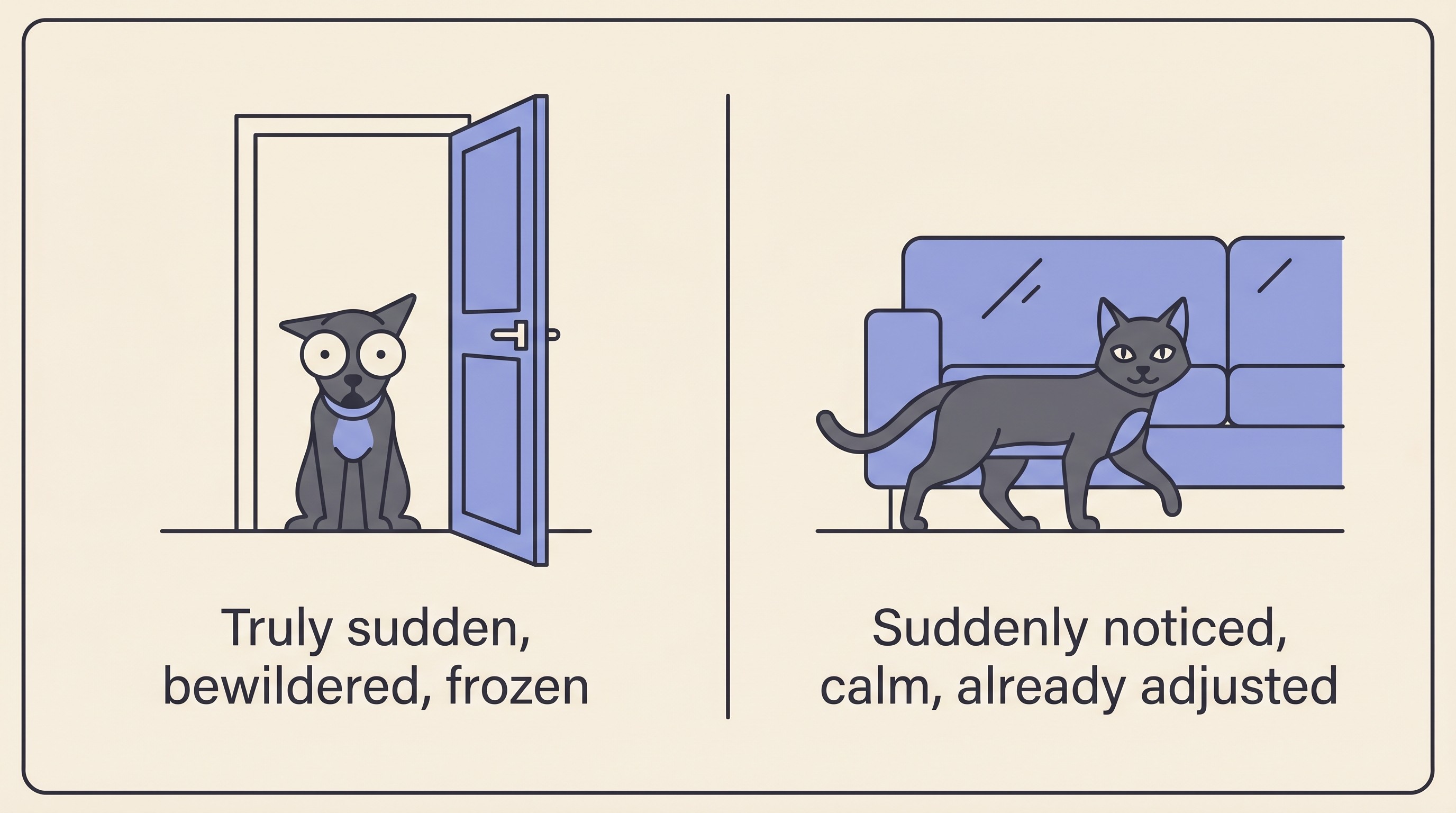
The two really are different events, and it helps to name them plainly. Truly sudden blindness comes on overnight or over a few days. Suddenly-noticed blindness is a progressive loss that has crept in gradually over an extended period, perhaps years, before it became evident to the owner (Kern / Cornell FHC, n.d.). One vet put the point about as bluntly as it can be put: although sudden-onset blindness genuinely does occur, it's likely that most cases are simply sudden awareness by the owner of a progressive loss of vision (Paul, 2014).
I want to be careful here, because that line is most true for the slow, painless, both-eye conditions, things like progressive retinal atrophy or a slowly maturing cataract, where vision drains away by degrees over months. It isn't a licence to assume every blind pet has been going blind for a year. Some genuinely do lose their sight overnight, and that's exactly the group the rest of this page is built to help you catch. But for a great many pets, the "sudden" was a discovery, not an event.
Why pets hide it so well
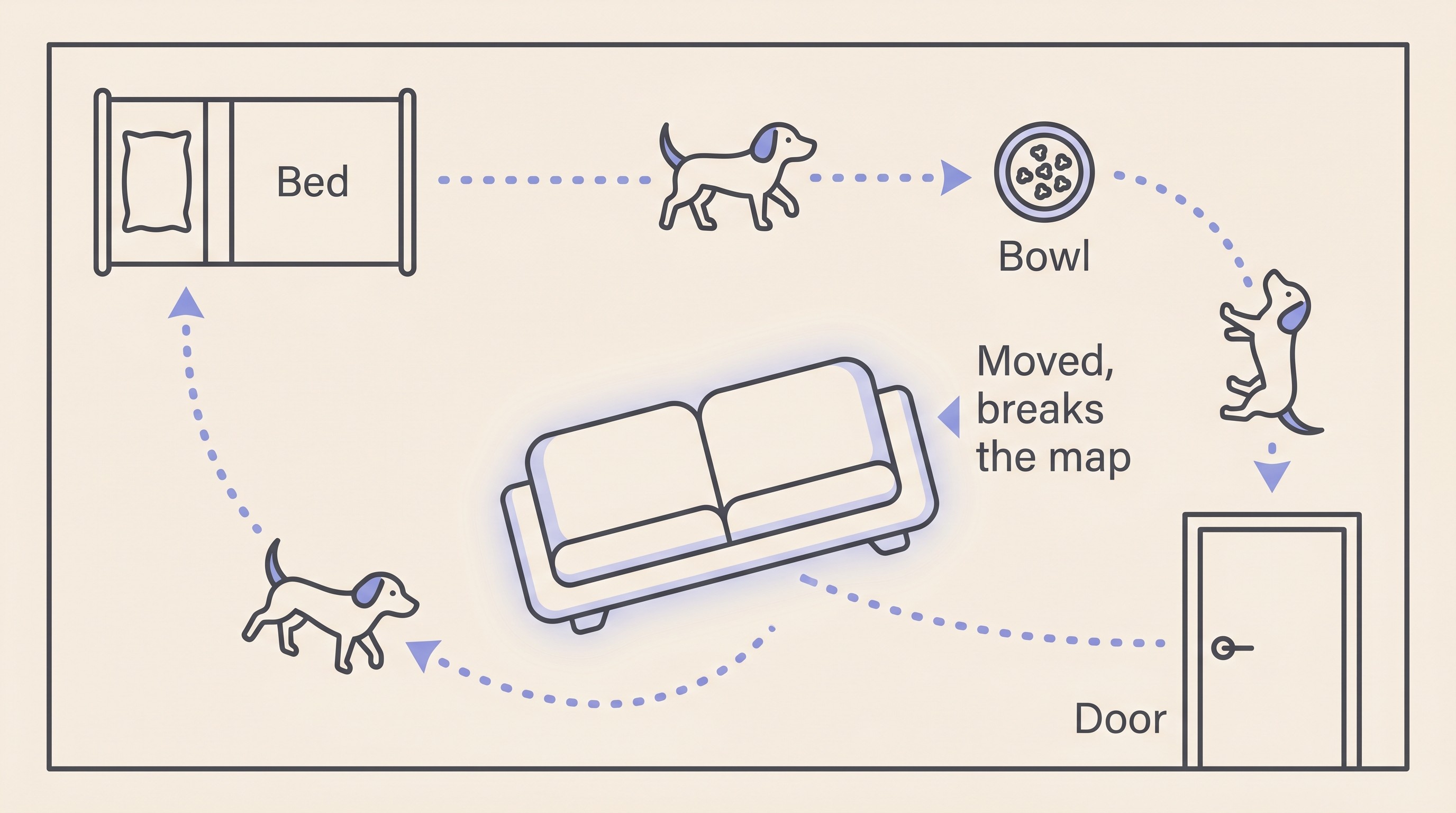
This happens, and it isn't your fault, for one of the most reassuring reasons in veterinary ophthalmology. Pets don't navigate the way we do, leaning on vision and topping it up with the other senses. They navigate by a memorised map of their world, stitched from smell, sound and habit, with sight only one thread in it. Once a dog or cat knows a room, it moves through it confidently unless something is moved (Paul, 2014). Your pet builds this map and gets about very well once adjusted, which is precisely why the standing advice is not to rearrange the furniture, and to make a little noise as you approach so they can hear you coming (Donohue / Texas A&M, 2025).
For a long time you could have dismissed that as the comforting thing vets say. It isn't folklore. The mental map is real, measurable cognition, built from the very senses a blind pet still has. In one experiment, researchers played fifty cats their owner's voice from one spot, then suddenly from another, and the cats were most startled when the voice jumped, possibly because they had mentally mapped the owner's location when they heard the owner's voice; the authors concluded that cats hold a mental representation of an unseen owner and map that owner's position from voice alone (Takagi et al., 2021). On the dog side the evidence is wired into the anatomy: a team tracing the canine brain found a direct white-matter tract running from the olfactory system straight to the occipital lobe, the visual cortex, the first documentation of such a connection in any species (Andrews et al., 2022). In plain terms, a dog's nose feeds the part of the brain we use for seeing. The senior author put the consequence kindly: it helps explain why blind dogs can still play fetch and navigate their surroundings much better than humans with the same condition, a finding she hoped would be "hugely comforting to owners of dogs with incurable eye diseases" (Andrews et al., 2022).
So the pet who "managed fine until the day we moved the sofa" was never managing on luck. It was leaning, the whole time, on a sophisticated map built from scent and sound, the spare navigation that lets gradual blindness pass unnoticed.
Usually it's the map that changed, not the eye
This is the part that quietly lifts the guilt. A pet running on a memorised map copes right up until the map stops matching the world. So the moment everyone remembers, the day it "suddenly" couldn't cope, is almost never the day its sight actually failed. It's the day the map broke: a house move, rearranged furniture, a new puppy underfoot, a strange holiday cottage, or simply a dimmer evening (Paul, 2014; Donohue / Texas A&M, 2025). That's why so many owners date the blindness to the afternoon they moved the sofa. The sofa didn't blind the dog. It revealed a dog that had been blind, and coping, for a long while.
It's also why owners so rarely catch it themselves. Pets compensate so completely that, as one ophthalmology team observed, the loss is often only discovered during a veterinary examination (Donohue / Texas A&M, 2025). If you're carrying any "how did I not see this", let it go: your pet was built to hide it, and it hid it well. The everyday tells that can tip you off earlier next time, the hesitation on the stairs, the missed treat, the startle when touched, are worth knowing, and I've set them out in signs of sight loss. Here they're only the mechanism behind "suddenly noticed": the map was fine until it wasn't.
Reading it from behaviour
Because the two kinds of blindness arrive so differently, your pet's own behaviour is a surprisingly good guide to which one you're facing, readable at home before you reach the clinic.
A pet that has lost its sight quickly, with no time to adapt, tends to look genuinely lost. It's confused, bewildered and fearful, and may simply freeze in place (Kern / Cornell FHC, n.d.). A pet that lost vision gradually looks like the opposite: it seems to have realised something has been going on for a long time, and is more relaxed, albeit blind (Kern / Cornell FHC, n.d.). The practical fallout follows the same line: a pet blinded suddenly struggles to adjust because there's no chance to adapt in advance, whereas one that lost vision slowly copes much better, having had the time (Paul, 2014; Kern / Cornell FHC, n.d.).
So, held loosely: bewildered and frozen points towards a recent loss, calm and already getting on with it towards a gradual loss that's been there a while. It isn't infallible, but it's a real signal, and it leads straight to why the distinction matters.
Why it actually matters
The difference is worth your attention because it comes down to urgency. Truly sudden vision loss is, generally, an emergency, and warrants prompt evaluation, because delayed care carries a poor prognosis for sight and may also delay the diagnosis of a significant underlying illness (Plummer, 2016). The bewildered, just-blinded pet may have something the clock is running against: glaucoma, a lens slipping out of place, a retina detaching, and in cats especially, a retina detached by dangerously high blood pressure. Some of those can be partly turned around if they're caught in hours rather than days.
But here's the caveat, because it's the nuance that separates a good page from a misleading one. Sudden onset does not mean salvageable. There's a condition called SARDS in which a dog goes blind over days with a normal-looking, pain-free eye, and there is, sadly, nothing to save, no proven treatment and no reversing it. So the rule isn't "rush in and we can always fix it". It's "get seen fast to find out which it is", because only the examination can tell the emergency you can act on from the loss you can't. That's why even truly sudden blindness earns a same-day visit: not because speed always rescues vision, but because speed decides whether it can. The calm, long-adjusted pet is in a different position entirely. It still needs a proper eye exam to find the cause and rule out anything treatable, but the job there is diagnosis and adaptation, not a race against the clock. There's no emergency to miss, and no failure on your part to atone for.
There's a lovely proof of all this in how vets test vision. When we run an obstacle-course test to measure a dog's sight, we're taught to move the obstacles between attempts, specifically to avoid the dog memorising the route and mapping its way through without seeing a thing (Plummer, 2016). Even in a controlled test, professionals have to design around the mental map to measure true vision, which is exactly why a gradually blind pet looked fine at home for so long: it had memorised the course, and nobody thought to move the furniture.
Which fork are you in?
So let this page do one practical thing before you close it. Work out which fork you're standing in, because the right next step depends entirely on that.
If your pet is bewildered, frozen and clearly only just blind, treat it as urgent and have it seen today, especially if there's redness, cloudiness, pain or an unwell pet alongside it. The immediate steps and the painful-versus-painless fork are in what to do about sudden blindness, the SARDS picture is in SARDS, and you can run the eye-emergency triage tool in a couple of minutes. One flag to hold on to: if it's a cat that's suddenly gone blind, ask your vet to check the blood pressure today, because a hypertensive detached retina is the commonest cause and acting fast can sometimes save sight. That journey belongs to sudden blindness and blood pressure in cats.
If your pet is calm and plainly coping, already finding its bowl and its bed, you're very likely looking at a loss that's been there a while. Book a proper eye examination so you know what you're dealing with, and in the meantime you can start tracking its vision over time with the at-home vision check, which is genuinely useful for working out whether sight is recently lost or long gone.
Either way, hold on to the headline rule the whole concept rests on: don't move the furniture, and talk before you touch. Your pet's confidence lives inside that memorised map, and the room-by-room practicalities are in home-proofing for a blind pet.
And here's the reassurance I'd leave you with, earned rather than a pat on the head. The "suddenly blind" pet who turns out to have been losing sight slowly is very often the one who adapts fastest, for the simplest of reasons: it's been quietly adapting for months already, standing on a map it built without you ever noticing. Most pets adapt within a few months and get back to normal life (Donohue / Texas A&M, 2025), and the early days of that, the dip, the work and the real emotional arc, are what the first 30 days with a newly blind pet is there for.
References
- Andrews, E. F., Pascalau, R., Horowitz, A., Lawrence, G. M., & Johnson, P. J. (2022). Extensive connections of the canine olfactory pathway revealed by tractography and dissection. Journal of Neuroscience, 42(33), 6392-6407. (plain-language summary: Cornell Chronicle, 18 July 2022, https://news.cornell.edu/stories/2022/07/study-finds-new-links-between-dogs-smell-and-vision)
- Donohue, L. (Texas A&M School of Veterinary Medicine & Biomedical Sciences, Pet Talk). (2025, September 4). Seeing the bright side: helping pets adjust to vision loss. VMBS News.
- Kern, T. (Cornell Feline Health Center). (n.d.). Sudden blindness. Cornell University College of Veterinary Medicine.
- Paul, M. (2014, July 21). Sudden onset blindness in cats. Pet Health Network.
- Plummer, C. E. (2016, October 18). Diagnosing acute blindness in dogs. Today's Veterinary Practice.
- Takagi, S., Chijiiwa, H., Arahori, M., Saito, A., Fujita, K., & Kuroshima, H. (2021). Socio-spatial cognition in cats: mentally mapping owner's location from voice. PLOS ONE, 16(11), e0257611.
Keep track of how your pet is doing
The owners who cope best are the ones who notice changes early. A simple health log shows you what is working, and what is not, before the next vet visit.
Start tracking, freeYou're not doing this alone
Compare treatment journeys and talk to owners managing vision & eye health. Free to join.
Join PetsLikeMine