

SARDS: Sudden Blindness in Dogs With No Warning
Alastair Greenway
BVM&S MRCVS
A dog who was fine last week is suddenly walking into doorframes. The eyes look completely normal, there's no redness, nothing obviously hurts, and yet the dog plainly cannot see. This is one of the handful of diagnoses I genuinely dread giving. The owner is searching for an accident to explain it and there isn't one. Then comes the part that feels almost designed to be cruel: there's nothing we can do to bring the sight back.
If that's roughly where you are, I'm sorry. I'd rather be straight with you than soft, because false hope around this condition does real harm, and because once you understand what's happening it stops being a terrifying mystery. The short version is this. The diagnosis is devastating, and your dog can still have a genuinely good life. Both are true at once.
If your dog has only just lost their sight and you haven't yet seen a vet, start with the acute steps in what to do when your pet suddenly goes blind, which sorts the emergencies from the rest and routes the painless cases like this one here. This page is the explainer you land on once SARDS is suspected or confirmed.
What SARDS actually is
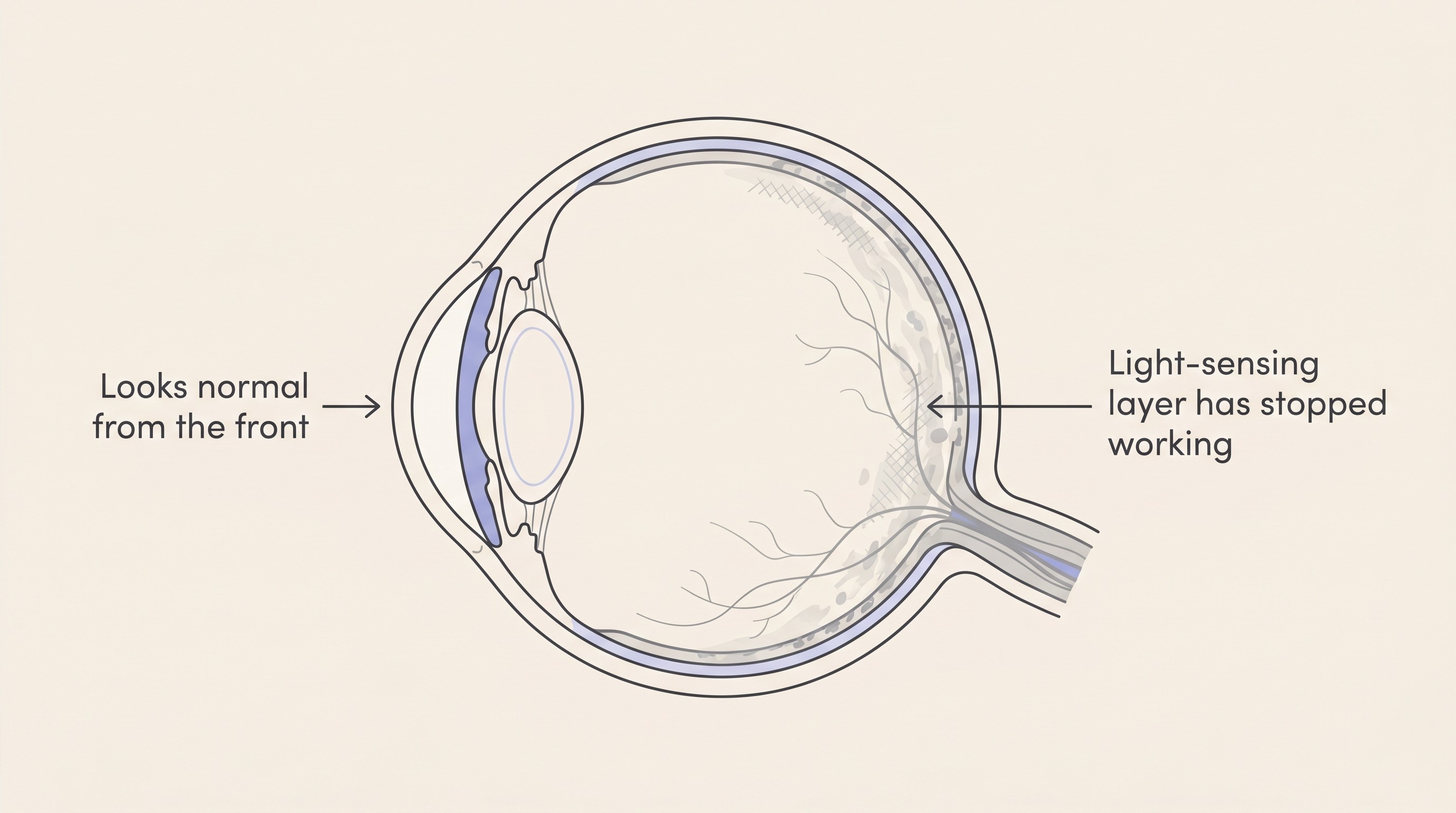
SARDS stands for sudden acquired retinal degeneration syndrome, and the plainest way to put it is that the retina's light-sensing cells, the photoreceptors, suddenly stop working. The retina is the layer at the back of the eye that turns light into signals for the brain. In SARDS those cells fail and the dog goes blind, but the eye itself stays structurally normal and it doesn't hurt. It is "one of the leading causes of currently incurable canine vision loss diagnosed by veterinary ophthalmologists" (Komáromy et al., 2016).
That normal-looking, painless eye is exactly why SARDS blindsides people. With most eye emergencies there's something to see: a red eye, a cloudy eye, a dog squinting in obvious discomfort. Here there's none of that. As the UK referral centres put it, SARDS "is a disease which leads to sudden and irreversible blindness" and "does not however cause any pain," and "in the early stages of the condition the retina looks normal, even though it is no longer working" (Willows Veterinary Centre; North Downs Specialist Referrals). A dog clearly blind behind a perfectly healthy-looking eye is a big part of why the diagnosis is so hard to accept.
One thing worth saying plainly and early: SARDS is a disease of dogs. It is consistently described as a canine condition and reported only in dogs (Komáromy et al., 2016; Thomasy, MSD Veterinary Manual, SARDS in Dogs, 2024). That matters, because a cat who suddenly goes blind is a different story, usually about blood pressure rather than the retina giving out, and belongs in sudden blindness in cats and what it means for the blood pressure. If you're here about a cat, that's the page you want.
Fast, but usually over a few days
People often describe it as overnight, and it can feel that way (VCA Animal Hospitals). In truth the loss usually plays out over a short window of days to a week or two rather than a single instant. It is acute and "often occurring throughout several days" (Thomasy, MSD Veterinary Manual, SARDS in Dogs, 2024), and in the largest survey of owners, 65.4% reported the time from first noticing a problem to complete blindness was under two weeks (Washington et al., 2021).
That detail explains the common story of a dog who seemed to manage at first and then suddenly couldn't. They weren't imagining the early coping. A dog can lose a lot of sight and still get around a familiar home on memory and scent for a while, until there's too little vision left to lean on. If you're wondering whether this really came out of nowhere or had been creeping up, that's a fair question, and it's covered in sudden versus suddenly noticed blindness. For SARDS, the answer is that it's genuinely fast, just measured in days rather than seconds.
Reaching a diagnosis, and why the tests still matter
When I examine a dog I suspect has SARDS, the eyes look normal but the pupils give it away: they tend to stay wide and respond slowly or not at all to light, rather than tightening down the way healthy pupils do (VCA Animal Hospitals). There's a neat clue here worth knowing. A SARDS pupil often won't react to a red light but will still react to a blue one, so you may see your vet shining different coloured lights at the eye (Komáromy et al., 2016; Thomasy, MSD Veterinary Manual, SARDS in Dogs, 2024).
The diagnosis is confirmed with an electroretinogram, or ERG, usually at a referral ophthalmologist. It's an electrical test of whether the retina is working, and in SARDS it comes back as a "flat-line electroretinogram," because the photoreceptors have shut down (Thomasy, MSD Veterinary Manual, SARDS in Dogs, 2024; Willows; North Downs Specialist Referrals). Owners understandably ask whether it's worth the trip when the likely news is bad. It is. A flat ERG places the problem firmly in the retina, which is SARDS, whereas a normal ERG in a blind dog points somewhere else, to the optic nerve or the brain, and some of those causes are treatable. So the ERG isn't labelling the inevitable. It rules out the things we could actually do something about.
The hard truth, told straight
Here is the fact I most need you to have, because it's the one most often misunderstood. SARDS is irreversible. The cause is genuinely unknown, described as idiopathic, with neuroendocrine and autoimmune mechanisms suggested but nothing proven (Komáromy et al., 2016; VCA Animal Hospitals). And there is no treatment shown to work: "there is currently no effective treatment for SARDS that is supported by published clinical trials" (ACVO), and "to date, there is no successful treatment available for SARDS" (Willows; North Downs Specialist Referrals).
I labour this because the word "sudden" plays a trick on people. With some eye emergencies, sudden onset means you must move fast to save the sight, an acute glaucoma or a freshly detached retina, where hours genuinely count. SARDS is not that. There is nothing to rush in and rescue, because the photoreceptors have already failed. The urgency around a newly blind dog is about ruling out those treatable look-alikes and supporting the dog, not about a clock ticking on the sight itself. Sudden, in this condition, does not mean salvageable, and I'd far rather tell you that kindly and clearly than let you spend weeks chasing a recovery the biology won't allow.
That clarity is also your protection, because desperation makes people vulnerable. Owners looking for hope online will find clinics offering experimental treatments, usually human intravenous immunoglobulin (IVIg) or other immunosuppression. Please be wary. The UK referral position is blunt, and I'd echo it: this experimental treatment "can lead to sudden death due to an allergic reaction and therefore we do not recommend it" (Willows; North Downs Specialist Referrals). The wider evidence is no kinder to it. Even in the large owner survey, dogs given combination treatment showed only a marginally higher rate of any reported vision recovery than those on a single drug, 14.4% against 3.2%, and "side effects of treatment were commonly reported" (Washington et al., 2021). The promised cures aren't backed by the evidence, and some carry real risk. A diagnosis this painful should not also cost you money, and your dog's safety, chasing something that doesn't work.
When it looks like Cushing's
There's one more piece that catches families off guard, and it's worth understanding rather than fearing. A lot of SARDS dogs, alongside the blindness, show signs that look a great deal like Cushing's disease (an overactive adrenal gland): drinking and weeing more, a bigger appetite, weight gain, sometimes panting and lethargy, with raised liver enzymes and cholesterol on their bloods (Komáromy et al., 2016; Kirby, 2019). The UK centres put the drink-more, wee-more sign at around 50% of affected dogs, while broader figures suggest up to around 85% show some systemic sign of this kind (Willows; North Downs Specialist Referrals; Kirby, 2019). If your dog has been thirstier or hungrier or heavier lately, you've probably noticed, and wondered if it's connected. It often is.
The important distinction, though, is that SARDS looks like Cushing's but it is not the same disease. The two can be told apart on testing (Oh et al., 2019), and a dog with SARDS shows these changes without the pituitary or adrenal tumour that drives true Cushing's. Whether the hormonal shifts contribute to SARDS or simply travel alongside it is still unknown (VCA Animal Hospitals). So when your vet runs bloods and perhaps tests for Cushing's, they're doing it for two reasons: to be sure it isn't a treatable disease masquerading as something worse, and because those thirst, appetite and weight changes are real and worth managing for your dog's comfort, sight or no sight. The detail of those hormonal conditions, and how they're handled, lives in our Hormone Health space, because this page is about the eyes.
The reassurance, and it's a real one
This is the truest counterweight to everything above. Blind dogs live happy lives, and the owners who have walked through SARDS say so with remarkable consistency.
The strongest evidence comes from a long-term study of 100 SARDS dogs across five academic hospitals. Of those owners, 95% said they would discourage euthanasia of a dog with SARDS, and 37% reported that their relationship with their dog had actually improved after the diagnosis (Stuckey et al., 2013). Most rated their dog's quality of life as good, around 80% scoring it good to excellent, with similar figures for getting around the house and garden, a level echoed by other academic centres at roughly 80% moderate-to-excellent quality of life and 87% moderate-to-excellent home navigation (Stuckey et al., 2013; Colorado State University; VCA Animal Hospitals). And crucially, this is a loss of sight, not of life expectancy: dogs with SARDS "did not have a shorter lifespan than the reference population" (Washington et al., 2021). The specialty college puts it plainly, that "most pets can and do still maintain a very active and interactive" role in the family (ACVO).
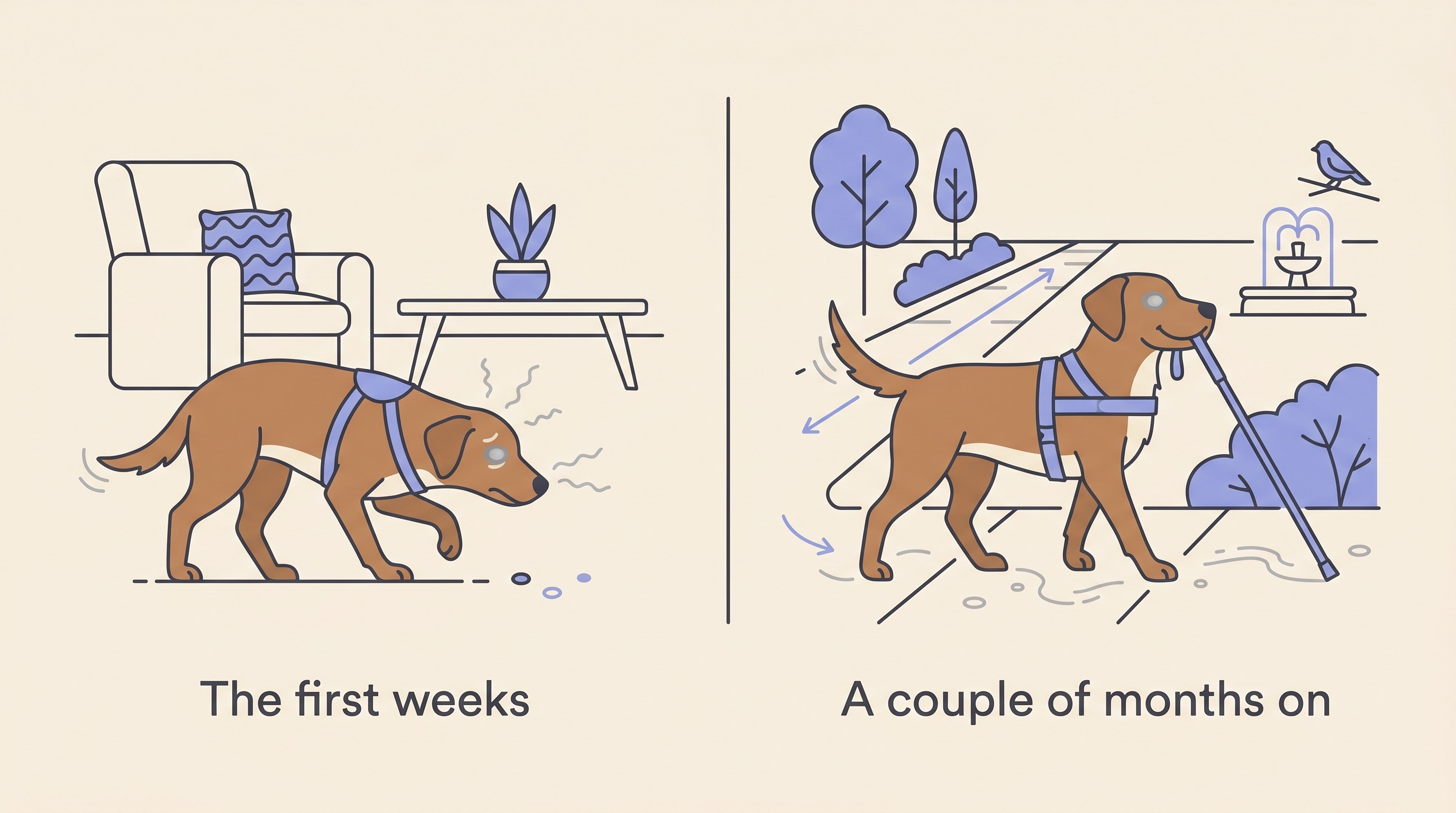
I won't pretend the adjustment is instant, and SARDS is harder on this front than a gradual loss precisely because there's no runway. The first weeks are genuinely the hardest. It is normal for a newly blind dog to be confused at first, and that confusion eases with time as they learn to lean on smell and hearing, typically over a couple of months (North Downs Specialist Referrals; Willows; Kirby, 2019). Owners often describe getting most of their dog back fairly quickly and the rest more slowly. The grief is real and the work is real. But the destination, for the great majority, is a dog who is comfortable, confident and themselves again.
Where you go from here
The path forward from SARDS isn't medical, it's practical, and it's more hopeful than this morning probably feels. Your dog still has their nose, their ears and you, and dogs use all three far more than we assume. The how-to of those first weeks, setting up the home, the don't-move-the-furniture rule, talking before you touch, and not making big decisions in the panic, is exactly what the first 30 days with a newly blind pet is written for, and it's where I'd send you next. If the bigger question is gnawing at you, whether a blind dog can truly be happy or whether you'd be kinder to let them go, that deserves a fuller answer than a paragraph, and is my blind pet still happy takes it on directly, with these same SARDS findings at its heart.
One concrete thing you can start once you're past the first shock: our at-home vision check gives you a gentle, repeatable way to gauge how your dog is navigating and watch that confidence build week by week. It turns an anxious "are they coping?" into something you can actually see improving, which is its own quiet reassurance over those first couple of months. The first 30 days blind pet checklist is a printable companion for the practical side.
References
- American College of Veterinary Ophthalmologists (ACVO). SARDS (Sudden Acquired Retinal Degeneration Syndrome). Common Conditions, 2018 (reviewed by ACVO).
- Colorado State University Veterinary Health System. Sudden Acquired Retinal Degeneration Syndrome (SARDS) in Dogs.
- Kirby, P. (2019). Sudden Acquired Retinal Degeneration Syndrome: An Overview. Today's Veterinary Nurse, Winter 2020 (published online 19 November 2019).
- Komáromy, A. M., Abrams, K. L., Heckenlively, J. R., Lundy, S. K., Maggs, D. J., Leeth, C. M., MohanKumar, P. S., Petersen-Jones, S. M., Serreze, D. V., & van der Woerdt, A. (2016). Sudden acquired retinal degeneration syndrome (SARDS): a review and proposed strategies toward a better understanding of pathogenesis, early diagnosis, and therapy. Veterinary Ophthalmology, 19(4), 319–331.
- North Downs Specialist Referrals. Sudden Acquired Retinal Degeneration Syndrome (SARDS) Information.
- Oh, A., Foster, M. L., Williams, J. G., Zheng, C., Ru, H., Lunn, K. F., & Mowat, F. M. (2019). Diagnostic utility of clinical and laboratory test parameters for differentiating between sudden acquired retinal degeneration syndrome and pituitary-dependent hyperadrenocorticism in dogs. Veterinary Ophthalmology, 22(6), 842–858.
- Stuckey, J. A., Pearce, J. W., Giuliano, E. A., Cohn, L. A., Bentley, E., Rankin, A. J., Gilmour, M. A., Lim, C. C., Allbaugh, R. A., Moore, C. P., & Madsen, R. W. (2013). Long-term outcome of sudden acquired retinal degeneration syndrome in dogs. Journal of the American Veterinary Medical Association, 243(10), 1425–1431.
- Thomasy, S. M. (section author; rev. Carnevale, J.). (2024). Sudden Acquired Retinal Degeneration Syndrome in Dogs. MSD Veterinary Manual (Professional), Ophthalmic Emergencies in Small Animals.
- VCA Animal Hospitals. Sudden Acquired Retinal Degeneration Syndrome (SARDS).
- Washington, D. R., Li, Z., Fox, L. C., & Mowat, F. M. (2021). Canine sudden acquired retinal degeneration syndrome: owner perceptions on the time to vision loss, treatment outcomes, and prognosis for life. Veterinary Ophthalmology, 24(2), 156–168.
- Willows Veterinary Centre & Referral Service. Sudden Acquired Retinal Degeneration Syndrome.
Keep track of how your pet is doing
The owners who cope best are the ones who notice changes early. A simple health log shows you what is working, and what is not, before the next vet visit.
Start tracking, freeYou're not doing this alone
Compare treatment journeys and talk to owners managing vision & eye health. Free to join.
Join PetsLikeMine