

Progressive Retinal Atrophy (PRA): Slow, Painless, Inherited
Alastair Greenway
BVM&S MRCVS
A PRA diagnosis arrives differently from most. There's no accident to point to, no emergency dash to the vet, no painful eye to treat. Just a quiet sentence in the consulting room that says, in effect, your dog is going to lose its sight, slowly, and there's nothing we can do to stop it. I've watched a lot of owners hear that, and the room usually goes very still.
So let me say the thing I most want you to hold onto first. This is a real loss, and it's right to grieve it. But of all the ways a dog can go blind, this is the one that gives you the most time and the kindest landing. PRA is slow, it's painless, and because it's gradual your dog will adapt to it remarkably well. Those three words in the title each do real work, and once you understand them this stops being a terrifying mystery and becomes something you can prepare for.
What PRA actually is
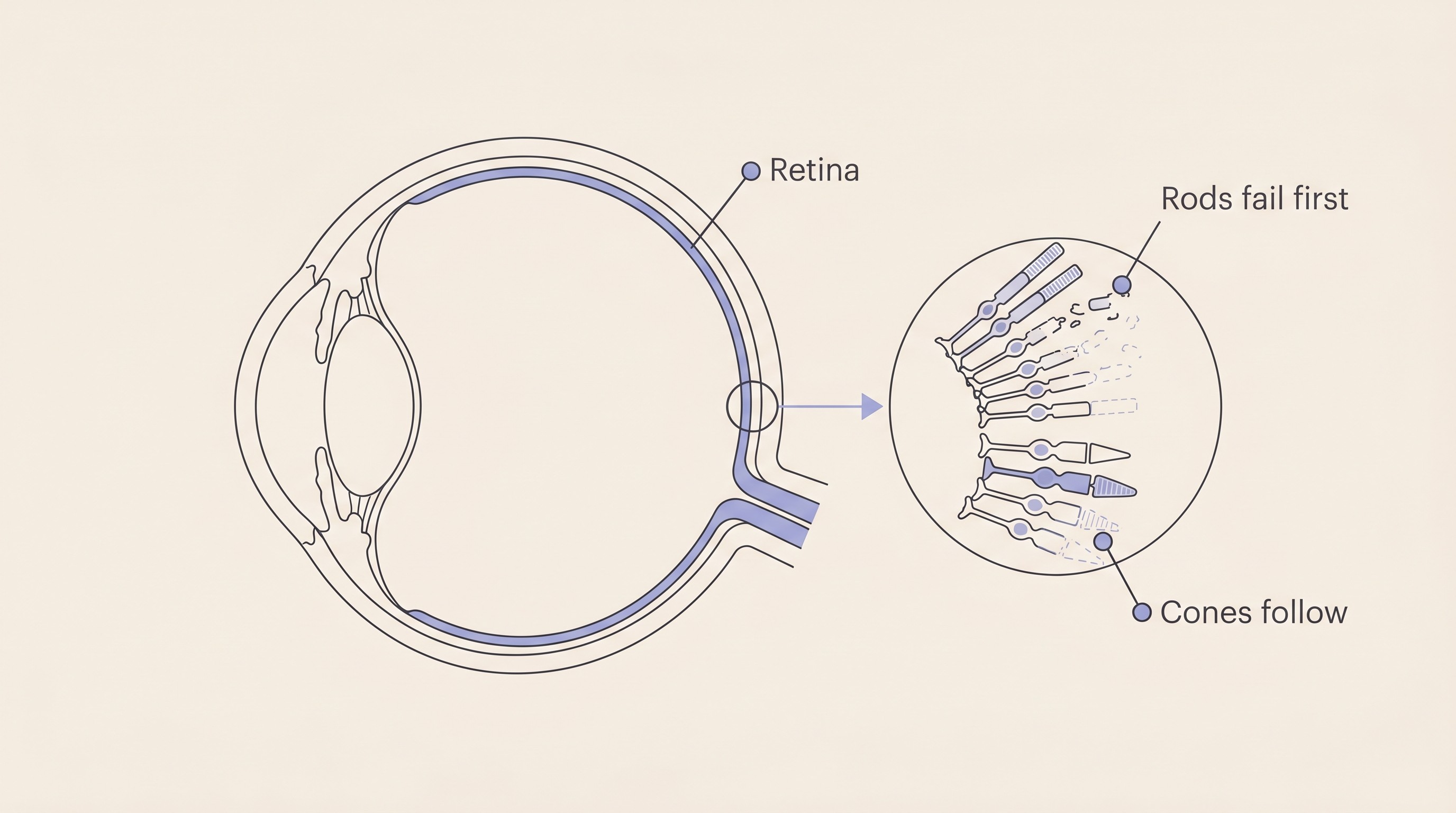
Progressive retinal atrophy is an inherited eye disease in which the light-sensing cells at the back of the eye slowly die, so a dog goes blind gradually, in both eyes, without pain (Dockweiler & Cohen, undated; Beale, 2018). The retina is the layer that turns light into the signal the brain reads as sight, and it holds two kinds of photoreceptor cell: rods, for dim light and movement, and cones, for daylight and detail. In PRA those cells break down over time, "causing vision problems and sometimes blindness" (Royal Kennel Club, undated).
Think of "PRA" as an umbrella term rather than one disease. It covers a family of inherited conditions that all end up in the same place, degeneration of the retina and eventual blindness (Gelatt, 2024). The commonest form has a name you may see written down, progressive rod-cone degeneration, usually shortened to prcd. I'll keep calling it PRA from here, but that's the one most pet dogs have.
Why night vision goes first
If you remember one practical fact from this page, make it this one. In PRA the rods tend to die before the cones, and because rods are the dim-light cells, night vision is almost always the first thing to fade (Dockweiler & Cohen, undated). In prcd specifically, "the rods degenerate first leading to a loss in night vision followed by the cones with a loss of day vision" (Beale, 2018).
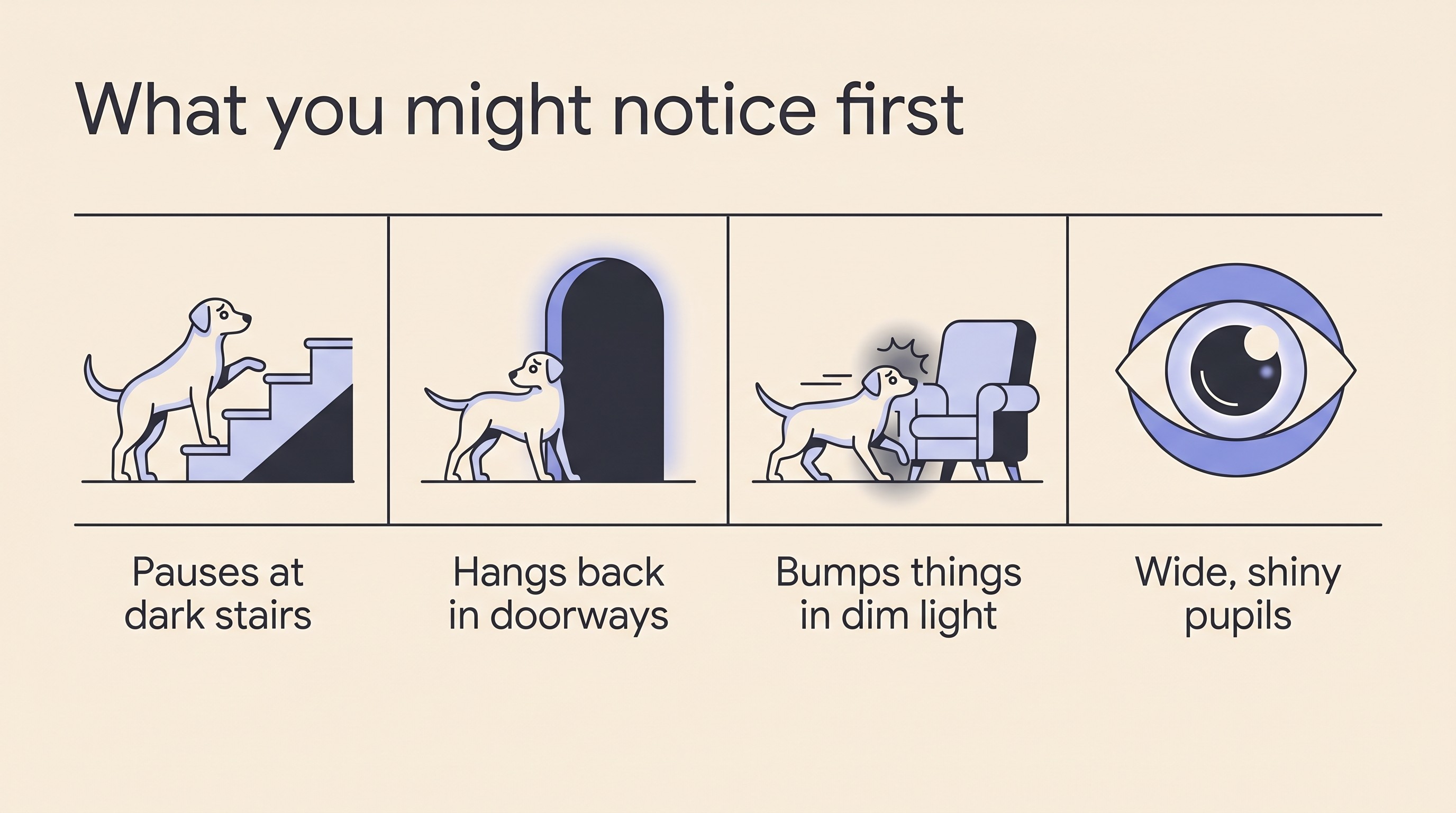
In everyday life that looks like small, easy-to-miss things. A dog that hesitates at the bottom of the stairs at dusk, hangs back rather than trotting out into a dark garden, or bumps about in a dim room while being perfectly fine in daylight. The Kennel Club lists exactly this, "loss of night vision" and a "reluctance to go into darker rooms", as early signs (Royal Kennel Club, undated). The eyes may look different too: a more reflective, almost glassy shine, and pupils that sit wider than they used to, as a failing retina leaves the pupil dilated trying to gather more light (Hunter, Llera & Yuill, undated).
Because none of this hurts, the early stages often slip by, and owners feel they should have spotted it sooner. Please don't. "PRA is not a painful condition, so it is rarely noticed in its earliest stages" (Hunter, Llera & Yuill, undated). A dog losing its sight slowly and silently is doing what dogs do best, compensating, and you are not a bad owner for not seeing through a disguise that good. (For the wider catalogue of failing-vision signs across all causes, the signs of sight loss covers them properly.)
How fast, and in which dogs
Speed varies, and I won't pretend to a precise number. Both eyes are affected, and night blindness "progresses to total blindness over a period ranging from months to years" (Gelatt, 2024; Dockweiler & Cohen, undated). In the common late-onset form a dog often loses most of its vision over roughly one to two years (Hunter, Llera & Yuill, undated), though the exact pace depends on the form and the breed. What's not in doubt is the endpoint, and I'd rather you heard it kindly from me than cold somewhere else: nearly all dogs with PRA do eventually go completely blind (Dockweiler & Cohen, undated).
There are broadly two timing patterns. An uncommon early-onset form shows up in young puppies, sometimes diagnosed at two to three months of age. Far more often it's the late-onset form, which creeps in during adulthood and is usually picked up between about three and nine years old (Hunter, Llera & Yuill, undated). A few breeds run early, Irish Setters, Collies, Norwegian Elkhounds, Miniature Schnauzers and Belgian Sheepdogs among them, while many familiar pet breeds, Poodles, Cocker Spaniels and Labradors, tend toward that adult onset (Gelatt, 2024).
PRA is inherited, and in most breeds it passes down as a simple recessive, which is why it runs in particular breeds and why a perfectly healthy-looking dog can be a hidden carrier. A dog only develops it if it inherits two copies of the faulty gene, one from each parent (Royal Kennel Club, undated; Beale, 2018). The breeds where it's recognised are many, including Poodles, Labrador and Golden Retrievers, English and American Cocker Spaniels, Springer Spaniels, Tibetan Terriers, Irish Setters, Collies and Miniature Schnauzers (Dockweiler & Cohen, undated; Gelatt, 2024; Royal Kennel Club, undated). One striking fact makes PRA feel less random: for the commonest form, a single tiny mutation accounts for the disease across many breeds at once. The landmark study found one mutation showing complete concordance with the disorder in 18 different dog breeds and breed varieties, and the same mutation causes retinitis pigmentosa, the equivalent inherited blindness, in people (Zangerl et al., 2006). So this is one well-understood inherited fault, shared across many breeds, and the canine version of a human eye disease. The full story of carriers, DNA testing and what a result means for an owner or a breeder belongs to PRA, breeds and DNA testing.
Diagnosis is usually made on a careful eye exam of the retina (Dockweiler & Cohen, undated). When the picture is early and subtle, or a cataract is blocking the view, your vet may refer you to an eye specialist for an electroretinogram, or ERG, which measures whether the retina is still responding to light (Gelatt, 2024; Beale, 2018). In plain terms the ERG asks the retina a question with a flash of light and listens for the answer; in PRA it comes back weak or flat (Beale, 2018).
No cure, and why I won't pretend otherwise
There is no treatment that stops or reverses PRA. I'm not going to soften that, because false hope is its own cruelty and it leaves grieving owners exposed to people selling it. "Generally, there is no treatment for PRA" (Beale, 2018); "there is currently no effective treatment available" (Hunter, Llera & Yuill, undated); and while DNA tests now identify carriers and affected dogs before signs appear, no effective treatment exists once the disease is underway (Gelatt, 2024).
A word on supplements, because you will be offered them. Antioxidant products are sometimes suggested for eye health, and Cornell notes that "specific antioxidant supplements may improve retinal function and help to delay the formation of cataracts" (Dockweiler & Cohen, undated). Read that carefully. The evidence behind it is thin and contested, so the fair position is that these products are low-risk but not proven to change the outcome, and they will not save your dog's sight. Discuss them with your own vet by all means, but treat anything sold as a "cure" with real suspicion, and don't spend money you can't afford chasing one. There is genuine science moving forward in the background, including gene therapy that has rescued photoreceptor function in laboratory dogs with a specific inherited form of PRA, work that its authors say opens a path toward treating the human disease, but it is experimental, form-specific, and not something your vet can offer your dog today (Beltran et al., 2012).
When a cataract hides the real problem
One complication causes a lot of confusion. Cataracts, a clouding of the lens, are the most common secondary problem in PRA, and they tend to turn up late in the disease (Beale, 2018). Awkwardly, a cataract sitting in front of an already-failing retina can mask the PRA behind it (Gelatt, 2024), and that's where dogs get the wrong story: the blindness is blamed on the cataract, when the retina behind it has already gone.
This is why, in an at-risk dog, the retina has to be assessed before anyone operates on a cataract. Removing a cloudy lens cannot restore sight that a dead retina can no longer provide, so the surgeon checks retinal function first, usually with an ERG and an ultrasound. I want to be precise rather than absolutist, because "surgery is pointless in PRA" overstates it. In English Cocker Spaniels with suspected PRA, cataract surgery still gave a real benefit, with vision in some dogs for up to two years afterwards, and 92.5% of owners felt their dog's quality of life improved (Koll-Hampp et al., 2019). So what this means in practice is that PRA limits and time-limits what surgery can buy, and the retina must be assessed first, not that surgery can never help. The operate-or-not decision lives in the cataract surgery decision, and the cataract disease itself in cataracts explained.
Where the kindness in this lies
Now the turn, and I mean every word of it. The very thing that makes PRA hard to be told, its slow inevitability, is also its great kindness. Because the loss is gradual and painless, dogs adapt to it astonishingly well. "Most dogs adapt well to their vision loss," and "dogs tend to acclimate well to vision loss, since most cases of PRA progress slowly" (Dockweiler & Cohen, undated). Animals adapt well to losing their sight, especially with help from their owners (Beale, 2018).
The gradualness is the gift. While your dog still has some sight, it's quietly building a mental map of your home and leaning ever harder on its already-superb smell and hearing, so that by the time the sight is gone the dog is, in a sense, most of the way to coping. This is a world apart from a dog that goes blind overnight. Unlike sudden acquired retinal degeneration syndrome (SARDS), which strikes out of nowhere over days, PRA fades over months to years, and that runway is everything (the SARDS guide covers that contrast if you're weighing the two).
One practical point underpins everything else, then I'll hand you on. A blind or low-vision dog navigates a familiar home beautifully, as long as you don't rearrange it. Dogs with failing sight "are able to move around well in their home environment, as long as furniture and other objects are not moved around" (Hunter, Llera & Yuill, undated). Keep the layout stable, keep the water bowl where it's always been, and a stair gate or two earns its keep. The full home-setup and communication how-to belongs to the living-with cluster, starting with home-proofing for a blind dog.
What you have that other owners don't is time, and the best thing you can do is use it. Because PRA declines over months to years, it suits gentle tracking, and our At-Home Vision Check is built for exactly this: a quick, repeatable check to watch how your dog navigates, catch the night-first changes early, and see the trend rather than panic over a single bad evening. The mindset of adapting early, of treating the runway as an advantage rather than a countdown, is its own subject in preparing for blindness. When your dog's sight does eventually go, the newly blind first 30 days walks you through the practical onboarding step by step.
References
- Beale, B. (2018). PRA (Progressive Retinal Atrophy). American College of Veterinary Ophthalmologists (ACVO), Common Conditions.
- Beltran, W. A., Cideciyan, A. V., Lewin, A. S., Iwabe, S., Khanna, H., Sumaroka, A., Chiodo, V. A., Fajardo, D. S., Román, A. J., Deng, W.-T., Swider, M., Komáromy, A. M., Hauswirth, W. W., Jacobson, S. G., & Aguirre, G. D. (2012). Gene therapy rescues photoreceptor blindness in dogs and paves the way for treating human X-linked retinitis pigmentosa. Proceedings of the National Academy of Sciences (PNAS), 109(6), 2132-2137.
- Dockweiler, J., & Cohen, A. (undated). Progressive retinal atrophy. Cornell University College of Veterinary Medicine, Richard P. Riney Canine Health Center.
- Gelatt, K. N. (2024). Disorders of the Retina, Choroid, and Optic Disk (Ocular Fundus) in Dogs. MSD Veterinary Manual, Pet Owner Version.
- Hunter, T., Llera, R., & Yuill, C. (undated). Progressive Retinal Atrophy in Dogs. VCA Animal Hospitals, Know Your Pet.
- Koll-Hampp, S., Enache, A. E., Fenollosa-Romero, E., Chang, Y. M., Busse, C., Oliver, J., Dawson, C., & Matas Riera, M. (2019). Visual outcome following phacoemulsification in English Cocker Spaniels with suspected progressive retinal atrophy: A retrospective multicenter study of 54 cases (2002-2017). Veterinary Ophthalmology, 22(5), 591-599.
- Royal Kennel Club. (undated). PRA disease in dogs. Health A-Z.
- Zangerl, B., Goldstein, O., Philp, A. R., Lindauer, S. J. P., Pearce-Kelling, S. E., Mullins, R. F., Graphodatsky, A. S., Ripoll, D., Felix, J. S., Stone, E. M., Acland, G. M., & Aguirre, G. D. (2006). Identical mutation in a novel retinal gene causes progressive rod-cone degeneration (prcd) in dogs and retinitis pigmentosa in man. Genomics, 88(5), 551-563.
Keep track of how your pet is doing
The owners who cope best are the ones who notice changes early. A simple health log shows you what is working, and what is not, before the next vet visit.
Start tracking, freeYou're not doing this alone
Compare treatment journeys and talk to owners managing vision & eye health. Free to join.
Join PetsLikeMine