

Preparing for Blindness When You Know It's Coming
Alastair Greenway
BVM&S MRCVS
A diagnosis like progressive retinal atrophy, or a slowly thickening cataract, lands hard. Someone has told you, in so many words, that your dog or cat is going to lose their sight over the coming year or two, and there's no operation or eye drop that will stop it. A few days on from that conversation, the floor can still feel like it's gone from under you, and that makes complete sense.
So let me say this as a clinical fact, not a kindness. You have something the owners I worry about most never get. You have time. The dog whose retina fails overnight, the cat blinded by a blood-pressure crisis in a weekend, those owners are thrown into the deep end with no warning at all. You've been handed a runway, and a pet uses every inch of it to adapt so quietly you may struggle to tell the day the lights finally go out. The job now is to use that runway well.
Why the slowness is on your side
Progressive retinal atrophy takes its time. It's a non-painful condition that tends to progress slowly, usually over one to two years, with night vision going first because the rod cells fail before the cones (Cornell Riney Canine Health Center, n.d.; Gibeault, 2023). The disease itself, the inheritance, why there's no treatment yet and why you should be wary of anyone selling a cure, belongs to progressive retinal atrophy. Slowly maturing cataracts can follow a similarly unhurried path. What matters here is the consequence of that slowness, because it changes what you do next.
A pet losing sight gradually doesn't experience a sudden catastrophe. It experiences a slow handover, leaning a little more each day on its nose and ears, quietly memorising the shape of your home. That's why the reassurance from the experts is so consistent. Many dogs adapt remarkably well to gradual vision loss and go on to live happy, fulfilling lives with some adjustments (University of Pennsylvania Ryan Veterinary Hospital, n.d.). For the average family dog, blindness simply isn't the catastrophe it is for a person, because dogs lean so heavily on smell and sound that they get about fairly well without much sight at all (Gibeault, 2023). Vision, for a dog, sits third behind smell and hearing rather than first (Brooks, n.d.). And the slowness softens the blow further: the behaviour changes can be too subtle to notice until the pet is essentially blind already (Best Friends Animal Society, n.d.). They have a lot of spare navigation built in, and your job this year is to help them lay it down on the safe, final version of your home.
I want to be straight rather than glib, though. "They adapt well" is true, and it isn't the same as "this is nothing". It's a real loss, you're allowed to grieve it, and there's work to do. The work is small, and you can start today.
Teach the cues now, while they can still watch you
If you do only one thing with the runway, do this. Start teaching your pet the words they'll navigate by later, now, while they can still see you doing it.
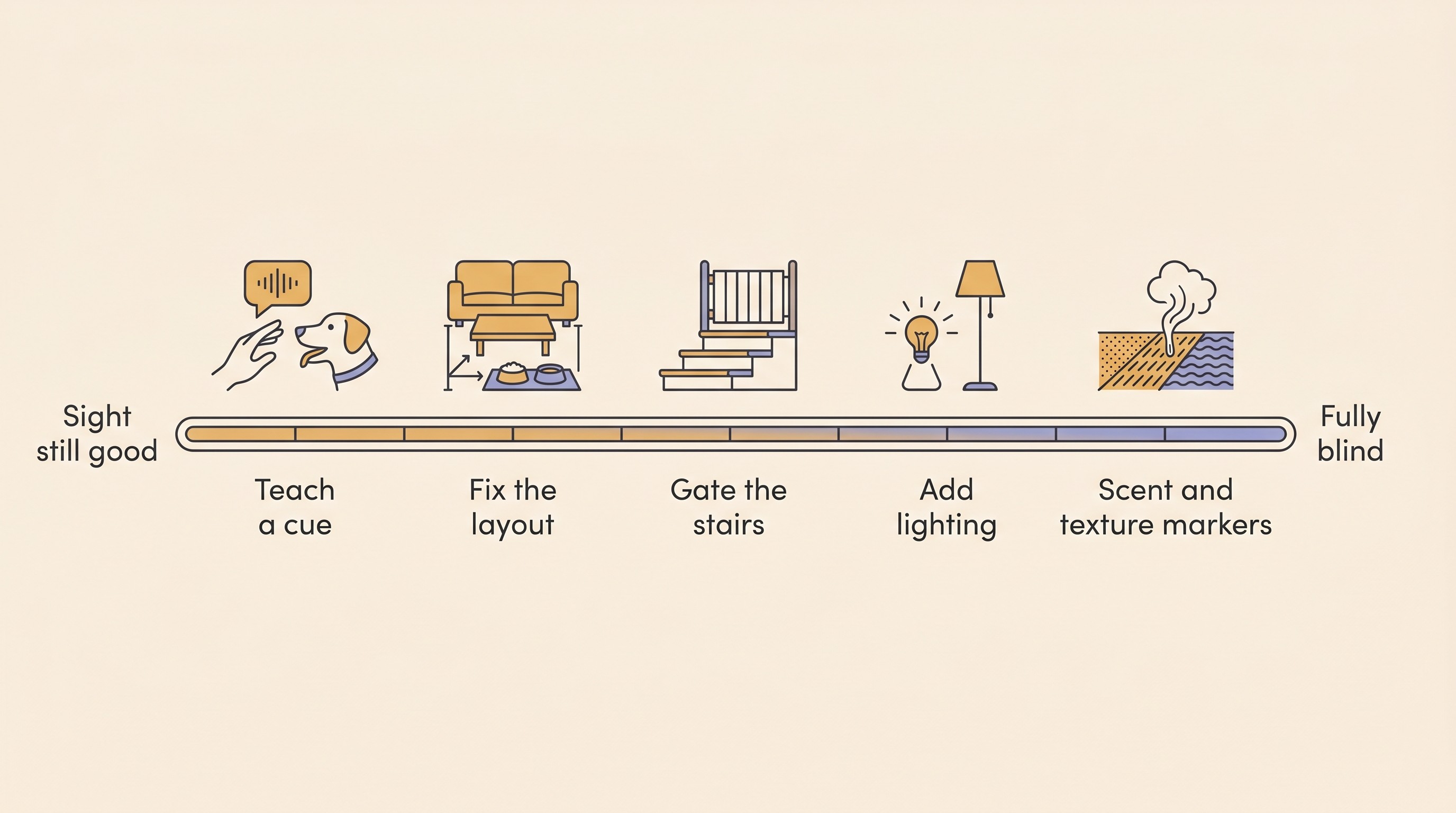
This isn't a lifestyle tip, it's named clinical management. Recommended care for a pet on the path to blindness from PRA explicitly includes training with verbal commands prior to vision loss (Cornell Riney Canine Health Center, n.d.). The cues blind pets come to rely on are short and consistent: "watch" to mean turn and avoid something, "step up" and "step down" for kerbs and stairs (Best Friends Animal Society, n.d.). The point is the timing. A dog who already knows "wait" or "step" as a sighted dog keeps that word as a lifeline once the picture goes. Knowing the loss is coming is a genuine opportunity to teach vocal commands instead of hand signals while your pet can still see you (Brooks, n.d.). So pair the words with the actions today, on your normal walks and at your normal doorways, long before they're strictly needed.
I won't write you the full vocabulary here, because it has its own piece. The complete command list and the talk-before-you-touch approach, including getting the whole household using the same words, live in communicating with a blind pet. Start the habit now; learn the detail there.
Lock in the map while it's still being drawn
The second job is to settle your home before your pet finishes memorising it, because once sight is gone they navigate almost entirely by a mental map. The advice is blunt and it matters: don't move the furniture around much, because your pet will build a mental map and move through the house remarkably well once they've adjusted (Donohue, 2025; Best Friends Animal Society, n.d.). Keeping the furniture in the same arrangement, and using safety gates to block access to stairs, are named parts of the recommended plan, and environmental consistency for a visually impaired pet is, as the phrase goes, paramount for their safety and security (Cornell Riney Canine Health Center, n.d.; Gibeault, 2023).
The prepare-early angle is what makes this powerful. Now, while the map is still being learned, is the moment to decide where the sofa lives for the next few years, fix the food and water bowls in one spot, settle the bed and the litter tray, gate the top of the stairs and fence off the pond. Do it now and the map your pet is committing to memory is already the safe, final one. Leave it and you're asking them to relearn the house blind.
A couple of navigation aids are worth getting in early too. Carpet runners near stairs or at the threshold of a room give useful tactile feedback underfoot, and subtle, pet-safe scent cues can tell a pet which space they're in (Donohue, 2025; Best Friends Animal Society, n.d.). Introduce these while your pet can still see and sniff them, so the association is already laid down. Lighting matters as well, with a real reason to act early: in true PRA, dim-light vision fades first, which the validated owner vision questionnaire confirms shows up as struggles in the dark before bright daylight does (Cornell Riney Canine Health Center, n.d.; Rogers et al., 2023). Adding supplemental lighting inside and out may help in those early stages when only night vision is affected (Cornell Riney Canine Health Center, n.d.), buying useful months of confidence on the stairs and in the garden at dusk.
The room-by-room home-proofing playbook, the full hazard list, exactly where to put the markers, and the rule about not carrying them everywhere, all of that is owned by home-proofing your blind pet. Treat this article as the "do it now" nudge and that one as the manual.
Keep their confidence up, don't wrap them in cotton wool
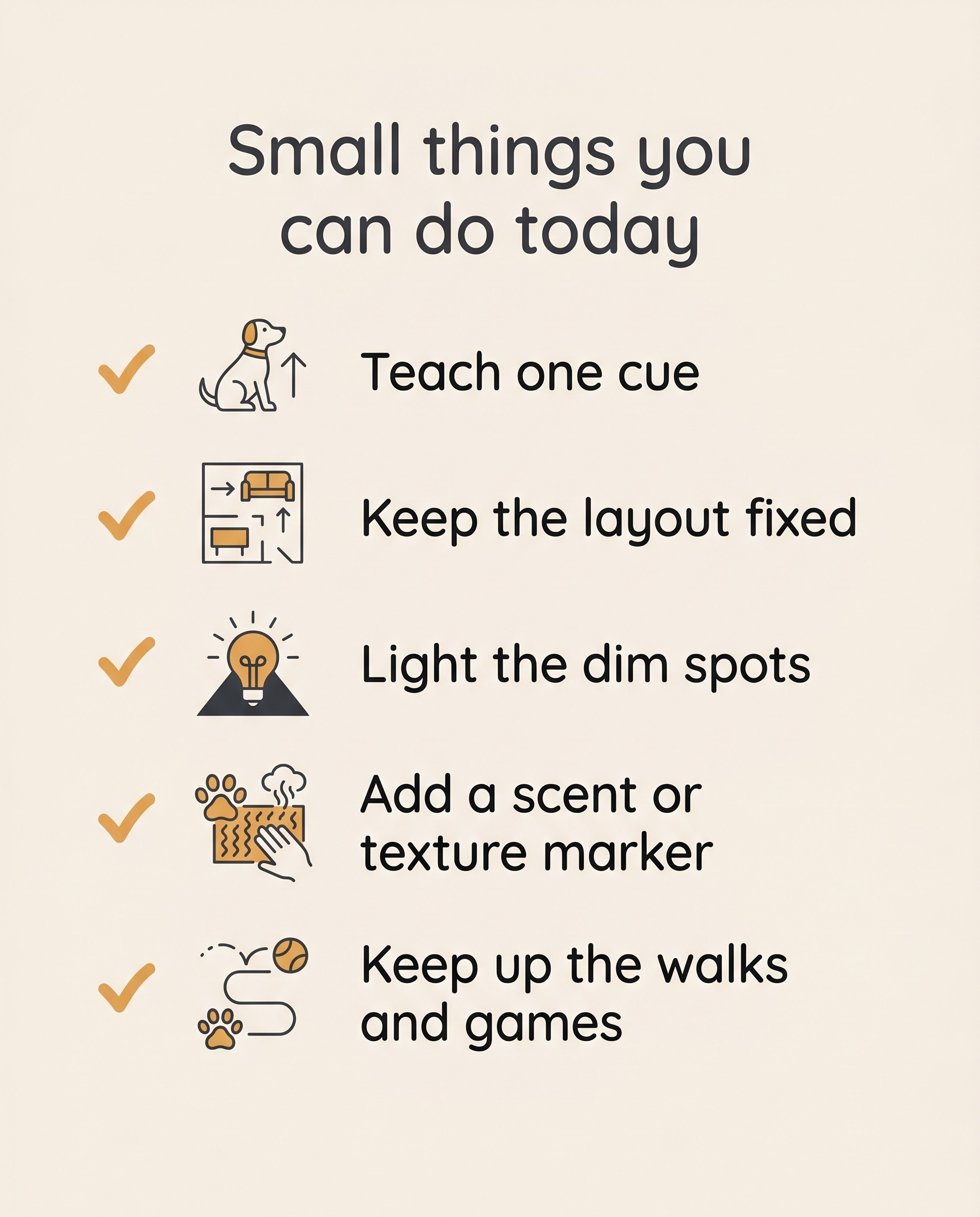
There's a temptation, once you know what's coming, to start protecting your pet from everything. Resist it. A pet that walks confidently into blindness adapts better than one already made anxious and housebound before they've lost a single thing. The advice from the people who do this for a living is to keep going: even when a pet goes blind, keep up all their favourite activities and simply adjust them (Donohue, 2025). Keep the familiar walks, keep the games. Nose work and scent games are especially worth building in early, partly because a blind pet can still do them brilliantly, and partly because they actively develop self-confidence (Best Friends Animal Society, n.d.). The outdoor side, the lead-work and telling the world, has its own piece in blind pets out and about. For now, the principle is just to keep them busy and bold.
Let yourself grieve the runway too
One more thing, and it's the one owners rarely give themselves permission for. The runway isn't only for preparing the house. It's for grieving, early, before the sight has even gone. Caring for a pet you know is heading for blindness is a genuine emotional load, and you're far from alone in finding it heavy. In the research on caregiver burden, roughly half of owners caring for a seriously ill companion animal show a measurable rise in burden, which tracks with real signs of low mood, and owners of a chronically ill pet are about twice as likely to report depression and high stress as owners of a healthy pet (Spitznagel et al., 2019). I share that to take the shame out of how you might be feeling. Anxiety and sadness that arrive ahead of the loss are a normal response to hard news, not a sign you're coping badly. PRA is sight loss, by the way, not a terminal illness. Your pet isn't dying, and that's worth holding onto.
Then balance it with the thing I see again and again in the consulting room. The dread is almost always worse than the reality. Most owners find the adaptation gentler than they feared, the pet settling within a few months and getting back to normal life (Donohue, 2025). When the sight finally goes, you won't be starting from scratch and frightened. You'll already have done the work. The cues will be in place, the house will be safe, and you'll be looking at the same pet you've always had, who now needs you to say their name before you touch them. When that day arrives, the first 30 days with a newly blind pet is the piece that will walk you through it.
A word for cat owners before I close: this plan applies to you too. A cat heading gradually into blindness adapts at least as readily as a dog, on the same playbook. Keep the cat-tree and litter-tray layout fixed, mind the high jumps and the balcony, and lean on those whiskers and that nose, with the cat-specific detail in blind cats. One caveat, though: this article is about the slow, known-it's-coming kind of blindness. A cat who loses sight suddenly, over a day or two, is a different and urgent story, usually about blood pressure, and needs a vet today (see sudden blindness, what to do).
So, starting this week: pick one cue and begin pairing the word with the action on your normal walks. Decide where the furniture lives for the next few years and leave it there. Light the dim corners and gate the stairs. Then let the rate of your pet's sight loss set the pace of the rest. Our at-home vision check lets you gently track where their vision is now and watch it change over the months ahead, so you can time the next light, the next cue and the next adjustment to what's actually happening rather than to your worst fears.
References
- Best Friends Animal Society. (n.d.). Blind dog and blind cat care.
- Brooks, W. C. (n.d.). Progressive retinal atrophy (PRA) in dogs. Veterinary Partner / VIN.
- Cornell Riney Canine Health Center. (n.d.). Progressive retinal atrophy. Cornell University College of Veterinary Medicine.
- Donohue, L. (2025, September 4). Seeing the bright side: Helping pets adjust to vision loss. Texas A&M School of Veterinary Medicine & Biomedical Sciences, VMBS News.
- Gibeault, S. (2023, August 22). Progressive retinal atrophy (PRA) in dogs: What to know. American Kennel Club.
- Rogers, C. M., Salzman, M. M., Li, Z., Merten, N., Russell, L. J., Lillesand, H. K., & Mowat, F. M. (2023). Subjective vision assessment in companion dogs using dogVLQ demonstrates age-associated visual dysfunction. Frontiers in Veterinary Science, 10, 1244518.
- Spitznagel, M. B., Mueller, M. K., Fraychak, T., Hoffman, A. M., & Carlson, M. D. (2019). Validation of an abbreviated instrument to assess veterinary client caregiver burden. Journal of Veterinary Internal Medicine, 33(3), 1251-1259.
Keep track of how your pet is doing
The owners who cope best are the ones who notice changes early. A simple health log shows you what is working, and what is not, before the next vet visit.
Start tracking, freeYou're not doing this alone
Compare treatment journeys and talk to owners managing vision & eye health. Free to join.
Join PetsLikeMine