

PRA and Your Breed: DNA Testing and What It Means
Alastair Greenway
BVM&S MRCVS
The most common question I get about PRA rarely comes from someone whose dog is already losing its sight. It comes from someone holding a puppy's paperwork, or thinking about a litter, reading the phrase "PRA clear" or "carrier" and quietly panicking. "My breeder says the puppy is clear, does that mean it can't go blind?" Or the other version, the one with a lump in the throat: "The test came back carrier. Have I bought a dog that's going to go blind?"
Both deserve plain answers, because the pages that explain DNA testing are almost all written for breeders, in breeder language, and leave a worried owner none the wiser. If you want the disease itself, what progressive retinal atrophy is, how it takes the night vision first, why it's painless, that's all in progressive retinal atrophy. This piece is about the genetics and the testing: why a test exists, what a result actually means for your dog, and where the test quietly falls short.
Why there's a DNA test at all
One thing has to land before any of the rest makes sense. PRA isn't one disease. It's a whole family of inherited retinal degenerations, and that single fact shapes everything about testing. More than twenty different mutations, across a number of different genes, are known to cause PRA in dogs, and the disease "displays significant genetic heterogeneity within as well as between breeds" (Downs et al., 2014). In other words there is no one universal "PRA test", because there's no one PRA. Each DNA test looks for one specific, known mutation.
Most of the common, testable forms follow a simple inheritance pattern: a single autosomal recessive gene. That's the bit of jargon worth unpicking, because it's the whole reason a clear/carrier/affected test is even possible. Recessive means a dog needs two copies of the faulty gene, one from each parent, before the disease shows up. One copy on its own does nothing to the dog's own eyes (Cornell Riney Canine Health Center, n.d.; The Kennel Club, n.d.). The single commonest form, with the unlovely name progressive rod-cone degeneration, or prcd, works exactly this way and "requires two copies to cause disease" (Cornell Riney Canine Health Center, n.d.; Zangerl et al., 2006).
That prcd mutation is also why "the PRA test" feels like a single famous thing even though PRA is a family. One tiny change in one gene turned up across a remarkable spread of breeds, eighteen of them in the original description, and the identical fault causes a form of inherited blindness in people too (Zangerl et al., 2006). Reputable labs now list the prcd test as relevant to well over forty breeds (Embark, n.d.). So when an owner says "my breed has the PRA test", they almost always mean the prcd test, one mutation that happens to be shared very widely. Useful to know, as long as you remember it's still only one of the PRA mutations out there.
What the three results actually mean
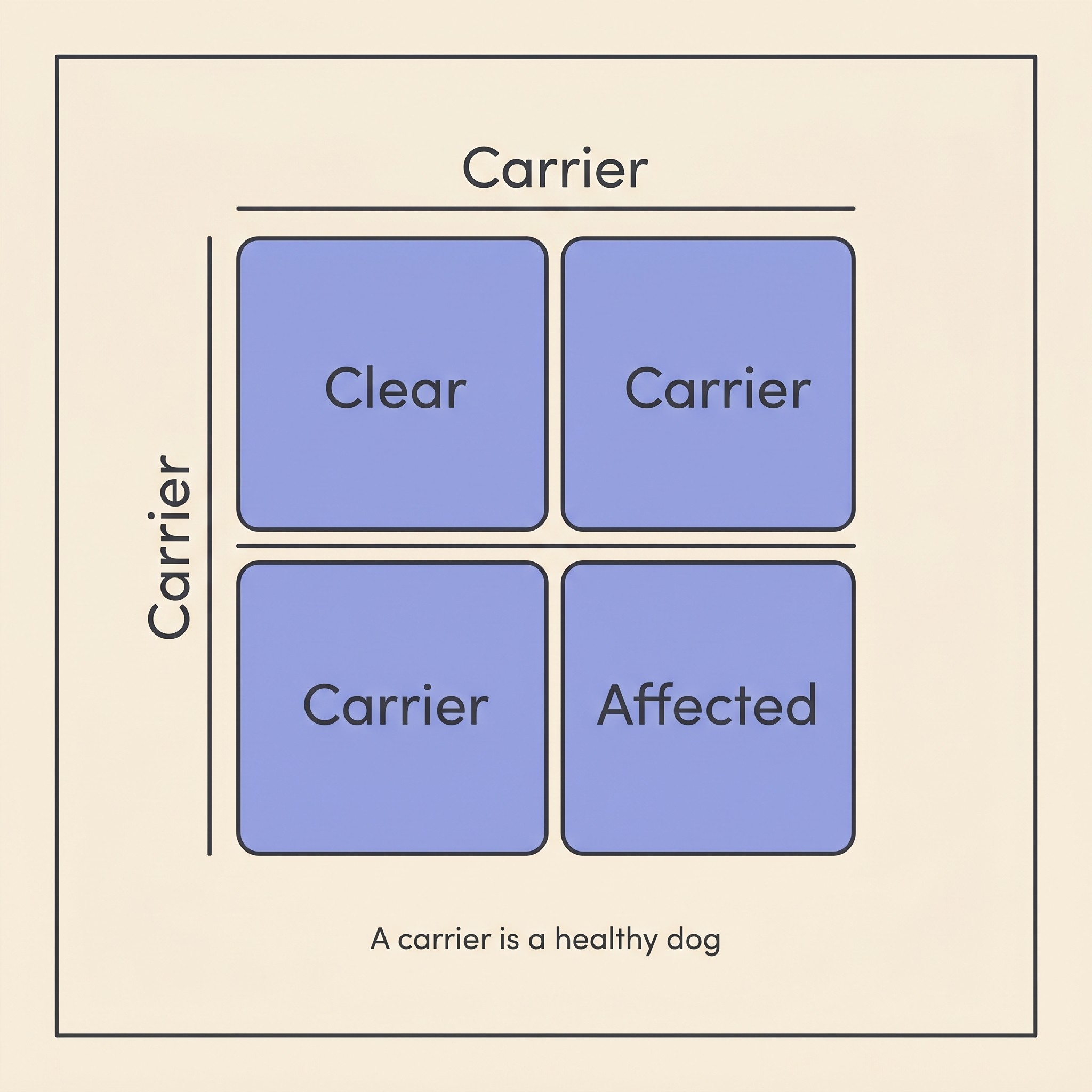
This is the part owners come for, so let me keep it concrete and use the UK Kennel Club's own wording. A DNA test sorts a dog into one of three boxes.
A clear dog has "no copies of the abnormal gene", is "highly unlikely to develop this condition", and passes only a normal copy to its puppies. A carrier has "one copy of the normal gene and one copy of the abnormal gene", is also "highly unlikely to develop this condition", and may pass on either copy. An affected dog has "two copies of the abnormal gene" and "will likely be affected by the disorder" (The Kennel Club, n.d.).
A carrier will not go blind from the gene it carries. It's a healthy dog with normal eyes that simply happens to carry one copy it could pass on. If your puppy's result says carrier, you have not bought a dog that's going to lose its sight to this. The only thing a carrier result tells you is something about that dog's future puppies, which matters a great deal to a breeder and not at all to most pet owners.
What the marketing page leaves out
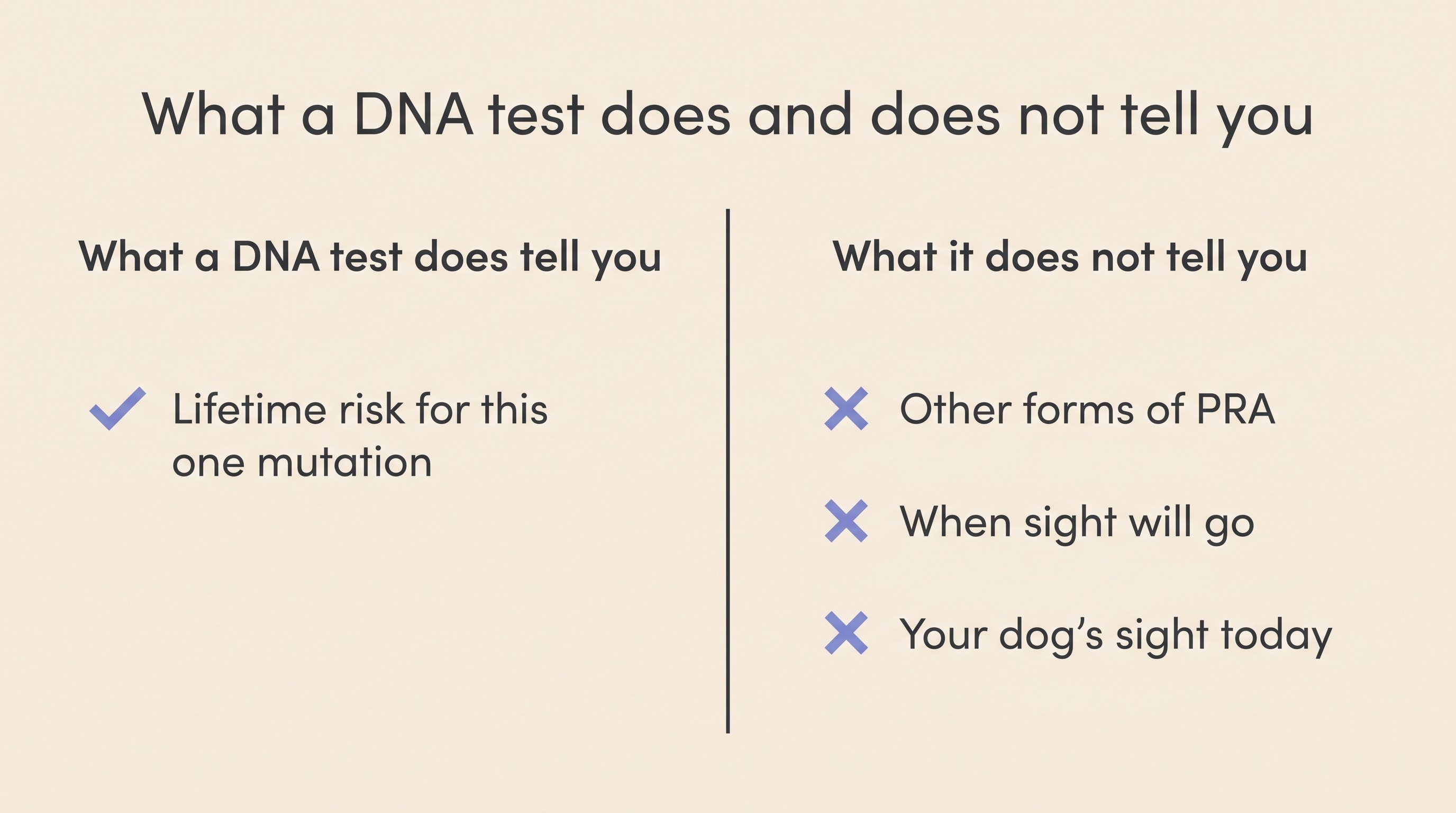
A clear DNA result is reassurance about one mutation. It is not a guarantee against every form of PRA.
I don't say that to undermine the test, which is genuinely useful. I say it because owners are handed a "clear" certificate and reasonably assume it means "this dog cannot get PRA", and that is a step further than the test can actually go. The evidence here is solid. When researchers screened 231 dogs that had PRA, across 36 breeds, for 17 different known mutations, they found that in most of the breeds where a PRA mutation is known to occur (15 of 21), some affected dogs carried none of the tested mutations (Downs et al., 2014). Their sight was being destroyed by some other form, untested or not yet discovered. So a clear result for, say, prcd genuinely lowers the odds, but it cannot promise that a breed-specific or as-yet-unknown form won't appear.
The Golden Retriever is the cleanest real-world example. At least three genetically distinct forms of PRA occur in the breed: prcd, plus two others known as GR_PRA1 and GR_PRA2, sitting in entirely different genes. When that third form, GR_PRA2, was identified in 2014 it turned out to account for roughly 30% of PRA cases in the breed, a substantial slice that no existing test could pick up until that point, and the authors noted that "genetically distinct forms of PRA may have different clinical characteristics such as rate of progression and age of onset" (Downs et al., 2014b). So a Golden that tested clear on the tests available before 2014 could still be carrying a third form nobody could yet test for. That isn't a flaw in the testing, it's just the reality of a disease with many genetic causes, and it's exactly why "clear for the test" can't mean "clear for everything".
Two more caveats belong here. Not every breed has a test at all yet, because not every breed's mutation has been found. And a DNA test never tells you about today: it's a lifetime risk statement, not a snapshot of your dog's current sight. An affected result means the dog is expected to develop PRA over its life, but for a late-onset form like prcd that typically means signs appearing somewhere around three to five years of age and progressing from there, not blindness this afternoon (UC Davis VGL, n.d.; GenSol Diagnostics, n.d.). To actually measure how your dog is seeing, and track it as the years go by, that's what a vet's examination and the at-home vision check are for. The DNA test predicts the future; the vision check watches the present.
What it means for you (owner or breeder)
These two readers want quite different things from a result, so let me split them.
If you're a pet owner, the value of testing is mostly foreknowledge, and that's worth more than it sounds. There's no treatment that stops or reverses PRA (Cornell Riney Canine Health Center, n.d.), so a positive result doesn't unlock a cure or a medical to-do list. What it unlocks is time. Because PRA is so gradual, an owner who knows it's coming can keep the home layout stable, build a vision-check baseline, and sidestep the awful shock of a "sudden" blindness that was really slow all along. That mindset, adapting early while you have the runway, is its own subject, and a hopeful one, in preparing for blindness. For a pet owner, think of testing as peace of mind plus a head start, not an alarm bell.
If you're breeding, the test earns its keep differently: it exists to stop affected puppies being born. The rule is genuinely simple. Never pair two carriers, and never pair a carrier with an affected dog. Two carriers bred together give, on average, a one-in-four chance that each puppy is affected (UC Davis VGL, n.d.; The Kennel Club, n.d.). But, and this matters for the gene pool, a carrier is not a dog to be thrown out of breeding. The Kennel Club's advice is that a carrier "can be used for mating, so long as they are only mated to clear dogs", which keeps a valued dog and its other qualities in the breed while guaranteeing no affected puppies (The Kennel Club, n.d.). Removing every carrier would do more harm than good by shrinking genetic diversity. The test lets you breed around the gene, not cull it.
Testing in the UK, kept concrete
Say you do test. Here's how it works in practice in the UK, and one distinction worth getting straight. Record your result with the Kennel Club, which accepts DNA results from laboratories meeting its criteria (recognised options include the Kennel Club's own service, Laboklin and Paw Print Genetics, among others), and find which tests actually apply to your breed through the Kennel Club's "Breeds A to Z" (The Kennel Club, n.d.).
Owners trip over one distinction constantly. A DNA test is not the same as an eye test. Separate from the genetics, the BVA/KC/ISDS Eye Scheme is a clinical examination, a panel of expert veterinary ophthalmologists (42 of them around the UK) actually looking into the eye to spot inherited and other conditions (BVA, n.d.). The two aren't rivals, they're complementary: "the parallel and complimentary use of DNA tests, when they are available, enables breeders to devise safe breeding programmes for single gene mutations" (The Royal Kennel Club, n.d.). So a DNA test reads the genes and gives a lifetime risk; the eye scheme is a vet examining the actual eye on the day. You may well want both, and they answer different questions. (For what other inherited eye conditions your breed might be screened for beyond PRA, that round-up lives in other inherited eye conditions.)
Where this leaves you
So, back to the owner in the doorway with the paperwork. A carrier dog is a healthy dog, and it will not go blind from being a carrier. An affected dog will lose its sight, but gradually and painlessly, with no red, sore, frightening eye to watch along the way, and dogs adapt to that kind of slow change remarkably well, far better than we expect them to. A positive result is the start of quiet preparation, not a tragedy, and the practical side of helping a dog through it is waiting in the living-with cluster whenever you need it.
And if you're choosing a puppy of an at-risk breed, the single most useful question isn't really "is this puppy tested?" It's "are the parents tested, and was a two-carrier pairing avoided?" Get a straight answer to that, and you'll know far more about your puppy's eyes than any single certificate can tell you.
References
- Downs, L. M., Hitti, R., Pregnolato, S., & Mellersh, C. S. (2014). Genetic screening for PRA-associated mutations in multiple dog breeds shows that PRA is heterogeneous within and between breeds. Veterinary Ophthalmology, 17(2), 126-130.
- Downs, L. M., Wallin-Håkansson, B., Bergström, T., & Mellersh, C. S. (2014b). A novel mutation in TTC8 is associated with progressive retinal atrophy in the golden retriever. Canine Genetics and Epidemiology, 1, 4.
- Zangerl, B., Goldstein, O., Philp, A. R., Lindauer, S. J., Pearce-Kelling, S. E., Mullins, R. F., Graphodatsky, A. S., Ripoll, D., Felix, J. S., Stone, E. M., Acland, G. M., & Aguirre, G. D. (2006). Identical mutation in a novel retinal gene causes progressive rod-cone degeneration in dogs and retinitis pigmentosa in humans. Genomics, 88(5), 551-563.
- The Kennel Club (Royal Kennel Club). (n.d.). Breeding advice for DNA test results.
- The Royal Kennel Club. (n.d.). Eye screening scheme.
- British Veterinary Association. (n.d.). Eye scheme (BVA/KC/ISDS Hereditary Eye Disease Scheme).
- Cornell University College of Veterinary Medicine, Riney Canine Health Center. (n.d.). Progressive retinal atrophy.
- Embark Veterinary. (n.d.). Progressive retinal atrophy, progressive rod-cone degeneration (PRA-prcd).
- GenSol Diagnostics. (n.d.). Progressive rod-cone degeneration (PRA-PRCD).
- University of California, Davis, Veterinary Genetics Laboratory. (n.d.). Progressive rod-cone degeneration (PRA-prcd).
Keep track of how your pet is doing
The owners who cope best are the ones who notice changes early. A simple health log shows you what is working, and what is not, before the next vet visit.
Start tracking, freeYou're not doing this alone
Compare treatment journeys and talk to owners managing vision & eye health. Free to join.
Join PetsLikeMine