

Red, Painful or Squinting Eye: What It Might Be and How Urgent
Alastair Greenway
BVM&S MRCVS
A sore eye, half-shut and weepy and a bit pink, raises one practical question above all others: is this a "ring first thing tomorrow" or a "get in the car now"? Of all the things owners try to judge from the sofa, a red eye is one of the genuinely hard ones. It can look alarming when it's nothing much, and almost ordinary when it's serious.
"Red eye" isn't a diagnosis. It's a single symptom sitting on top of several very different conditions, some trivial and one or two able to cost an eye if they're left. And here's the catch: you cannot reliably tell them apart by looking at home, and neither can I down a phone line. What separates a mild surface irritation from a sight-threatening problem inside the eye is found on an exam, with a tear-test strip, a stain and a pressure reading (Laminack, Myrna & Moore, 2013). When a red eye also carries real pain, cloudiness or any change in vision, the safe move is to be seen today, because the eye gives you very little time when it's the serious end.
The reassuring part is that most red eyes are not the serious end. So let me show you the landscape, while we hold that "get it looked at" default.
Four problems that wear the same red
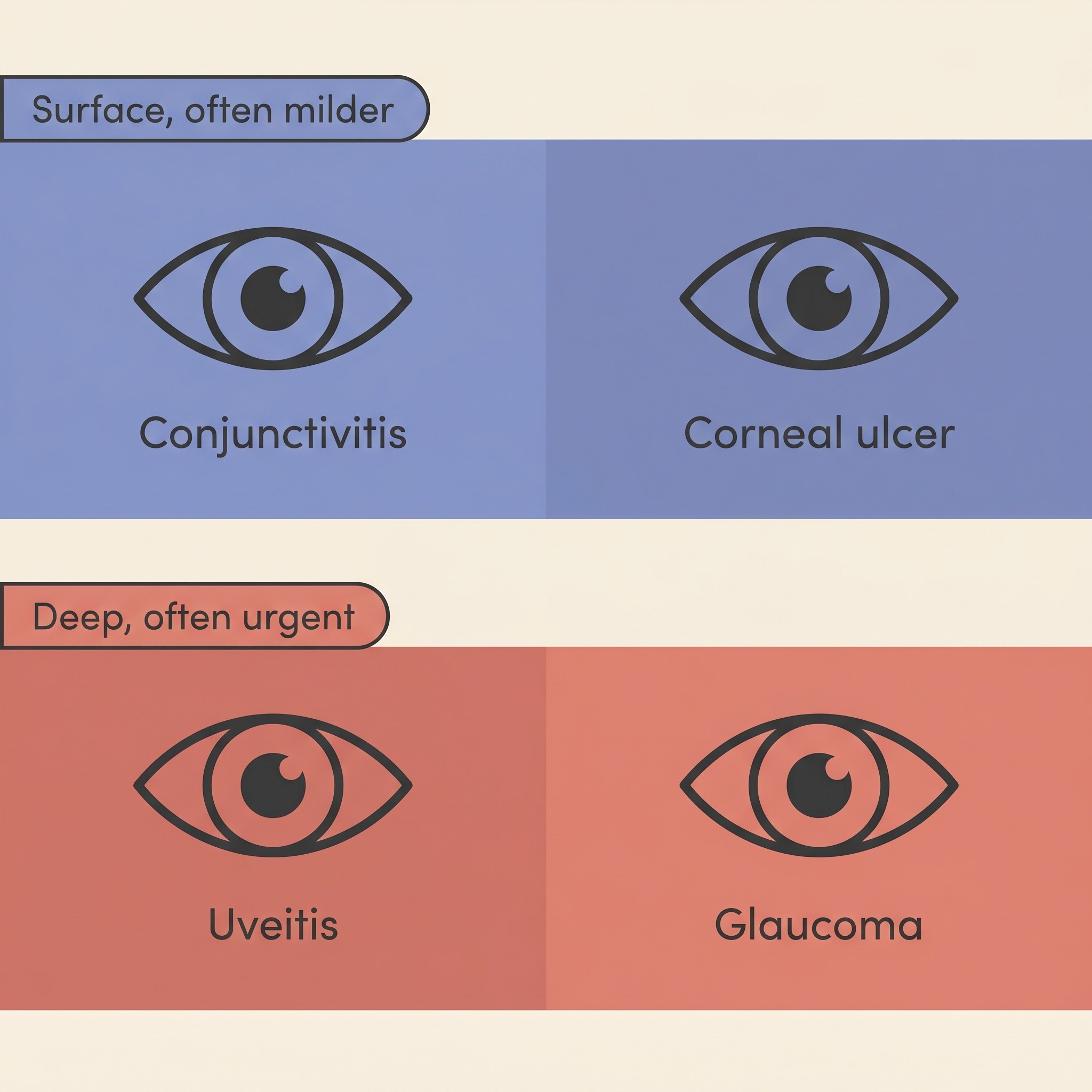
When a vet looks at a red eye, we're sorting it into one of four buckets, and three of those four are the ones we actively hunt for because they can threaten sight (Laminack, Myrna & Moore, 2013).
Conjunctivitis is the mild end, and the most common. It's inflammation of the pink membrane lining the lids and the white of the eye, the surface rather than the depths. In cats it's the single most frequent eye problem there is, usually infectious: the feline herpesvirus, calicivirus, or the bacteria chlamydophila or mycoplasma (Cornell Feline Health Center). A cat with a pink, watery, slightly squinty eye is very often dealing with exactly this. It still warrants a check, and Cornell put the reason plainly: see a vet for a cat with eye discomfort and discharge precisely to rule out the more serious disorders (Cornell Feline Health Center). There's a trap here that catches careful owners out. Subtle, early uveitis can cause only mild redness and look for all the world like simple conjunctivitis, which is exactly why the textbooks warn vets not to mistake one for the other (Laminack, Myrna & Moore, 2013). The pink eye that looks like nothing is occasionally the one that needs the most attention.
A corneal ulcer is a breach in the clear window at the front of the eye, and these hurt. You'll often see hard squinting, redness, tearing, sometimes a dull or bluish spot, and a pet pawing at it. Superficial scratches usually heal well with prompt, simple treatment. The deep ones are what I want you to take seriously: a deep ulcer can erode until the eye is a surgical emergency, fragile enough that a perforation lets the fluid leak out and causes irreparable, blinding damage (Merck/MSD Veterinary Manual). The pace is the part owners don't expect. A so-called melting ulcer, where bacteria and the body's own white cells release enzymes that digest the cornea, can go from a normal-looking surface to a perforated eye in twenty-four hours (Perth Eye Vet). That's why a markedly painful, squinting, cloudy-spotted eye is a same-day job, not a wait-and-watch.
Anterior uveitis is inflammation inside the eye itself, in the iris and the structures around it. This is the quiet, important one, because a red painful eye can be the first sign that something is wrong in the whole body. Its signs include squinting, light sensitivity, a bloodshot look, a constricted pupil and, tellingly, a low pressure inside the eye (Allbaugh, 2019). The causes are, in the words of the literature, numerous and often elusive, so a vet frequently runs blood tests to hunt for a driver, especially in cats, where the work-up screens for things like feline leukaemia and FIV, coronavirus, toxoplasma, bartonella and fungal disease (Allbaugh, 2019). Left uncontrolled, uveitis can itself lead on to cataracts, glaucoma, pain and loss of vision (Allbaugh, 2019). It's very much a "look further" diagnosis, and the full systemic picture lives in uveitis.
Glaucoma is the one I most need you to know about, because it's the red painful eye that is a sight-saving emergency measured in hours. Here the pressure inside the eye climbs and damages the optic nerve and the retina (Miller, 2008). It typically shows as an acutely red, painful eye, often with a cloudy cornea and the real possibility of rapid vision loss, plus engorged vessels and a fixed, relatively dilated pupil (Miller, 2008). That's almost a mirror image of uveitis, which drops the pressure and tightens the pupil rather than raising it and fixing it wide (Allbaugh, 2019; Miller, 2008), and the only reliable way to tell the two apart is the pressure reading. As for why the clock matters: sustained high pressure kills the retina's ganglion cells, and the dying cells release glutamate that goes on to kill their healthy neighbours even after the pressure has been brought back down, so vision lost early may simply not come back (Komáromy et al., 2019). An untreated acute attack can blind an eye within a day or two. That's what makes "today" the rule, and it's what our Eye-emergency triage tool is built to flag.
One species note so you're not over-warned. That dramatic, acute, painful attack is mainly a dog story, and certain breeds are predisposed. In cats, glaucoma is almost always secondary to something else, usually long-standing inflammation inside the eye, and tends to be more gradual, so for a cat the message tilts towards "this may be inflammation that needs its cause found" rather than "this is the same sudden dog emergency". The disease itself, the breeds, the treatment and the second-eye risk live in glaucoma in dogs and glaucoma in cats. My job here is just to put glaucoma on your radar as the emergency in this line-up.
Inside the exam room
It helps to know that telling these four apart isn't guesswork at the clinic either. It's a quick, fixed routine. For any red or sore eye, vets run the same three basic tests in the same order: a Schirmer tear test (a small paper strip tucked in the lower lid for a minute to measure tear production), a fluorescein stain (a drop of orange dye that glows green wherever the corneal surface is broken, lighting up an ulcer you'd never see otherwise), and tonometry (a gentle, near-instant pressure reading) (Laminack, Myrna & Moore, 2013). None of it hurts, all three together take only a few minutes, and between them they answer the three questions that decide everything: is the eye too dry, is the surface breached, and is the pressure dangerous. That stain is the one I most want you to picture, because it's the test that turns "I can't tell" into a clear answer, and it's the precise reason an undiagnosed red eye must never be medicated from the cupboard before someone has looked.
One rough-and-ready clue you can read at home, while you arrange that look, is to count the eyes. As a rule of thumb, two eyes gone pink and watery together in a comfortable pet lean towards the conjunctivitis end or a body-wide cause, whereas one eye suddenly red, painful and screwed shut leans towards the urgent end, an ulcer or a glaucoma in that single eye. It's a tilt, not a diagnosis, and it never overrides pain or a vision change, but it's a fair way to gauge how fast to move while you pick up the phone.
The pain your pet won't tell you about
Pets are stoic, and eye pain is quiet. Most of our animals don't cry out or complain when they're hurting, and they'll often carry on eating, drinking, asking for walks and even playing while genuinely uncomfortable, which means a painful eye is easy to miss and a treatable problem can quietly progress to irreversible vision loss while everyone thinks all is well (ACVO). So I'd rather you learned the signs than waited for an obvious one.
The tells the ophthalmology body asks owners to watch for are squinting or holding the eye less open than usual, or fully shut; the third eyelid coming up across the eye; extra tearing or discharge; rubbing or pawing at it, which the specialists note is seen more in dogs than in cats; and the obvious one, redness (ACVO). Two more are worth adding from the wider picture: a sore eye is often sensitive to light, which is a recognised sign of inflammation inside the eye (Allbaugh, 2019), and in my experience a genuinely painful eye quietly flattens a pet's mood and can put it off its food, even when nothing else seems wrong. Hard blinking or holding an eye shut, what we call blepharospasm, is itself a common sign of a painful eye (Merck/MSD Veterinary Manual). Spot one or more of these and the advice from the ophthalmology body is simply to seek veterinary care without delay (ACVO). This is a compact version of a bigger skill, so if you want to get really good at reading a sore eye, spotting eye pain is the full guide.
Leave the eye-drop cupboard shut
Do not put leftover drops, a relative's drops, or anything with a steroid in it into an undiagnosed red eye. I know the temptation, you've a tube from last time and the eye looks like it did then, but this is the move that turns a small problem into a sight-threatening one.
Here's the why, because it deserves more than "because I said so". A steroid drop is contraindicated when there's a corneal ulcer: it's toxic to the healing surface and dampens the local immunity the eye needs, so it delays healing and can let an infection take hold (Allbaugh, 2019). Since you cannot tell at home whether that red eye has an ulcer hiding in it, a steroid from the cupboard can convert a treatable scratch into a melting, perforating one. A specialist eye hospital puts the owner version bluntly: topical steroids can make ulcers much worse and will promote melting ulcers, so never use them without having your vet check first whether an ulcer is present (Perth Eye Vet). That fluorescein stain is exactly why this has to be a vet's call. Even plain antibiotic drops aren't a free pass, because the wrong choice or a missed ulcer wastes time the serious eye doesn't have. When in doubt, the eye gets looked at, not medicated blind.
So how urgent is yours, really
Here's the rule I'd want my own family using, simple enough to hold while you're worried. Redness plus any of these means treat it as an emergency and be seen today: marked pain (a held-shut eye, hiding, off food), cloudiness, a pupil or an eye that suddenly looks different or larger than its partner, or any drop in vision. Any of those and you're not overreacting by ringing the emergency line, because that's the picture of glaucoma, a deep ulcer or active uveitis, and those are the eyes that don't wait (Laminack, Myrna & Moore, 2013; Miller, 2008; ACVO).
At the gentler end, a comfortable pet with both eyes a bit pink and a little watery discharge, eating and bright, is most likely the conjunctivitis end and usually needs a prompt routine appointment rather than a dash to the out-of-hours clinic. Because uveitis can wear conjunctivitis's clothes, the safe default whenever you're genuinely unsure is to be seen. You'll never be told off in my consulting room for bringing in an eye that turned out fine, and you might be very glad you did.
If you'd like a second pair of eyes on the decision right now, our Eye-emergency triage tool walks you through the same sorting questions and lands you on emergency, same-day or routine, and the one-page red-flag summary is worth sticking on the fridge, because there's so often a next time with eyes. If your worry is broader than redness, a cloudy or suddenly blind eye, start at is this an eye emergency. Whatever yours turns out to be, the move from here is the same, and it's a kind one: get it looked at properly, and let someone put a light and a pressure reading on it before anyone reaches for a drop.
References
- American College of Veterinary Ophthalmologists (ACVO). Signs of Ocular Discomfort in Your Pet. ACVO Public Resources.
- Allbaugh, R. A. (2019). Managing Uveitis in Dogs and Cats. Today's Veterinary Practice.
- Cornell Feline Health Center. Conjunctivitis. Cornell University College of Veterinary Medicine.
- Komáromy, A. M., Bras, D., Esson, D. W., et al. (2019). The future of canine glaucoma therapy. Veterinary Ophthalmology, 22(5), 726-740. (DOI: 10.1111/vop.12678)
- Laminack, E. B., Myrna, K., & Moore, P. A. (2013). Clinical Approach to the Canine Red Eye. Today's Veterinary Practice, May/June 2013.
- Merck/MSD Veterinary Manual. Deep Stromal Corneal Ulcers, Descemetocele, and Iris Prolapse in Small Animals (Ophthalmic Emergencies in Small Animals).
- Miller, P. E. (2008). Acute Primary Angle-Closure Glaucoma. Clinician's Brief.
- Perth Eye Vet. Melting Ulcers (advice sheet).
Keep track of how your pet is doing
The owners who cope best are the ones who notice changes early. A simple health log shows you what is working, and what is not, before the next vet visit.
Start tracking, freeYou're not doing this alone
Compare treatment journeys and talk to owners managing vision & eye health. Free to join.
Join PetsLikeMine