

Glaucoma in Cats: Nearly Always Secondary
Alastair Greenway
BVM&S MRCVS
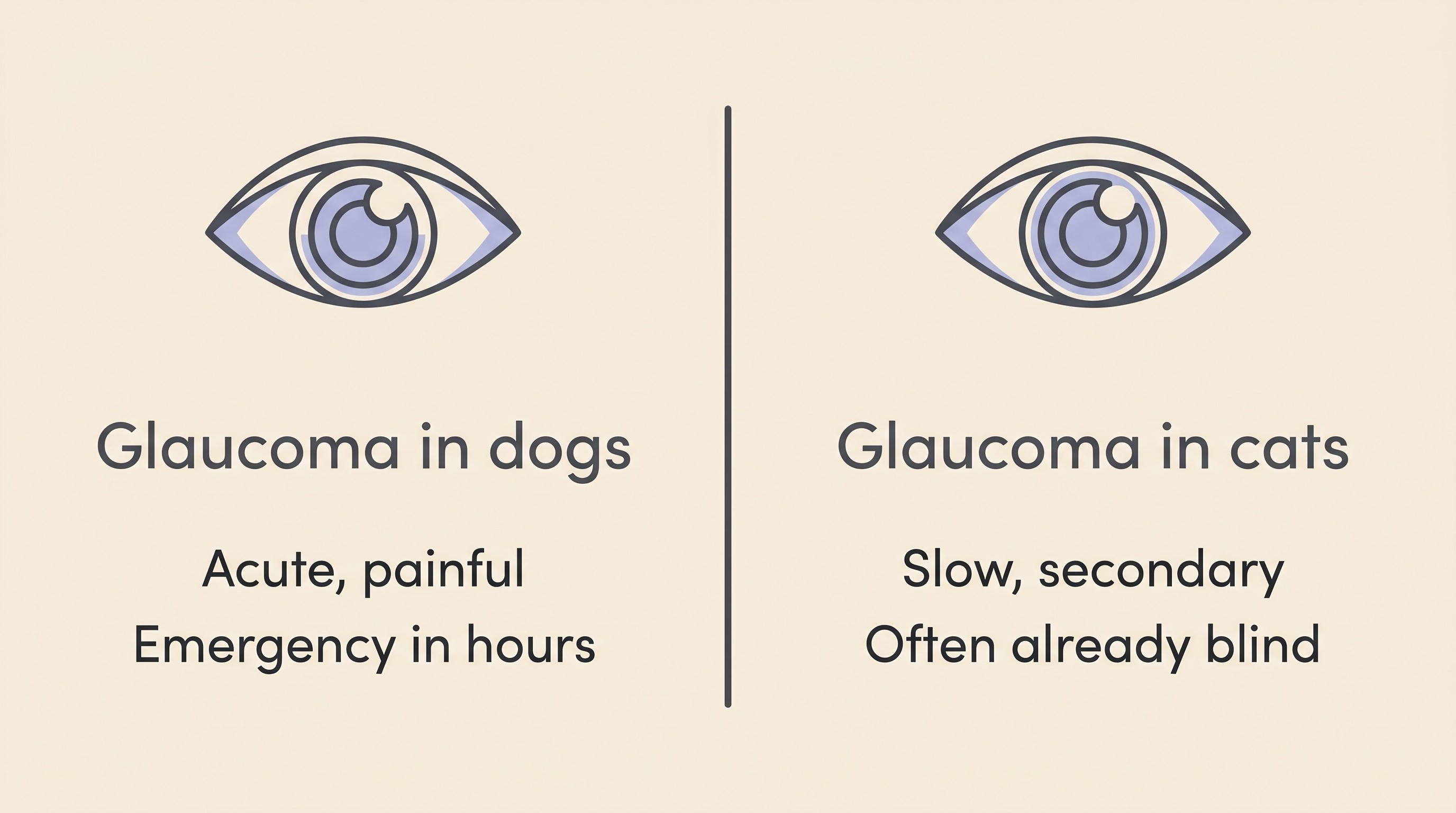
Glaucoma in a cat is a different animal from glaucoma in a dog, and that difference is the whole point of this page. In dogs it's often a dramatic emergency: a red, bulging, agonising eye that comes on over hours, frequently with no underlying cause we can name. That story belongs to glaucoma in dogs. A cat almost never reads from that script. Feline glaucoma is slow, quiet and sneaky, and it nearly always has a cause behind it that matters at least as much as the pressure itself. So whether your cat has just been diagnosed, or you've noticed an eye that's a little larger, cloudier, or a slightly different colour or shape, the useful question isn't only "how do we get the pressure down?" It's "what's driving this?" And that, oddly, is where a lot of the hope lives, because some of the causes are treatable.
What "secondary" means
Glaucoma is simply raised pressure inside the eye, intraocular pressure (IOP), when the fluid the eye makes can't drain away as fast as it's produced (Cornell Feline Health Center, n.d.). In dogs, much glaucoma is primary: an inherited fault in the drainage angle, in an otherwise healthy eye. In cats that's rare. The landmark review of feline glaucoma puts the secondary glaucomas, the ones with a disease sitting behind them, at 95 to 98% of cases (McLellan & Miller, 2011). Primary glaucoma does occur, it's inherited and affects both eyes, and breeds like the Burmese and Siamese are over-represented, but it's very much the exception (McLellan & Miller, 2011; Cornell Feline Health Center, n.d.). So unlike a dog, a cat with glaucoma almost always has something to find: the pressure is the symptom, the cause is the disease.
Chronic uveitis: the usual culprit
By a clear margin, the commonest thing behind feline glaucoma is long-standing inflammation inside the eye, called uveitis. Chronic lymphoplasmacytic uveitis (the most common slow, low-grade type) is the most frequently reported cause of glaucoma in cats (McLellan & Miller, 2011; Maggio, 2015 / Veterian Key).
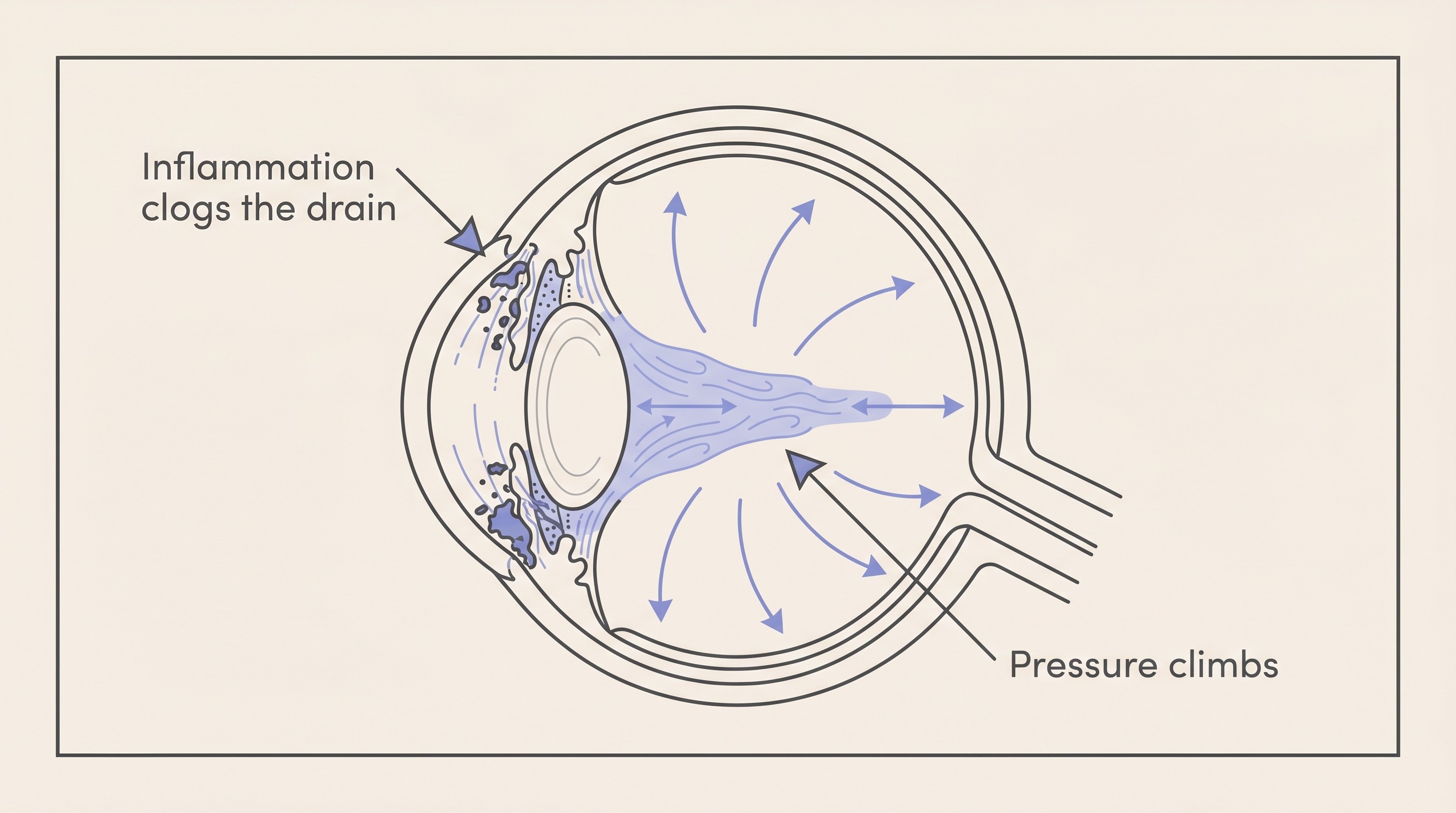
The mechanism is mechanical. The eye has a built-in drainage meshwork, like a plughole strainer, that lets fluid filter out. Months of grumbling inflammation throw protein, cells and debris into that fluid, and over time they clog and scar the strainer until it can't cope, so the fluid keeps coming but can't leave, and the pressure climbs (Cornell Feline Health Center, n.d.; Improve International, n.d.). This is why treating the pressure is only ever half the plan in a cat. The other half is finding and calming the inflammation, because ignoring the cause is bailing out a boat without patching the hole.
Uveitis is often a window onto whole-body health, so the vet frequently looks beyond the eye for a trigger, and the differential, infectious suspects and systemic workup all live in uveitis. One companion point: the same inflammation can also cloud the lens into a cataract, which is why feline cataracts are usually secondary too, covered in cataracts in cats.
The cause that makes us look twice: a tumour
The second major cause of feline secondary glaucoma is a tumour inside the eye (McLellan & Miller, 2011). The one we think about most is diffuse iris melanoma, the most common primary intraocular tumour in cats. It often starts as a flat patch of extra pigment that slowly spreads across the iris, the coloured part of the eye, and in its later stages it infiltrates the drainage angle and causes glaucoma (McLellan & Miller, 2011; Today's Veterinary Practice, 2018). The hard part is that it's malignant, a tumour that can spread elsewhere (Kalishman et al., 1998). Intraocular lymphoma (lymphosarcoma) is the next most common (Maggio, 2015 / Veterian Key). Most colour changes in a cat's eye are harmless freckles, so this isn't cause for alarm, but it is why a vet takes a darkening iris, or a glaucoma with no obvious inflammation behind it, and looks carefully for a tumour rather than just reaching for pressure drops. It matters because timing counts: cats whose melanoma is still confined to the iris when the eye is removed go on to live as long as cats without it, while those operated on only once the tumour has spread fare worse (Kalishman et al., 1998). Catching one early genuinely changes the outlook.
A smaller share follows a displaced lens or bleeding inside the eye. A reassuring quirk of feline anatomy: a slipped lens (lens luxation) causes far less of an emergency in cats than dogs, the deep front chamber means it's less likely to jam the drainage, and even then it's usually itself secondary to long-standing uveitis (Vetlexicon Felis, n.d.; McLellan & Miller, 2011). Bleeding into the front of the eye (hyphaema), often from high blood pressure in an older cat, is another trigger, and I'll come back to that one.
Why it slips by unnoticed
Glaucoma in cats is insidious and gradually progressive, and the acutely painful, fulminant presentation so typical in dogs is seldom recognised in cats (McLellan & Miller, 2011). Cats are also masters at hiding discomfort, and the signs are so subtle that many are simply not brought in until the eye is already lost, which is exactly why the disease is under-diagnosed (McLellan & Miller, 2011; Maggio, 2015 / Veterian Key).
The result is sobering, and I'd rather be straight than soften it: in one study, 73% of cats with glaucoma were already blind in the affected eye by the time they were first seen (McLellan & Miller, 2011). That isn't because those owners did anything wrong, it's because cats are built to mask it. Please don't read that figure as a reason for guilt. Read it as the reason a subtle change in a cat's eye is worth a prompt vet check, rather than a few weeks of watching to see what happens.
So what are the quiet signs? An eye gradually getting larger (an enlarged eyeball is called buphthalmos, and it can be dramatic, especially in younger cats), a haze or cloudiness, a change in colour or shape, a pupil that stays wide and doesn't shrink in light, a little squinting, and a cat that's simply less themselves, often over months before anyone notices (Cornell Feline Health Center, n.d.; McLellan & Miller, 2011; Improve International, n.d.). The absence of a red, obviously sore eye does not mean the eye is comfortable. The full art of reading feline eye pain is covered in spotting eye pain.
One clean distinction, because it's the guardrail I don't want blurred. Feline glaucoma is the slow, chronic story. It is not the same as a cat that goes blind suddenly, over a day or two, with widely dilated pupils. That's a different emergency, usually a detached retina from very high blood pressure, and it means asking your vet to check the blood pressure today. If that's your cat, go to a suddenly blind cat: check the blood pressure and use the eye-emergency triage.
What the vet does: measure, then hunt
Diagnosing glaucoma starts with measuring the pressure, using a tonometer that touches the surface of the eye briefly and is generally well tolerated (Cornell Feline Health Center, n.d.). A cat's normal pressure is fairly modest: in a large study of 538 cats aged seven and over the mean was around 12 mmHg, the practical normal range runs roughly 10 to 25 mmHg, and anything sustained above about 30 mmHg is treated as abnormal (McLellan & Miller, 2011; Improve International, n.d.).
But the vet doesn't stop at the number, and that's what separates a good feline workup from a dog one. Because the disease is overwhelmingly secondary, raised pressure is the start of the investigation, not the end. That usually means a thorough eye exam plus blood tests and infectious-disease screening for the same suspects that drive feline uveitis, and a careful search for a tumour (Today's Veterinary Practice, 2019; Cornell Feline Health Center, n.d.). The full panel belongs to uveitis.
One realistic expectation about that hunt: quite often we test thoroughly and don't find a nameable cause. A large slice of feline uveitis turns out idiopathic, somewhere around 40 to 60% of cases, and many of these eyes show immune-mediated inflammation when examined (Today's Veterinary Practice, 2019; Cornell Feline Health Center, n.d.). That's not a failure of the workup. We test hard for the treatable causes, frequently find none we can name, and still treat the inflammation. "No specific cause found" is a normal, common outcome, not a dead end.
Treatment: drops for the pressure, plus treating the cause
Treatment runs on two tracks, and the drug list is genuinely different from a dog's. For the pressure, the feline first choice is dorzolamide, a drop that reduces how much fluid the eye makes. It probably remains the first-line therapy of choice for glaucoma in cats (McLellan & Miller, 2011), and it's often paired with timolol, a beta-blocker, for added effect (Improve International, n.d.). Now the teaching point that surprises people who've researched dog glaucoma: latanoprost, a canine mainstay, doesn't work well in cats, because they have too few of the receptors it acts on, and it can even stir up the very inflammation we're trying to settle, so it's used cautiously if at all (McLellan & Miller, 2011; Improve International, n.d.).
Running alongside is the second track: treating whatever's behind it, anti-inflammatory therapy where uveitis is the driver, and definitive treatment (often removing the eye) where a tumour is the cause (McLellan & Miller, 2011; Today's Veterinary Practice, 2019). Treatment in a cat is rarely a single bottle of drops, and the plan is ongoing, so the eye-drop and pressure tracker and managing glaucoma at home are there for the day-to-day of it.
One cause ties into the wider health of an older cat. When the trigger is bleeding inside the eye (hyphaema), it often comes from high blood pressure, which in cats is usually driven by kidney disease or an overactive thyroid (ACVIM consensus, 2018; Cornell Feline Health Center, n.d.). The eye is actually the most common place feline high blood pressure shows up, at least 60% of hypertensive cats have kidney disease, and about 20% of hyperthyroid cats are hypertensive too (Cornell Feline Health Center, n.d.; ACVIM consensus, 2018). So if your cat has kidney disease or a thyroid problem, it's well worth asking about routine blood-pressure checks. The full picture lives in high blood pressure and eyes, and the underlying diseases in our CKD space and Hormone Health home.
The realistic outlook, and the comfort-first reframe
I'll be straight about prognosis. The outlook for saving vision in feline glaucoma is, sadly, guarded in most cases, partly because so many eyes are already advanced by the time we see them, and medical treatment tends to buy time rather than last forever, which is why staying in close touch with your vet matters (Improve International, n.d.; McLellan & Miller, 2011).
Sitting right beside that hard truth is a kinder one: pain can always be dealt with, even when sight can't be saved. When an eye is irreversibly blind and uncomfortable, removing it (enucleation) gives immediate and permanent relief from the pain inside it, and it's one of the kindest operations we do, not a failure or a mutilation (McLellan & Miller, 2011; Improve International, n.d.). Where the cause was a diffuse iris melanoma, it does double duty, ending the discomfort and taking out a cancer before it can spread (Today's Veterinary Practice, 2018; Kalishman et al., 1998). The full conversation, and the genuine reassurance that cats do wonderfully afterwards, is held in enucleation: removing an eye. Cats lean far less on sight than we do, and a cat who loses an eye, or even both, very often gets back to a full and happy life within a few weeks to a few months, especially when the loss is gradual. The practical art of helping them is gathered in blind cats.
So if you're sitting with a feline glaucoma diagnosis tonight: the pressure is the symptom, so the real work is finding and treating the cause, keeping the eye comfortable, and never letting anyone frame comfort, including removing a blind, painful eye, as giving up. Check the blood pressure if there's a kidney or thyroid issue in the background. And know that even if this eye can't be saved, your cat's life ahead of them can still be a thoroughly good one.
References
- McLellan GJ, Miller PE. Feline glaucoma: a comprehensive review. Veterinary Ophthalmology, 2011;14(Suppl 1):15-29.
- Cornell University College of Veterinary Medicine, Cornell Feline Health Center. Feline Glaucoma. (n.d.).
- Improve International (UK), Clinical Library. Management options for glaucoma in cats. (n.d.).
- Maggio F. Glaucomas. Topics in Companion Animal Medicine, 2015;30(3):86-96.
- Veterian Key (Maggio F, contributing literature). Feline Glaucoma. (n.d.).
- Today's Veterinary Practice. Managing Uveitis in Dogs and Cats. 2019.
- Today's Veterinary Practice. Clinical Approaches to Common Ocular Tumors. 2018.
- Kalishman JB, Chappell R, Flood LA, Dubielzig RR. A matched observational study of survival in cats with enucleation due to diffuse iris melanoma. Veterinary Ophthalmology, 1998;1(1):25-29.
- Vetlexicon, Felis. Eye: lens luxation in Cats. (n.d.).
- Acierno MJ, Brown S, Coleman AE, et al. ACVIM consensus statement: Guidelines for the identification, evaluation, and management of systemic hypertension in dogs and cats. Journal of Veterinary Internal Medicine, 2018;32(6):1803-1822.
- Cornell University College of Veterinary Medicine, Cornell Feline Health Center. Hypertension. (n.d.).
Keep track of how your pet is doing
The owners who cope best are the ones who notice changes early. A simple health log shows you what is working, and what is not, before the next vet visit.
Start tracking, freeYou're not doing this alone
Compare treatment journeys and talk to owners managing vision & eye health. Free to join.
Join PetsLikeMine