

Managing Glaucoma at Home: Drops, Pressure and What to Watch
Alastair Greenway
BVM&S MRCVS
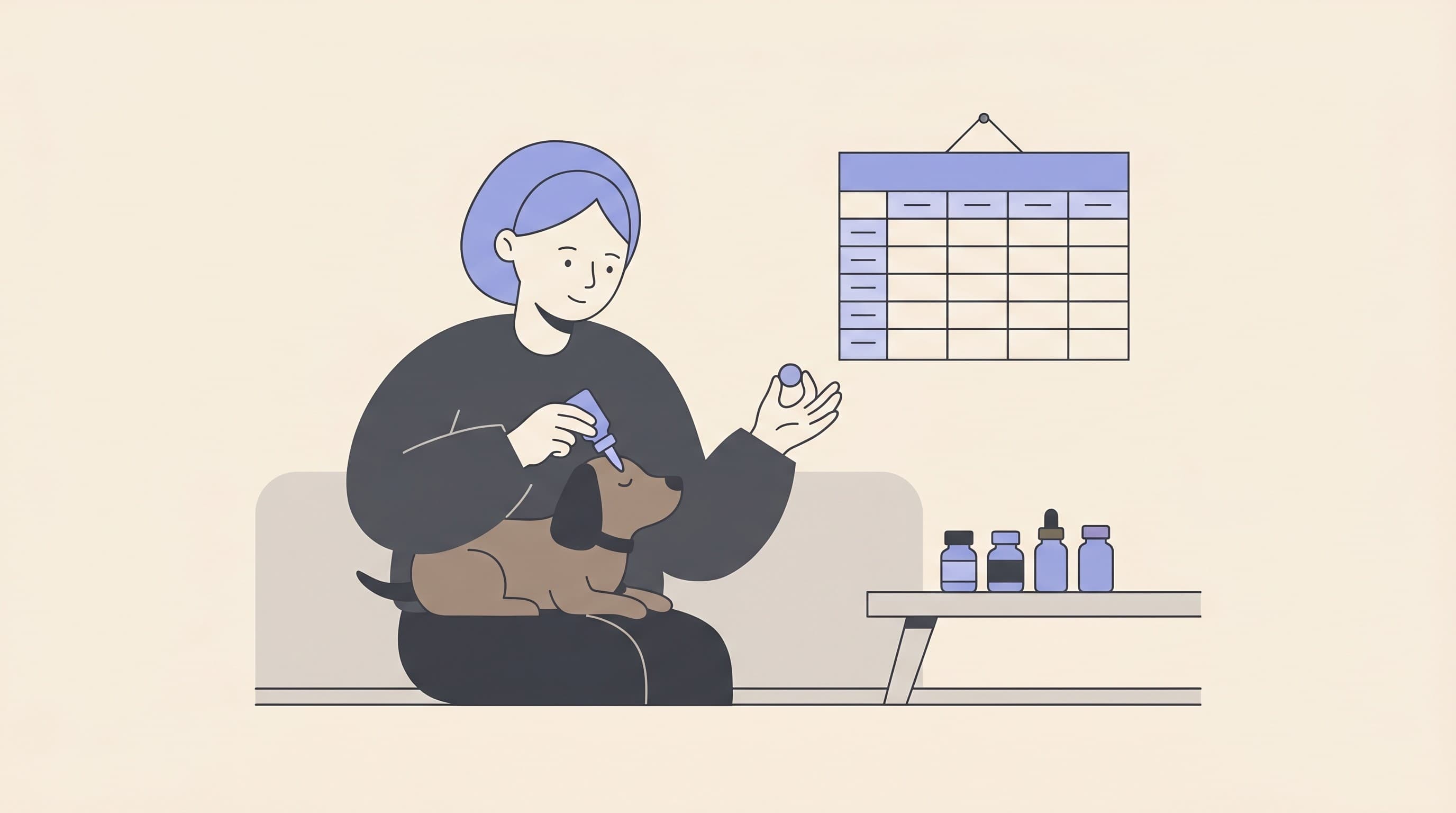
Three bottles, several times a day, one eye, then a wait, then another drop. By now the diagnosis is probably behind you, and what wears you down is the daily grind of it: the small anxious voice asking whether you got the timing right, or whether today's the day the eye flares up while you're at work. Let me say this plainly before anything else. This is a relentless, fiddly job, and the owners who do it well are not heroes with superhuman discipline. They're ordinary people who built a system. That's what this page is for: the system, a clear account of what the drops can and can't do, and the short list of things that mean pick up the phone.
What you won't find here is the disease itself. What glaucoma is, why it's a genuine emergency when an eye attacks, why it hurts like a migraine, the breeds at risk, all of that lives in glaucoma in dogs, and the feline picture, which is rather different, lives in glaucoma in cats. Here we deal with the mechanics: keeping the affected eye comfortable, keeping its pressure down, and knowing what to watch.
Why there are so many bottles
Start with what's actually in those bottles, because understanding it makes the schedule feel less arbitrary. Glaucoma is high pressure inside the eye, and the drops lower that pressure in one of two ways: by helping fluid drain out faster, or by making the eye produce less of it in the first place. Three classes do most of the long-term work. Prostaglandin analogues such as latanoprost lower pressure mainly by increasing drainage, and they work fast, latanoprost can drop the pressure by around 45% within twenty minutes (Reinstein, 2018). Topical carbonic anhydrase inhibitors such as dorzolamide, and beta-blockers such as timolol, both reduce fluid production, and they're usually given every eight to twelve hours and every twelve hours respectively (Reinstein, 2018). In a well-controlled eye a drop might be needed only once a day; in a crisis it can be up to four times a day (Reinstein, 2018). That's the range you're somewhere inside.
So the multi-bottle regime isn't your vet being thorough for its own sake. Different drops attack the pressure by different routes, and combining them holds the eye steadier than any one alone. There's even a combined dorzolamide and timolol drop, given two or three times a day, which puts two of those medicines in one bottle and cuts the number of separate drops you have to juggle, a small thing that makes a real difference to whether the schedule survives a busy week (Reinstein, 2018).
One genuinely useful instruction owners almost never get: the exact drops are chosen for your pet's specific eye, so never improvise, never reach for a leftover bottle, and never borrow another animal's drops. Latanoprost in particular is the wrong drug for some eyes, it constricts the pupil hard, and if the lens has slipped forward or the eye is actively inflamed that can trap things and push the pressure up rather than down (Merck Veterinary Manual). Your vet has weighed all that. For the cat reader, the drug choices differ again, latanoprost simply doesn't work well in cats, so the feline specifics belong in glaucoma in cats. And the full warning about why leftover or human steroid drops can be dangerous in any red eye is covered in is this eye red and painful, how urgent is it. The rule here is the simple one: only your pet's prescribed drops, in the order and at the times your vet set.
Making a heavy schedule actually work
The gap between the prescription and what happens at home is wide, and it's wide for everyone. We know this from human glaucoma, where it's been studied properly: in one study more than half of patients (54%) had poor drop technique, and 81% couldn't recall ever being shown how to do it (Tatham et al., 2013). These are motivated adults treating their own eyes. The same study found that consistently failing to get the drop in means the treatment fails and the disease is more likely to progress, and that poorer adherence tracks with worse sight loss (Tatham et al., 2013). I'm not telling you that to add to the pressure. I'm telling you because getting the drops in reliably is the treatment, not fussiness, and the fix is almost always a better system rather than more willpower.
So build the system.
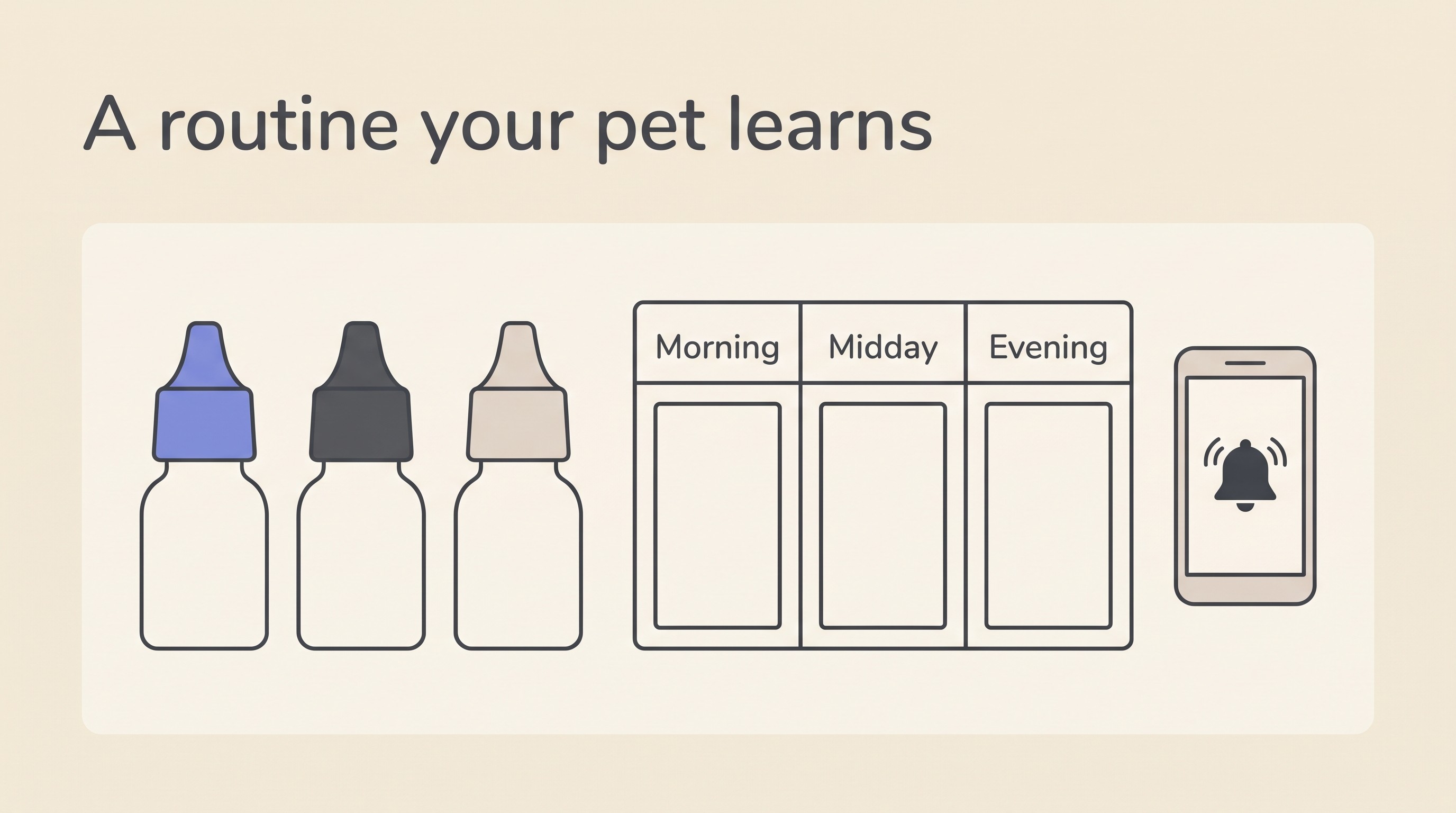
- Write the schedule down, per eye, with times, rather than holding it in your head. Glaucoma drops are often for the affected eye for life, and in primary glaucoma the other eye is frequently on preventive drops too because it's genuinely at risk of going the same way, so there's a lot to track (PDSA, 2024). Why that second eye matters, and how preventive drops protect it, is the whole subject of protecting the second eye in glaucoma.
- Set phone alarms for each round. The relentless several-times-a-day rhythm is exactly what slips, and an alarm carries the load your memory shouldn't have to.
- Colour-code the bottle caps so the right drop at the right time is a glance, not a decision, especially when you're half-asleep at the early or late round.
- Two people in the first weeks if you possibly can, one to hold and reassure, one to instil, until you've both found the knack.
- Tie drops to things that already happen, the kettle going on, the morning walk, the evening feed, so the routine hangs off habits already in place.
- Reward straight after, every single time. A treat the instant the drop is in teaches your pet that the bottle predicts something good, and over a few weeks that turns a wrestling match into a pet that comes to you.
One piece of timing almost nobody is told. When two different drops are due at the same moment, leave a gap between them, or the second simply washes the first back out before it's had a chance to work. Clinics usually say wait about five minutes, and that's a safe, easy number to follow, though it's worth knowing the evidence is gentler than that, a small study in dogs suggested as little as one minute between different drops may be enough for full effect (Arad et al., 2021). So don't agonise over a stopwatch: a few minutes between different drops, drops before any ointment, and you've got it right.
If you want this turned into something concrete, the Eye-Drop and IOP regimen tracker builds your per-eye schedule, sends the reminders and lets you log everything in one place, and the printable eye-drop schedule is there to stick on the fridge for whoever's doing the next round. The plain truth is that imperfection is human, you will miss a dose one day, and the answer is a system that catches you, not a guilty heart.
Spotting a pressure spike
Read this part twice, because it's where home management meets the emergency. Even on a good drop regime, the pressure can break through and rise sharply, and when it does, vision is lost fast. So the watching matters.
What a spike looks like at home: an eye that's gone red, or cloudy or hazy on the surface, an eye your pet is holding shut, rubbing or pawing at, a pet that's suddenly dull, withdrawn or off their food, and, over a longer run, an eye that looks larger than its partner. Any of that on a glaucoma pet means a same-day vet visit, today, not a wait-and-see, because pressure above roughly 40 to 50 mmHg needs emergency treatment and the eye doesn't give you long (Cornell Riney Canine Health Center). Pets are stoical about eye pain and the signs are quiet, so the threshold for ringing should be low; the quieter tells, the squint, the held-shut eye, the flat mood, are covered in more depth in spotting eye pain. If you're ever unsure whether what you're seeing is an emergency, the eye-emergency triage will sort it in a couple of questions, and the full anatomy of an acute attack is in glaucoma in dogs. For the cat reader, feline glaucoma tends to be slower and more secondary, so the tells skew towards a gradually enlarging eye, a change of colour or quietly reduced vision as much as sudden pain, and that picture lives in glaucoma in cats.
Checking the pressure at home
Here's the development that's quietly changing how we manage these eyes, and it's the most useful thing on this page for the right pet. The problem with relying on clinic pressure checks is that the dangerous spikes don't book appointments. In a 2026 pilot study, owners of fourteen dogs predisposed to primary angle-closure glaucoma measured their dog's pressure at home with a rebound tonometer, and in seven of the nine dogs that went on to develop overt glaucoma, the attack arrived as a sudden rise above 50 mmHg that was not preceded by any gradual creep (Westermeyer and Salmon, 2026). In other words, the spike would have been completely invisible between routine clinic visits. The authors concluded that owner-obtained home pressure readings can provide genuinely useful information for managing this disease, and could substantially increase the chance of catching these rises in time (Westermeyer and Salmon, 2026).
The technology that makes this even thinkable is rebound tonometry. The device, a TonoVet, bounces a tiny light-tipped probe off the surface of the eye and reads the rebound, and because it touches the cornea so briefly it needs no local anaesthetic drop and is well tolerated, in dogs and in unsedated cats (Wilkie, 2013; McLellan et al., 2013). It's validated against the true pressure inside the eye, so the numbers mean something (McLellan et al., 2013). Normal pressure in both dogs and cats sits at about 10 to 20 mmHg (Wilkie, 2013).
Let me frame this carefully, because it isn't a standard expectation for every glaucoma pet. Home tonometry is an emerging, vet-supported tool for selected cases, the predisposed eye, the high-risk fellow eye, the pet whose spikes keep being missed, and it only works where your ophthalmologist or vet sets it up, trains you on the technique and lends or recommends the device. It's not something to buy off the internet and run solo. But if your pet is a candidate, it's worth asking about, and the Eye-Drop and IOP regimen tracker is built to log those home readings alongside the drops so you and your vet can see the trend.
A word on reading the numbers, whether they come from home or the clinic, because a single figure can mislead. Stress pushes the pressure up: excitement, fear, restraint, a tight collar, pressure on the neck, even squeezing the eyelids will falsely raise the reading, so a calm setting and a loose collar matter (Wilkie, 2013). There's a real "white-coat effect" too, a 2026 study of forty dogs found the average pressure was meaningfully higher in the clinic than at home, by up to several mmHg (Barrow et al., 2026). The practical upshot: keep the collar loose and your pet calm, don't panic over one high clinic reading in a stressed dog, and trust a trend of readings over any single number, always interpreted with your vet rather than alone.
When drops only buy time
I'd be doing you a disservice if I let you think the drops were a permanent fix, because for primary glaucoma they usually aren't, and you deserve to hear that from me gently and early rather than discover it on a bad day. Medical control tends to buy time rather than last forever. The drops become less effective as the months go by, the pressure creeps back up, and eventually every medical therapy reaches its limit (Reinstein, 2018). Even with good treatment, glaucoma is a progressive disease, and in most cases sight in the affected eye is lost in time (Cornell Riney Canine Health Center).
Read that as the reason for the plan, not as despair. The drops buy precious time and, just as importantly, comfort, and the close watching you're doing is exactly what stretches that time as far as it will go. It's why those recheck appointments and pressure reviews matter so much, the regime gets adjusted as the eye changes, and staying in close contact with your vet is the whole game.
And when the day comes that an eye is blind and the drops can no longer keep it comfortable, removing that eye is not a failure or a defeat. It's one of the kindest operations we do, because it takes away a constant pain that nothing else can reach, and pets are very often brighter within days. That decision, and the reassurance that goes with it, has a whole page of its own in enucleation and eye removal, and if vision is fading, pets adapt to blindness remarkably well, far better than their owners fear, with a good quality of life on the other side.
For now, though, you're managing an eye that's still in the fight, and that's worth doing well. Set the regime up properly in the Eye-Drop and IOP regimen tracker so the reminders carry the load instead of your memory, ask your vet whether home pressure checks would suit your pet, and keep those recheck appointments in the diary. The watchful, unglamorous daily routine you're building is precisely what keeps that eye comfortable and seeing for as long as it possibly can.
References
- PDSA (People's Dispensary for Sick Animals). (2024). Glaucoma in dogs. PDSA Pet Health Hub.
- Reinstein, S. (2018). Acute glaucoma: a true emergency. Today's Veterinary Practice, 8(2), 38–46.
- Cornell University College of Veterinary Medicine, Riney Canine Health Center. (n.d.). Glaucoma.
- Westermeyer, H. D., & Salmon, J. H. (2026). Owner obtained intraocular pressure measurements in canine primary angle closure glaucoma: a pilot study in 14 dogs. Veterinary Ophthalmology, 29(2), e70156.
- Barrow, R. P., Strong, T., Oikawa, K., McLellan, G. J., & Bentley, E. (2026). The white coat effect influences intraocular pressure measurements in dogs: comparing tonometry values obtained in the clinic versus home. Veterinary Ophthalmology, 29(2), e70113.
- Wilkie, D. A. (2013). Determining intraocular pressure in dogs and cats. Clinician's Brief.
- McLellan, G. J., Kemmerling, J. P., & Kiland, J. A. (2013). Validation of the TonoVet rebound tonometer in normal and glaucomatous cats. Veterinary Ophthalmology, 16(2), 111–118.
- Tatham, A. J., Sarodia, U., Gatrad, F., & Awan, A. (2013). Eye drop instillation technique in patients with glaucoma. Eye (London), 27(11), 1293–1298.
- Arad, D., Deckel, R., Pe'er, O., Ross, M., Sebbag, L., & Ofri, R. (2021). Is it necessary to wait several minutes between applications of different topical ophthalmic solutions? A preliminary study with tropicamide eye drops in healthy dogs. Veterinary Ophthalmology, 24(4), 374–379.
- Merck Veterinary Manual. (n.d.). Acute glaucoma in small animals.
Keep track of how your pet is doing
The owners who cope best are the ones who notice changes early. A simple health log shows you what is working, and what is not, before the next vet visit.
Start tracking, freeYou're not doing this alone
Compare treatment journeys and talk to owners managing vision & eye health. Free to join.
Join PetsLikeMine