

The first signs your pet is getting older (normal vs not)
Alastair Greenway
BVM&S MRCVS
A few grey hairs around the muzzle that you are fairly sure were not there last year. A slower greeting at the door. A cat who used to pour herself onto the top of the wardrobe and now takes it in two careful stages, or skips it altogether. Notice enough of these and you reach the question that brings most people to a page like this: is this just my pet getting older, or is it something I should do something about?
It is a good question, and the honest answer is that it is both, depending on which change you mean. Some of what you are noticing really is the gentle, ordinary business of getting older. But a specific handful of changes are not "just old age" at all, even though they wear its coat, and those are the ones worth a vet's eyes sooner rather than later. This article is here to help you tell the two apart, calmly, for both dogs and cats.
Start with the most reassuring fact in senior care, because the rest only makes sense once you have it. Old age is not, in itself, a disease. The veterinary profession says this deliberately and often, precisely because so many loving owners assume an older animal's decline is inevitable and that nothing can be done (Today's Veterinary Practice, on the 2023 AAHA Senior Care Guidelines). For most pets, "senior" is not a countdown. It is the start of a long, good plateau, often the most companionable years of all.
First, is your pet even "older" yet?
"Senior" is not a switch that flips on a particular birthday, and a pet who is officially senior on paper can still be tearing around like a youngster. It is a band, not a date, and where that band begins depends a great deal on what kind of animal you share your life with.
For dogs, the rule that surprises people is that size sets the clock: the bigger the dog, the sooner the years count. The 2023 AAHA Senior Care Guidelines avoid a fixed age and define a senior dog as one in the last quarter of their expected lifespan, which lands very differently for a small terrier than for a giant breed. As a rough guide: small breeds reach their senior years around 11 to 12; medium breeds around 9 to 10; large breeds (Labradors, German Shepherds) around 7 to 8; and giant breeds (Great Danes, Bernese Mountain Dogs) as early as 6. That gap is real: large and giant dogs genuinely age faster and live shorter lives than small ones. We unpack why, and where your dog sits, in when is a dog "senior"?
For cats, the bands differ again. International Cat Care and the feline veterinary guidelines describe a cat as mature from around 7, senior from around 11, and super-senior from 15 onwards (Cats Protection). That earlier "mature" line matters more than it looks, because some of the most treatable feline conditions begin quietly in those years, long before anyone would call the cat old. There is a full guide in when is a cat "senior"?
The deeper point is that the calendar is the least useful part. What matters is your pet's biological age, the real condition of their body and mind, shaped by size, breed, weight, dental health and plain luck. Two dogs of the same age can be worlds apart, so the most helpful question is rarely "how old is my pet?" and almost always "how is my pet doing, really?"
Changes that are usually just the years catching up
Here is the gentle list: the everyday signs of ageing that, on their own, are usually nothing to worry about, and that you can mostly note and otherwise let your pet enjoy.
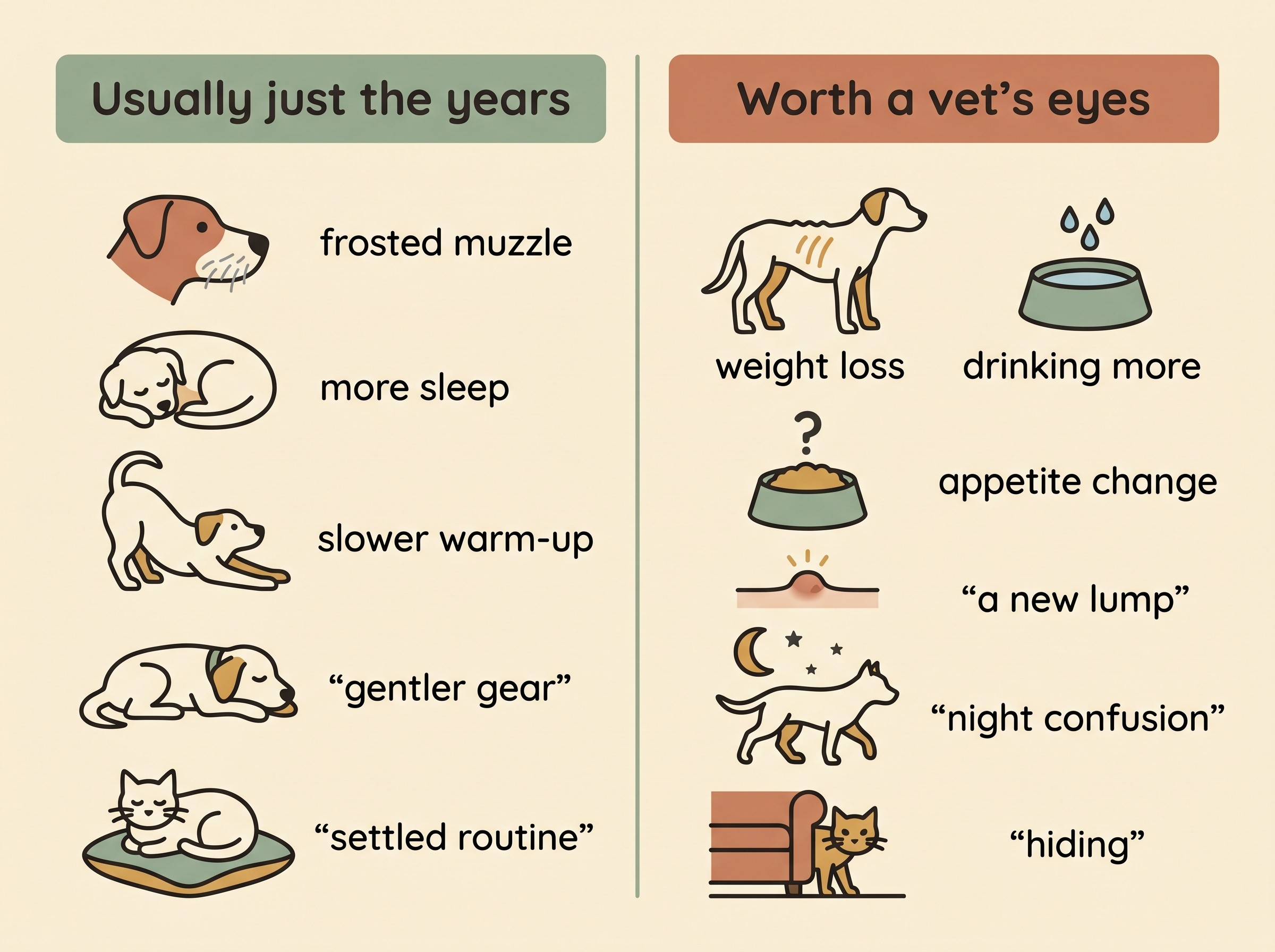
In dogs, the ordinary changes include a frosting of grey on the muzzle, a little more sleep, a slower warm-up on a cold morning, and a fraction less spring in the jump into the car. The lenses of the eyes often take on a faint bluish haze with age, a harmless change easily mistaken for cataract (your vet can tell them apart, which is why a genuinely cloudy eye is worth a look rather than a guess: see the Vision and Eye Health space). Many older dogs simply mellow, content with a shorter walk and a longer doze.
In cats, the ordinary picture is similar but quieter: more sleeping and lighter sleep, less acrobatic leaping, a reduced tolerance for noise and upheaval, and a general settling into routine. An older cat who chooses the radiator over the rooftop is often just being sensible.
A word of caution before you breathe out completely, because that word "usually" is doing a lot of work. Every one of these gentle changes overlaps with something less innocent, and the difference is often in the detail and the trend rather than the sign itself. A bit more sleep is normal; a dog who cannot settle and seems exhausted by a short walk is not. So the most useful habit is to watch the direction of travel over time rather than judging any single change alone, which is exactly what the Senior Wellness Check is built for, and which we will come back to.
Why "slowing down" deserves a second look
Slowing down is a symptom, not a diagnosis. "He's just getting old" describes what you are seeing; it does not explain it. And far more often than owners expect, the explanation is something a vet can actually treat.
The big, frequently missed culprit is pain. Dogs and cats both hide it, for the same evolutionary reason: an animal that visibly limps and aches is one a rival or predator can take advantage of, so pets carry discomfort quietly and simply stop doing the things that hurt. That is why pain in an older pet so rarely looks like pain: it looks like a change in who they are.
In an older dog, that means the reluctance on the stairs, the pause before the car, the new preference for the floor over the sofa, the dog who has "calmed down" or grown grumpy when a hip is touched. The commonest hidden cause is sore, stiff joints, and although the clinical word for it sounds frightening, the reality is hopeful: it is one of the most treatable conditions in older dogs. Read the reluctance as a question, not a personality change: is he comfortable, or is he sore?
In an older cat, the disguise is even better, which is why the cat half of this matters just as much. A cat will not limp to tell you their joints hurt; they will simply, silently, stop making the jumps that hurt. Watch for the high places they have quietly abandoned (the windowsill they no longer reach), a coat that has lost its polish over the back and rump (twisting to groom has become uncomfortable), missing the litter tray when climbing into a high-sided one hurts, and more time hidden away with a shorter fuse when handled. None of that is simply an old cat being an old cat.
For both species, much of this slowdown is treatable joint pain. The Arthritis space covers cats as well as dogs, our Mobility Check lets you score and track how your pet is actually moving, and is it pain, age, or disease? takes the whole question apart.
Signs that are never "just old age"
Some changes should jump the queue entirely. These are not things to watch for a few weeks, file under ageing, or save for the next routine visit. If your older pet shows any of them, treat it as your cue to ring the vet.
- Losing weight. This is the one I would underline twice. Weight loss in an older pet, even when the appetite looks completely normal, is never something to shrug off as ageing (Cats Protection). In an older cat it points to a short, important list: an over-active thyroid (the commonest hormonal disorder of older cats, classically causing weight loss despite a good or increased appetite), kidney disease, diabetes, dental pain or gut disease (VCA Hospitals). In an older dog the differentials overlap and add others, including cancer. And you often cannot judge muscle loss from the scales alone: a pet can hold its weight while quietly losing muscle, and can lose muscle even while overweight, which is why vets score body fat and muscle separately and feel along the spine and hips at every senior exam (dvm360). We give this the full treatment in why weight loss is never "just old age".
- Drinking and weeing noticeably more. A dog emptying the water bowl, or a cat with suddenly heavier litter, is one of the most useful early warnings there is. The usual older-pet causes are kidney disease and diabetes in both species, plus an over-active thyroid in cats and a hormonal condition such as Cushing's in dogs, and only a vet can tell them apart (Veterinary Partner). The Kidney space, the Diabetes space and the Hormone Health space cover the suspects, and tracking how much your pet drinks gives your vet a real number instead of an impression.
- A clear change in appetite, up or down. A cat eating ravenously while losing weight is a classic over-active thyroid picture; a pet that goes off its food deserves a look just as much.
- Any new or changing lump. The reality is neither alarm nor false comfort: you genuinely cannot tell a harmless lump from a worrying one by look or by feel, and neither can your vet without a closer look (often a quick needle sample). So do not sit and worry about every soft bump, but do not assume the worst either. Just get new or changing lumps checked. We talk it through calmly in lumps, bumps and the cancer conversation.
- New restlessness or confusion at night, pacing, waking, vocalising, or seeming briefly lost in a familiar room.
- Hiding, withdrawing, or a sudden shift in temperament, which is often a pet in pain or feeling unwell rather than a personality that has simply changed with age.
If any of those describe your pet, that is the moment to book in. This list is the exact territory where loving owners go wrong by being kind: it feels generous to give an old friend some slack and assume the change is "just their age", but that same instinct is what lets treatable disease tiptoe in undetected.
When it might be the mind, gently
Sometimes the change is not in the body but in the way an older pet thinks. You might notice they seem a little foggier: slower to catch on, staring at a wall, standing on the wrong side of a door they have used for years, less interested in the family, or muddling up their days and nights so the small hours become restless and vocal.
The clinical name for this is cognitive dysfunction, the pet equivalent of dementia, and I will use that label just once and then go back to plain language, because the words frighten owners far more than they need to. Tellingly, the researchers who built the main screening questionnaire for dogs deliberately renamed it to avoid sounding like dementia, calling it "social and learned behaviour" instead (Yarborough et al., 2022). So let us simply call it changes in memory and sharpness. Vets describe these in five everyday areas (disorientation, changed interactions with the family, disturbed sleep, accidents indoors, and altered activity) (Clinician's Brief). They are real, common and badly under-recognised: in dogs, the odds of cognitive change rise by roughly half with each additional year of age, yet only a small fraction are ever formally picked up, largely because owners assume it is simply old age and never mention it (Yarborough et al., 2022). Cats are affected too, and feline cognitive change is even more of a blind spot.
There is good news: changes in memory and sharpness are a diagnosis of exclusion. A careful vet will not simply pin an older pet's confusion on an ageing mind; they will first rule out the many treatable things that mimic it (Clinician's Brief). In a dog, that means checking for pain, fading sight or hearing, and conditions such as an under-active thyroid first. In a cat it matters even more: a cat who yowls at 3am, paces or seems lost is very often hyperthyroid, or has high blood pressure (which can quietly steal their sight), or has kidney disease or sore joints, long before "feline dementia" is the answer. So a foggier older pet is not a dead end. It is a reason to get the proper checks, because the treatable causes hide in exactly the same clothes.
If memory and sharpness are your worry, you are in one of the loneliest corners of senior care, and you do not have to be. The night-time disruption in particular is the single thing owners of affected dogs find hardest to live with, and many describe getting very little guidance about it (Taylor et al., 2024, Veterinary Record). We cover the first signs in dogs in is my dog losing his mind? and the night-time side in the 3am pet, and disorientation and house-soiling are exactly what the Behaviour space routes here once medical causes are ruled out. Our senior community is full of owners walking the same road, where the broken nights and the quiet grief of watching a personality change are talked about openly rather than brushed aside.
Turning "I think she's slowing down" into something useful
You cannot diagnose your pet from the sofa, and you are not meant to. But you can do the one thing that makes a real difference to how early problems are caught: stop trying to judge from memory whether your pet is "worse than they were a while ago", and start watching the trend. A single observation is hard to act on; a direction of travel is not.
This is the whole idea behind logging your pet's Vitality in the Senior Wellness Check: in a couple of minutes you record how they are doing across a handful of everyday things (energy, appetite, how they are moving, their muscle, and how sociable they are being), plus how their Mind and Sharpness seem, and the tool shows you whether the line is holding steady or quietly drifting down. Those five domains are not picked at random: they come from a recently validated veterinary tool that found this exact cluster could flag the dogs most in need of attention, and did so independently of the dog's age (Russell et al., 2024). In other words, "old" and "in trouble" are not the same thing.
And when you go to the vet, bring a film. A 30-second video of your dog getting up from lying down, or your cat hesitating before a jump, is one of the most useful things you can hand to a consultation, because many pets trot around the consulting room looking deceptively fine while the video shows what really happens at home on a stiff morning.
What to do this week
You do not need to solve any of this today, or treat the first grey hair as the beginning of the end. Noticing the years is simply the cue to pay a little more attention, so the gentle changes can be enjoyed and the meaningful ones caught early.
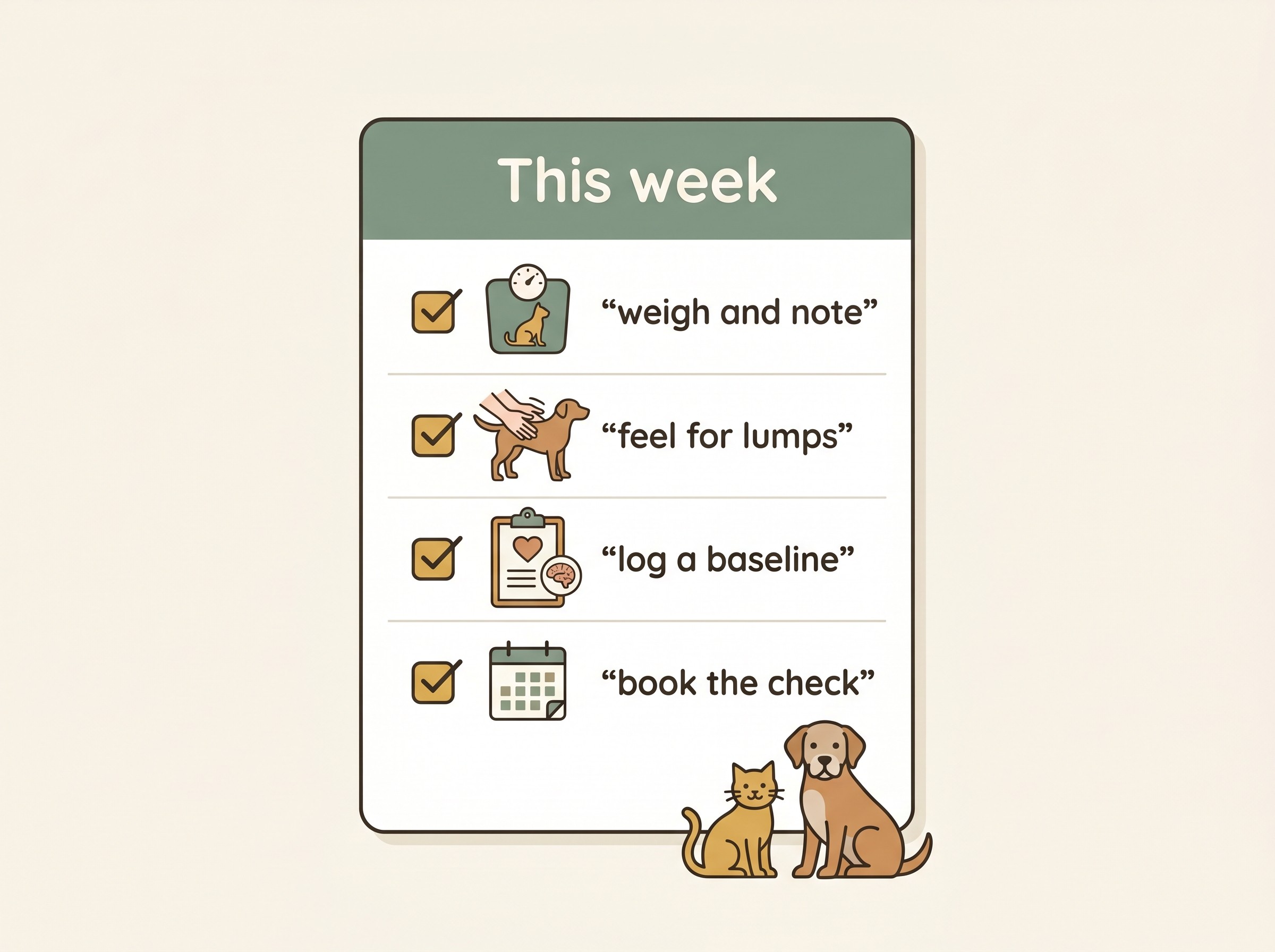
- Weigh your pet and write the number down. This is the first line of a baseline everything else gets measured against. Read setting a senior baseline for the short list of numbers and notes worth having now.
- Feel along the whole body, head to tail, for any new lump and for muscle that has thinned over the spine and hips.
- Log a first Vitality and Mind reading, so that next time you wonder "is she slowing down?", you have a line to compare against rather than a guess.
- Book the next check, and make it six-monthly from now on. Because pets age several times faster than we do, a year is a long time to leave between looks under the bonnet, which is why the senior guidelines recommend twice-yearly visits. What happens at those visits, and which tests are worth doing, lives in the senior wellness check.
- If any item on the short list is present (weight loss, more drinking or weeing, an appetite change, a new lump, night confusion, or hiding and a sudden change in temperament), book a vet visit now, not "at some point".
Sister tool · Sightline
Track quality of life over time
Sightline, a separate ConciergeVet tool, runs a short adaptive weekly assessment with a quality-of-life focus mode built around exactly these frameworks, tracks a single composite score over time so you can see the trend rather than judge a single bad day, and produces a Sightline Report PDF you can bring to your vet.
A written log, or our printable quality-of-life sheet, does much the same job.
See how Sightline tracks quality of lifeKeep track of how your pet is doing
The owners who cope best are the ones who notice changes early. A simple health log shows you what is working, and what is not, before the next vet visit.
Start tracking, freeYou're not doing this alone
Compare treatment journeys and talk to owners managing senior pets. Free to join.
Join PetsLikeMine