

When is a cat "senior"? The mature, senior and super-senior years
Alastair Greenway
BVM&S MRCVS
With cats it tends to creep up on you. There is no single moment, just a slow accumulation of small things. A few white hairs on the chin that you are fairly sure were black last year. The windowsill she now reaches by way of the chair, when she used to clear it in one liquid leap. A few more hours asleep in the airing cupboard, a slightly stiffer stretch first thing. You find yourself wondering, half fondly and half uneasily, when did my cat get old. And because cats wear their age so quietly, the question is genuinely hard to answer from the sofa.
The good news comes first. Cats are, in one important way, much kinder to orient than dogs. A dog's senior age swings wildly with size, so a Chihuahua and a Great Dane reach old age years apart. Cats do not do that. A Maine Coon and a small moggie age on more or less the same calendar, which means we can give you something genuinely useful: a clear sense of the life stages, roughly when each one starts, and the one small thing worth doing the moment your cat steps into the first of them.
Mature, senior and super-senior
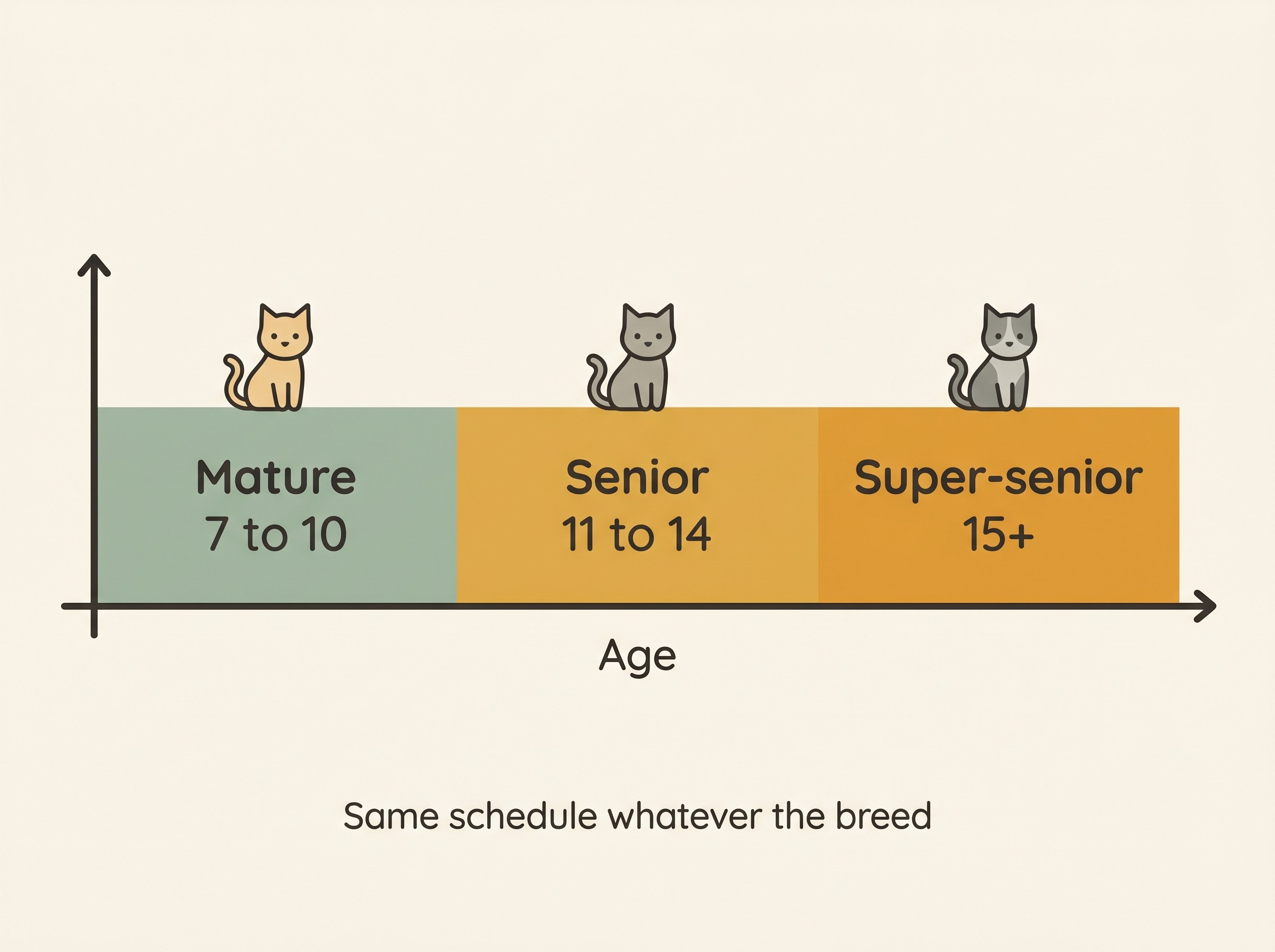
Vets and feline charities map a cat's later life onto three owner-friendly tiers, and these are the words worth knowing. As a widely used guide (the framework popularised by International Cat Care and echoed across feline practice), they run roughly like this:
- Mature: around 7 to 10 years. Your cat is the human equivalent of someone in their mid-forties to mid-fifties. Often still in their prime to look at, but the body has quietly turned a corner, and this is exactly when the first ageing changes begin under the surface.
- Senior: around 11 to 14 years. The equivalent of a person in their sixties and early seventies. Most cats are still very much themselves here, just with a bit more sleep and a bit less spring.
- Super-senior (sometimes called geriatric): 15 years and beyond. A grand old age, the equivalent of someone well into their late seventies, eighties and past. Plenty of cats reach it in good order, and a fifteen-year-old cat dozing in a sunny window is a quietly wonderful thing.
One clarification, because you may have seen different numbers and wondered who is right. The veterinary profession recently tidied its life-stage map: the current 2021 AAHA and AAFP Feline Life Stage Guidelines use a simpler four-stage scheme (kitten, young adult to age six, mature adult from seven to ten, then senior from ten onward). The biology has not changed at all; it is the same animal getting gently older. The tiers are a map to help you and your vet have the right conversations at the right time, not a verdict pinned to a birthday. A cat who is "senior" on paper can still ambush your ankles at breakfast.
No size rule, but lifestyle and luck still count
This is the part that makes cats simpler than dogs. With dogs, size is destiny: big dogs age fast and small dogs get the longer run. Cats do not vary nearly as much in size, and they do not show that effect, so you can use the tiers above for almost any cat with reasonable confidence.
What does move the dial is lifestyle and a fair amount of luck. The largest UK study of its kind, built from real veterinary records through the Royal Veterinary College's VetCompass programme, found the average life expectancy of a cat in Britain was 11.83 years, with crossbred moggies doing best at around 12 years (Teng et al., 2024). Two findings stand out for everyday owners. Neutered cats lived markedly longer than entire ones (about 12.45 years against 11.83), and entire male cats fared worst of all at around 9.4 years, largely because an un-neutered tom roaming and fighting is taking risks a steady house cat is not. None of this changes the age at which your cat becomes "mature" or "senior"; it shifts the odds of how long they stay there. So a well-kept, neutered, largely indoor cat may sail comfortably into super-senior territory, and that is a perfectly realistic hope to hold.
Forget "times seven"
Let us retire a myth while we are here. The old "one cat year equals seven human years" was never right, and the truth is more interesting. Cats do not age at a steady pace. They sprint through the equivalent of human childhood and adolescence and then settle into a slower stride.
The convention most feline vets use runs like this: a cat's first year is roughly the equivalent of a human reaching fifteen, the second year takes them to about twenty-four, and after that each cat year adds in the region of four human years. By that rough reckoning a ten-year-old cat is something like a person in their mid-fifties. Treat it as a useful sketch rather than a precise law, because the real point is not the conversion at all.
The real point is that the number of birthdays tells you surprisingly little. What matters is biological age, the actual condition of the body and mind, and two cats born on the same day can be worlds apart depending on weight, dental health, what they have lived through and plain luck. This is why the most helpful question is almost never "how old is my cat?" and almost always "how is my cat doing, really?" That shift, from the calendar to the condition, is the whole idea behind tracking your cat's Vitality over time, which I will come back to at the end.
Why the feline poker face matters so much
Cats are extraordinary at hiding when something is wrong. A small, self-reliant predator that shows weakness is a small predator in trouble, and that instinct does not switch off just because they live on your bed now. The result is that a quiet, sleepy, less adventurous old cat is one of the most under-investigated patients in the whole building. The veterinary guidelines say so plainly: "the cat's innate ability to hide ailments makes regular physical examination that much more critical in the elderly cat," and "many clients may be unaware of gradual changes until we ask provocative questions" (AAFP, 2021).
So please be gentle but suspicious about the phrase "she's just getting old." Slowing down is a symptom, not a diagnosis. Far more often than owners realise, what looks like ordinary ageing is treatable pain or treatable illness wearing an old cat's coat. Three quiet conditions in particular hide behind "just old age," and all three are worth a vet's attention rather than a shrug:
- Hidden joint pain. This is the great under-diagnosed problem in older cats. On x-rays, around 90% of cats over twelve show signs of arthritis, yet cats almost never limp the way dogs do (NC State Comparative Pain Research, citing the work of Lascelles and colleagues). Instead they go quiet: no longer jumping to the windowsill, taking the stairs more carefully, sleeping more, grooming less (so the coat looks unkempt), and sometimes missing the litter tray because climbing into it hurts. It is desperately easy to read all of that as "she's just an old lady now," when much of it is comfortable, treatable soreness. The whole Arthritis space exists to help you tackle it rather than tolerate it.
- Kidney trouble. Chronic kidney disease affects "up to 40% of cats over the age of 10 and 80% of cats over the age of 15," and in its early stages it is silent, then shows as drinking more, bigger wet patches in the litter tray, and weight quietly slipping away (Cornell Feline Health Center). The earlier it is caught, the more can be done, which is why it lives in the Kidney Disease space.
- An overactive thyroid. Hyperthyroidism is "a relatively commonly diagnosed disease in older cats (over 7 years old)," and its signature is almost paradoxical: weight loss despite a hearty or even ravenous appetite, increased thirst, restlessness and a scruffy coat (Davies Veterinary Specialists). An old cat who is eating well but melting away is not "burning it off because she's lively"; she needs a blood test. You will find the detail in the Hormone Health space.
The common thread is that none of these announces itself. They are caught by someone paying close, slightly suspicious attention to an old cat who is "just slowing down."
Changes that jump the queue
A few specific changes are not "just old age" at any point, and they deserve a vet's attention sooner rather than later. If your cat shows any of these, treat it as your cue to book in, not to read on:
- Weight loss, even if appetite seems normal or good. This is the single most important one in cats. It is never something to file under ageing, and under a thick coat it hides until it is dramatic, so a reading on the scales matters more than the eye. It can flag hyperthyroidism, kidney disease, diabetes, dental pain, gut disease or cancer.
- Drinking noticeably more, or leaving bigger clumps in the litter tray, which points toward the kidneys, the thyroid or diabetes rather than the warm weather.
- A clear change in appetite, up or down.
- New restlessness or yowling at night, pacing, or seeming briefly lost or blank in a familiar room.
- Any new or changing lump. You genuinely cannot tell a harmless lump from a worrying one by look or feel, so the rule is simply to have new ones checked, often with a quick fine-needle sample, rather than to watch and worry.
One extra nuance worth knowing, because it trips up even careful owners: in older cats these problems love company. Kidney disease and an overactive thyroid, in particular, often travel together and can each partly mask the other, so treating one sometimes reveals the other (Geddes and Aguiar, 2022). That is not a reason to worry, just a reason your vet may want to monitor more than one thing at once. We cover that double act in the senior cat with kidney disease and an overactive thyroid, and how to tell ordinary ageing from something that needs a vet in Is it pain, age, or disease? The thread running through all of it is the same: at this age, an old cat earns the benefit of the doubt that a change is worth investigating.
If you do one thing this year
The single most valuable move you can make for a newly mature or senior cat is not a special diet or a heated bed. It is to switch from a yearly check-up to one every six months, and to capture a baseline now.
The reason is simple arithmetic. A cat's life runs roughly five times faster than ours, so by the logic the senior guidelines spell out, a once-a-year visit for an old cat is like a person seeing their doctor only once a decade (AAFP, 2021). A year is just too long to leave between looks under the bonnet when a quiet condition can go from invisible to advanced in that time. Twice-yearly visits, with a hands-on exam and the senior blood, urine and blood-pressure checks your vet will suggest, catch problems while they are still small and gentle to treat. For very old or already-poorly cats the guidelines suggest looking even more often, every three to six months. The full picture of what should happen at those visits lives in the senior wellness check.
The baseline matters every bit as much. The real power of those tests is not any single result but the trend: a kidney value or a body weight that is creeping in the wrong direction tells your vet a far clearer story than one snapshot ever could. But you can only see a trend if you wrote down where you started. So while your cat is well, get the numbers down, and setting a senior baseline walks you through exactly what is worth recording.
This is precisely what the Senior Wellness Check is built for. Cats have a poker face; a tracker does not. Rather than asking you to remember whether she seems slower than she was "a while ago," it lets you log her Vitality (energy, appetite, mobility, muscle and how sociable she is being) and her Mind / Sharpness in a couple of minutes, then shows you the direction of travel over months and years. Those everyday domains are not chosen at random; they come from a recently validated veterinary tool that found this cluster could flag the animals most in need of attention, independently of age (Russell et al., 2024). Tracking them turns a vague worry into something you can actually see and hand to your vet, and if a particular area starts to slide, the check points you toward the right next step.
A word to settle any unease before you go. "Senior" sounds heavier than it should. For most cats it is not a diagnosis and certainly not a countdown; it is the start of a long, good plateau, often the most affectionate, lap-seeking, sunbeam-following years of all. If you are worried about one specific change, or facing several things down the line, you are not on your own with it: our senior community is full of owners walking the same road, and the rest of this space is here for each stage of it, gently and only when you are ready. For today, though, the job is small and hopeful.
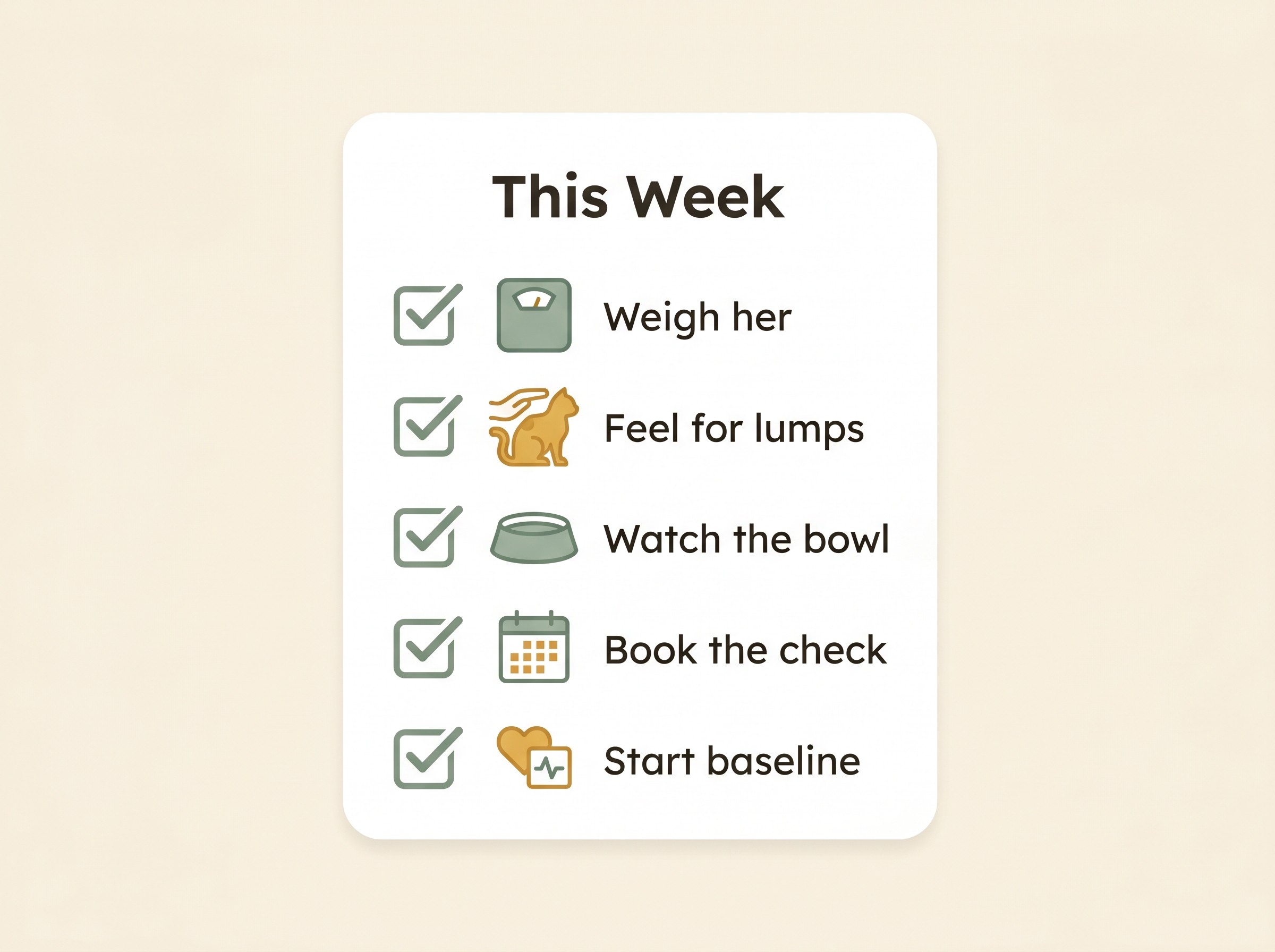
This week, if your cat has just crossed into the mature or senior band:
- Weigh her and write it down. A vet weigh-in is ideal; failing that, weigh yourself holding her and subtract your own weight. Under a thick coat, weight loss is the change you will miss with your eyes, so this is the first line of your baseline.
- Run your hands over her whole body and chin. A slow head-to-tail feel finds new lumps you would otherwise miss, and gives you a sense of how much muscle she is carrying.
- Watch the water bowl and litter tray for a week. Drinking more and bigger clumps are early signals of the common senior conditions, and you only notice the change if you have looked at the baseline.
- Book the six-monthly senior check (and ask whether now is the right time for baseline bloods, urine and a blood-pressure reading).
- Start tracking her Vitality and Mind / Sharpness, so that next time you wonder "is she slowing down, or is something wrong?", you will not be guessing. You will know.
Free downloads
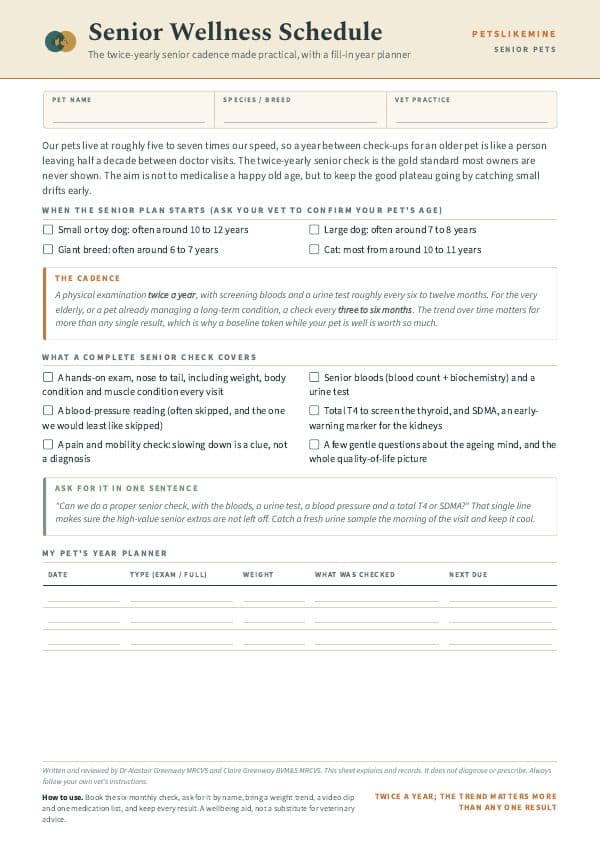
Companion worksheets to put what you've read into practice. Free PDFs, print at home.
Sister tool · Sightline
Track quality of life over time
Sightline, a separate ConciergeVet tool, runs a short adaptive weekly assessment with a quality-of-life focus mode built around exactly these frameworks, tracks a single composite score over time so you can see the trend rather than judge a single bad day, and produces a Sightline Report PDF you can bring to your vet.
A written log, or our printable quality-of-life sheet, does much the same job.
See how Sightline tracks quality of lifeKeep track of how your pet is doing
The owners who cope best are the ones who notice changes early. A simple health log shows you what is working, and what is not, before the next vet visit.
Start tracking, freeYou're not doing this alone
Compare treatment journeys and talk to owners managing senior pets. Free to join.
Join PetsLikeMine