

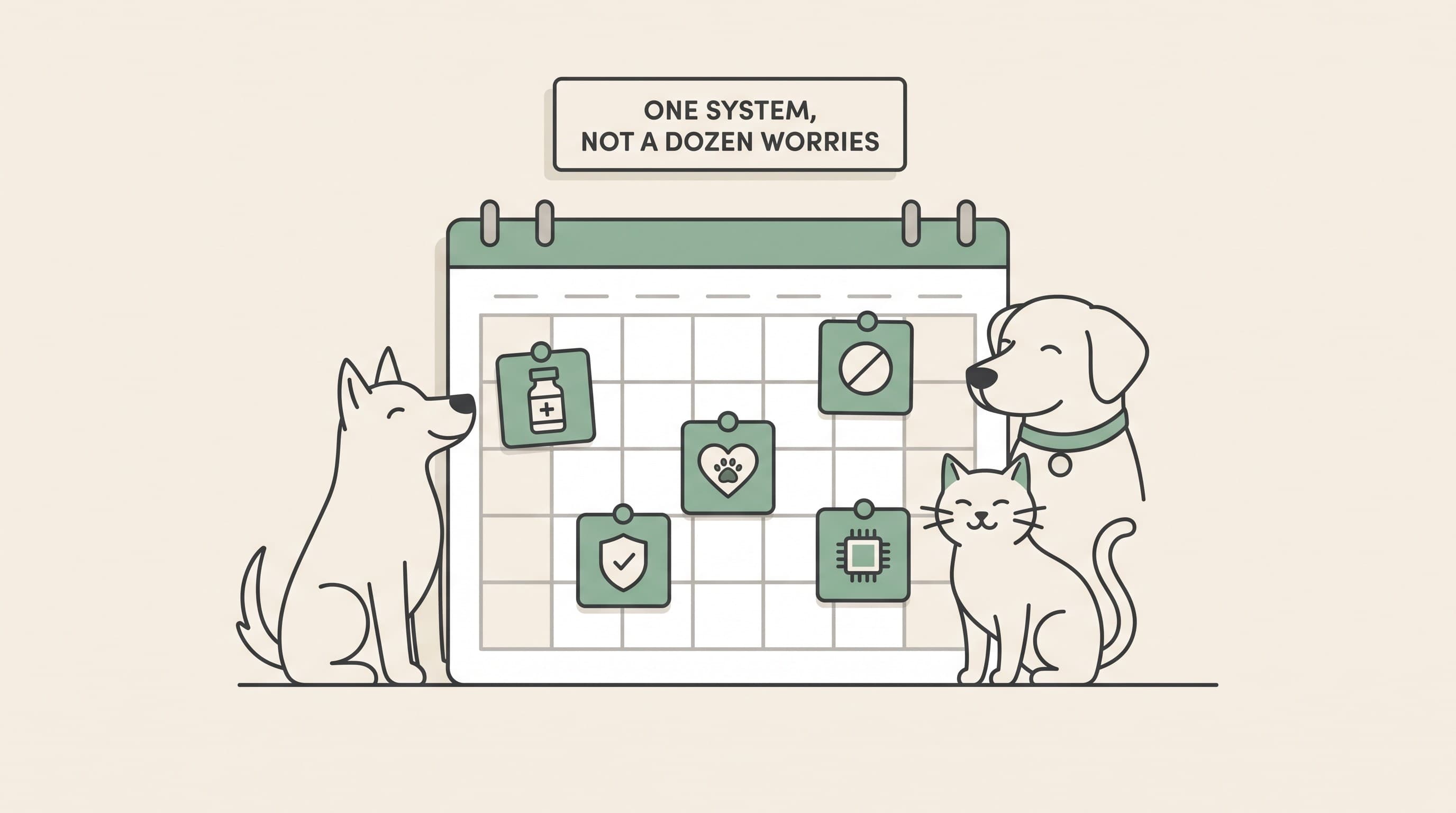
Building Your Pet's Prevention Calendar
Alastair Greenway
BVM&S MRCVS
Preventive care has a quiet flaw: it's not one thing you do, it's a dozen small things you have to remember, spread unevenly across the year. The booster reminder that arrives while you're on holiday. The worming tablet you're fairly sure you gave last quarter but can't actually recall. The insurance renewal that auto-renews at a price you meant to question. The microchip details still registered to a phone number you changed two house-moves ago. None of these is hard. The hard part is holding all of them in your head at once, for years, for every pet you own.
So don't. The purpose of a prevention calendar is to get every recurring task out of your memory and into one system that tells you what's due and when, so that "staying well" stops being a background worry and becomes a short list you tick off. That system, in PetsLikeMine, is the Preventive Care Scheduler, and this piece is the map of what goes into it and why. Think of it as the thread that ties the whole of Staying Well together.
The honest-broker principle behind the calendar
Before the dates, one thing that makes this calendar different from the reminder card your vet posts out, or the app a subscription box gives you. Those default almost everything to monthly, because monthly product sales are how they're funded. That's not what the profession's own guidance says a typical pet needs.
The right calendar isn't the busiest one, it's the one matched to your actual pet, in your actual area, with your actual household. A hunting farm cat, an indoor-only flat cat and a puddle-drinking spaniel in a lungworm hotspot should not have identical schedules. So the sensible first step isn't setting reminders at all, it's the parasite risk quiz, a short lifestyle and region questionnaire built from ESCCAP's risk-based framework. It works out where your pet genuinely sits and populates the scheduler with a plan that fits them, rather than defaulting everyone to the maximum. That's the honest-broker position in practical form: the right amount, not the most.
How the calendar thinks: monthly, seasonal, annual
The trick to a prevention calendar that actually works is to sort every task by how often it truly recurs, and then let the scheduler surface each one only when it's due. Almost everything in preventive care falls into three rhythms: things you review each month, things that turn with the seasons, and things that come round once a year (or, for a couple of the vaccines, once every three). Nothing here is a daily task, the everyday habits like toothbrushing and portion control are just that, habits, and they live in your routine rather than as calendar reminders.
The monthly rhythm: looking, not dosing
The most valuable monthly task costs nothing: a quick at-home nose-to-tail check and a hands-on body condition check. Once a month you run your hands over your pet, note any new lump, glance at eyes, ears and teeth, and confirm they're a healthy weight. This is your early-warning system, and it's a genuine monthly reminder worth setting.
Flea and tick prevention, where your pet needs it, may also fall into a monthly or a longer interval depending on the product and the risk, so the scheduler tracks the next dose date for whatever plan you and your vet have agreed rather than assuming a blanket monthly one.
The seasonal rhythm: worming and parasite pressure
Worming for most pets sits on a quarterly footing. ESCCAP's baseline for a typical pet is a minimum of four roundworm treatments a year, roughly every three months, with more frequent worming reserved for genuinely higher-risk animals such as those in homes with young children, scavengers, hunters, or raw-fed pets. That quarterly beat maps neatly onto the seasons, so the scheduler carries four worming prompts across the year rather than a monthly one you may not need. The one thing that's never optional is roundworm control, because Toxocara is a genuine risk to people, especially children, which is covered in worming: how often does your pet really need it?.
Parasite pressure also genuinely rises and falls with the seasons, ticks peak in spring and autumn, lungworm risk tracks slug and snail activity, so a seasonal review of the parasite plan (a good moment to re-run the risk quiz if anything's changed, a house move, a new baby, a switch to raw feeding) belongs on the calendar too.
The annual rhythm: the big anchors
Four tasks come round once a year, and these are the backbone of the calendar.
- The annual health check is the appointment where your vet turns "seems fine" into real reassurance, or catches something early. It's the most valuable ten minutes of your pet's year, and it's due annually. What actually happens in it is covered in the annual health check.
- Boosters ride alongside that visit but on a split schedule that surprises people. The non-core vaccines that genuinely need yearly cover, leptospirosis and kennel cough for dogs, are annual; the core vaccines are boosted no more often than every three years under current WSAVA guidance. So the scheduler carries an annual booster prompt and flags the triennial core year when it comes round, which is exactly why one year's "booster" bill looks different from the next. The detail is in the UK vaccination schedule and do dogs really need a booster every year?.
- Insurance renewal deserves its own annual prompt, because policies auto-renew and premiums climb, and the renewal date is the one sensible moment to check the cover still fits (without switching insurers carelessly, since that can lose cover for existing conditions). The framework for judging it is in choosing pet insurance.
- Microchip-detail review is the annual task everyone forgets and the one that actually reunites lost pets. A chip only works if the registered phone number and address are current, and for dogs keeping them updated is a legal requirement. Once a year, confirm your details are right on the database. The law itself is in microchipping: the law for dogs and cats.
Starting from scratch, or with more than one pet
Two situations make the "hold it all in your head" approach fall apart completely, and both are exactly where a calendar earns its keep.
The first is an unknown history, most often a rescue. If you've taken on a pet whose paperwork is thin or missing, you genuinely don't know when they were last vaccinated or wormed, and guessing is risky in both directions. Here the sensible move is to note what you do know, book a health check to establish a baseline, and let your vet advise on restarting the vaccination and worming schedule from a known point. Once you have that first solid date, the scheduler carries it forward for you, and you never have to guess again.
The second is a multi-pet household, where the mental load multiplies fast: three pets, each with their own booster month, worming beat and insurance renewal, is genuinely impossible to track reliably by memory. The scheduler holds a separate calendar per pet, so a busy household sees one combined list of what's due this month across all of them, rather than four sets of reminder cards pinned to the fridge and half of them out of date. This is also where the data quietly becomes valuable: every date you enter is building a real health record for each pet, the kind of continuous history that's genuinely useful the day something goes wrong.
Fitting the calendar to your pet's life stage
A prevention calendar isn't fixed for life, it shifts as your pet does, and the scheduler adjusts with them.
Puppies and kittens run on a compressed, front-loaded version of everything: a primary vaccination course, more frequent worming in the early months, neutering decisions, and the microchip deadline. If you've a young pet, the New Puppy and Kitten space lays the first-year roadmap out in full, and the scheduler builds it in for you.
Senior pets step up rather than down. The single most useful change in an older pet's calendar is moving the health check from once a year to twice, because a lot can change in twelve months when a pet is ageing, and problems caught at a six-monthly check are problems caught earlier. When your pet reaches that stage, the Senior Pets space covers what changes and why, and the scheduler can shift the check-up rhythm accordingly.
The everyday habits that sit alongside the calendar
Two of the most important pieces of prevention aren't calendar dates at all, they're daily habits, and it's worth being clear about the difference so you don't wait for a reminder that shouldn't exist. Dental care works because it's done little and often as part of your routine, not because a prompt tells you to, and preventing dental disease at home explains how. Weight is held steady by everyday portion control and treat discipline rather than by a scheduled event, with weight and body condition as the guide, and the Weight Management space for when a pet needs a real plan. The calendar handles the periodic tasks; these habits fill the gaps between them.
Building yours, today
You don't have to reconstruct the whole thing from memory. Start the Preventive Care Scheduler, add your pet, and enter the dates you do know, the last booster, the last worming, the insurance renewal month, and it will work out what's next and surface each task through your Care Hub as it falls due. Run the parasite risk quiz so the flea and worm side is matched to your pet rather than defaulted to monthly. Then let it do the remembering for you.
The best measure of a prevention calendar is that you stop thinking about it. The reminders arrive when things are genuinely due, you act on the short list, and the low background hum of "am I forgetting something for the dog?" simply goes quiet. That's the whole point: not more tasks, but the right ones, at the right time, off your mind and onto a page that keeps track for you.
Free downloads
Companion worksheets to put what you've read into practice. Free PDFs, print at home.
Keep track of how your pet is doing
The owners who cope best are the ones who notice changes early. A simple health log shows you what is working, and what is not, before the next vet visit.
Start tracking, freeYou're not doing this alone
Compare treatment journeys and talk to owners managing staying well. Free to join.
Join PetsLikeMine