

Worming: How Often Does Your Pet Really Need It?
Alastair Greenway
BVM&S MRCVS
Monthly? Every three months? Twice a year? If you've been given three different answers to how often you should worm your pet, you're not imagining it, and it isn't because anyone is trying to mislead you. It's because the honest answer genuinely depends on your pet and your household, and turning that into a rule you can actually live by takes a little unpacking.
Let's do that unpacking properly, because worming is one area where getting it right really matters, and not only for your pet. It matters for your family too.
Why you've been given different answers
Part of the confusion is honest disagreement about a genuinely individual question, but part of it is that the loudest default in pet care, "treat everything, every month", is also the one that sells the most product. Monthly subscription boxes, wellness plans and pharmacy reminders are all built around a steady monthly cadence. That isn't a scandal, and monthly is genuinely right for plenty of pets, but it does mean the message you hear most often was shaped partly by a business model rather than purely by your pet's risk. The veterinary profession's own guidance takes a different starting point: risk-assess the individual animal and match the plan to it, rather than defaulting everyone to monthly (BVA/BSAVA/BVZS, 2021, updated 2025). So when we walk you through a risk-based answer here, we're describing your own profession's current position, not arguing with your vet.
Start with the baseline
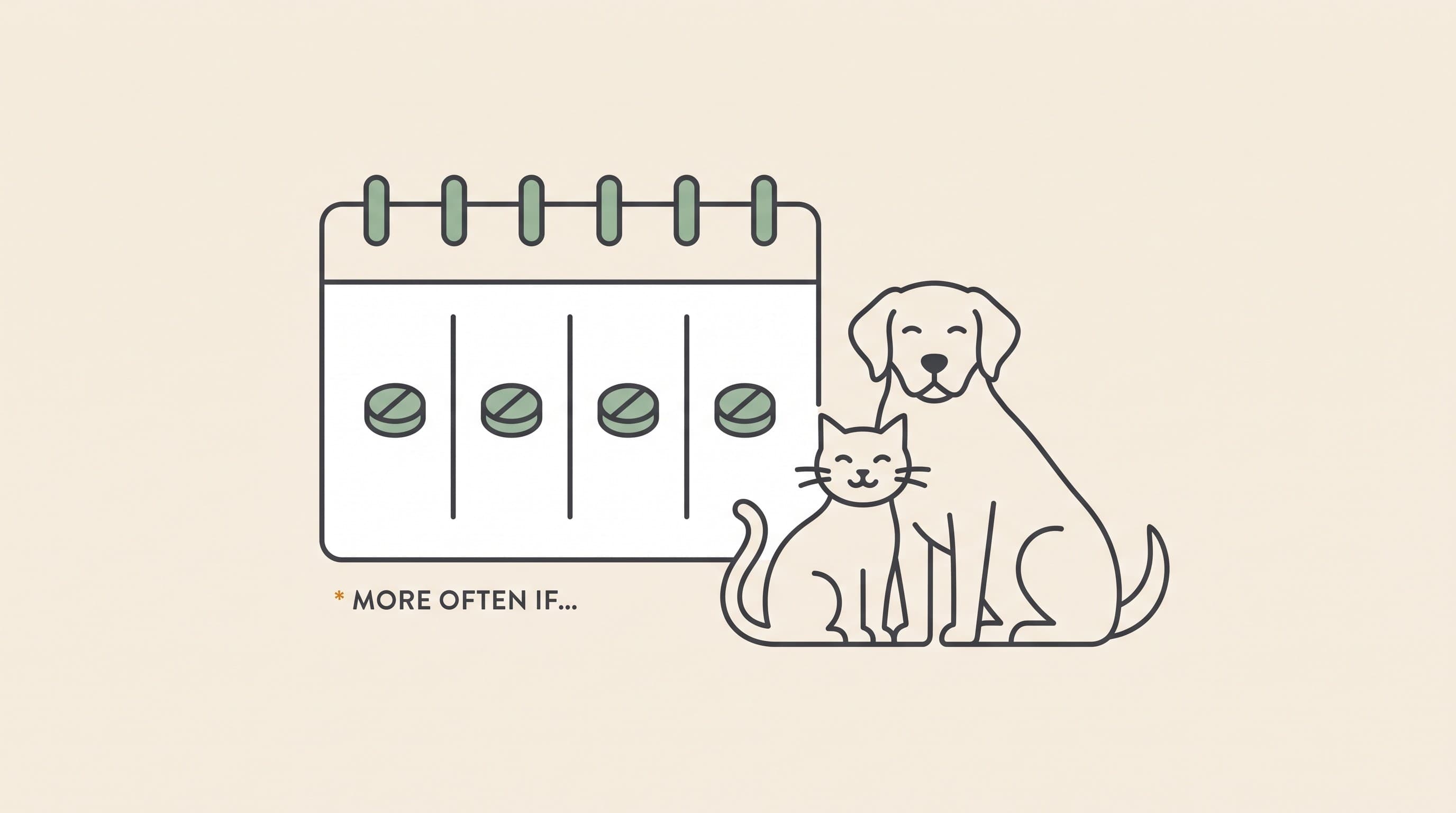
Here is the number to anchor to. For most cats and dogs, the sensible baseline recommended by ESCCAP UK & Ireland (the body that sets parasite-control guidance for this part of the world) is a minimum of at least four worming treatments a year, which works out at roughly one every three months (ESCCAP UK & Ireland, GL1 Worm Control, 7th edition, June 2025).
That baseline exists because treating only once or twice a year leaves long gaps in which worms can establish and, crucially for roundworm, in which eggs can be shed into your home and garden. Quarterly treatment keeps that under reasonable control for a typical, average-risk pet. So if you take nothing else from this article, "at least four times a year" is the floor to build from, not the ceiling.
When monthly is genuinely the right answer
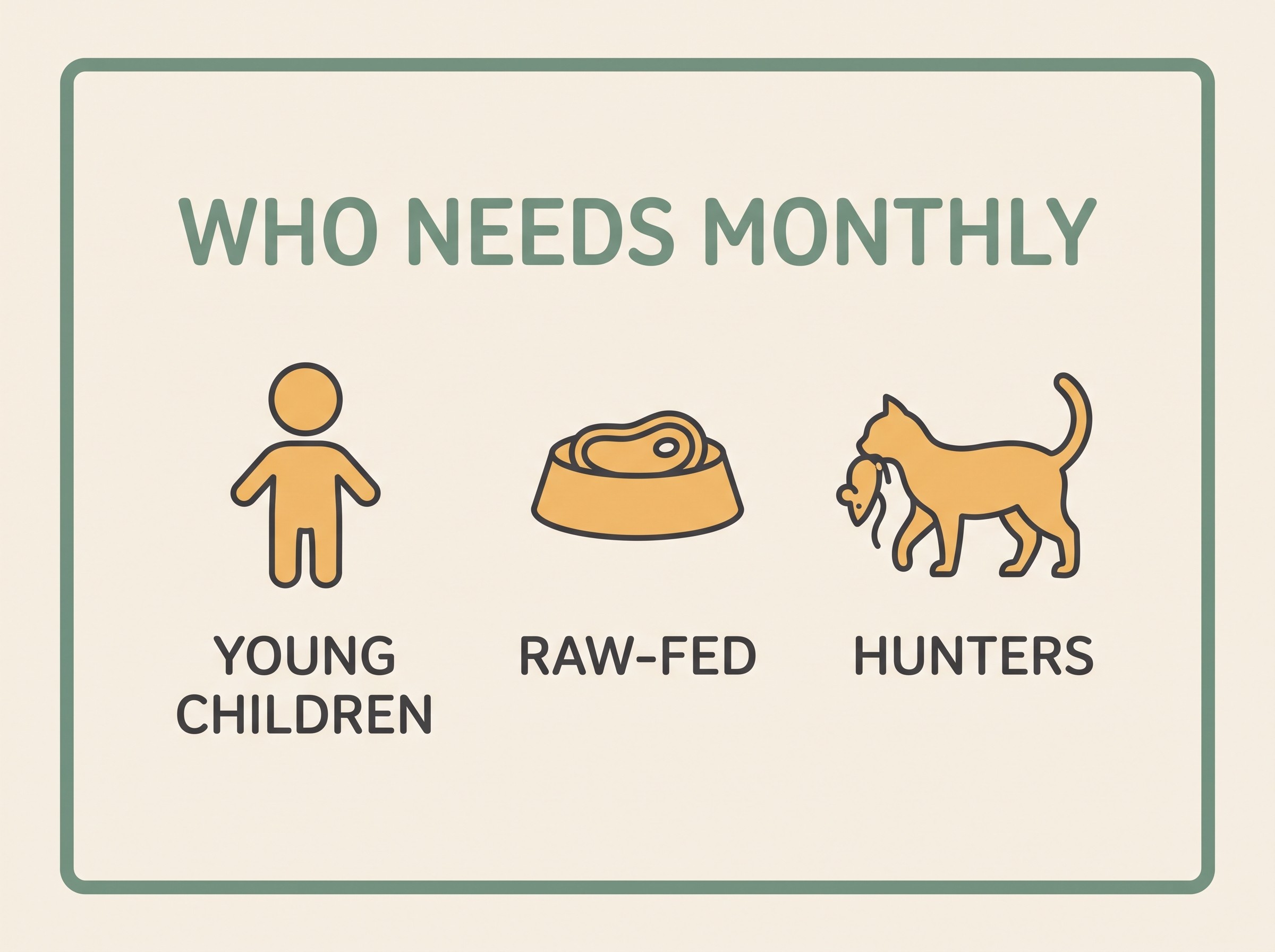
Notice that risk-based worming can point upward just as easily as downward. For some pets and some households, quarterly isn't enough, and monthly treatment is the genuinely correct, evidence-based choice. That's the case when:
- There are young children in the home, or anyone who is pregnant or immunocompromised. This is the big one, and we'll come back to why in a moment.
- Your pet hunts or scavenges. Cats that catch and eat rodents or birds, and dogs that scavenge, are constantly re-exposed, because prey animals carry worm stages.
- Your pet is raw-fed. Raw meat diets can be a route for certain parasites, so raw-fed pets often need more frequent worming.
- There's a specific tapeworm risk in the household or lifestyle.
If any of those describe your home, monthly worming is not over-treating. It's matching the plan to a genuinely higher risk. Risk-based means right-based, and sometimes right is more.
The one you never skip
Now the part that has to be said plainly, because it is the whole reason worming is never truly optional.
Roundworm, and Toxocara in particular, is zoonotic. That means it can pass from pets to people. The eggs are shed in an infected animal's faeces and, given a couple of weeks in the environment, become infectious. If a person, most often a young child, accidentally swallows those eggs (from soil, sandpits, or unwashed hands), the larvae can migrate through the body and, rarely but seriously, damage the eyes or internal organs. This is called ocular or visceral larva migrans, and it can cause lasting harm, including sight loss in a child (ESCCAP UK & Ireland, GL1, 2025).
This is why roundworm control is non-negotiable, and why "risk-based" never collapses into "optional" for this particular worm. When there are children in the home, the maths tilts firmly toward more frequent treatment, and the small effort of regular worming protects the humans in your household as much as the pet. There's more on this, without the scaremongering, in Roundworm and Your Family: Why Some Worming Is Non-Negotiable.
A quick word on the worms themselves
It helps to know that "worming" isn't one thing, because different worms behave differently and that's part of why frequency isn't one-size-fits-all.
Roundworms (Toxocara being the important one) are the everyday concern. They're common, especially in young animals, they're the zoonotic risk to people, and their eggs are shed in faeces and contaminate the environment. This is the worm the quarterly baseline is really built around.
Tapeworms are picked up rather than caught directly, usually by swallowing an infected flea or infected prey, so their risk tracks your pet's flea control and hunting habits rather than a fixed calendar.
Whipworms and hookworms are less common in the UK but do occur, and are covered by many broad-spectrum wormers. Lungworm is a worm too, but a special case with its own transmission route and its own products, covered separately in Lungworm in the UK: Risk by Region.
Most owners don't need to memorise all of this. The reason it matters is simply that a good worming plan is chosen to cover the worms your pet is actually likely to meet, which is another reason "what product, how often" is a conversation rather than a reflex.
Do wormers prevent, or just treat?
One point that trips people up: most wormers don't stop your pet catching worms in the first place, they clear the worms your pet already has at the moment you give the dose. That's why frequency matters so much. A treatment today does nothing about a worm picked up next week, which is the whole logic behind treating often enough to keep any burden from building up and, for roundworm, from contaminating your home between doses. It's also why "I wormed him last year" isn't the reassurance it sounds like.
Tapeworm and the special cases
Roundworm is the everyday worm, but it isn't the only one. Tapeworm works differently: pets usually pick it up by swallowing something that carries it, most often an infected flea during grooming, or, in hunting animals, infected prey. This is one of the ways flea control and worm control are linked, because a flea problem can quietly become a tapeworm problem too.
There's also a more serious tapeworm, Echinococcus, which matters for dogs that could be exposed (for example through eating raw offal or in certain rural settings) and which is itself a zoonotic concern. And there's a legal dimension worth flagging: dogs re-entering the UK after travel abroad must have a tapeworm treatment (praziquantel) given by a vet within a set time window before entry, to keep Echinococcus multilocularis out of the country. If you travel with your dog, that treatment isn't optional, it's a legal requirement, and your vet will time it for you.
Puppies and kittens are a different story
Very young animals need worming much more often than adults, because they can be born with, or pick up early, a heavy roundworm burden from their mother. The routine for the first few months of life is more frequent, then it settles down toward the adult schedule. If you have a new puppy or kitten, don't apply the adult "four times a year" rule to them yet, follow the early-life schedule your vet sets. The full first-year picture is laid out in The First-Year Roadmap for Puppies and Kittens.
Can you tell if your pet has worms?
Sometimes, but not reliably, which is exactly why routine control matters rather than waiting for symptoms. Many pets with a modest worm burden look completely healthy, which is reassuring for them but unhelpful for you. When signs do appear they can include visible worms or worm segments (tapeworm segments look like grains of rice near the tail or in bedding), a pot-bellied appearance in puppies and kittens, weight loss despite a good appetite, a dull coat, diarrhoea, or "scooting" along the floor (though scooting is more often about anal glands than worms).
The catch is that by the time roundworm is causing visible signs, eggs have very likely already been shed into your home, which is the risk to your family. So the aim of a worming plan isn't to react to symptoms, it's to keep the burden low enough that it rarely gets that far. Absence of visible worms is genuinely not proof your pet is worm-free.
Is there an alternative to routine dosing?
For some genuinely low-risk adult pets, there is another evidence-based option worth knowing about: faecal testing. Instead of dosing on a fixed schedule, your vet can test a stool sample periodically and treat only when worms are actually found. ESCCAP recognises testing as a legitimate part of a risk-based approach for suitable animals.
It's important to be clear about what this does and doesn't do. Faecal testing works for some worms but not perfectly for all (a negative test isn't a cast-iron guarantee), and it's generally suited to lower-risk adults rather than to households with young children, where the safer default is regular treatment regardless. But if you have a settled, low-risk pet and you'd rather not dose routinely, testing is a reasonable thing to raise with your vet rather than something you have to argue for.
So how often should *your* pet be wormed?
Pulling it together: the baseline for most pets is at least four times a year, roughly quarterly. Step it up toward monthly if there are young children or immunocompromised people at home, if your pet hunts, scavenges or is raw-fed, or if there's a specific tapeworm risk. Consider faecal testing as an alternative for a genuinely low-risk adult. And whatever the frequency, roundworm control stays on the list, because of the risk to the people you live with.
The parasite risk quiz will walk you through your household and your pet's habits and give you a personalised starting point, and once you and your vet have agreed the right interval, the Preventive Care Scheduler will keep it on track (quarterly, monthly or seasonal, as agreed) so you're never guessing when the next one is due.
The question to take to your vet: "Given who lives in our home and what my pet gets up to, is quarterly enough, or do we need monthly, and would faecal testing be a sensible option for us?" Worming is the one area where "do less" has a firm limit, because roundworm can make children seriously ill. Risk-based worming means matching the frequency to your household, not dropping it, and your vet can set the interval that fits your particular situation.
References
- ESCCAP UK & Ireland. *Guideline 1: Worm Control in Dogs and Cats*, 7th edition (June 2025). Risk-based deworming; minimum baseline of at least four treatments a year for roundworm; monthly for higher-risk animals; *Toxocara* zoonosis; faecal testing; tapeworm and *Echinococcus* in at-risk groups.
- British Veterinary Association, British Small Animal Veterinary Association and British Veterinary Zoological Society (2021, updated 31 October 2025). *Responsible use of parasiticides for cats and dogs* (position statement); risk-assess the individual, avoid blanket treatment.
- NOAH Compendium. UK licensed-product datasheets (worm spectrum, including which products cover which worms; praziquantel for tapeworm).
- GOV.UK. Bringing your pet dog to Great Britain: tapeworm treatment requirement.
Free downloads
Companion worksheets to put what you've read into practice. Free PDFs, print at home.
Your Pet's Year-Round Prevention Calendar
PDF · 272 KBA fill-in annual wall-planner for the tasks that keep a well pet well: vaccination and boosters, quarterly worming, flea and tick, the annual health check, microchip-detail review and insurance renewal, each sorted by how often it truly recurs. Pairs with the Preventive Care Scheduler.
Your Risk-Based Parasite Plan
PDF · 266 KBA take-to-the-vet worksheet: work through the lifestyle and region questions (hunting, swimming, lungworm areas, raw diet, multi-pet, young children, indoor-only cat) and write down the plan you agree together. Roundworm control stays non-negotiable. Pairs with the parasite risk quiz.
Keep track of how your pet is doing
The owners who cope best are the ones who notice changes early. A simple health log shows you what is working, and what is not, before the next vet visit.
Start tracking, freeYou're not doing this alone
Compare treatment journeys and talk to owners managing staying well. Free to join.
Join PetsLikeMine