

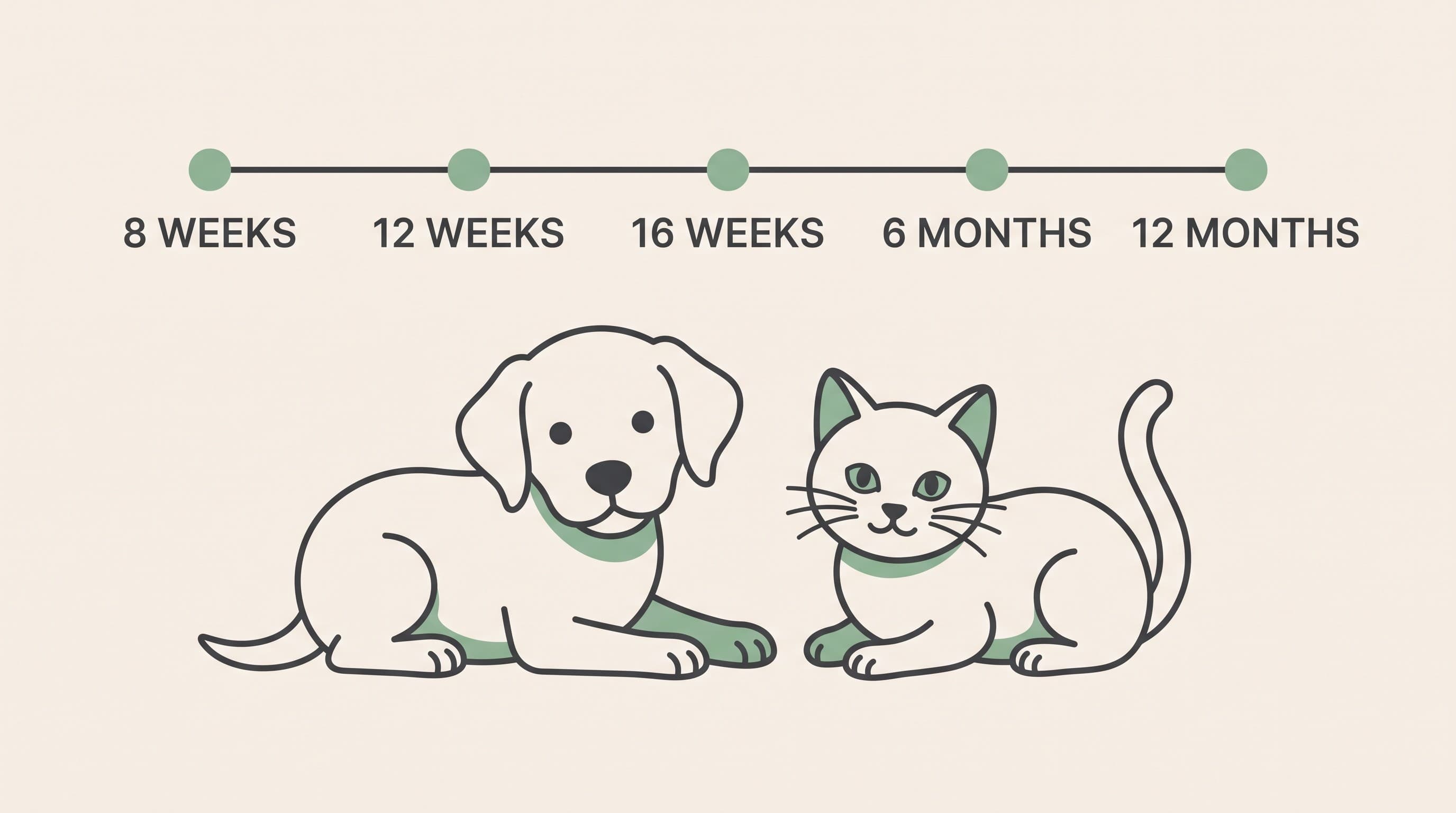
The First-Year Roadmap for Puppies and Kittens
Alastair Greenway
BVM&S MRCVS
Bringing home a puppy or a kitten is joyful and, if you are anything like most new owners, quietly overwhelming. Alongside the delight there is a long, jumbled list of things you have been told you must do, jabs and worming and chipping and neutering and "socialisation", each with its own timing, and no single place that lays it all out in order.
This is that place, at least for the medical and preventive side. Think of it as a roadmap for the first year: what happens when, and why, so you can walk into your first vet appointment already understanding the plan rather than nodding along to it. It is an overview, deliberately, because the first year is far too big for one article. Once you have the shape of it, I will point you to the space we built to hold your hand through the whole thing.
One promise up front: puppies and kittens are not the same animal on a different setting, and I will keep them distinct wherever the timing genuinely differs. Where I say "your pet", it applies to both. Where it splits, I will say so.
The first weeks: settling, and the first vet visit
Before any needles, the first job is simply letting your new arrival settle, and getting them seen. An early "well pet" check, ideally in the first week or so, is worth booking even if everything looks perfect. It lets your vet confirm your pet is healthy, check for the things a new owner would not spot, a heart murmur, a hernia, retained testicles, cleft issues, and start the relationship on a happy, treat-filled note rather than waiting for the first problem.
It is also the moment to sort the paperwork side of things, which matters more than it sounds.
Microchipping and the law
Your puppy or kitten must be microchipped, and this is law, not just good practice.
For dogs, microchipping has been compulsory across England, Scotland and Wales since 6 April 2016. A puppy must be chipped and registered on a compliant database by the age of eight weeks, which in practice means a responsible breeder should have done it before you collect them.
For cats, the law is newer and catching up. In England, cats must be microchipped and registered by the age of twenty weeks, with this having become compulsory on 10 June 2024. At the time of writing, Scotland, Wales and Northern Ireland do not yet require cats to be chipped, though this is an area that is changing, so check the current position where you live.
Whichever pet you have, the single most important part is the bit everyone forgets: the chip only works if the registered contact details are yours and are current. The full detail, including how to check and update your pet's record, is in our guide to microchipping law.
Vaccinations: the primary course and the first booster
This is the part with the tightest timing, so it is worth understanding rather than just turning up for.
Puppies and kittens are protected in early life by antibodies from their mother, but that protection fades over the first few months, and there is a window where it has faded enough to leave them vulnerable but can still block a vaccine from working properly. That is why the early vaccines come as a primary course of more than one dose, spaced a few weeks apart, rather than a single jab.
Current WSAVA guidance is that the final dose of the primary course is given at sixteen weeks of age or older, because before that maternal antibody can still interfere. This is important and often surprises owners: your pet is not reliably protected until that later dose has been given and has had time to take effect, which has real consequences for when it is safe to do certain things. After the primary course comes a first booster at six or twelve months, and only after that does the pet settle onto the adult schedule, where the core vaccines are boosted no more often than every three years while some non-core ones remain annual.
For puppies, the core vaccines cover distemper, infectious hepatitis and parvovirus, diseases that can kill, with leptospirosis and kennel cough added by lifestyle. For kittens, core covers panleukopenia, herpesvirus and calicivirus, and the feline leukaemia virus vaccine is now recommended for kittens and outdoor cats. The full picture is in our UK vaccination schedule.
The socialisation window can't wait for the last jab
Here is a genuine tension that trips up careful owners. Your pet is not fully protected until the primary course is complete, yet the critical window for socialisation, the weeks in which a puppy or kitten learns that the world is safe, closes early, before those vaccines are finished.
You cannot afford to keep a puppy shut away from all experience until it is fully vaccinated, because a pet that misses socialisation can end up with lifelong fear and behaviour problems that are far harder to live with than the risks you were trying to avoid. The answer is careful, not zero: safe, controlled experiences, carrying a puppy in your arms, meeting calm vaccinated dogs, exposure to sounds and people at home, rather than the puddles and public parks where infection risk is highest. This is exactly the sort of nuanced, timing-critical topic that the dedicated space handles far better than an overview can, so treat this as a flag to go and read the detail.
Worming and parasites in the first year
Puppies and kittens need worming more often than adults, because many are born with or quickly pick up roundworms. A typical early schedule is frequent worming through the first months, then settling towards the adult risk-based interval.
Roundworm control genuinely matters here, and not only for your pet. Roundworm (Toxocara) is zoonotic, meaning it can pass to people and cause serious illness, particularly in young children, which is why some worming is simply non-negotiable however low-risk your household feels (ESCCAP UK & Ireland). Once your pet is older, worming and flea treatment move onto a risk-based footing tailored to how they actually live, which we cover in worming: how often does your pet really need it? and does my pet actually need monthly flea treatment?.
Neutering: a first-year decision, but not a fixed date
Somewhere in the first year, neutering comes up, and it is the one item on the roadmap where I most want to stop you reaching for a single number.
For cats, the picture is now fairly settled: neutering from around four months of age is widely recommended, before they reach sexual maturity, which prevents unwanted litters and unwanted behaviours. For dogs, it is genuinely more individual. The evidence on timing has moved a great deal, and for many larger dogs there is now a case for waiting until they are closer to skeletally mature rather than neutering early, while for many smaller dogs earlier is fine. There is no single right age for dogs, and the right answer depends on breed, size and sex. Please do not carry the cat timing across to a dog, or vice versa. We have laid out the whole balance, for both species kept separate, in neutering: timing and the honest trade-offs.
Then comes the first-birthday check
The first year ends where the rest of adult life begins: the first-birthday health check, the transition onto adult food, the first booster settled, and a preventive plan set for the years ahead. It is a natural moment to take stock of the whole picture with your vet, and to start the annual rhythm covered in the annual health check.
Where to go from here
I have given you the skeleton. The first year has a great deal more flesh on it, the toilet training and the sleepless first nights, the socialisation checklist done properly, the growth and feeding, the adolescence that ambushes owners around six to twelve months, and we could not do it justice here without writing a book.
So we did build the book, in effect. The New Puppy & Kitten space is dedicated to this whole first year, week by week and topic by topic, with tools to track growth and keep the schedule straight. If you have just brought a puppy or kitten home, go there next. It is where the real detail lives.
And do the practical thing today: put the vaccination dates, the worming intervals and the microchip registration into the Preventive Care Scheduler. The first year moves fast, the timing is tighter than at any other stage of life, and a due date that lives in the app instead of your head is one less thing to lie awake worrying about.
Keep track of how your pet is doing
The owners who cope best are the ones who notice changes early. A simple health log shows you what is working, and what is not, before the next vet visit.
Start tracking, freeYou're not doing this alone
Compare treatment journeys and talk to owners managing staying well. Free to join.
Join PetsLikeMine