

Microchipping: The Law for Dogs and Cats in the UK
Alastair Greenway
BVM&S MRCVS
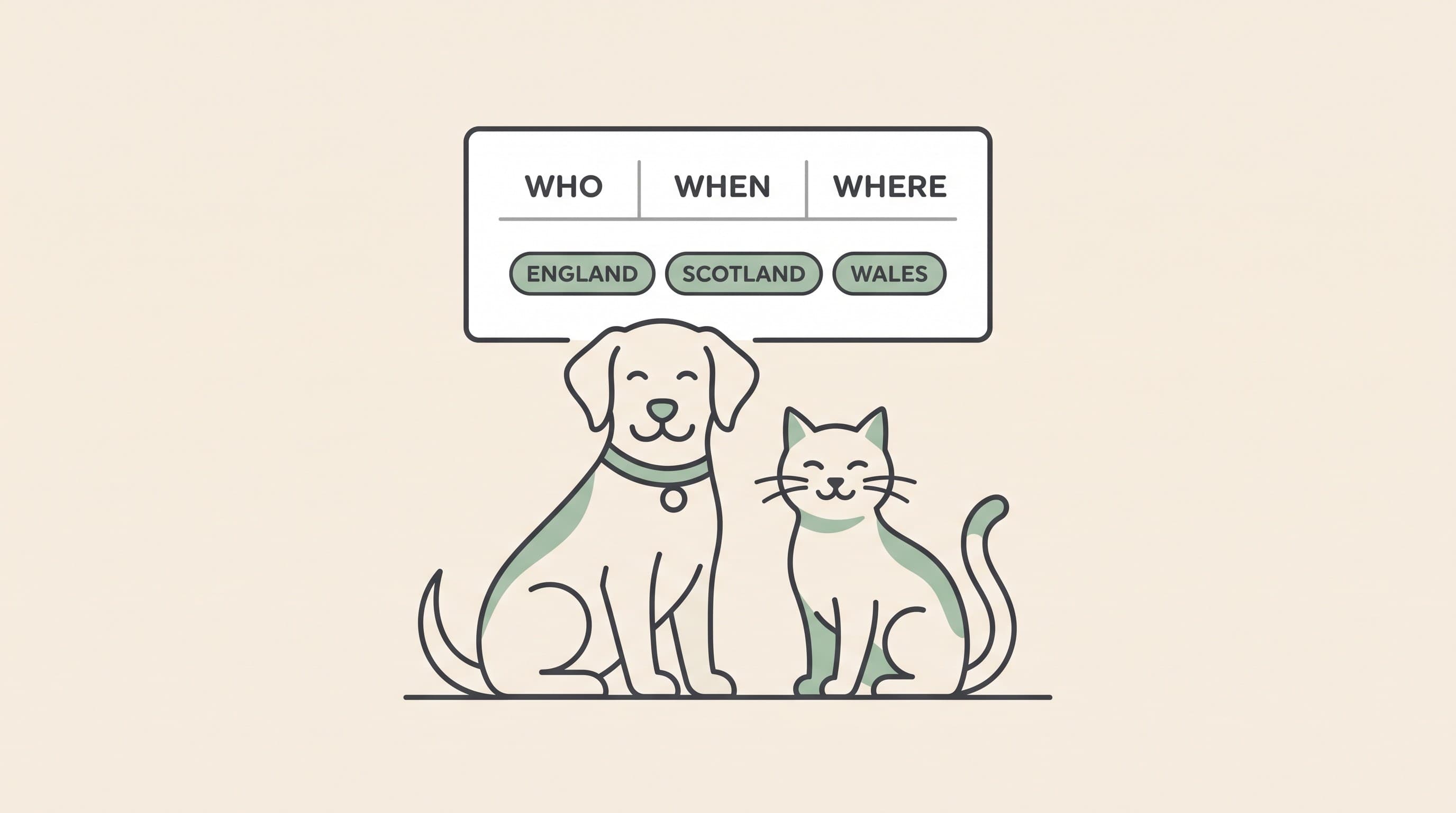
If you've just got a puppy or kitten, or you've heard that cats now legally need chipping and you're not sure whether that includes yours, this is the piece that gives you a plain answer. Microchipping law in the UK is one of those things that sounds simple until you realise the rules are different depending on which nation you live in, and different again for cats and dogs. So let's lay it out clearly, tell you exactly what you're required to do, and cover the part almost everyone forgets, which is the part that actually reunites lost pets with their families.
A quick note before we start. Laws change, and the cat law in particular is recent and still being campaigned on in the other nations. Everything here reflects the position at the time of writing, and we flag every date so that it can be checked against the current rules where you live. If you want the definitive word for your exact situation, gov.uk and your vet are the places to confirm it.
Dogs: compulsory for years, in every nation
Let's start with the settled part. Dogs have been legally required to be microchipped for a long time now, so if you have a dog, the law almost certainly already applies to you.
In England, Scotland and Wales, microchipping became compulsory on 6 April 2016 (gov.uk). Your dog must be microchipped by the age of eight weeks, and registered with your contact details on a compliant database. In practice this means a responsible breeder should have chipped a puppy and registered it before you ever collected it, and the registration should then be transferred into your name.
Northern Ireland is actually ahead of the rest of the UK here. Dog microchipping has been compulsory there since 2012, a few years before Great Britain caught up.
The penalty for not complying is a fine of up to £500 if you don't get your dog chipped within a set notice period after being told to (gov.uk).
So for dogs, across the whole UK, the answer is the same: your dog must be chipped, and it must be registered to you. If you've taken on an older dog and you're not certain whether it's chipped, any vet or rescue centre can scan it for you in seconds, usually free of charge.
Cats: the newer law, and it's not the same everywhere
This is the part that's caught a lot of owners by surprise, because for most of us cats being chipped was a good idea rather than a legal duty for a very long time. That has now changed, but only in one nation so far.
In England, cat microchipping became compulsory on 10 June 2024 under the Microchipping of Cats and Dogs (England) Regulations 2023 (gov.uk). If you keep a cat in England, it must be:
- microchipped and registered on a compliant database
- chipped by the time it is 20 weeks old
If your cat isn't chipped, you can be given a notice and 21 days to sort it out. If you don't, you can face a fine of up to £500 (gov.uk).
Now the crucial nation split, because this is where owners get it wrong. At the time of writing:
- Scotland: not yet compulsory for cats.
- Wales: not yet compulsory for cats.
- Northern Ireland: not compulsory for cats.
Charities including Cats Protection and the RSPCA have been campaigning for the other nations to follow England's lead, so this is genuinely a "watch this space" area, and it may well have changed by the time you read this.
To be completely clear about why we keep flagging these dates: legal requirements are live, they get updated, and the cat law especially is one that could extend to other nations at short notice. Don't take a date on any web page, including this one, as gospel. Check gov.uk or ask your vet for the current position where you live.
The bit everyone forgets: keeping your details up to date
Here's the part that matters more than any of the dates above, and it's the part the law is quietly built around.
A microchip is not magic. It's a tiny sterile capsule, about the size of a grain of rice, placed under the skin between your pet's shoulder blades. It doesn't do anything on its own. When a vet, a warden or a rescue centre scans it, all it gives them is a unique number. That number then has to be looked up on a database to find your name and phone number. If those details are wrong, the trail goes cold right there.
This is why the single most useful thing you can do, chipped pet or not, is make sure the registered details are current. If you've moved house, changed your mobile number, or taken on a pet from someone else and never transferred the registration, the chip may be pointing to a phone that no longer rings. Out-of-date or missing contact details are one of the main reasons chipped pets still don't get home (PDSA).
And for dogs, keeping your details current isn't just sensible, it's part of the legal duty. The dog law requires the registered keeper's details to be kept up to date, not simply entered once and forgotten (gov.uk).
So treat the chip as a two-part job. Part one, the chip itself, is usually done by the breeder or at your first vet visit. Part two, the details, is on you, forever, and it's the part that actually works when it counts.
What a microchip is not
It's worth heading off a common and completely understandable hope, because it changes what you rely on the chip for.
A microchip is not a GPS tracker. It won't tell you where your pet is if it wanders off, it doesn't have a battery, and you can't ping it from an app. It only does anything when someone finds your pet and physically scans it. If you want live location tracking, that's a separate GPS collar or tag, which is a different product entirely and not what the law is about.
What the chip gives you is permanent identification that can't fall off, unlike a collar and tag. The two work best together: a collar tag gives an instant phone number to a helpful neighbour, and the chip is the permanent backup that a vet or warden can always read. The law requires the chip. The tag is a good idea on top.
Practical bits: checking, updating and changes of ownership
If you want to get this genuinely sorted rather than just informed, here's what to actually do.
Find out if your pet is chipped, and on which database. Any vet or rescue centre can scan your pet and read the number. To find which database that number is registered on, you can use a chip-checker lookup that searches across the compliant UK databases.
Update your details. This is done directly with the database your pet is registered on, not with your vet. Log in, or contact them, and update your phone number and address. There's sometimes a small admin fee, and it's worth every penny.
Transfers of ownership. If you rehome a pet, or take one on, the registration needs to be transferred into the new keeper's name. A pet that changes hands and never has its chip updated is effectively invisible if it goes missing, so make this part of the handover every time.
New pets. For a puppy or kitten, confirm with the breeder or rescue that it's already chipped and, just as importantly, that the registration is being transferred to you rather than left in their name.
The one thing to do today
You don't need to do everything at once, but there's a single action that pays off out of all proportion to the effort: check that your pet's registered chip details are current, right now. If you've moved or changed your number since your pet was chipped, that's the gap that stops a found pet coming home, and it takes ten minutes to close.
Your vet or a rehoming centre can scan the chip and tell you which database it's on, but only you can keep the details current, and that's the bit that actually reunites a lost pet with you. If you're the sort of person who'll forget, this is a perfect job for the Preventive Care Scheduler, which can hold an annual "check my microchip details" reminder for you alongside your pet's boosters and worming, so it comes round once a year without you having to remember.
If you're setting all of this up from scratch with a new pet, our first-year roadmap for puppies and kittens walks through where microchipping fits alongside vaccinations and worming, and registering with a vet covers getting your practice set up so the scanning, updating and everything else has a home.
References
- GOV.UK. Compulsory dog microchipping comes into effect. Department for Environment, Food & Rural Affairs.
- GOV.UK. Cat microchipping now mandatory. Department for Environment, Food & Rural Affairs, 2024.
- The Microchipping of Cats and Dogs (England) Regulations 2023. UK Statutory Instruments.
- The Microchipping of Dogs (England) Regulations 2015. UK Statutory Instruments.
- BSAVA. Microchipping Legislation. British Small Animal Veterinary Association.
- Cats Protection. Microchipping your cat.
- PDSA. PAW Report. People's Dispensary for Sick Animals.
Free downloads
Companion worksheets to put what you've read into practice. Free PDFs, print at home.
Keep track of how your pet is doing
The owners who cope best are the ones who notice changes early. A simple health log shows you what is working, and what is not, before the next vet visit.
Start tracking, freeYou're not doing this alone
Compare treatment journeys and talk to owners managing staying well. Free to join.
Join PetsLikeMine