

The UK Dog and Cat Vaccination Schedule Explained
Alastair Greenway
BVM&S MRCVS
Let's start with the two honest facts that this whole subject sits on, because most of the confusion comes from people telling you only one of them.
The first is that some of these vaccines protect your pet against diseases that genuinely kill. Parvovirus and distemper in dogs, panleukopenia in cats, are not historical curiosities. Vets who have been in practice a while have watched puppies die of parvo, and it is a grim way to go. These vaccines are not optional in any meaningful sense.
The second fact is that not all of the vaccines your pet receives are needed every single year. The profession's own guidance has said so for years now, and the science behind it is settled enough that your vet almost certainly already works this way.
Both of those things are true at the same time, and a good vaccination plan holds them together. This piece is the map: what a UK dog or cat actually needs, what each vaccine prevents, and how often, with the "every year" ones separated cleanly from the "every three years" ones.
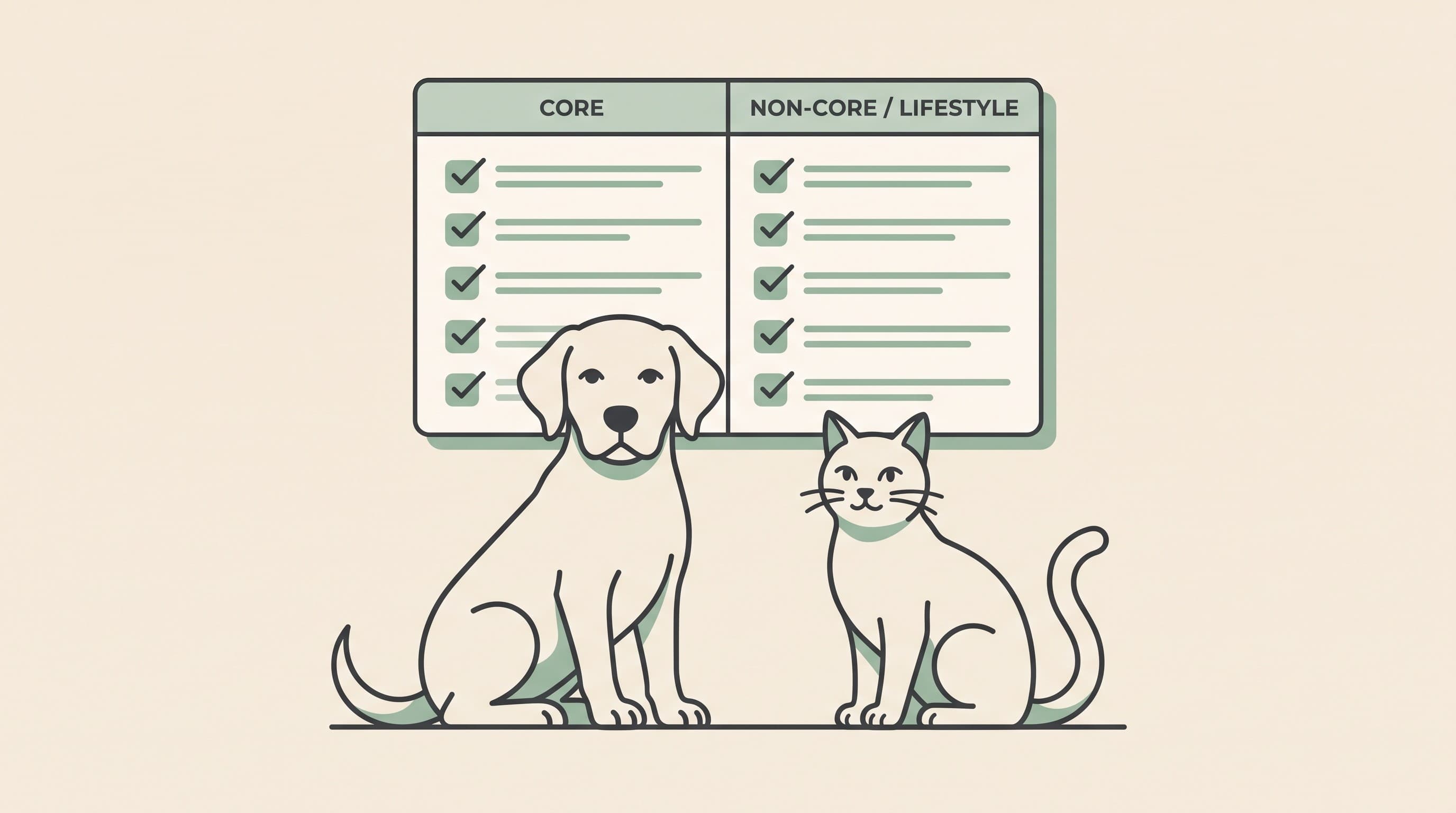
Core versus non-core: the distinction that explains everything
Vets sort vaccines into two groups, and once you understand the split, the whole schedule makes sense.
Core vaccines protect against diseases that are severe, widespread, and dangerous enough that essentially every dog or cat should be protected, whatever their lifestyle. These are the non-negotiable ones.
Non-core vaccines protect against diseases where the risk depends on your individual pet: where you live, whether they board in kennels, whether they roam outdoors, whether you travel abroad. These are chosen by lifestyle, not given by default.
Before we get anywhere near how often, here is what the core vaccines actually prevent, because you deserve to know what you are protecting against.
For dogs: DHP
The canine core is usually written on your record as DHP (sometimes DHPPi or with an L added for leptospirosis, more on that shortly). It covers:
- Distemper: a viral disease attacking the nervous system, gut and respiratory tract. It is frequently fatal, and survivors can be left with permanent neurological damage.
- Hepatitis (infectious canine hepatitis, caused by canine adenovirus, the "H" or CAV): a viral disease that damages the liver and can kill quickly.
- Parvovirus: a brutal gut infection causing catastrophic vomiting and bloody diarrhoea, particularly in puppies. Without intensive treatment it is very often fatal, and even with it, some pups don't make it.
For cats: FPV, FHV-1 and FCV
The feline core is often written as FPV/FHV-1/FCV or shorthanded to the "cat flu and enteritis" jab (AAHA/AAFP 2020). It covers:
- Feline panleukopenia (FPV, feline "parvo" or infectious enteritis): a devastating virus that wipes out white blood cells and the gut lining. In unvaccinated kittens it is a killer.
- Feline herpesvirus (FHV-1) and feline calicivirus (FCV): the two main causes of "cat flu", which can be far more serious than the name suggests, especially in kittens, with severe upper respiratory disease, mouth ulcers, and lasting effects.
None of these are diseases you want your pet to meet unprotected. That's the point of the core group, and it's why the frequency question that follows is never a reason to leave a pet unvaccinated in the first place.
The puppy and kitten primary course
A newborn puppy or kitten gets some temporary protection from its mother's antibodies, but that protection fades over the first weeks of life, and while it is present it can actually block a vaccine from working. This is why the first vaccines come as a primary course of two (sometimes more) doses a few weeks apart, rather than a single jab: it makes sure that once the maternal antibodies drop away, the pet is covered.
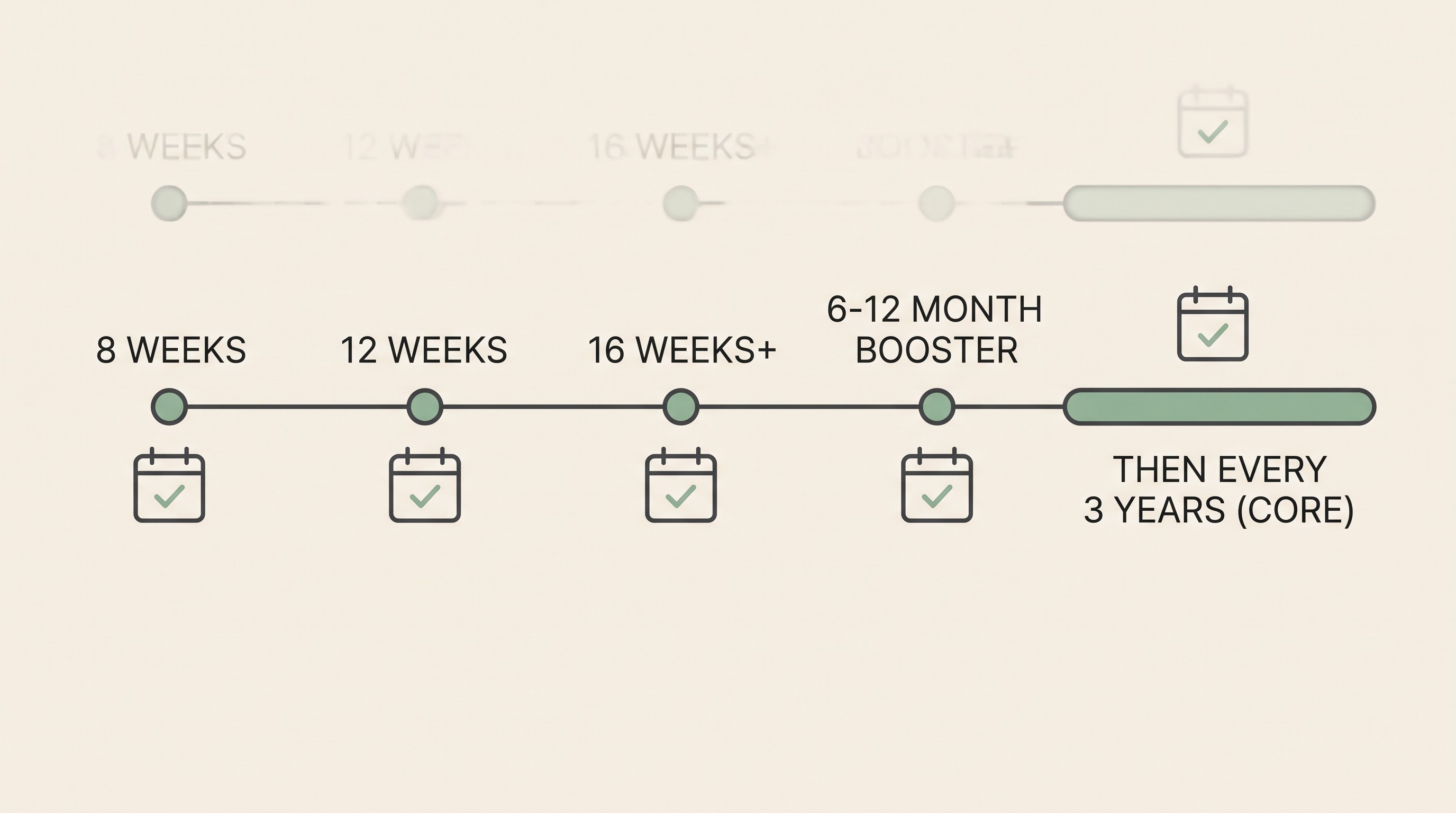
The detail that matters most, and the one owners most often miss, is the timing of the last dose. The current WSAVA guidance is that the final dose of the primary course should be given at 16 weeks of age or older, because giving it too early risks it being blunted by leftover maternal antibody (WSAVA 2024). If your puppy or kitten finished their course before 16 weeks, it is worth asking your vet whether a further dose is advisable, rather than assuming they're fully covered.
After the primary course: the first booster, then triennial core
Here is where the "not every year" part comes in, and it is worth reading slowly because it is the single most misunderstood point in preventive care.
After the primary puppy or kitten course, your pet gets a booster at either 6 or 12 months of age. This one matters: it catches any animal whose primary course didn't take fully, and it sets up long-lasting immunity.
After that booster, the core vaccines are given no more often than every three years (WSAVA 2024). Not annually. The immunity from the core viral vaccines is long-lived, and repeating them every twelve months doesn't add meaningful protection. This is the profession's own position, published by the World Small Animal Veterinary Association, and it is why your vet may only give the core jab on one visit in three.
If that surprises you, it's because for years "the annual booster" was spoken about as a single yearly event, when in reality what's due each year changes. Which brings us to the vaccines that genuinely are annual.
The non-core, often-annual vaccines
These are the ones chosen by your pet's lifestyle, and several of them do need boosting more often than the core group, because the immunity they produce is shorter-lived.
For dogs:
- Leptospirosis ("lepto", the "L" in DHPPiL): a bacterial disease spread through water and the urine of wildlife and rats, causing kidney and liver failure. It is often fatal, and importantly it is zoonotic, meaning it can infect people too (in humans it's known as Weil's disease). The lepto vaccine produces shorter-lived immunity than the core viral vaccines and is typically given annually. This is the vaccine most often responsible for a "yearly" appointment even in a non-core year.
- Kennel cough (usually a Bordetella and parainfluenza vaccine, often given up the nose): for dogs that mix with others, board in kennels, go to daycare, training classes or shows. Also typically boosted annually or as required by your kennel.
For cats:
- Feline leukaemia virus (FeLV): a serious viral disease spread between cats. Under current WSAVA guidance, FeLV is now considered core for all cats under a year old and for outdoor cats who might meet others, and non-core for older strictly-indoor cats (WSAVA 2024). More on this below.
- Chlamydia and Bordetella in some multi-cat or high-risk settings.
For both, if you travel:
- Rabies: required for the pet travel scheme if you're taking your dog or cat abroad and bringing them back. This runs on its own schedule set by the destination and the scheme rules.
We've given the two annual dog ones their own dedicated piece, because they're the reason "is my yearly booster a con?" is such a common question. If that's what brought you here, read Kennel Cough and Leptospirosis: The Annual Ones next.
What if a booster has lapsed?
Life happens, reminders get missed, and a lot of owners arrive at the vet worried they've "left it too late". It's a fair worry, so here's the honest picture. If a booster lapses, your pet doesn't instantly lose all protection the day it becomes overdue, but the degree of ongoing cover depends on which vaccine, how long it's been, and your pet's history. For the core vaccines, a modest overrun is usually less of a concern than for the shorter-lived lepto and kennel cough, where protection genuinely wanes on a tighter timescale.
What your vet won't do is guess. Depending on how overdue things are, they may simply resume the schedule, or they may advise restarting a short course to be sure protection is properly re-established, particularly for lepto. The one thing worth avoiding is deciding, from an article or a forum, that a lapse doesn't matter. If your pet's cover has slipped, book the appointment and let your vet tell you what's actually needed to get them safely back on track, rather than leaving a real gap open on the assumption it's fine.
Cats are not small dogs
It's worth saying plainly, because vaccination advice is so often written dog-first: your cat is not covered by anything above just because your dog is. Cats have their own core (FPV, FHV-1, FCV) and their own risk picture.
Two points catch cat owners out. First, indoor-only cats still need their core vaccines. Panleukopenia is hardy and can be carried into the home on shoes and clothing, and cat flu viruses are widespread, so "she never goes out" is not the same as "she's not at risk". Second, FeLV is now core for kittens and outdoor cats under current guidance, which is a change from how many owners remember it (WSAVA 2024).
If you have a cat, the honest answer to "what does my cat actually need?" deserves its own read: see Cat Vaccinations: What Your Cat Actually Needs.
How to read your reminder card
Your annual reminder card or email lumps everything together, which is exactly why it feels like "the same jab, every year, forever". It usually isn't. In any given year, what's actually happening is some combination of:
- the annual lifestyle vaccines that genuinely are due (lepto, kennel cough, FeLV for at-risk cats),
- the core vaccines only in their triennial year,
- and the annual health check, which for many pets is the most valuable part of the visit and which we cover in full in The Annual Health Check: What Your Vet Actually Looks For.
If you're wondering whether the whole thing is worth it in a non-core year, the honest answer is in Do Dogs Really Need a Booster Every Year?. And if you've read that a titre test could replace the lot, please read Titre Testing: When It Makes Sense and What It Can't Tell You first, because a titre covers only the core viruses (parvo, distemper, hepatitis) and does not cover leptospirosis or kennel cough at all.
The one sentence to take to your vet
Your vaccination record and your pet's lifestyle decide what's actually due, and no generic schedule can beat a vet who knows your animal and your area. So at your next appointment, hand over the record and ask the single question that cuts through all of this:
"Which of these vaccines is core and due this year, and which are lifestyle-based for my pet, where we live?"
That question puts you and your vet on the same side of the table, working out the right plan for your specific dog or cat, rather than either paying for more than you need or, far worse, leaving a core vaccine lapse on a pet who needs it. You can set the reminder for the booster that is genuinely next in the Preventive Care Scheduler so it surfaces at the right time rather than as a blanket yearly nudge.
References
- Squires RA, et al. WSAVA Vaccination Guidelines for the Owners and Breeders of Dogs and Cats / Guidelines for the Vaccination of Dogs and Cats. *Journal of Small Animal Practice*, 2024.
- AAHA/AAFP Feline Vaccination Guidelines, 2020.
- NOAH Compendium of Data Sheets for Animal Medicines: leptospirosis and kennel cough vaccine intervals.
- GOV.UK: Taking your pet dog, cat or ferret abroad (rabies / pet travel scheme).
Free downloads
Companion worksheets to put what you've read into practice. Free PDFs, print at home.
Your Pet's Year-Round Prevention Calendar
PDF · 272 KBA fill-in annual wall-planner for the tasks that keep a well pet well: vaccination and boosters, quarterly worming, flea and tick, the annual health check, microchip-detail review and insurance renewal, each sorted by how often it truly recurs. Pairs with the Preventive Care Scheduler.
My Pet's Vaccination Record
PDF · 243 KBA personal write-on record of which vaccines were given and when, core versus lifestyle, and what is next due, with a plain note on what a titre can and cannot tell you (it covers only parvo, distemper and hepatitis, never lepto or kennel cough).
Keep track of how your pet is doing
The owners who cope best are the ones who notice changes early. A simple health log shows you what is working, and what is not, before the next vet visit.
Start tracking, freeYou're not doing this alone
Compare treatment journeys and talk to owners managing staying well. Free to join.
Join PetsLikeMine