

Titre Testing: When It Makes Sense and What It Can't Tell You
Alastair Greenway
BVM&S MRCVS
If you've been reading around vaccination, you've probably met two loud voices. One says the booster is due every year, forever, no discussion. The other, often from a holistic corner of the internet, says a titre test proves your pet is immune so you never need to vaccinate again. Both are selling you a tidy story, and the truth sits honestly in the middle.
A titre test is a real, useful, evidence-based tool. It is also one of the most oversold ideas in pet healthcare, because the single most important thing about it, what it can't tell you, is the part that gets left out. So let's do it properly: what a titre is, exactly what it covers, exactly what it doesn't, and when it genuinely makes sense to ask for one.
What a titre test actually is
A titre test (you'll also see it spelled "titer") is a blood test that measures the level of antibodies your pet has against specific diseases. Antibodies are one part of the immune system's memory, so a sufficient level suggests your pet has retained protection from a previous vaccine or exposure.
That's it. It's a snapshot of antibody level for the particular diseases the test is validated for. It isn't a general "is my pet healthy" test, and it isn't a measure of everything the immune system can do. But for the specific job it's designed for, it's genuinely informative.
You may come across two kinds. Some practices use an in-house test kit that gives a same-day positive or negative style result, while others send blood to an external laboratory for a more precise number. Both are answering the same narrow question: is there enough measurable antibody against these specific diseases to suggest ongoing protection? A result reported as "positive", "protective" or above a threshold is the reassuring one; a low or negative result suggests protection may have waned and revaccination is worth considering.
It's also worth understanding why a titre can stand in for the core booster at all. The core viral vaccines produce long-lived immunity, often lasting years, which is the same reason current guidance boosts them only every three years rather than annually. A titre is essentially a way of checking, for an individual pet, whether that long-lived immunity is still doing its job, rather than assuming it either has or hasn't.
What a titre covers, and this is the whole point
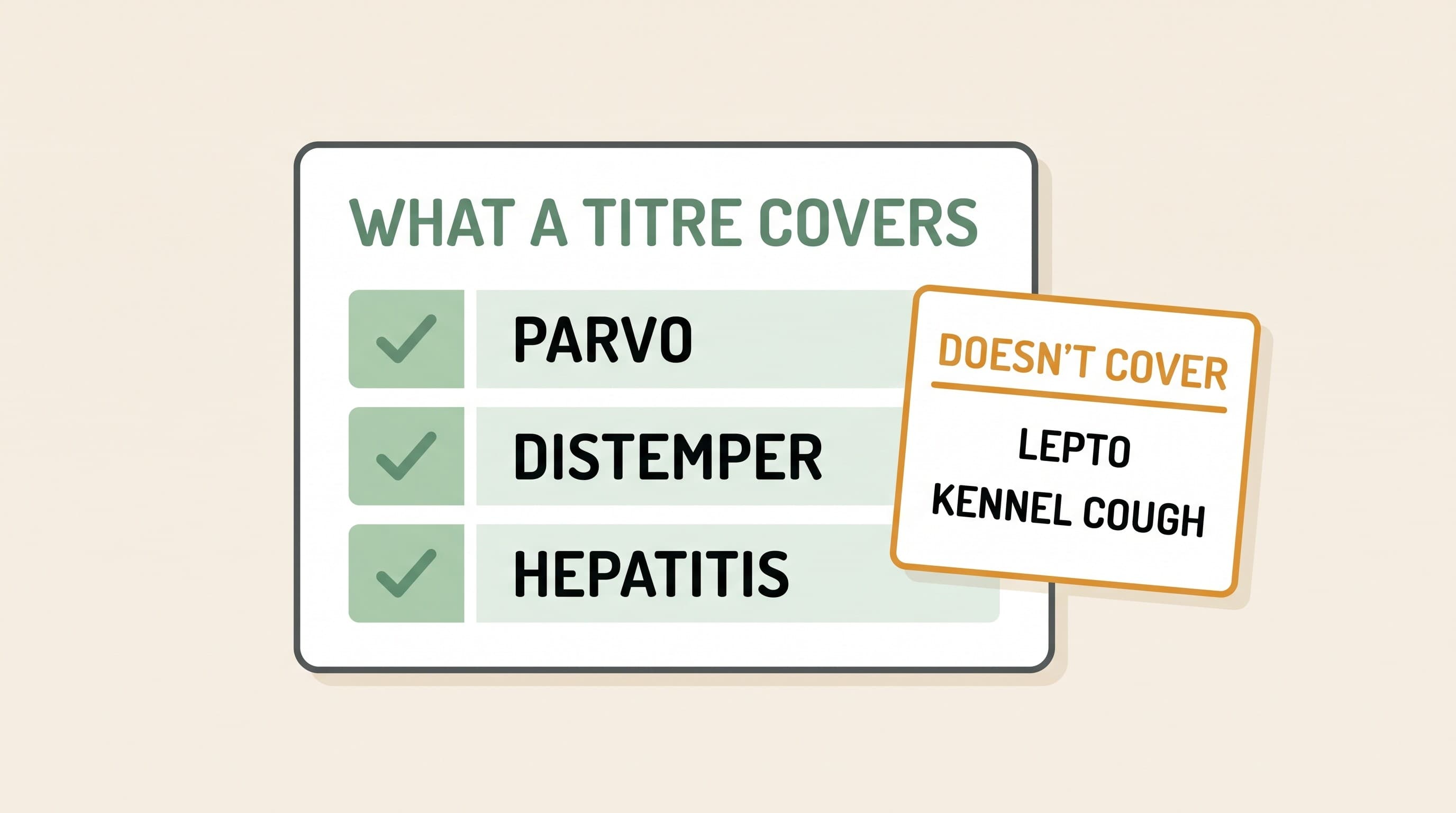
Here's the part that matters most, so it's going first: titre testing is validated for the core viral diseases only. In dogs that means:
- Parvovirus (CPV)
- Distemper (CDV)
- Infectious hepatitis / canine adenovirus (CAV)
(In cats, titre testing focuses on feline panleukopenia, with the flu viruses less reliably assessed this way.)
A good titre result for these is reasonable evidence that your pet is still protected against them, which is exactly why current WSAVA guidance accepts titre testing as a legitimate alternative to automatically repeating the core vaccine (WSAVA 2024). If a dog has a strong parvo and distemper titre, giving another core dose that year adds little. That's a sound, science-backed use of the test, and it's not fringe at all.
What a titre does NOT cover, and why that changes everything
Now the sentence that the "never vaccinate again" crowd conveniently drops. A titre test does not cover leptospirosis or kennel cough.
Those two are killed and bacterial vaccines, not core viral ones. They produce shorter-lived immunity and need boosting on their own schedule, and antibody titre testing is not the way their protection is judged. So a titre result, however strong, tells you nothing whatsoever about whether your dog is still protected against lepto (a fatal, zoonotic disease you really don't want your dog, or your family, to meet) or kennel cough.
This is why "titre instead of vaccinating" is a partial truth that misleads owners. It quietly narrows "vaccination" down to just the core viruses, and then declares victory. A dog whose owner replaced everything with an annual titre could have excellent parvo immunity and zero lepto cover, which is precisely the wrong gap to leave open. Whenever anyone mentions a titre, the honest sentence has to travel with it: a titre covers only parvo, distemper and hepatitis, and never lepto or kennel cough.
There's a related reason vets don't lean on titres for the bacterial vaccines even in principle: for some diseases, antibody level isn't a reliable stand-in for real-world protection anyway. Antibodies are only part of the immune picture, which also includes cell-mediated memory that a titre doesn't measure. So a titre is best understood as a specific answer to a specific question, not a general immunity certificate.
Where the "never vaccinate again" story comes from
It's worth being fair about why this idea has taken hold, because the owners drawn to it are usually thoughtful people, not cranks. The instinct behind it is a good one: not wanting to give a medical intervention more often than necessary. And it lands on a genuine truth, that the core vaccines really do last longer than the old annual habit assumed. When you've just learned that the profession itself now says "no more often than every three years", it's a short and tempting step to "so maybe never".
The trouble is that the online version quietly makes two leaps the evidence doesn't support. The first is treating a single strong titre as a permanent certificate, when it's a snapshot that can change over time. The second, and the more dangerous, is folding all vaccination into the word, so that a test which only reads core viral immunity gets sold as proof your pet needs nothing further, lepto and kennel cough included. That's not a scientific position; it's a marketing-shaped simplification, and it's how conscientious owners end up leaving exactly the wrong gap open. Respecting the instinct means keeping the good part (vaccinate appropriately, not reflexively) and dropping the leap (a titre does not equal "done forever").
A note for cat owners
Titre testing is talked about far more in dogs than cats, and the picture for cats is a bit more limited. Titre testing for feline panleukopenia is reasonably meaningful, but antibody testing for the cat flu viruses (herpesvirus and calicivirus) is a much less reliable guide to protection, so a titre tells you less about a cat's overall core status than it does for a dog. And it still says nothing about FeLV, which for younger and outdoor cats is a core concern in its own right. So if you're a cat owner drawn to titre testing, it's especially worth a proper conversation with your vet about what a result would and wouldn't settle.
When a titre genuinely makes sense
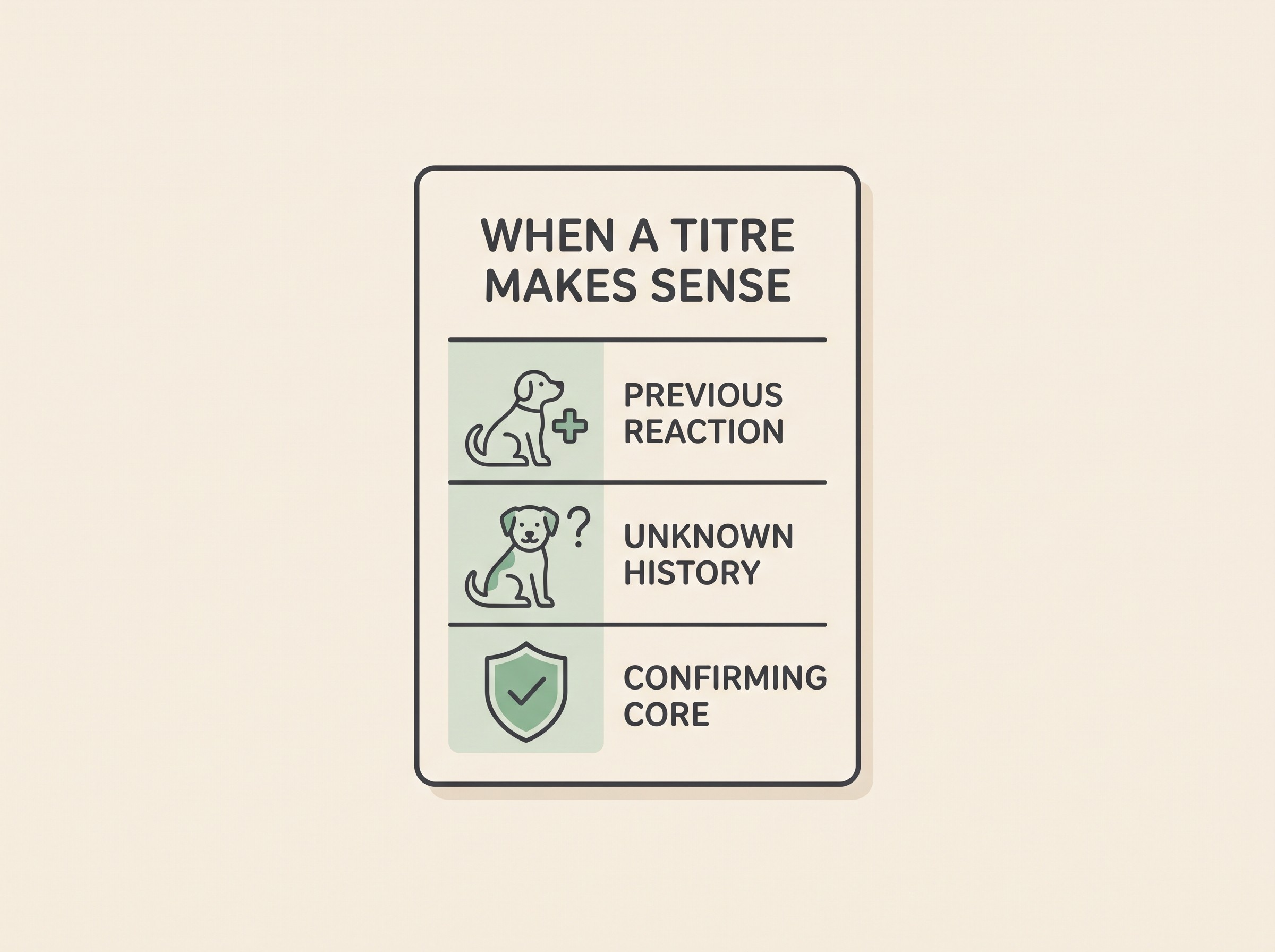
None of the above means titres are pointless. There are real situations where asking for one is a sensible, evidence-based choice:
- A pet with a history of vaccine reaction. If your dog or cat has had a genuine adverse reaction, a titre can help confirm existing core immunity so you and your vet can avoid an unnecessary repeat dose. This is probably the strongest indication. (If this is your situation, read Vaccine Reactions and the Over-Vaccination Debate too.)
- A rescue or rehomed pet with unknown history. When you have no reliable record, a titre can tell you whether the animal is already protected against the core viruses, sometimes sparing an unnecessary full course.
- An owner who wants to confirm core immunity before a triennial dose. If you'd rather check than automatically re-give the core vaccine, a titre is a legitimate way to do that, and it fits the risk-based spirit of modern guidance.
- Breeders and litters timing the primary course.
In each of these, the titre is doing the same honest job: helping you and your vet vaccinate appropriately, giving what's needed and not what isn't. That's a world away from using it as an excuse to stop.
The practical limits owners aren't told
Even where a titre makes sense, there are real-world catches worth knowing before you assume it's the cheaper or simpler route:
- Cost. A titre test often costs more than the vaccine it might replace, and if it comes back low you may need to vaccinate anyway, so you could end up paying for both.
- Turnaround. Some titres go to an external lab, so results aren't always same-day, which matters if you're up against a deadline.
- Acceptance. This is the big practical one. Boarding kennels, catteries, insurers and the pet travel scheme may not accept a titre in place of an up-to-date vaccination record. Many require the actual vaccination certificate, full stop. So a titre can leave you compliant with the science but non-compliant with your kennel's booking form. Always check what your specific kennel, insurer or the travel scheme requires before relying on a titre.
The honest bottom line
A titre test is a way to vaccinate appropriately, not a way to stop vaccinating. Used well, it can spare a reaction-prone pet an unnecessary jab, confirm a rescue's protection, or let you check before automatically re-dosing the core vaccine. Used as the "never vaccinate again" story sells it, it can leave a dog wide open to lepto and kennel cough while its owner believes everything is covered.
So if titres appeal to you, that instinct isn't wrong, it just needs the full picture. The conversation to have with your vet is:
"Would a titre be reasonable for my pet's core vaccines this year, and if so, what will I still need to keep boosting separately, like lepto and kennel cough?"
Anyone who answers the first half of that question and skips the second is leaving out the part that can still make your pet ill. Your vet can weigh whether a titre fits your individual animal, and tell you honestly what it will and won't settle. If you and your vet agree on a titre-led plan for the core vaccines, you can still set the separate lepto and kennel cough reminders in the Preventive Care Scheduler so the cover a titre doesn't measure doesn't quietly lapse.
References
- Squires RA, et al. WSAVA Vaccination Guidelines, 2024. *Journal of Small Animal Practice*.
- AAHA/AAFP Feline Vaccination Guidelines, 2020: feline panleukopenia titre; limits for FHV-1/FCV.
- NOAH Compendium: leptospirosis and *Bordetella*/parainfluenza vaccines as killed/bacterial with shorter-duration immunity.
- GOV.UK: pet travel scheme documentation requirements (vaccination record vs titre).
Free downloads
Companion worksheets to put what you've read into practice. Free PDFs, print at home.
Keep track of how your pet is doing
The owners who cope best are the ones who notice changes early. A simple health log shows you what is working, and what is not, before the next vet visit.
Start tracking, freeYou're not doing this alone
Compare treatment journeys and talk to owners managing staying well. Free to join.
Join PetsLikeMine