

Do Dogs Really Need a Booster Every Year?
Alastair Greenway
BVM&S MRCVS
If you're reading this, a booster reminder has probably just landed and a small, cynical voice has asked whether the whole thing is a money-spinner. It's a fair question, and you're not wrong to ask it. So here's the straight answer before anything else.
No, your dog does not need every vaccine every year. But no, the annual reminder isn't a scam either. Both halves of that matter, and the gap between them is where all the confusion (and a fair amount of bad advice online) lives. Let's take it apart honestly.
The core jab protects for years, not months
The vaccines vets call core are the ones every dog should have, because they protect against diseases that genuinely kill. They're usually written on your record as DHP:
- Distemper: a viral disease that attacks the nervous system and is frequently fatal.
- Hepatitis (infectious canine hepatitis, from canine adenovirus): a virus that can cause rapid, fatal liver damage.
- Parvovirus: a devastating gut infection that kills puppies and is horrible to treat even when a dog survives.
Here's the key fact: the immunity these core vaccines produce is long-lived. Current WSAVA guidance is that after the puppy primary course and the booster at 6 to 12 months, the core vaccines should be given no more often than every three years (WSAVA 2024). Repeating them every twelve months doesn't add useful protection.
So on the narrowest reading of your question: no, the core "jab" isn't needed annually. If that were the whole story, you'd be right to feel a bit sold to. But it isn't the whole story, and the next part is the bit the cynical version leaves out.
Where the "it's a scam" idea comes from
The suspicion isn't irrational, and it's worth naming honestly rather than dismissing. For years, "the annual booster" was spoken about as a single fixed yearly event, and the guidance genuinely used to lean more heavily on annual boosting before the evidence on duration of immunity matured. So a generation of owners was told "every year" for everything, then some of them later read that the core jab lasts three years, and understandably concluded they'd been overcharged for a decade.
What actually happened is less sinister and more ordinary: the science moved, the profession's guidance moved with it (WSAVA now sets core at no more often than every three years), and the language on reminder cards didn't keep up. "Booster" still gets used as a catch-all for the whole annual visit, even though what's inside that visit changes year to year. So the honest position is neither "it was always a scam" nor "nothing has changed", but "the core interval genuinely lengthened, and the yearly appointment is now mostly about other things".
So why does the reminder come every year?
Two reasons, and neither of them is the core DHP jab.
Reason one: some vaccines genuinely are annual. Not every disease behaves like parvo. A couple of the most important dog vaccines produce shorter-lived immunity and do need topping up more often:
- Leptospirosis ("lepto"): a bacterial disease caught from water and the urine of rats and wildlife, causing kidney and liver failure. It's often fatal, and it's zoonotic, meaning it can pass to you and your family (Weil's disease). The lepto vaccine is typically given annually because its protection doesn't last as long as the core viral vaccines.
- Kennel cough (Bordetella / parainfluenza): for dogs that board, go to daycare, training, shows or otherwise mix closely with other dogs. Also typically boosted annually or as your kennel requires.
These are lifestyle-based, so exactly which of them your dog needs depends on where you live and what your dog does. But for most UK dogs, the lepto vaccine alone means there's genuinely something due most years. We've given these two their own piece: Kennel Cough and Leptospirosis: The Annual Ones.
Reason two: the health check. The yearly appointment isn't only about what goes in the syringe. It includes a full nose-to-tail clinical examination, which for a lot of dogs is the single most valuable ten minutes of the year. Your vet is feeling the abdomen, listening to the heart, checking teeth, eyes, ears, skin, weight and joints, and catching the quiet early problems your dog can't tell you about. We walk through the whole thing in The Annual Health Check: What Your Vet Actually Looks For.
The confusion, really, comes from language. "Booster" and "annual check" got bundled into one phrase, "the yearly booster", and so it sounds like you're paying for the same jab over and over. You're usually not.
What's actually happening at your dog's "yearly booster"
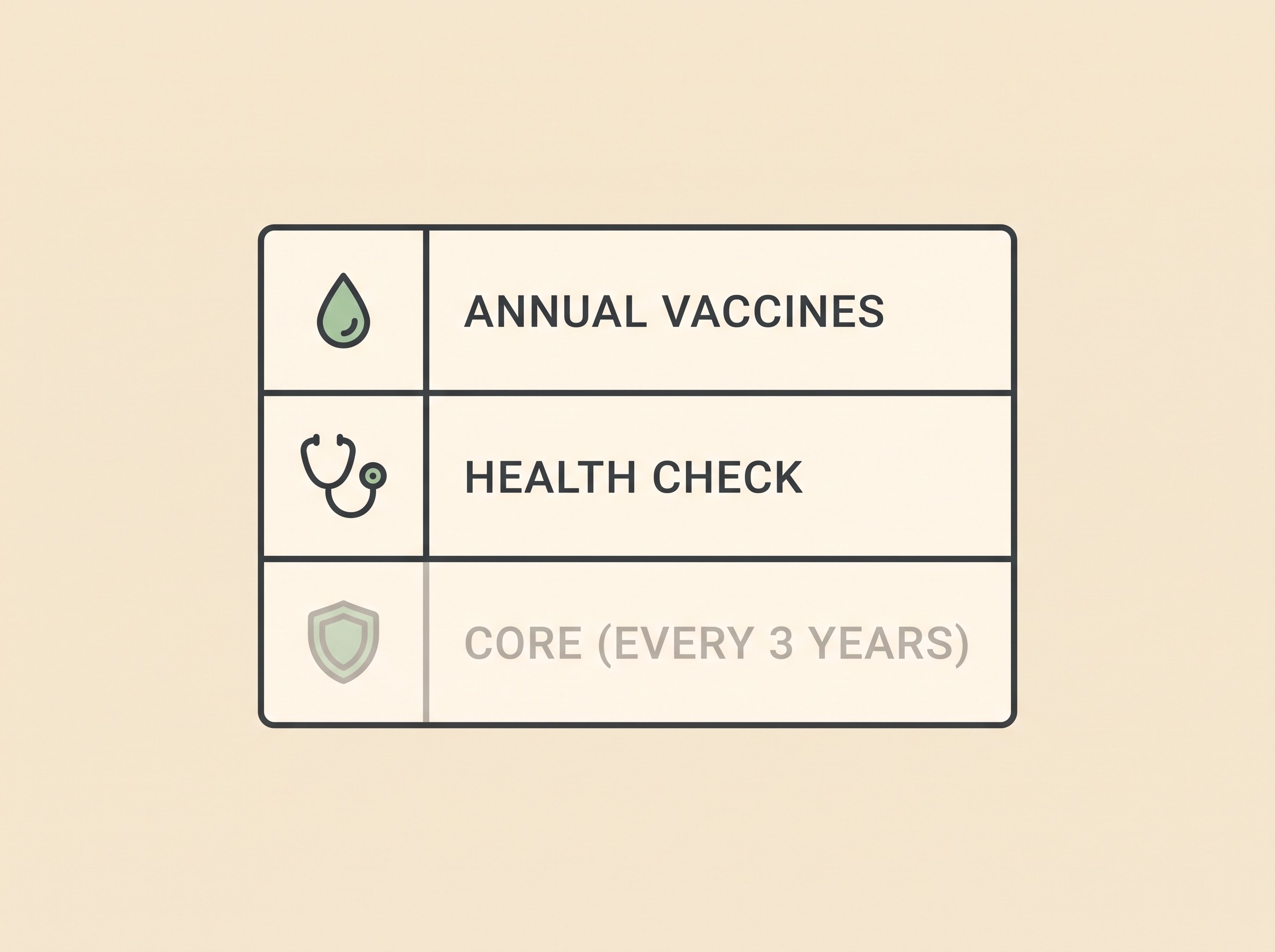
Once you see the parts separately, the bill makes far more sense. In a typical year, an appointment badged as a booster is usually:
- the annual lifestyle vaccines that are due (lepto, and kennel cough if your dog needs it),
- plus a full clinical health check,
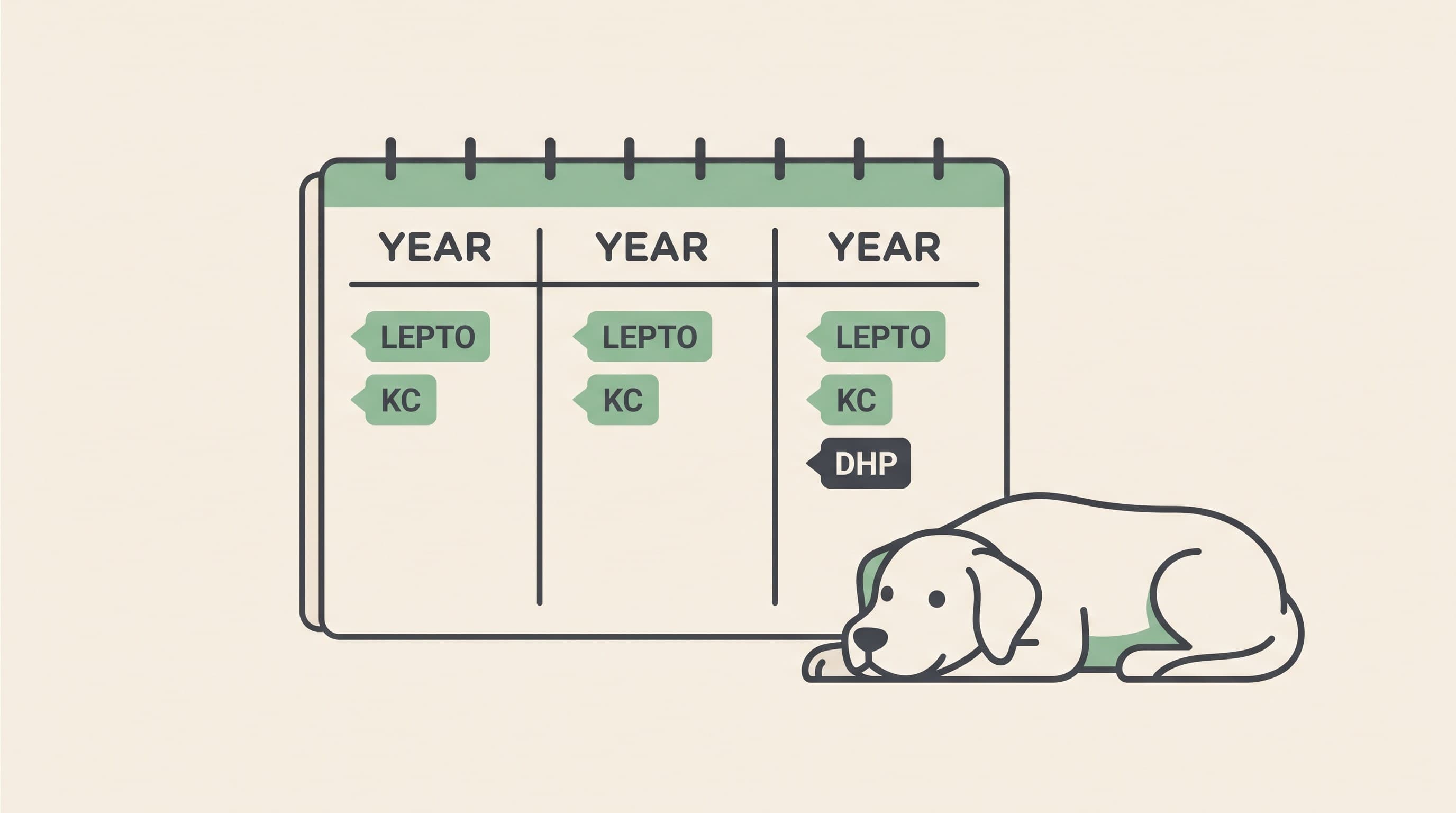
- with the core DHP given only in its triennial year (roughly one visit in three).
So two years out of three, no core vaccine is going in at all. What you're paying for is the lepto and kennel cough cover and the examination. In the third year, the core DHP is added on top. None of that is dishonest; it's just rarely spelled out, which is what makes it feel murky.
Why the health check is worth more than it looks
It's easy to mentally file the examination as a formality, a quick once-over before the real business of the injection. It's usually the opposite. Dogs are stoical and they hide illness well, so a lot of the things worth catching early, a new heart murmur, dental disease building under the gumline, a slowly creeping weight problem, a lump you hadn't noticed, an enlarged organ on abdominal palpation, produce no symptoms you'd spot at home until they're further along. The annual exam is a structured, hands-on screen for exactly those quiet problems, done by someone who examines hundreds of dogs and knows what "not quite right" feels like.
Put bluntly, in a non-core year the vaccine part might take thirty seconds and the examination is the reason the visit is worth your money. That's not a reframing to make you feel better about the bill; it's genuinely where the clinical value sits. We walk through the whole nose-to-tail exam, and what each part is screening for, in The Annual Health Check: What Your Vet Actually Looks For.
But couldn't a titre test replace it?
You may have read that a blood test called a titre can prove your dog is still immune, so you can skip the booster entirely. It's a genuine tool, and it's worth understanding, but there's a catch that gets left out constantly.
A titre test measures antibody levels for the core viral diseases only: parvovirus, distemper and infectious hepatitis (CPV, CDV, CAV). A good result is reasonable evidence your dog is still protected against those. But a titre does not cover leptospirosis or kennel cough, which are killed and bacterial vaccines with shorter-lived immunity that need boosting on their own schedule regardless of any titre. So a titre can, at most, tell you whether the core jab can be safely deferred, and even then a kennel, insurer or the travel scheme may not accept it. It is never a route to "no more vaccines ever". The full, honest picture is in Titre Testing: When It Makes Sense and What It Can't Tell You.
And cats, briefly
This piece is dog-led because "yearly dog booster" is what everyone types, but don't let that leave you thinking cats are exempt. The same logic applies: after the kitten course and the first booster, feline core vaccines (panleukopenia, herpesvirus, calicivirus) are given no more often than every three years, while FeLV for at-risk cats runs on its own schedule (WSAVA 2024). Cats get the full treatment in Cat Vaccinations: What Your Cat Actually Needs.
The temptation to save money, and why it usually backfires
Here's the honest risk. Once someone realises the core jab isn't annual, the tempting next step is to skip the whole appointment to save the fee. That's the move I'd gently steer you away from, and not for the practice's sake.
If you skip the visit, you don't just skip a jab you didn't need anyway. You lose the lepto and kennel cough cover your dog probably does need, and you lose the health check that's often the real value. Lapsed lepto cover in particular leaves a genuine, potentially fatal, zoonotic gap. Skipping the appointment isn't the smart, informed version of this decision. The smart version is going in and asking better questions.
The question to ask this year
So take the reminder, keep the appointment, and ask your vet to break it down for you:
"Which parts of today's booster are core, which are the annual lifestyle vaccines like lepto and kennel cough, and is the health check the main value for my dog this year?"
If cost is the real worry, say so plainly. Your vet can tell you what's genuinely due this year rather than you guessing from a bundled reminder, and can help you plan the more expensive triennial year in advance. You can also log your dog's actual due dates in the Preventive Care Scheduler so the annual lepto reminder and the triennial core reminder surface separately, at the right time, instead of arriving as one undifferentiated yearly nudge.
That's the difference between being informed and being cynical: the cynic skips the visit and hopes; the informed owner keeps it and asks the right question.
References
- Squires RA, et al. WSAVA Vaccination Guidelines, 2024. *Journal of Small Animal Practice*.
- NOAH Compendium of Data Sheets for Animal Medicines: leptospirosis and kennel cough (*Bordetella*/parainfluenza) vaccine intervals.
- AAHA/AAFP Feline Vaccination Guidelines, 2020: feline core + triennial support.
Keep track of how your pet is doing
The owners who cope best are the ones who notice changes early. A simple health log shows you what is working, and what is not, before the next vet visit.
Start tracking, freeYou're not doing this alone
Compare treatment journeys and talk to owners managing staying well. Free to join.
Join PetsLikeMine