

The Annual Health Check: What Your Vet Actually Looks For
Alastair Greenway
BVM&S MRCVS
Most people book the yearly appointment and think of it as "the booster". You come in, your pet gets a jab, you pay, you leave, and somewhere in the back of your mind is a quiet suspicion that you have just paid quite a lot of money for a small injection.
I want to change how you see that visit, because the injection is genuinely the least interesting thing that happens in the room. While I am chatting to you about how your dog has been, or coaxing your cat out of the carrier, I am running a full physical examination that takes in almost every system in the body. It is a screen for the problems you cannot see yet, and for many pets it is the only time all year that a trained pair of hands goes over them nose to tail. The vaccine is often just the reason the appointment got booked. The examination is the reason it matters.
So here is what is actually happening in those ten minutes, roughly in the order I tend to do it, and what each part is looking for. Once you can see it, you will get far more out of the visit, and you will know what to watch for at home in between.
The hands-on examination, system by system
Eyes, ears and the front end
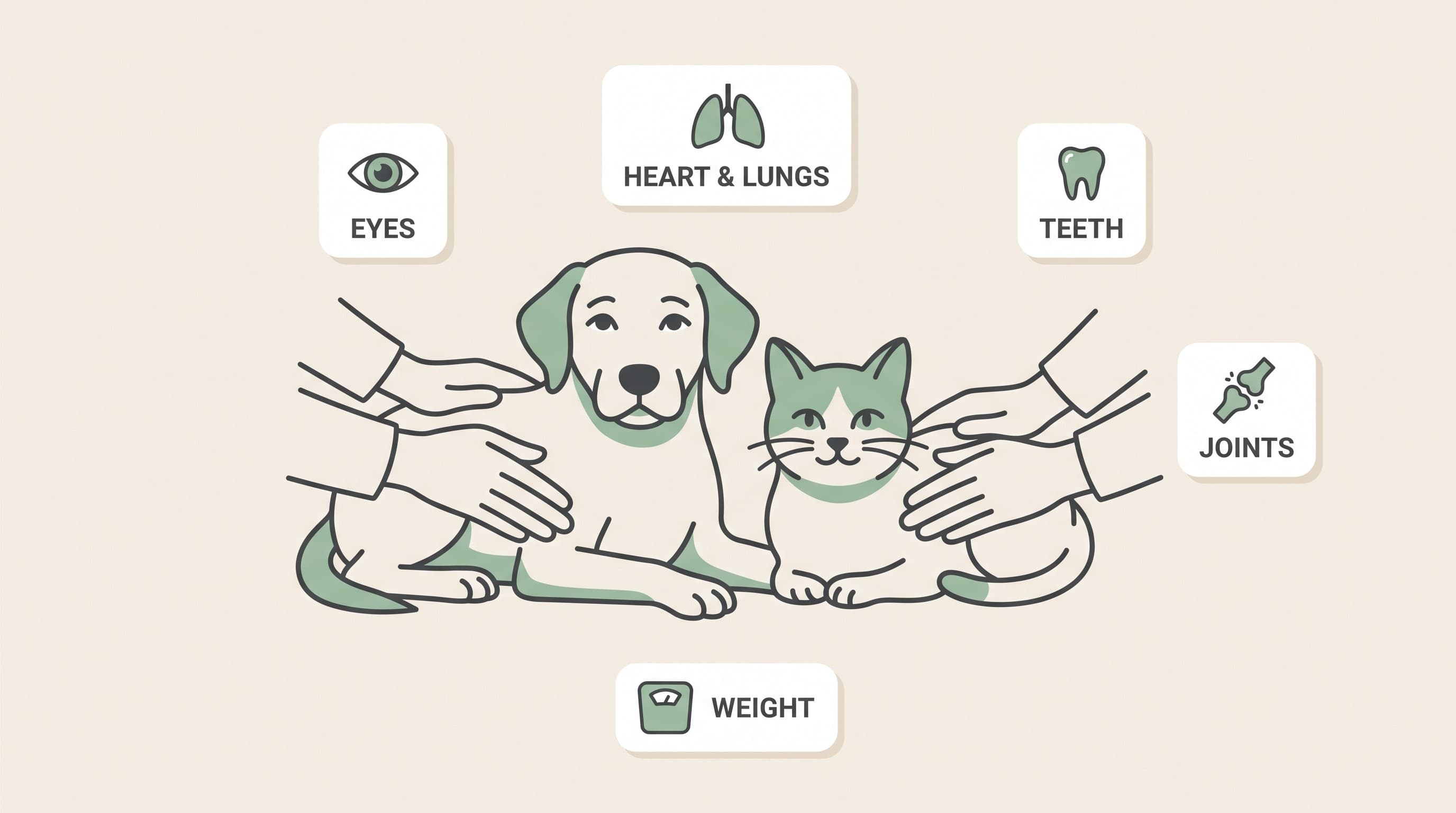
I usually start at the head, partly because it settles a nervous animal to be greeted before being handled. The eyes tell you a surprising amount. I am looking for clarity, for any cloudiness that might hint at early cataract or the nuclear haze that comes with age, for redness or discharge, and at the third eyelid and the colour of the membranes, which can flag anaemia or jaundice long before you would notice anything at home.
The ears come next, and this is where a good few problems hide in plain sight. A quiet, low-grade ear infection, a bit of yeast, the early narrowing that predisposes to trouble later, none of it is obvious to an owner until the pet is shaking its head or crying. In cats especially I am checking for ear mites and for the thickened, scarred canals that come from years of untreated grumbling.
The mouth, and the thing I find most often
If you asked me what I diagnose most often at a routine check, the honest answer is dental disease. By the age of three, a large share of dogs and cats already have some degree of periodontal disease, gum inflammation and tartar sitting under the gumline where it does real harm. It is common, it is painful, and it is almost completely silent, because a pet will keep eating through a level of dental pain that would have you at the dentist within the hour.
Cats deserve a special mention here. They get a particularly nasty problem called tooth resorption, where the tooth is essentially eaten away from the inside, and it is genuinely agonising, yet most affected cats show nothing beyond eating a little more slowly. Lifting the lip and looking is one of the highest-value things I do all appointment. If you want to get ahead of this at home, our guide to preventing dental disease at home is the place to start, and the Dental and Oral Health space goes much deeper.
Heart and lungs
Then the stethoscope. I am listening for a heart murmur, for an irregular rhythm, and for the rate and character of the breathing. A soft murmur in an older cat or a small-breed dog can be the very first sign of heart disease, appearing long before there is any cough, any tiredness, any change you would spot at home. Catching it early does not always mean treating it early, but it means we can monitor it, and it changes the conversation entirely if that pet ever needs an anaesthetic.
While the stethoscope is on the chest I am also feeling the pulse at the same time, checking it matches the heartbeat, and I am watching how hard the animal is working to breathe. None of this is visible to you across the living room, which is rather the point.
The abdomen, lymph nodes and skin
Next I run my hands over the belly. Abdominal palpation is me feeling the shape and size of the organs, the liver, the spleen, the kidneys, the bladder, and feeling for anything that should not be there. In an older cat, kidneys that feel small and irregular are a prompt to run a blood and urine test, because chronic kidney disease is common in senior cats and is far more manageable when it is caught early. I can sometimes feel a mass, a full bladder, or a loop of gut that is not happy, and I can gauge whether the pet is comfortable with me pressing or flinches away.
I check the lymph nodes at the same time, the ones under the jaw, in front of the shoulders, behind the knees. Enlarged nodes are one of the ways some cancers first announce themselves, and they are easy to miss unless someone is deliberately feeling for them. Then the skin and coat, parting the fur to look for lumps, fleas, flea dirt, hot spots, thinning, or the dull coat that can signal something going on underneath.
Weight, body condition, and joints
I will weigh your pet and, just as importantly, put a body condition score on them, which is a hands-on assessment of whether they are carrying the right amount of fat, scored on a scale of one to nine. Weight creep is slow, it happens a few grams a month, and because you see your pet every day you are the least likely person to notice it. An outside pair of hands, comparing against last year's number, catches it. If you want the full picture on this, it is genuinely the prevention that pays back the most, and our weight and body condition guide and the Weight Management space are built around exactly that.
Finally I will flex and feel the joints, watch how your pet moves across the floor, and check for the stiffness, muscle wastage or pain that points to arthritis. In cats this is chronically under-recognised, because a stiff cat does not limp, it just quietly stops jumping onto the windowsill, and owners read that as "getting old" rather than "in pain".
The half you can't do without: the conversation
Here is the part that surprises people. The history you give me is worth as much as anything my hands find, and sometimes more. The examination is a snapshot. You have the film.
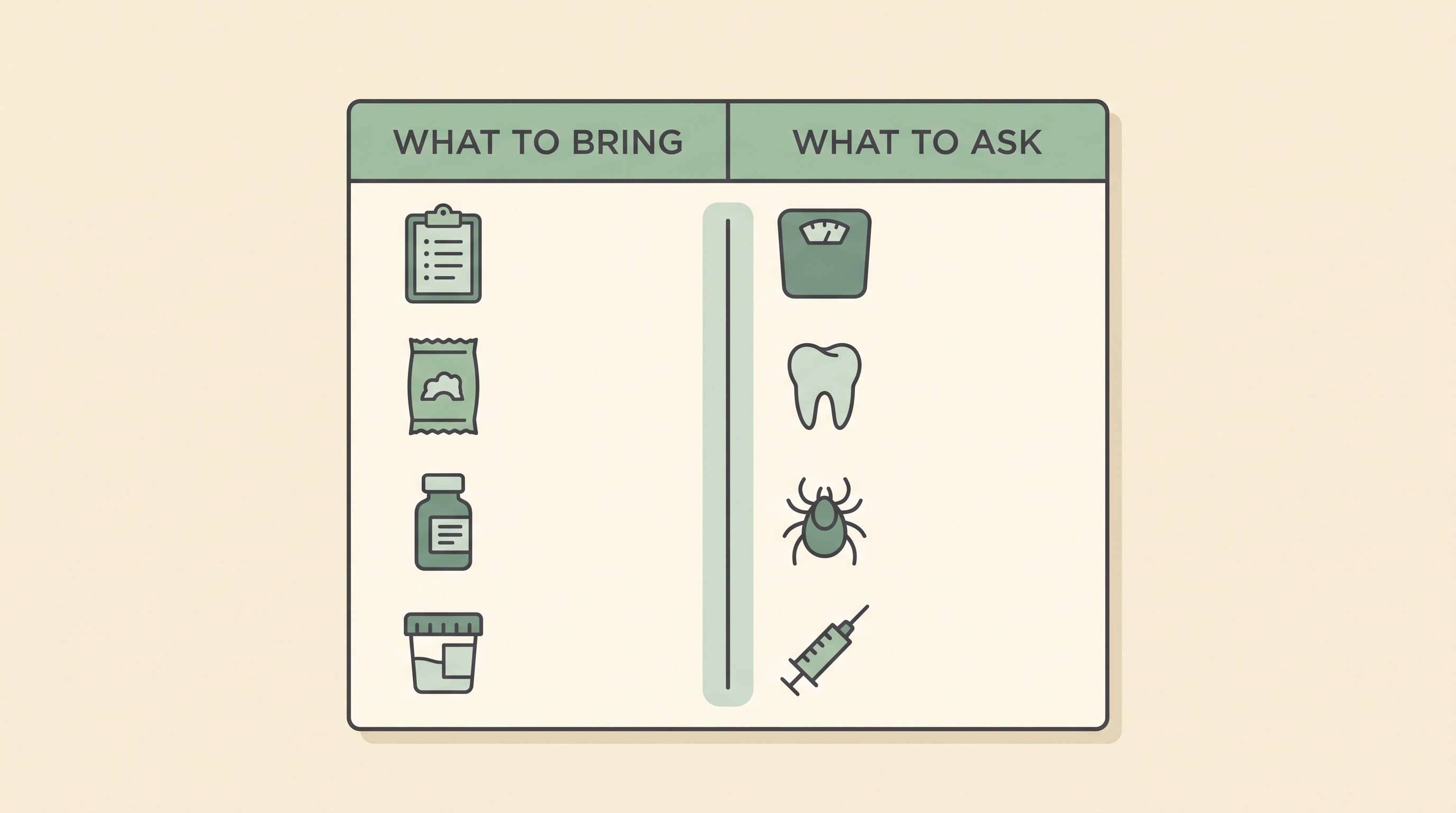
So I will ask, and I would love you to arrive ready to answer: how is the appetite, any change in what or how much they eat? How much are they drinking, because increased thirst is one of the earliest signs of several serious conditions, kidney disease, diabetes, Cushing's, and it is almost impossible to spot without deliberately watching the water bowl. What about toileting, any straining, accidents, changes in the stool? Energy levels, are they slowing down, or restless at night? Any lumps you have found? Any change in behaviour, because behaviour change in an older pet is very often a medical sign wearing a disguise.
The trouble is that these questions get sprung on you in the consulting room and you go blank, then remember the important thing in the car park. So do this: for the week before the appointment, jot notes on your phone. The thing you have half-noticed, the lump you keep meaning to mention, the fact that they seem to be drinking more. Bring that list in. It genuinely changes what we find.
Why "he seems fine" is exactly why you come
The most common thing owners say, usually a little apologetically, is "I feel like I'm wasting your time, he seems completely fine". I understand the instinct, but it has the logic backwards, and this is the single most important thing to take from this article.
Pets are built to hide illness. In the wild, an animal that looks weak becomes a target, so dogs and cats have deep instincts to mask pain and sickness until they simply cannot any more. By the time your pet "seems off", the problem has usually been developing for a while. A pet that seems fine is not proof that nothing is wrong. It is precisely the population in which the annual check earns its keep, because the whole job of the examination is to find the early, silent things while they are still easy to deal with, the dental disease before the tooth abscesses, the weight before the arthritis, the heart murmur before the collapse, the kidney change before the crisis.
If you are still weighing up whether it is worth it for an apparently healthy animal, we have written the fuller argument in why 'healthy' pets still need a yearly check. The short version is that "seems fine" is the reason to come, not the reason to skip.
When once a year becomes twice
For most healthy adult pets, once a year is the right rhythm. But there is a point at which that changes, and it comes sooner than most people expect. As pets move into their senior years, and for any pet living with an ongoing condition, the useful interval often shortens to every six months, because things move faster and small changes matter more.
I have written about when and why to step the checks up in health checks for older pets, and if your pet is already into that stage of life, the Senior Pets space is built around keeping them well for longer.
Getting the most from the ten minutes
Treat the annual visit as the yearly review of your pet's entire prevention plan, not just a jab and a weigh-in. It is the natural moment to take stock of everything: is the vaccination status where it should be, given that core vaccines are boosted no more often than every three years under current guidance while some are genuinely annual (WSAVA 2024); is the parasite plan still right for how your pet actually lives; has the weight crept; how are the teeth. These are the four or five things that, tracked year on year, do more for your pet's length and quality of life than almost anything else.
That is also why so few owners keep it all straight in their heads, and why we built the Preventive Care Scheduler to hold the dates for you, the annual check, the boosters on their real intervals, the worming, the flea plan, the insurance renewal. Set the annual check reminder, walk in with your notes, and turn the most transactional appointment of the year into the most useful ten minutes your pet gets.
And do one thing between now and the visit: start the notes list today. The half-noticed thing you write down this week is often the thing that matters most when you are sitting in front of me.
Free downloads
Companion worksheets to put what you've read into practice. Free PDFs, print at home.
Keep track of how your pet is doing
The owners who cope best are the ones who notice changes early. A simple health log shows you what is working, and what is not, before the next vet visit.
Start tracking, freeYou're not doing this alone
Compare treatment journeys and talk to owners managing staying well. Free to join.
Join PetsLikeMine