

Preventing Dental Disease at Home
Alastair Greenway
BVM&S MRCVS
If you lifted your dog's lip or peered into your cat's mouth right now, there's a fair chance you'd find something you'd rather not: a rim of yellow-brown tartar along the back teeth, gums that are a little redder than they should be, and breath that has drifted from "doggy" to genuinely off. You're not alone, and you're not a bad owner. Dental disease is one of the most common things vets diagnose in dogs and cats, and by the age of three most pets already have some degree of it.
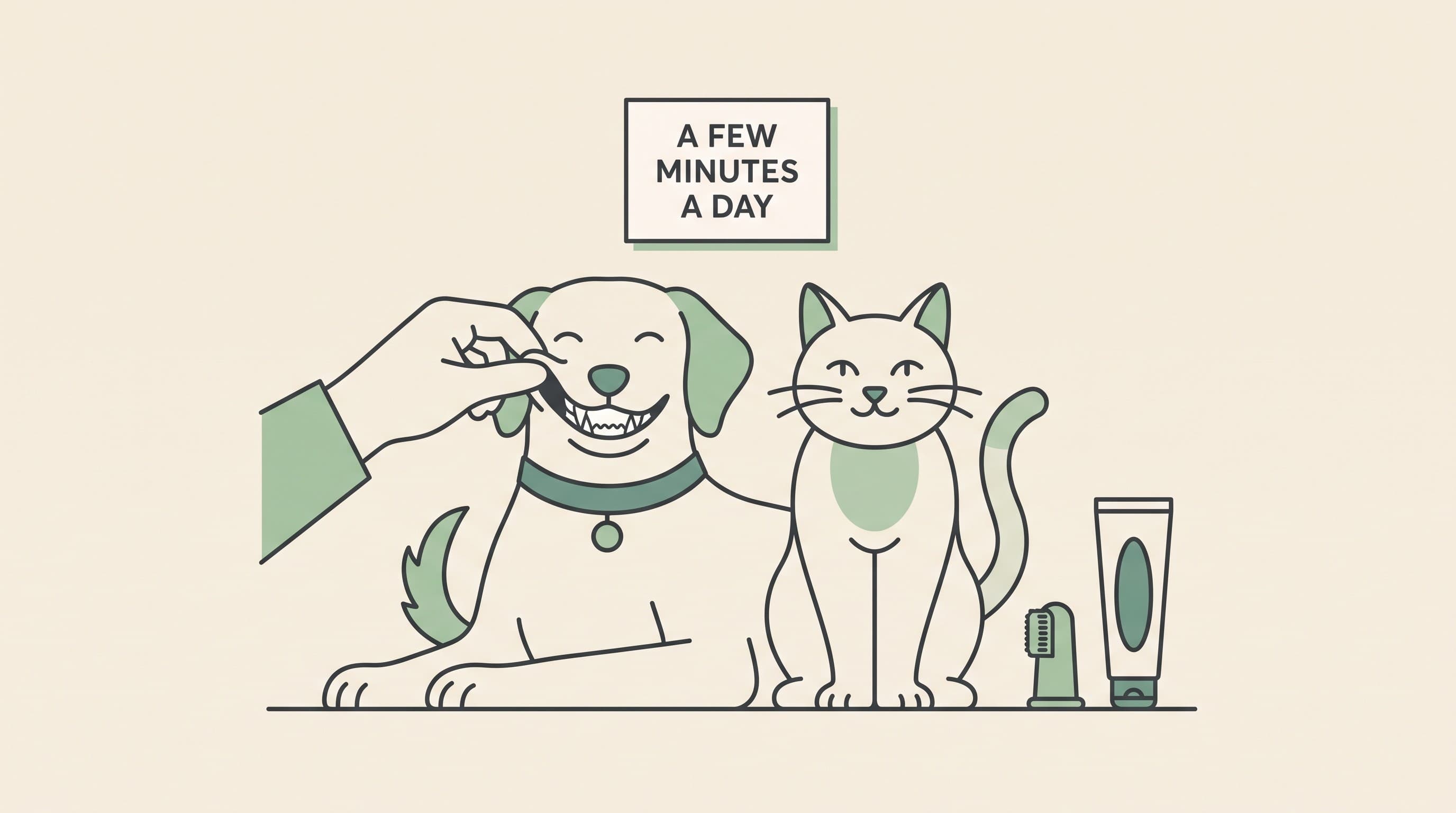
The good news is that this is one of the few common conditions you can genuinely get ahead of at home. A few minutes of the right kind of care, done consistently, changes the trajectory of your pet's mouth for the rest of their life. This piece is the everyday-prevention overview: what dental disease actually is, what works at home and what only pretends to, and the point at which home care stops and your vet needs to take over. For the deeper story of diagnosis, dental x-rays, extractions, feline tooth resorption and painful gum conditions, we hand you across to the Dental and Oral Health space, which is built for exactly that.
What you're actually trying to prevent
It helps to know what's happening under the lip, because it explains why some home routines work and others are wishful thinking.
It starts with plaque, a soft, sticky film of bacteria that forms on the teeth within hours of eating. Plaque you can brush off. Left alone, though, it hardens as it takes up minerals from saliva, and within a couple of days it becomes tartar (also called calculus), that cement-like brown crust. Tartar you cannot brush off. It needs a scale and polish under anaesthetic.
The real damage isn't the brown colour, though, it's what the bacteria do to the gum. Plaque along the gumline triggers gingivitis, where the gum becomes inflamed, red and prone to bleeding. Gingivitis is reversible with good care. If it's allowed to progress, it becomes periodontitis, where the inflammation destroys the tissue and bone anchoring the tooth. That is not reversible, it's painful, and it's how pets lose teeth.
So home prevention has one honest, achievable job: keep plaque off the teeth, at the gumline, before it hardens and before the gum is damaged. Everything below is judged against that job.
Toothbrushing: the one that actually works
There's no gentle way to say this, so here it is plainly: brushing your pet's teeth is the single most effective thing you can do at home, and nothing else comes close. Everything else on this page is a useful add-on to brushing, not a replacement for it. Chews and diets and additives reduce plaque a bit; the bristles of a brush physically remove it, which is the whole game.
A few practical rules make it far more likely to stick:
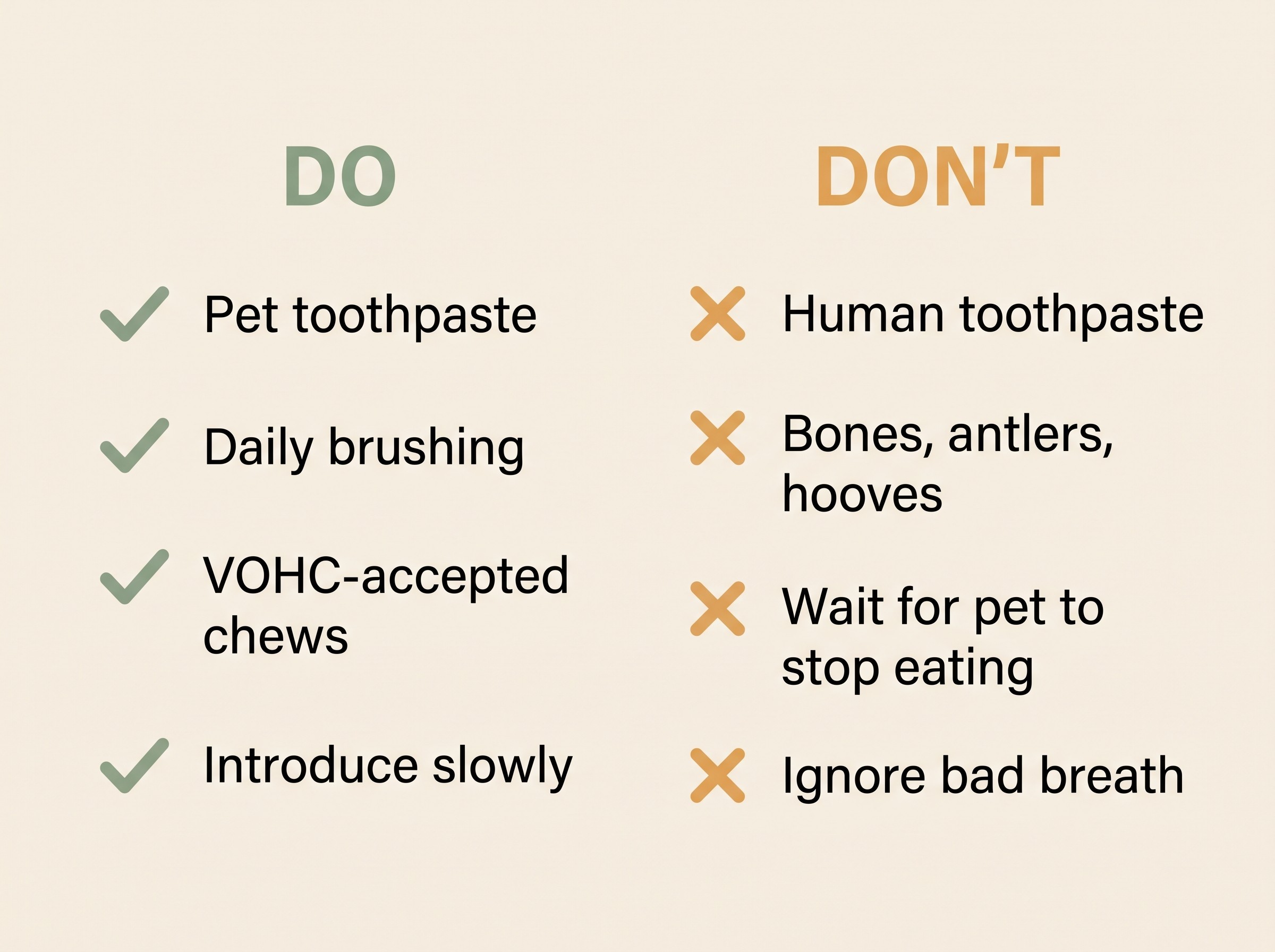
- Use pet toothpaste, never human toothpaste. Human paste is meant to be spat out, and pets swallow it. Fluoride in quantity and, in some brands, xylitol are genuinely harmful to pets, and the foaming is unpleasant for them. Pet pastes are enzymatic, safe to swallow, and come in flavours (poultry, malt) your pet will often treat as a reward.
- Aim for daily; be honest about what you'll keep up. Plaque re-forms within a day or two, so daily brushing is the target and does the most good. That said, brushing a few times a week is far, far better than never, so build the habit you can actually sustain rather than aiming for perfect and giving up.
- Build it up slowly, over a couple of weeks. Start by letting your pet lick paste off your finger, then off the brush, then touch the brush to a few teeth, then work up to the outer surfaces of the back teeth where tartar loves to gather. Keep sessions short and end on a fuss. You're training a routine, not winning a wrestling match on day one.
- Focus on the gumline of the outer surfaces. That's where plaque does its damage and where your brush earns its keep. You rarely need to worry about the inner surfaces or the biting surfaces.
Cats can absolutely be brushed, and cat owners who assume it's a dog-only job are missing the most valuable feline dental tool there is. It takes more patience and a smaller, softer brush (a finger brush or even a cotton bud with paste can start the process), but a cat introduced gently, ideally as a kitten, will tolerate it. Given how common painful dental disease is in cats, the effort is well spent.
The add-ons: honest about what helps and by how much
Walk into any pet shop and you'll meet a wall of products promising dental miracles. Some genuinely help. None replaces the brush. Here's how to read the shelf.
Dental diets and dental chews can reduce plaque and tartar, mainly through the mechanical scrubbing action as the tooth sinks into a specially textured kibble or chew. The way to cut through the marketing is to look for the VOHC seal, the Veterinary Oral Health Council's mark, which is only given to products shown in trials to meaningfully reduce plaque or tartar. A VOHC-accepted product is a reasonable, evidence-backed add-on. A product with a cartoon tooth on the box and no VOHC mark is a marketing claim.
Water additives and dental gels are the gentlest option and, unsurprisingly, tend to do the least, though some VOHC-accepted ones have a place, particularly for pets who simply will not tolerate a brush. Treat them as a small extra, not a solution.
Raw bones, antlers, hooves and very hard chews deserve a specific caution. They do scrape teeth, but they also fracture them, and a slab fracture of a big chewing tooth is a common, painful, expensive injury. The rule of thumb vets use: if you couldn't dent it with your thumbnail or wouldn't want it dropped on your knee, it's too hard for your pet's teeth. There's also a choking and gut-obstruction risk with bones. If you want the chewing benefit, choose something with a bit of give, and steer towards VOHC-accepted chews.
Cats are not small dogs here
Feline mouths have their own problems, and it matters that you know them, because they change what home care can and can't do.
Cats are prone to tooth resorption, where the tooth structure is eaten away from the inside, often at the gumline. It's common, it's painful, and no amount of brushing prevents or fixes it, it needs a vet to diagnose (usually with dental x-rays) and treat. Some cats also develop gingivostomatitis, a severe, painful inflammation of the mouth that is well beyond the reach of a toothbrush. Home care keeps a healthy feline mouth healthy; it does not treat these conditions.
There's also a quieter feline problem: cats are experts at hiding oral pain. A cat with a genuinely sore mouth will often keep eating, just more slowly, or start swallowing kibble whole, or quietly drop the odd piece. So with cats especially, don't wait for them to stop eating before you look. The detail on all of the above lives in the Dental and Oral Health space.
Where home care stops and your vet begins
This is the honest line every prevention piece has to draw. Brushing and good products keep a healthy mouth healthy and slow the drift into disease. They do not remove tartar that's already there, they do not reverse periodontitis, and they do not treat a painful tooth. Once disease is established, only your vet can put it right, usually with a scale, polish and assessment under anaesthetic, and any extractions on dental x-ray findings.
Book a vet visit if you notice any of these:
- Breath that's genuinely foul rather than just "petty" (a strong, rotten smell often signals infection).
- Red, swollen or bleeding gums, or a visible line of tartar along the teeth.
- Drooling, or blood-tinged saliva.
- Pawing at the mouth, rubbing the face, or head-shy behaviour.
- Reluctance to eat, chewing on one side, dropping food, or going quiet at the bowl.
- A broken, loose or discoloured tooth.
- Any swelling on the face, especially just below an eye (this can be a tooth-root abscess).
None of these means you've failed. Mouths need professional attention from time to time exactly as ours do, and catching a problem at "the gums look sore" rather than "she's stopped eating" is the whole point of looking regularly.
The most useful next step is small: pick up a tube of pet toothpaste this week, let your pet lick a little off your finger, and start there. Fold a mouth-check into your monthly at-home nose-to-tail check, and raise anything you find at the annual health check, where your vet grades your pet's teeth as a matter of routine. And if what you find today is already past the brushing stage, the Dental and Oral Health space will walk you through what happens next.
Keep track of how your pet is doing
The owners who cope best are the ones who notice changes early. A simple health log shows you what is working, and what is not, before the next vet visit.
Start tracking, freeYou're not doing this alone
Compare treatment journeys and talk to owners managing staying well. Free to join.
Join PetsLikeMine