

Weight and Body Condition: The Prevention That Matters Most
Alastair Greenway
BVM&S MRCVS
If you could do only one thing to keep your pet healthy for longer, it wouldn't be a supplement, a special diet, or a particular vaccine. It would be keeping them at a lean, healthy weight. That's not a slogan, it's about as close to settled science as preventive care gets, and it's the reason vets keep raising the subject even when it makes everyone slightly uncomfortable.
It's also the prevention most owners are quietly getting wrong, and not through neglect. Somewhere between a third and a half of UK dogs and cats are overweight or obese, and the striking part is how many of their owners genuinely believe their pet is a healthy weight. The bar for "normal" has shifted, because a slightly rounded pet has become the thing we see every day. This piece resets that bar: what a healthy weight actually looks and feels like, why it matters more than almost anything else you'll do, and the small everyday levers that keep a pet lean. When a pet needs a real, structured slim-down, we hand you across to the Weight Management space, which is built around that job with its own trackers and step-by-step programme.
Why this is the prevention that matters most
Carrying extra weight isn't a cosmetic issue or a moral one. Fat is metabolically active tissue that drives inflammation throughout the body, and the downstream effects are serious and well documented.
It shortens life. The landmark study here followed Labradors in pairs, littermates fed either freely or kept lean, for their whole lives. The lean dogs lived a median of nearly two years longer, and developed signs of arthritis noticeably later. Nearly two years, from body condition alone, is a bigger effect than almost any medicine.
It causes and worsens arthritis. Extra load on the joints, plus the inflammation, means overweight pets develop osteoarthritis earlier and feel it more. Weight loss is one of the few things proven to reduce arthritis pain, sometimes as effectively as medication.
In cats, it's a leading driver of diabetes. An overweight cat is several times more likely to develop diabetes mellitus than a lean one, and weight is the single biggest modifiable risk factor. Some newly diabetic cats even go into remission once the weight comes off.
The list goes on, heart and breathing strain, heat intolerance, higher anaesthetic risk, more skin and urinary problems, but the point is made. Keeping a pet lean isn't fussing. It's the most powerful lever you have, and unlike most of preventive care, it costs nothing and needs no prescription.
What a healthy weight actually looks like
Here's the trap: the number on the scales tells you how heavy your pet is, not whether that weight is right for them. "The right weight for a Labrador" spans a huge range depending on frame, and for two cats of the same breed the ideal can differ by a couple of kilos. So vets don't judge weight by the scales alone. We use body condition score.
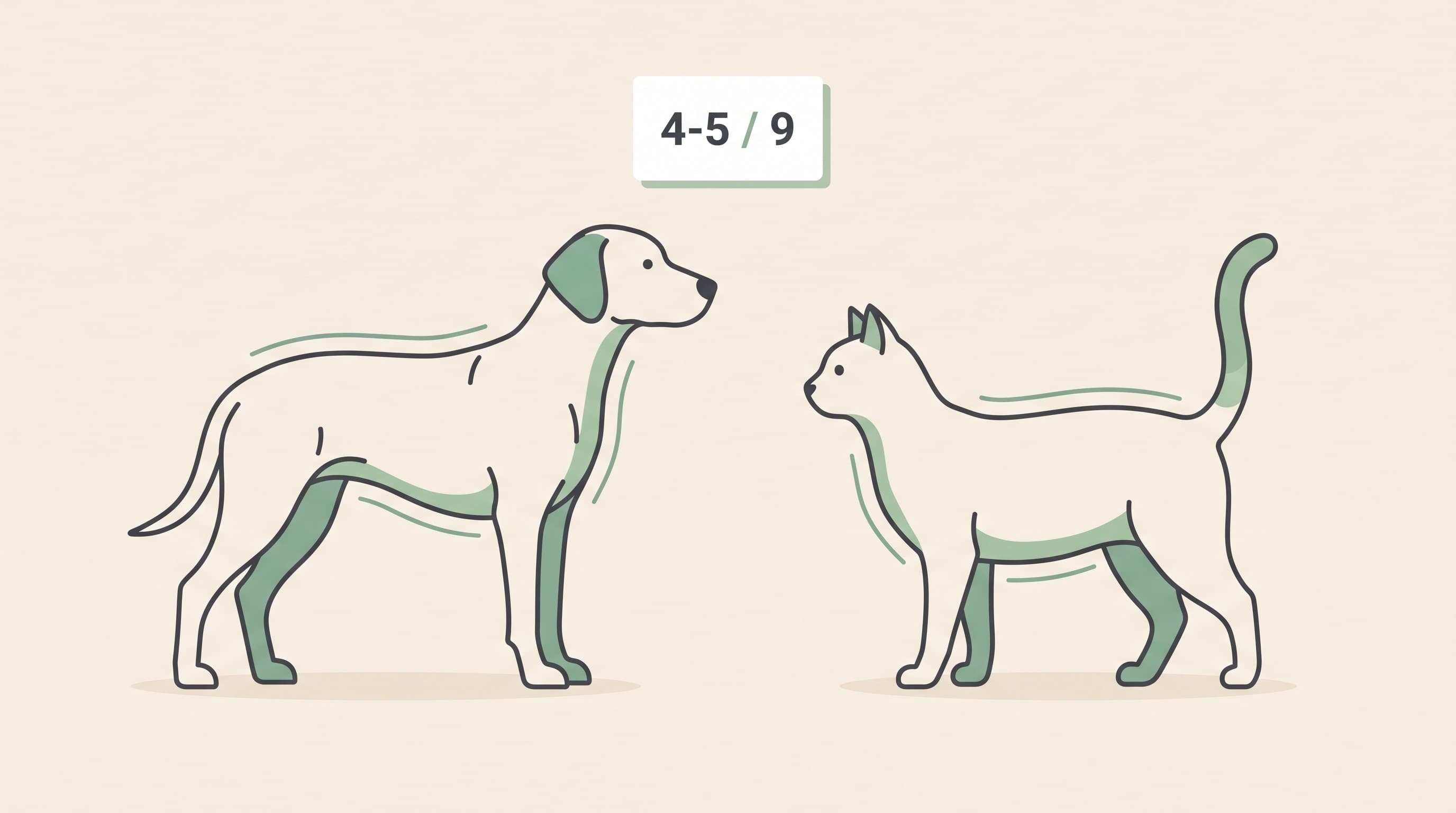
The standard tool is the WSAVA body condition score, a 9-point scale where 1 is emaciated, 9 is grossly obese, and the ideal for most dogs and cats sits at 4 to 5 out of 9. WSAVA publishes free illustrated charts for both dogs and cats that are well worth pinning up. The beauty of it is that you assess the animal in front of you, not a number a chart says they "should" hit, and you can learn it in a minute.
There are three hands-on checks, and you can do all of them during a cuddle:
- Feel the ribs. Run your fingertips lightly over the ribcage just behind the front legs. In ideal condition you can feel each rib easily through a thin covering, with light pressure, much as you can feel the bones on the back of your own hand. If you have to press to find ribs under a soft layer, that's too much weight. If they feel sharp with no covering, that's too little.
- See the waist from above. Stand over your pet and look down. Behind the ribs and before the hips, you should see the body narrow into a waist, a gentle hourglass. A straight or bulging outline means excess condition.
- See the tummy tuck from the side. Look at your pet in profile. The underline should slope up from the ribcage towards the back legs. A belly that hangs level or droops is a sign of extra weight.
Ribs easily felt, a visible waist, a tucked-up tummy: that's a pet at 4 to 5 out of 9, and you've assessed it without the scales saying a word.
Cats are not small dogs here either
Two feline features trip owners up, so it's worth naming them.
The first is the primordial pouch, the loose flap of skin and a little fat that hangs along a cat's lower belly, in front of the back legs, and swings gently when they walk. This is completely normal anatomy, present in fit, lean cats, and it is not a sign of being overweight. Don't try to diet it away. Judge a cat by the ribs, waist and overall covering, not by that swinging flap.
The second is that cats hide weight problems in plain sight. Because so many are indoors, gradual weight gain creeps up unnoticed, and because cats groom less well when they're heavy, a scruffy patch over the lower back is sometimes the first clue an owner spots. Weigh cats regularly, because half a kilo on a five-kilo cat is a tenth of their body weight, the equivalent of a fair few kilos on a person.
There's also a muscle condition score, separate from fat, that matters especially in older pets, a pet can be overweight and still losing muscle. That's another reason the hands-on read beats the bare number, and a change in muscle is always worth mentioning to your vet.
The everyday levers that keep a pet lean
Prevention here is mostly small, dull, repeatable habits. They work far better than any dramatic diet, because you're stopping the drift before it starts.
- Measure the food, don't eyeball it. A scoop "topped up" by eye is the single most common way pets get fat. Weigh the daily ration on kitchen scales and split it into the day's meals. The guide on the bag is a starting point, not gospel, and it's often generous.
- Count the treats, and cap them. Treats should make up no more than around a tenth of daily calories. Everything counts: the training treats, the dental chew, the corner of toast, the cheese for hiding a tablet. Either subtract treats from the meal or switch to bits of the daily kibble as rewards.
- Watch the whole-household problem. The classic reason a diet fails is that one person feeds officially and everyone else feeds on the side. Agree a single plan and a treat jar with a daily limit that the whole house works from.
- Weigh regularly and write it down. Monthly for most pets, more often if you're actively managing weight. Trends matter more than any single reading, and a slow upward creep is easy to catch early and hard to reverse late. This is the kind of task worth putting on your prevention calendar.
- Mind the life-stage tipping points. Weight gain very often starts right after neutering, when energy needs drop but the food doesn't, and again in middle age as activity tails off. Adjust the ration down a notch at both, rather than waiting to notice the difference. The trade-offs around timing are covered in neutering decisions.
When to bring in your vet, and where to go next
Prevention is keeping a lean pet lean. If your pet has already drifted up, that's not a failure and it's not a home project to improvise, it's worth a plan.
Raise weight with your vet if: your hands-on check puts your pet above a 5 out of 9, your vet has mentioned they're "carrying a bit", the scales are creeping up over the months, or you're finding it hard to feel the ribs at all. Ask them to score your pet's condition with you so you're both working from the same baseline, and ask whether any weight change might have a medical cause worth checking, because in some cases (an underactive thyroid in dogs, for instance) weight isn't purely about the bowl.
For a genuine, structured slim-down, the Weight Management space is built for exactly that: a safe rate of loss, how to calculate the calories to feed a pet who needs to lose rather than maintain, the trackers to keep you honest, and how to do it without leaving your pet hungry and pestering. Crash-dieting a pet is dangerous, especially cats, so a real weight-loss plan is steered with your vet and that space, not guessed at.
The single most useful thing you can do today is put your hands on your pet and find the ribs. Whatever you find, you'll know your starting point, and you'll have joined the small group of owners who judge their pet's weight by what's actually there rather than by what's become normal to see.
Keep track of how your pet is doing
The owners who cope best are the ones who notice changes early. A simple health log shows you what is working, and what is not, before the next vet visit.
Start tracking, freeYou're not doing this alone
Compare treatment journeys and talk to owners managing staying well. Free to join.
Join PetsLikeMine