

Neutering: Timing and the Honest Trade-Offs
Alastair Greenway
BVM&S MRCVS
Few questions produce more confident, contradictory advice than "should I neuter, and when?" The rescue wanted it done before you collected them. The breeder said wait, whatever you do. One vet said six months, another said wait for maturity, and a forum insisted both are wrong and that neutering will ruin your pet's character. You wanted a straight answer. What you got was an argument.
I am not going to end the argument with a single number, and I want to be honest about why, because the honesty is the useful part. Over the last decade the evidence on neutering, especially the timing of it in dogs, has genuinely shifted, and the old one-size-fits-all rule has not survived contact with the research. The current, honest answer is that whether and when to neuter depends on the species, and for dogs on the breed, size and sex too, and it is a decision to reach with your vet rather than off a leaflet or a forum. This article gives you enough of the trade-offs to have that conversation well.
The most important thing before we start: dogs and cats are opposite cases here, and you must not mix them up. So I am going to deal with them separately, cats first because they are simpler, then dogs. If you have both, read both, and keep them firmly apart in your head.
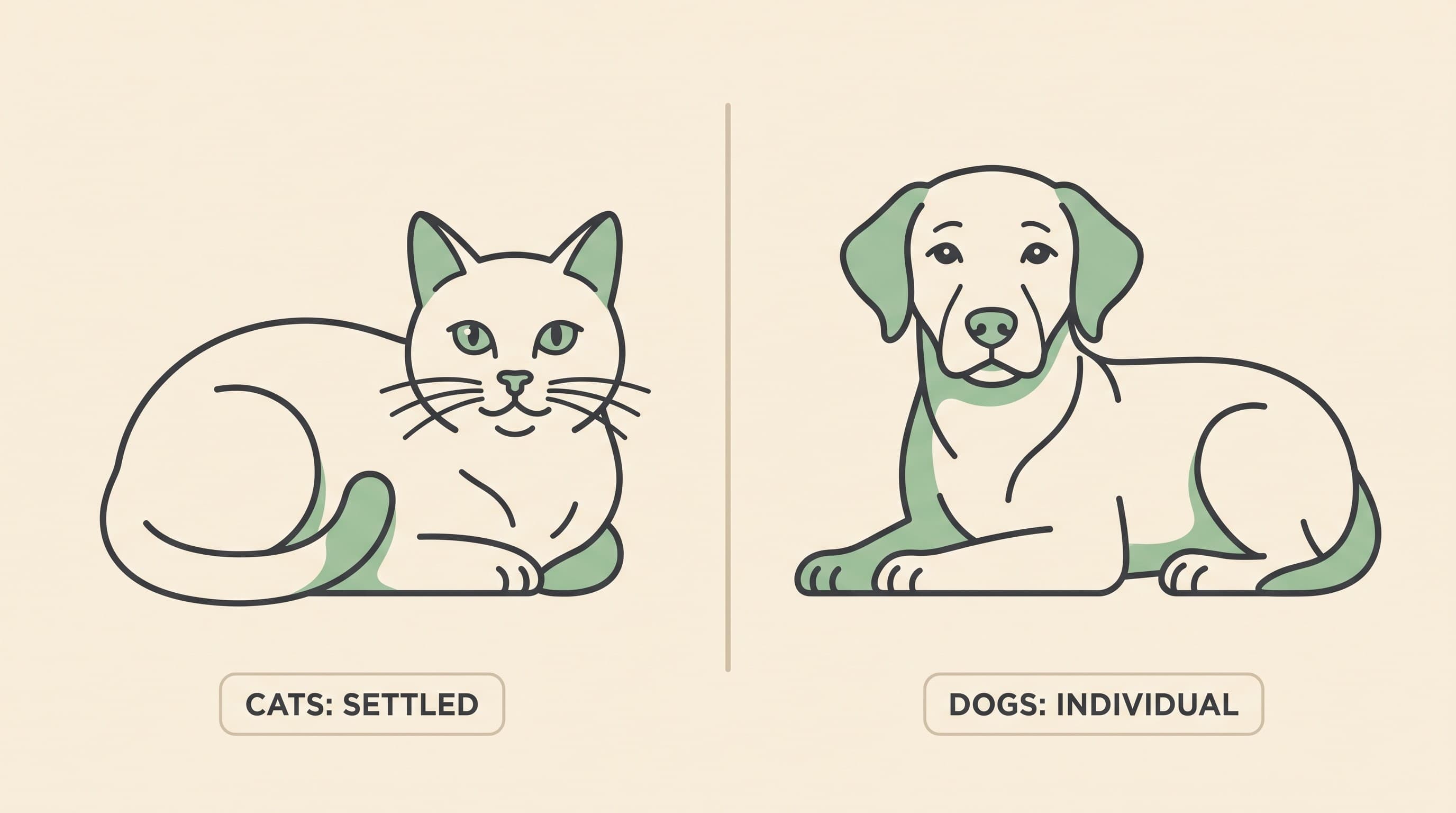
Cats: the settled case
For cats, the picture is now reasonably clear, and I can be more definite than I can for dogs.
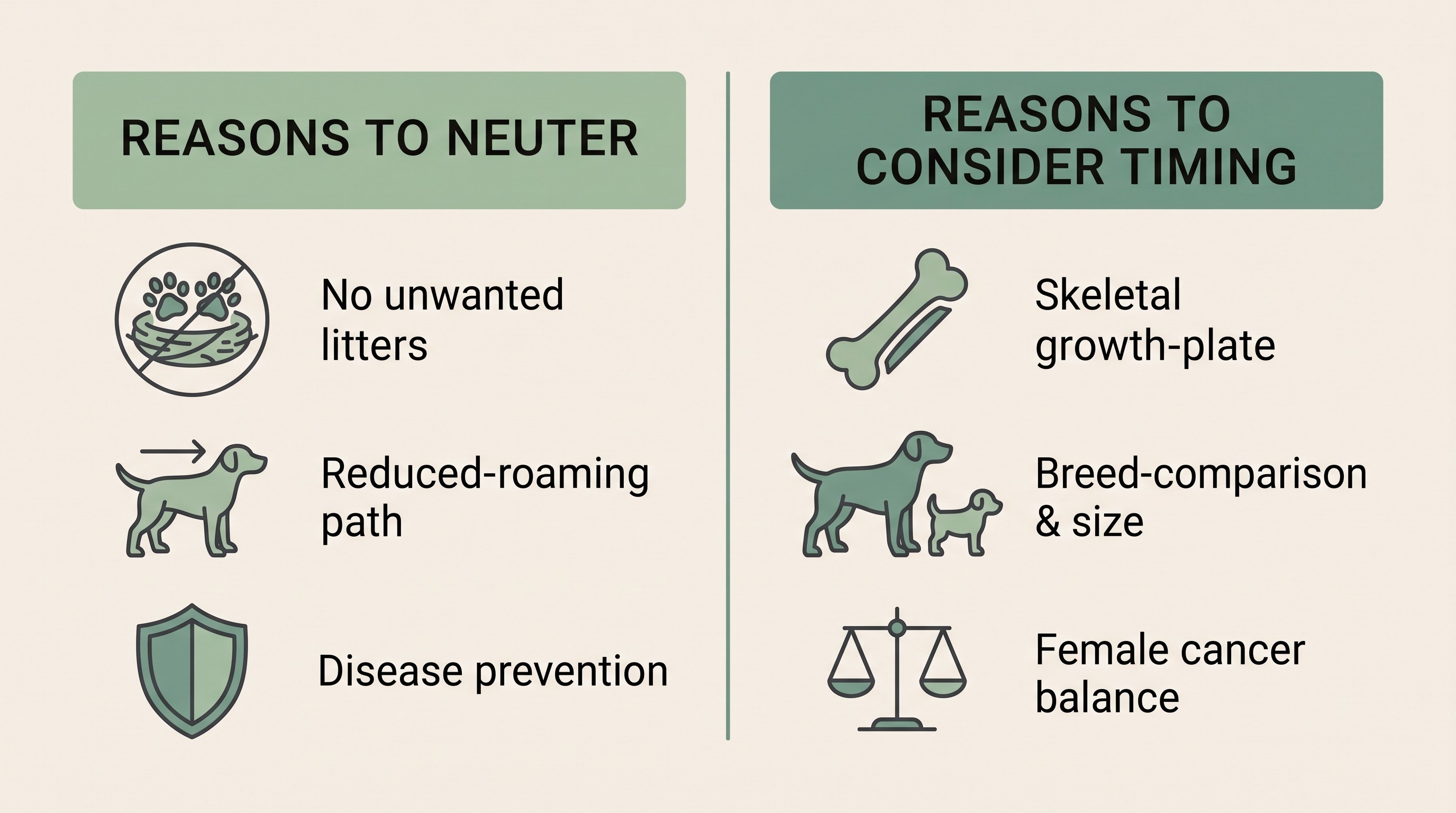
Neutering from around four months of age is widely recommended in the UK, before a kitten reaches sexual maturity. The reasoning is practical and strong. Cats reach breeding age young, sometimes as early as four months, and an unneutered female can produce litters startlingly quickly, so neutering before maturity is the single most effective thing you can do to prevent the unwanted kittens that fill rescue centres every year. It also heads off the behaviours that come with maturity: for toms, the roaming, fighting and spraying that lead to abscesses, road accidents and the spread of viruses like FIV and FeLV; for queens, the repeated, noisy calling of the breeding cycle.
There is a genuine health dimension too. Neutering removes the risk of ovarian, uterine and testicular disease, and spaying females is associated with a reduced risk of mammary tumours, which in cats are frequently malignant. Unlike in dogs, the "wait for skeletal maturity" concern does not carry the same weight in cats, which is why the four-month recommendation stands where it does.
None of this is a decision to make against your vet, and there are always individual exceptions, a poorly kitten, an underweight one, a specific health issue. But for most cats, "neuter around four months" is sound, and it is a rare area of preventive care where the honest answer really is close to a single number.
Dogs: why "neuter at six months" is over
Now the harder one, and the reason this article exists.
For a long time, "six months" was the blanket rule for dogs too, and for many it did no harm. What changed is that researchers stopped looking at dogs in general and started looking at specific breeds, and the picture that emerged was far more varied than one rule could hold.
The landmark work is Hart and colleagues, published in Frontiers in Veterinary Science in 2020, which examined many breeds and how the age at neutering related to the risk of certain joint disorders and some cancers. The central finding was that in some dogs, neutering before skeletal maturity was associated with an increased risk of joint problems, including hip dysplasia, cruciate ligament disease and elbow disease, and with a raised risk of certain cancers. The biology behind it makes sense: sex hormones are part of the signal that tells the growth plates when to stop, so removing them early can subtly alter how the skeleton finishes growing, and joints that developed under changed signalling may be more vulnerable later.
The crucial part, and the reason a single rule cannot work, is that the effect was strongly breed- and sex-specific. Several large and giant breeds showed a meaningful rise in risk when neutered young, while many small breeds showed little or no added joint or cancer risk from early neutering at all. What is prudent for a large-breed dog is simply not the same as what is prudent for a small terrier, and averaging them into "six months" served neither well.
What the current dog advice actually says
The professional bodies have moved with the evidence. Rather than a fixed age, current UK guidance frames dog neutering as an individualised decision, weighing the specific dog, its breed and size, its sex, its home and its behaviour, instead of applying one timing to all.
In practice, that tends to mean this. For many larger dogs, there is a case for waiting until they are closer to skeletally mature, which for a big or giant breed can fall somewhere in the region of twelve to twenty-four months depending on the breed, so the skeleton has largely finished before the hormonal signals are removed. For many small breeds, the older timing carries little of that penalty, so earlier neutering remains perfectly reasonable. And for all of them the decision sits alongside the practical realities of living with an entire dog, seasons, unwanted litters, roaming and marking, which have not disappeared.
I want to be careful here, because this is exactly the sort of nuance that gets flattened into a slogan. "Wait" is not universally right. For some dogs, and some households, earlier neutering is the better call. The point of the individualised approach is not "always wait", it is "the right time depends on this dog", and your vet, who knows your dog and your circumstances, is the person to land it with. Take your breed to that conversation, not a number from an article.
The female balance, in both species
There is one more layer that tips the decision, and it applies to females in particular.
Spaying a female removes the risk of pyometra, a serious and common infection of the womb in older unspayed females that is frequently life-threatening and needs emergency surgery. It also reduces the risk of mammary tumours, and, importantly, that protection is greatest when spaying is done earlier and falls away the longer you wait. So in a female dog, "wait for skeletal maturity" and "spay early for cancer protection" can pull in opposite directions, and where the balance lands genuinely depends on her breed and her joint risk. In cats, the early-spay case is more straightforward and the mammary protection is a strong argument in its own right.
Against the benefits sit a few considerations worth knowing: in bitches, a modest increased risk of urinary incontinence after spaying, usually manageable and more common in larger dogs, and in both species a tendency to gain weight after neutering because the metabolism slows. That weight point is real and manageable, and it is worth reading our weight and body condition guide around the time of the operation so you can adjust feeding before the weight creeps on rather than after.
What neutering will not do
There is a persistent hope, sometimes actively sold, that neutering is a behaviour cure, that it will calm a boisterous dog, stop reactivity or fix aggression. It is worth being clear, because acting on that hope leads to disappointment and can mean a real behaviour problem goes unaddressed. Neutering reliably reduces the behaviours driven directly by sex hormones, roaming, some marking, the drive to find a mate. It is not a treatment for fear, anxiety or reactivity, and in some cases early neutering of an already anxious dog may not help those behaviours at all. If behaviour is your reason for considering it, that is a conversation to have with your vet on its own terms.
Making the decision
So where does this leave you? For a cat, the settled answer of neutering around four months is a sensible default to confirm with your vet. For a dog, there is no number I can honestly hand you, because the right one depends on your dog. Bring the specifics to your vet: the breed, the expected adult size, the sex, whether it is a male or a female and how that changes the mammary and pyometra picture, your home and lifestyle, and any behaviour concerns kept as their own question. That conversation, informed by the trade-offs above, is how you get a decision that fits your animal rather than a rule that fits nobody in particular.
If your pet is still in their first year, this decision sits inside the wider first-year plan, and it is worth seeing it in that context in the first-year roadmap for puppies and kittens. Whatever you and your vet decide, put the date, and the pre- and post-op notes, into the Preventive Care Scheduler so the plan you agreed does not drift once the puppy or kitten chaos takes over.
Keep track of how your pet is doing
The owners who cope best are the ones who notice changes early. A simple health log shows you what is working, and what is not, before the next vet visit.
Start tracking, freeYou're not doing this alone
Compare treatment journeys and talk to owners managing staying well. Free to join.
Join PetsLikeMine