

When Once a Year Becomes Twice: Health Checks for Older Pets
Alastair Greenway
BVM&S MRCVS
There is a moment most owners notice but few act on. The muzzle greys a little. The leap onto the bed becomes a scramble, or stops. The cat sleeps a bit more, plays a bit less, and settles on the lower shelf instead of the top of the wardrobe. Nothing is wrong, exactly. Your pet is just getting older.
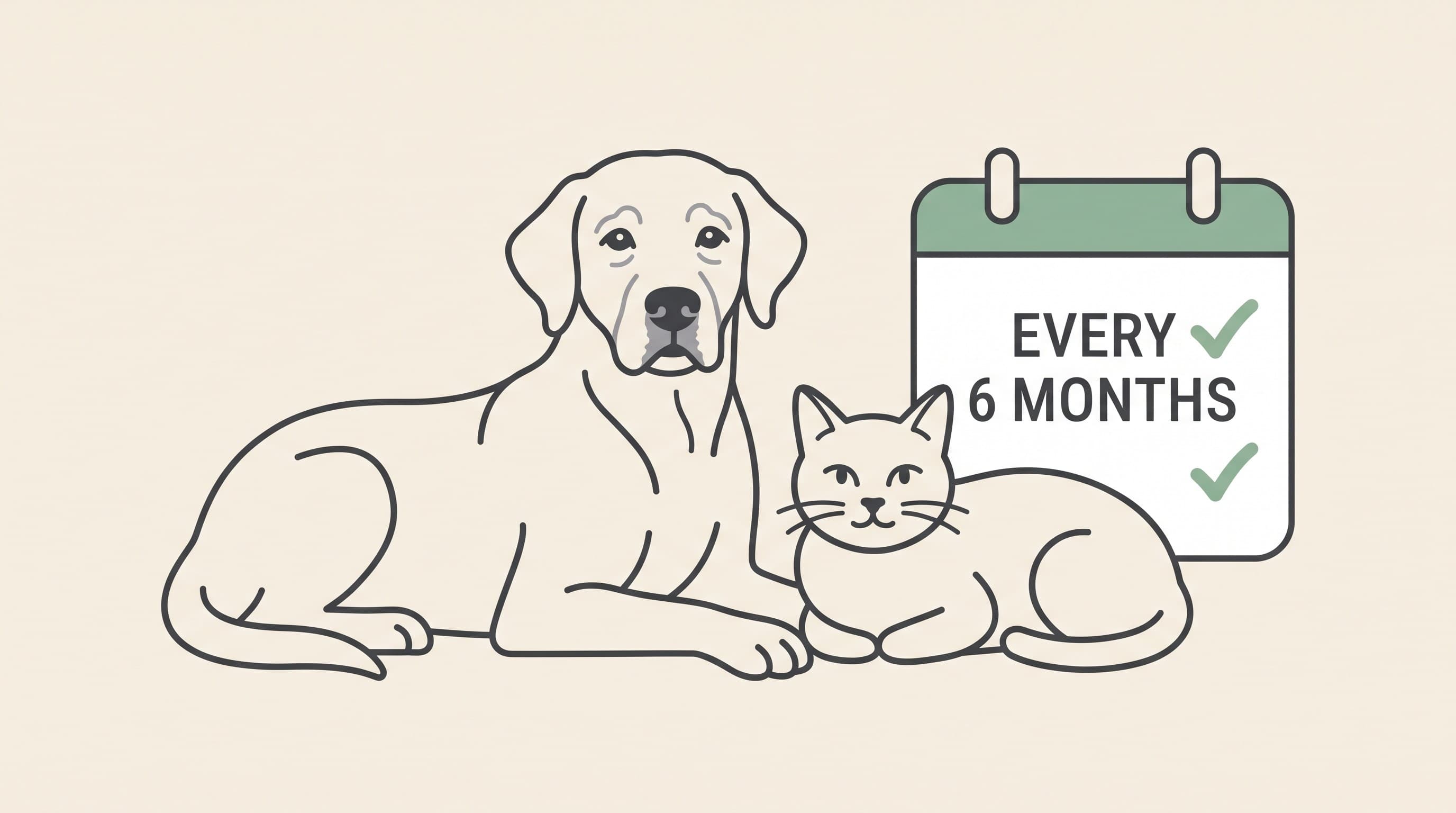
That moment is the cue to change something small that makes a large difference: the rhythm of their health checks. For most of adult life, once a year is right. As pets age, the useful interval shortens, and for a lot of older dogs and cats the answer becomes every six months. This piece explains why the maths changes, when to make the switch, and what an older pet's check adds on top of the standard one. It is a genuine overview, and then, because your senior pet deserves more than a single article, it hands you over to the space we built for exactly this stage of life.
Why the interval shortens
The logic is really about how fast time runs for an older animal.
A year in the life of a healthy five-year-old dog is a fairly stable stretch. A year in the life of a twelve-year-old is not. Pets age faster than we do, and they age faster still towards the end, so twelve months for a senior pet covers a lot more biological ground than it does for a young adult. A problem that would have been a footnote at the last annual check can become established, and harder to manage, before the next one comes round.
On top of that, the conditions that turn up in older pets tend to be the slow, silent, progressive kind, the ones where catching them a few months earlier genuinely changes the outcome. Chronic kidney disease in cats, heart disease, arthritis, diabetes, hormonal disorders like Cushing's and hyperthyroidism, and the various cancers all share that pattern: quiet at first, then not. Seeing an older pet twice a year roughly halves the window in which one of these can develop unnoticed. That is the whole argument in a sentence.
When does "senior" actually start?
There is no single birthday, and anyone who gives you one is rounding. As a rough guide, cats and smaller dogs are often considered senior from around eleven or twelve, medium dogs a little earlier, and large and giant breeds earlier still, sometimes from six or seven, because bigger dogs age faster and have shorter lives.
But the number matters less than the trajectory. The better prompt is what you are already seeing: greying, stiffness or reluctance on stairs and jumps, sleeping more, subtle weight change up or down, cloudier eyes, more thirst, or simply an animal doing a little less of what it used to. When you start noticing those, that is the signal to raise the check-up frequency with your vet, regardless of what the calendar says. And crucially, most of those changes are not "just old age" to be accepted. Old age is not a diagnosis. Very often what looks like slowing down is a treatable problem, arthritis pain, an underactive or overactive thyroid, failing vision, wearing a convincing disguise.
What a senior check adds
An older pet's appointment starts with the same nose-to-tail examination as any other, everything covered in what your vet actually looks for, the eyes, ears, mouth, heart, abdomen, lymph nodes, skin, joints and body condition. Then it goes further, in a few specific directions.
A closer look at weight and muscle. Older pets often lose muscle even as they gain fat, so the weight on the scale can hide what is really going on. Tracking body condition and muscle mass over time, twice a year, catches the wasting that points to kidney disease, heart disease or cancer, and the weight gain that worsens arthritis. Our weight and body condition guide explains how that score works.
A proper conversation about mobility and comfort. This is where owners and vets most often miss things, especially in cats. A stiff dog might slow down; a stiff cat simply stops jumping, and that gets read as old age rather than the pain it usually is. Expect more questions about stairs, jumping, grooming, litter tray access and where your pet chooses to sleep.
Screening blood and urine tests. This is the biggest practical addition. In older pets, and particularly senior cats, a periodic blood and urine screen can pick up kidney disease, diabetes, thyroid disorders and liver changes months or years before there is any outward sign. Whether and how often to run these is a judgement your vet makes for your individual pet, but it is the conversation to have. A screen on a well older cat is one of the highest-value tests in the whole of preventive medicine.
Blood pressure and quality-of-life questions. High blood pressure is common and damaging in older cats and often silent, so many practices check it in seniors. And a good senior appointment includes the gentle, important questions about quality of life, comfort and what a good day looks like for your pet now, which matter more with every passing year.
A closer eye on teeth and behaviour. Dental disease does not stop at middle age, it accumulates, and by the senior years many pets are living with painful mouths they have never once complained about. A twice-yearly look catches the resorbing tooth or the loose one before it becomes an abscess. Behaviour change gets more attention too, because in an older pet a shift in behaviour is very often a medical sign in disguise: the cat that starts toileting outside the tray, the dog that seems confused at night, the pet that becomes withdrawn or unusually clingy. Some of that is cognitive decline, the pet equivalent of the early memory changes we see in people, and some of it is pain or an underlying illness. Either way it is worth raising rather than filing under "just old age", because much of it can be helped.
"Old age" is not a diagnosis
It is worth pausing on that phrase, because it quietly costs older pets a great deal of comfort. When a dog slows on walks, or a cat stops jumping to the windowsill, or either one sleeps more and engages less, the easy reading is that they are simply old and there is nothing to be done. Often there is a great deal to be done. Arthritis pain, an overactive or underactive thyroid, failing vision or hearing, high blood pressure, early kidney disease and dental pain all masquerade as "just getting old", and every one of them has management that can give a pet back months or years of feeling like themselves. The reason to keep checking, and to check more often, is precisely to separate the ageing you cannot change from the treatable problems hiding inside it.
The honest cost conversation
Twice-yearly checks and the occasional screening blood test do cost more than a single annual visit, and I would rather be straight with you about that than pretend otherwise. Two things make it worth it. First, catching a slow disease early in an older pet is very often cheaper over the animal's remaining life than managing the crisis it becomes if missed, quite apart from the difference in your pet's comfort. Second, if cost is a genuine worry, say so to your vet plainly. They can tell you which parts of a senior work-up are the priority for your particular pet and which can wait, and prioritise accordingly. That is a far better decision than quietly stretching the interval and hoping.
This is where we hand you over
Everything above is the overview. But an ageing pet is a whole chapter of life, not a single article, and it deserves proper company.
We have built the Senior Pets space for exactly this stage: the slow changes to expect and which ones are treatable rather than inevitable, keeping an older dog or cat mobile and comfortable, senior nutrition, cognitive decline and the tools to track how your pet is doing month to month. If your pet is greying, slowing, or simply not quite as springy as they were, that space is where to go next, and it will serve you far better than we can in one page here.
For now, do the one concrete thing this article is really about. If your pet has crossed into their senior years, book the switch to twice-yearly checks, and set both dates in the Preventive Care Scheduler so the second one does not quietly slip. Six months is a long time in an older pet's year. Do not give a silent problem all of it.
Free downloads
Companion worksheets to put what you've read into practice. Free PDFs, print at home.
Keep track of how your pet is doing
The owners who cope best are the ones who notice changes early. A simple health log shows you what is working, and what is not, before the next vet visit.
Start tracking, freeYou're not doing this alone
Compare treatment journeys and talk to owners managing staying well. Free to join.
Join PetsLikeMine