

Does My Pet Actually Need Monthly Flea Treatment?
Alastair Greenway
BVM&S MRCVS
If you have ever stood in front of the flea aisle, or opened yet another reminder telling you a monthly treatment is due, and quietly wondered whether your pet genuinely needs all of this, you are asking a fair and sensible question. It is also a question that most of the loudest voices around you have a financial reason to avoid.
So let's have the unhurried version of the conversation, the one there isn't usually time for in a ten-minute appointment. The honest answer is that some pets do need year-round monthly flea cover, some don't, and the only way to know which one you've got is to look at your particular animal and your particular home rather than defaulting to "monthly, forever" because that's what the box, the plan and the pharmacy all say.
The tension nobody names out loud
Here is the thing worth saying first. "Treat every pet, every month, all year round" is the message you hear most, and it is also the message that sells the most product. Vet wellness plans, pharmacy subscriptions, awareness campaigns and monthly boxes are all built around a steady monthly volume of treatment. That doesn't make any of them dishonest, and it doesn't mean the products don't work. It just means the default you keep bumping into was designed partly around a business model, not purely around your individual pet's risk.
And that default is not what the veterinary profession's own current guidance actually says. That is the part most owners have never been told, and it changes the whole conversation.
What the profession actually recommends
In 2021 the British Veterinary Association, the British Small Animal Veterinary Association and the British Veterinary Zoological Society published a joint position on the responsible use of parasiticides in cats and dogs. It was updated on 31 October 2025. The headline message is that we should move away from blanket, one-size-fits-all treatment and instead risk-assess the individual animal, choosing the parasites we cover, and how often, based on that pet's actual lifestyle, and weighing the environmental impact of the products alongside the benefit (BVA/BSAVA/BVZS, 2021, updated 2025).
That is worth reading twice, because it is the opposite of "monthly-everything". It comes from the profession's own leading bodies, not from a pet-care website second-guessing your vet. When we point you toward a risk-based approach here, we are simply telling you what your own profession's guidance already says, and giving you the words to have a better conversation about it.
The European Scientific Counsel Companion Animal Parasites for the UK and Ireland takes the same view: treat based on a genuine assessment of risk rather than reflex (ESCCAP UK & Ireland). Risk-based is now the mainstream veterinary position. It is not fringe, and it is not anti-treatment.
What "risk-based" does not mean
Before we go a step further, let's nail down the single most important boundary in this whole article, because it is the one that gets lost.
Risk-based does not mean none. It never means none.
A pet with fleas, a pet with a history of fleas, a pet that reacts badly to flea bites, or a pet whose lifestyle genuinely exposes it to fleas should be treated, reliably and regularly. Risk-based simply means we stop treating a very low-risk animal on the same rigid monthly schedule as a very high-risk one, and we match the plan to the pet. If you take one sentence from this piece to your vet, make it that one.
How to think about your pet's flea risk
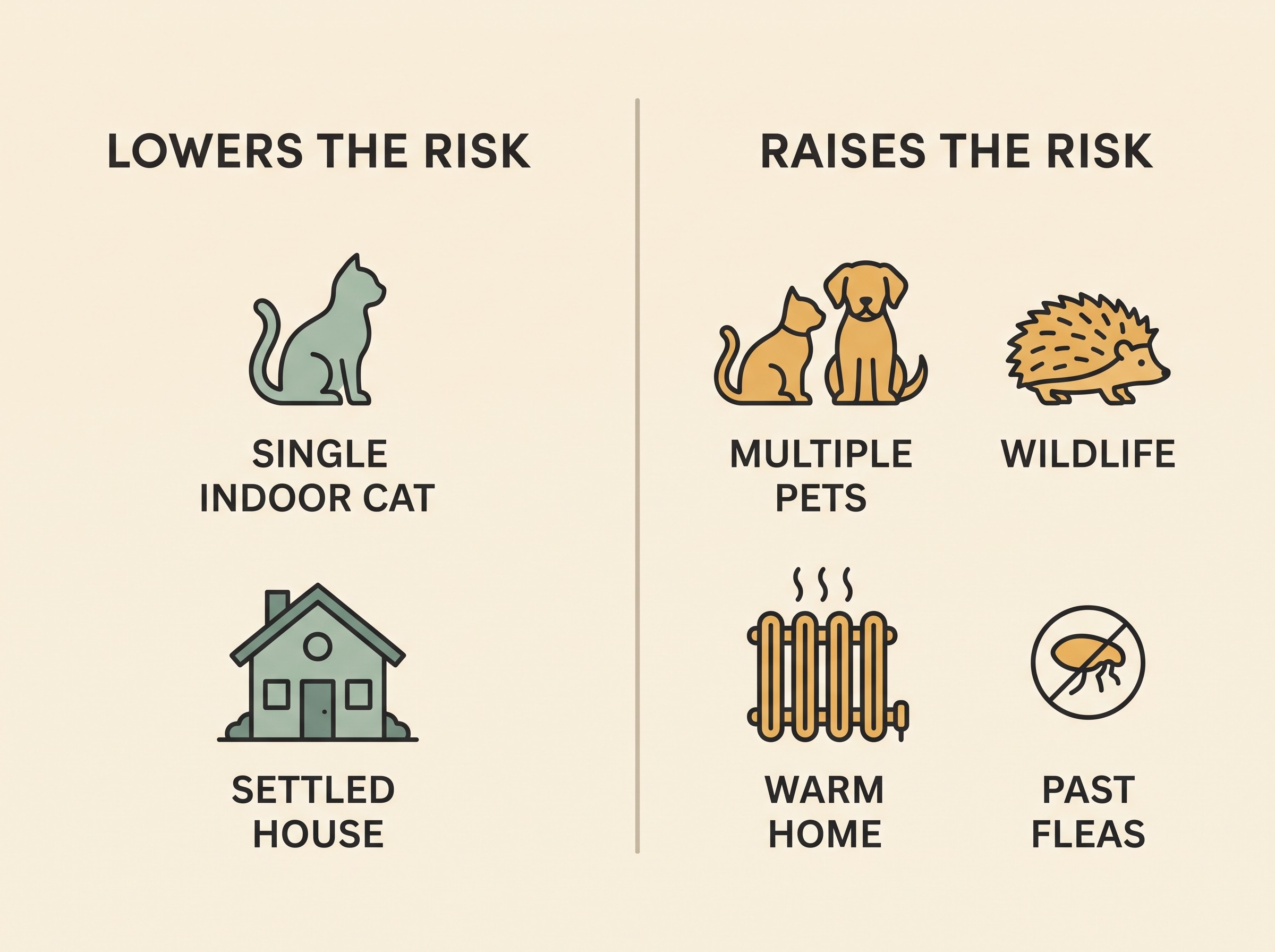
So what actually raises or lowers the odds that your pet needs regular cover? These are the things a vet weighs up, and you can start weighing them up yourself today.
Things that push risk up:
- A history of fleas in your home. Once a house has had fleas, the environment can hold flea eggs, larvae and pupae for a long time, so re-infestation is easy. A previous infestation is one of the strongest reasons to stay on reliable cover.
- Multi-pet households. More animals means more chances for fleas to arrive, breed and spread between them.
- Contact with other animals. Dogs that meet lots of other dogs, cats that roam and mix, and homes with wildlife visitors (hedgehogs, foxes, rodents) in the garden all raise exposure.
- A warm, centrally heated home. Fleas are not just a summer problem in the UK any more. Warm homes let them stay active through the winter, which is part of why the old "treat in summer only" habit no longer fits many households.
- Outdoor and hunting lifestyles. A cat that hunts, or a dog that spends a lot of time in long grass and wildlife-rich areas, meets more fleas than a housebound pet.
Things that push risk down:
- A single-pet home with little contact with other animals.
- A genuinely indoor-only cat with no other pets coming and going (though "genuinely indoor-only" is doing a lot of work in that sentence, and even indoor cats aren't zero-risk).
- No history of fleas in the home.
- A settled, low-traffic environment.
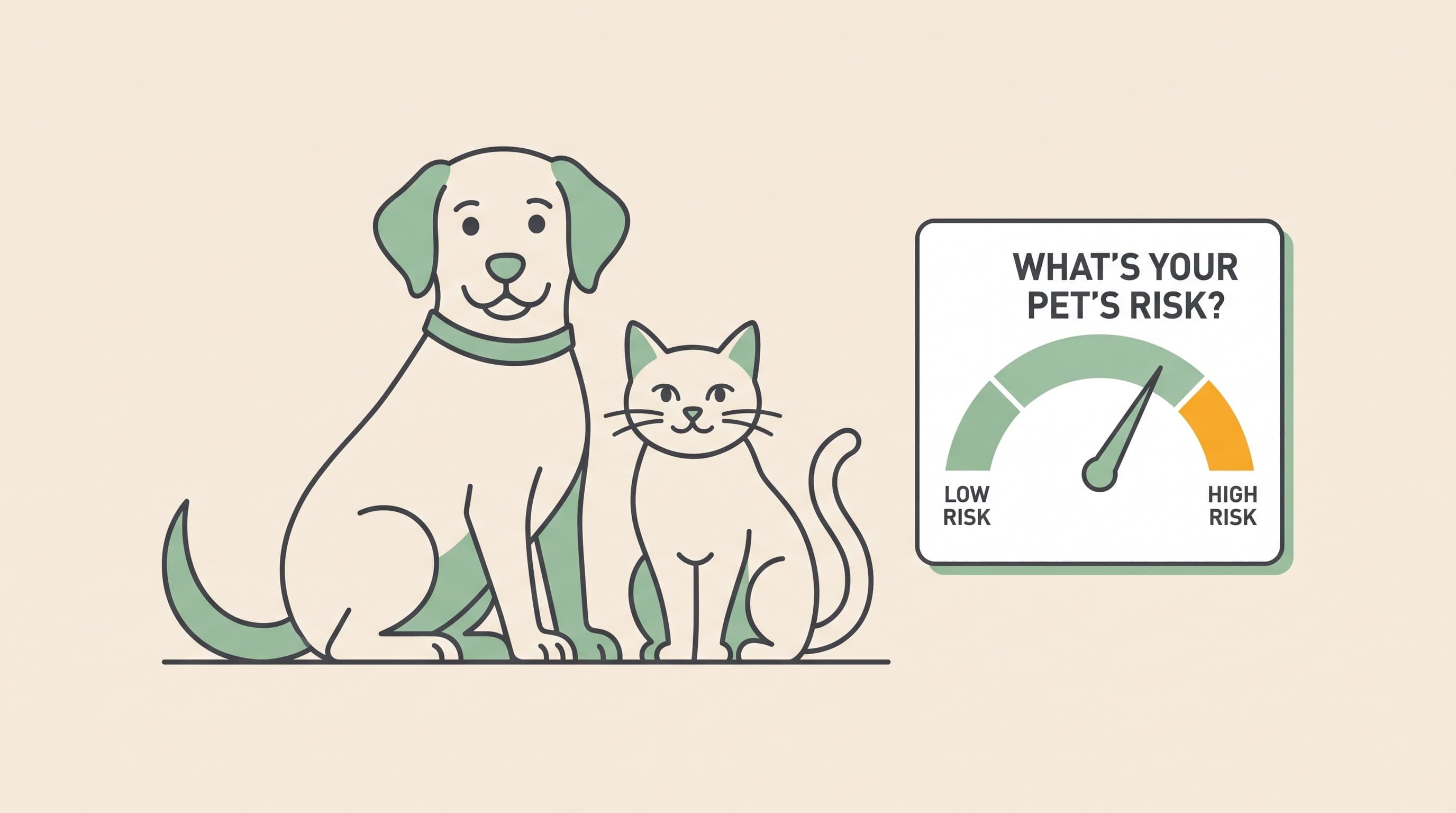
Most pets sit somewhere in the middle rather than at either extreme, which is exactly why a blanket rule serves them badly. To turn this into a real answer for your pet rather than a vague sense of it, the parasite risk quiz walks you through these questions and gives you a personalised starting point to take to your vet.
The honest case for treating, so we don't pretend fleas are harmless
It would be dishonest to talk you through "you might not need monthly" without being equally clear about why fleas genuinely matter, because they do.
Fleas are not just an itch and an inconvenience. They cause flea-allergic dermatitis, one of the most common skin conditions we see, where a single bite triggers intense, miserable itching in a sensitised animal. They can transmit tapeworm, because a pet that swallows an infected flea while grooming can pick up Dipylidium caninum. In young, small or debilitated animals a heavy burden can even cause anaemia through blood loss. And once fleas are established in a home, clearing them is genuinely hard work, because most of the flea population is in the carpet and soft furnishings as eggs and larvae, not on your pet.
That is the honest counterweight. For a pet with real risk, regular, reliable flea cover is not over-treatment, it is sensible prevention, and it is far easier than dealing with an infestation after the fact.
Not all flea products are the same
If you do treat, it's worth knowing that the product from your vet and the one on a supermarket shelf are not simply the same thing at different prices. Veterinary medicines fall into legal categories that determine how they are supplied and how strong the oversight is, and the most effective, best-targeted products are often prescription-only for good reasons around safety and resistance. An over-the-counter spot-on and a vet-prescribed product are not interchangeable, and choosing purely on price can mean choosing a product that doesn't fit your pet. There is a fuller explanation in POM-V, NFA-VPS, AVM-GSL: Pet Medicine Categories Decoded, and the short version is: ask your vet what your pet actually needs rather than what is cheapest on a shelf.
One particular caution for cat owners: some flea products made for dogs contain permethrin, which is highly toxic to cats and can be fatal. Never use a dog product on a cat, and be careful about treated dogs and cats living together.
A word specifically about cats
Cats deserve their own paragraph here rather than being treated as small dogs. It is tempting to assume an indoor-only cat has no flea risk at all, and its risk is genuinely lower, but it isn't zero. Fleas can hitch in on your clothing, on a dog that comes and goes, or on a visiting animal, and a cat that slips out even occasionally, or lives alongside a pet that goes outside, has real exposure. So an indoor cat is a good example of the middle ground: often lower-risk than an outdoor hunter, rarely genuinely no-risk. If you have a truly indoor, single cat and you're wondering whether you can do less, that's a legitimate question to raise, and there's a fuller, cat-specific answer in Indoor-Only Cats: Do They Need Flea and Worm Treatment?.
Seasonal, year-round, or something in between
One of the most useful things a risk-based conversation can produce is not a simple yes or no but a shape. For some pets the right answer is genuinely year-round monthly cover. For others it might be heavier cover through the warmer months and lighter or paused cover through winter, and for a few it might be treating reactively when there's a known exposure. The old rule of "treat in summer, forget the rest of the year" no longer fits many UK homes, because centrally heated houses keep fleas active in winter too, so "seasonal" isn't as simple as it once was. This is exactly the kind of nuance a good vet will help you tune, and exactly the kind of plan the scheduler is built to hold, whether that's monthly, seasonal or annual.
The part about rivers and songbirds
There is one more reason "the right amount" matters, and it isn't just about your pet or your wallet. When we over-treat animals that don't need it, the active ingredients in spot-on flea products end up in the environment, and UK research has now found them widely in rivers and even in the nests of songbirds. This is a real and growing concern, and it is one of the reasons the profession moved toward risk-based use in the first place.
That is not a reason to leave an at-risk pet untreated, and it is emphatically not a reason to feel guilty for protecting your animal. It is simply another argument for right-sizing: treat the pets that need it, on the schedule they need, and don't dose-and-forget the ones that don't. If this is on your mind, Flea and Worm Treatments and the Environment lays out the evidence calmly, along with the simple practical steps that make a real difference.
So, does your pet need monthly flea treatment?
Here is where all of this lands. For some pets, yes, absolutely: a dog with flea allergy, a multi-pet home, a house that has had fleas before, a hunting cat, or a pet in a warm home with year-round exposure often does best on reliable, regular cover. For others, a genuinely lower-risk animal in a settled single-pet home, the honest answer may be that year-round monthly treatment is more than that individual needs, and a different plan might fit better.
The point is not to talk you out of treatment, and it is definitely not to talk you into stopping treatment on a pet that needs it. The point is to match the plan to the animal.
The question to take to your vet: "Based on my pet's lifestyle and our home, does my pet need year-round monthly flea cover, seasonal cover, or something in between, and which product actually suits my pet?" Your vet knows your pet and your area, so this is a conversation to have with them, not a decision to make against them. Taking the parasite risk quiz first gives you a personalised starting point to bring along, and once you and your vet agree on a plan, the Preventive Care Scheduler will keep the due dates straight for you so nothing slips.
References
- British Veterinary Association, British Small Animal Veterinary Association and British Veterinary Zoological Society (2021, updated 31 October 2025). *Responsible use of parasiticides for cats and dogs* (position statement).
- ESCCAP UK & Ireland. *Guideline 1: Worm Control in Dogs and Cats*, 7th edition (June 2025); risk-based approach to parasite control.
- NOAH Compendium. UK licensed-product datasheets (spectrum, species, age/weight limits; permethrin/cat contraindication).
- Perkins, R., Goulson, D. et al. (2020 onwards). Studies on fipronil and imidacloprid in English rivers and songbird nests. *Science of the Total Environment* / University of Sussex.
Free downloads
Companion worksheets to put what you've read into practice. Free PDFs, print at home.
Keep track of how your pet is doing
The owners who cope best are the ones who notice changes early. A simple health log shows you what is working, and what is not, before the next vet visit.
Start tracking, freeYou're not doing this alone
Compare treatment journeys and talk to owners managing staying well. Free to join.
Join PetsLikeMine