

Indoor-Only Cats: Do They Need Flea and Worm Treatment?
Alastair Greenway
BVM&S MRCVS
If your cat has never set a paw outside, and you're being told she still needs monthly flea and worm treatment, your scepticism is entirely reasonable. It's one of the most sensible questions a cat owner can ask, and, unlike a lot of preventive advice, it has an honest answer that includes the words "probably less than you've been told". An indoor-only cat genuinely does sit in a lower-risk group, and I'd rather give you the real picture than the one-size-fits-all default.
But "lower risk" is not the same as "no risk", and this is where the honest answer has two halves. There are a few specific ways parasites still reach an indoor cat, and one of them, roundworm, matters enough that even the most housebound cat deserves a proper conversation rather than a blanket "you're fine, don't bother". So let's do this properly: what you can reasonably relax about, what you can't, and how to work out where your own cat sits.
The instinct is right: indoor cats really are lower-risk
Let's start by validating the thing that brought you here. A cat who lives entirely indoors, doesn't hunt, and shares a home with no other animals that go outside, avoids most of the ways cats pick up parasites. She isn't walking through flea-infested grass, she isn't eating infected prey, and she isn't rubbing up against unknown cats. The profession's own move towards risk-based parasite control (rather than treat-everything-monthly) is built precisely on this idea: match the treatment to the individual animal's actual exposure, not to a marketing calendar. The guidance from the BVA, BSAVA and BVZS on responsible use of parasiticides is explicit that we should risk-assess the individual rather than blanket-treat, and ESCCAP UK & Ireland frames deworming the same risk-based way. So if you've felt slightly silly buying flea treatment for a cat that's never met a flea, you weren't being irresponsible. You were noticing something real.
The honest permission this piece can give you is this: for a genuinely low-exposure indoor cat, you very likely don't need the year-round, every-single-month regime that's marketed as the default. What you need instead is to understand the handful of routes that do still apply, and to set a sensible, lighter plan around those.
The ways parasites still get to an indoor cat
Here are the real, specific gaps in the "she never goes out, so she's safe" logic. None of these should frighten you, but each one is a genuine route.
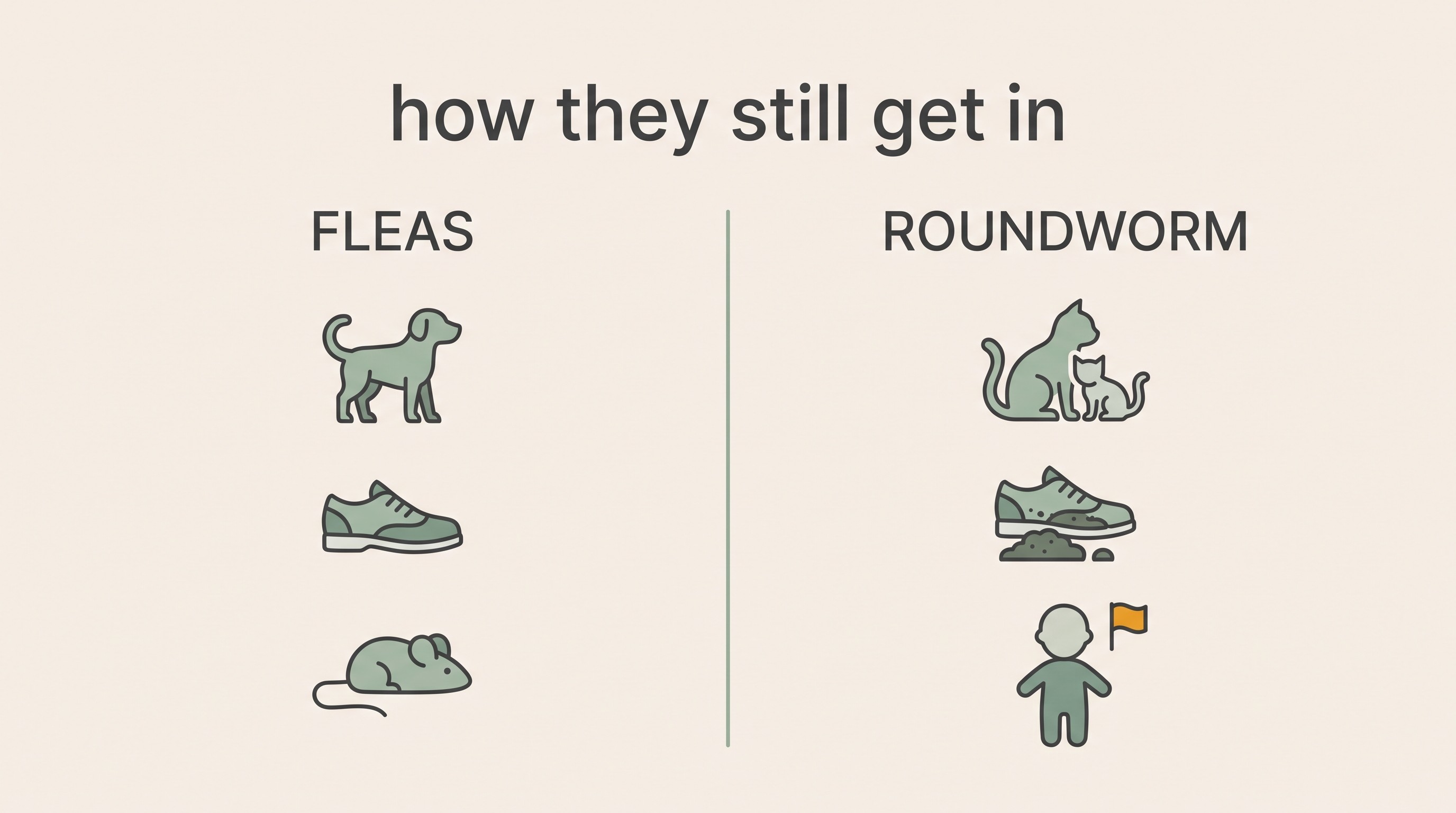
Fleas can arrive without your cat ever leaving. Fleas are brought in. They hitch a ride on another pet in the household that does go outside, they can come in on your clothing after you've been somewhere with animals, they can already be present in a home you've recently moved into, and they can be carried by wildlife such as mice, rats or foxes getting into or under a property. An entirely indoor cat can, and sometimes does, end up with fleas, and because owners of indoor cats often aren't looking for them, an infestation can get established before anyone notices. Fleas aren't just an itch: they cause flea allergic dermatitis in sensitive cats and can transmit tapeworm.
Roundworm is the one that reaches even the housebound. This is the beat that stops "indoor cat" meaning "zero worming". Cats acquire Toxocara cati (the cat roundworm) in ways that don't need the cat to go outside:
- Kittens are often infected from their mother, through her milk, before they ever leave home. A kitten that has "always been indoors" may still have been born infected, which is why kitten worming is not optional.
- Roundworm eggs can be carried into the home on shoes and on soil, from gardens, parks and pavements. It takes weeks in the environment for eggs to become infective, so this is a low-level route rather than a dramatic one, but it exists.
- If your indoor cat catches the occasional mouse that has found its way inside, prey can carry larvae.
Roundworm matters more than the others because it's zoonotic: Toxocara can infect people, and, though it's uncommon, it can cause serious illness in children. That single fact is why the honest "do less" has a floor, and we come back to it below. There's a fuller piece on this at roundworm and your family: why some worming is non-negotiable.
"Indoor" is often not quite as absolute as we think. Plenty of cats we describe as indoor-only actually have a supervised balcony, a catio, an open window in summer, a garden they're occasionally let into, or a habit of shooting out of the front door now and then. Mosquitoes and other biting insects come indoors too. If your cat's world includes any of that, her risk profile shifts a little towards an outdoor cat's, and it's worth being honest with yourself about how sealed her life really is.
Where you can honestly do less, and where you can't
Now the practical part. Here's how the two halves fit together for a typical indoor cat.
Where you can reasonably relax: if your cat is truly indoor-only, doesn't hunt, and lives with no other animals that go outside, routine year-round flea treatment is often not necessary. A reasonable approach many vets are comfortable with is to stay alert rather than treat by default: know the signs of fleas (scratching, over-grooming, flea dirt in the coat), check her over now and then, and be ready to treat promptly and thoroughly if fleas do appear, because they're miserable and hard to shift once established. This is a real, guideline-consistent way to do less, not a corner being cut.
It's worth knowing what "treat reactively" actually involves, so it doesn't catch you out. Fleas spend only part of their life on the cat; the rest, eggs, larvae and pupae, sit in your carpets, bedding and soft furnishings. That's why a single dose rarely fixes an established infestation, and why "I'll deal with it if it happens" needs to mean treating the cat properly and dealing with the home environment, usually over a few weeks. If you're going to run a reactive plan rather than a preventive one, the trade-off is that you have to actually notice fleas early and act decisively. Owners who know they won't spot the signs, or won't get round to it, are often better off with light routine cover instead. There's no shame in choosing the option that matches how you actually run your household.
One more genuine relaxation: ticks and lungworm are largely outdoor, prey-and-slug problems, so for a truly indoor, non-hunting cat these are usually not a concern at all. If your cat never encounters slugs, snails or the outdoors, you can generally set those worries aside, which is another reason a blanket product designed for an outdoor cat is often overkill indoors.
Where you can't drop to zero: roundworm. Even an indoor cat warrants a baseline of worming for roundworm, and how often depends on your household. The single most important factor is who lives with the cat: if there are young children, or anyone pregnant or immunocompromised in the home, the roundworm case is stronger and more frequent worming is sensible, because the consequences of Toxocara in a child, though rare, are serious. Kittens, as above, need worming regardless of ever having been outside. This is exactly the kind of thing that should be set with your vet rather than guessed at, and the general framework, including how often, is in worming: how often does your pet really need it?.
So the honest headline is: for many indoor cats, fleas are where you can genuinely ease off and treat reactively, while roundworm keeps a baseline you shouldn't drop entirely, especially with children in the house.
Work out where your own cat sits
Rather than me guessing at your cat, the useful move is to map her actual life. The questions that matter are the ones our parasite risk quiz is built around, and they're worth thinking through:
- Is she completely indoor, or does she have a balcony, catio, garden access or a habit of escaping?
- Are there other pets in the home that go outside?
- Does she hunt, even the occasional indoor mouse?
- Who else lives in the home, and are any of them young children, pregnant, or immunocompromised?
- Have you recently moved, or is there wildlife getting into the property?
Your honest answers to those turn "do indoor cats need treatment?" into "what does my indoor cat need?", which is the only version of the question with a real answer. Take that answer to your vet, and use the Preventive Care Scheduler to set whatever plan you land on as monthly or seasonal reminders so nothing gets forgotten (and so you're not treating on autopilot either way).
The one honest sentence to hold onto
An indoor-only cat is a genuinely lower-risk cat, and you're right to question a monthly-everything default that was never designed for her. The line I'd draw is this: you can very reasonably do less for an indoor cat, but "less" isn't "nothing", because fleas can still be carried in and roundworm still applies, especially where there are children in the home. The best next step isn't to stop or to keep blanket-treating out of habit. It's to take your cat's real, specific circumstances to your vet and agree a right-sized plan, then let it run. That's doing less, honestly and safely, which is exactly what a thoughtful indoor-cat owner should be able to do.
References
- BVA/BSAVA/BVZS (2021, updated 31 October 2025). *Responsible use of parasiticides in cats and dogs* (position statement).
- ESCCAP UK & Ireland. *GL1 Worm Control in Dogs and Cats*, 7th ed (June 2025) (risk-based deworming; roundworm baseline; *Toxocara* zoonosis; monthly for higher-risk households).
- *Toxocara cati* transmission (queen-to-kitten via milk; environmental eggs; prey) and zoonotic potential (ocular/visceral larva migrans, risk to children).
- Flea allergic dermatitis and flea-borne tapeworm (*Dipylidium caninum*) in cats.
Free downloads
Companion worksheets to put what you've read into practice. Free PDFs, print at home.
Keep track of how your pet is doing
The owners who cope best are the ones who notice changes early. A simple health log shows you what is working, and what is not, before the next vet visit.
Start tracking, freeYou're not doing this alone
Compare treatment journeys and talk to owners managing staying well. Free to join.
Join PetsLikeMine