

Roundworm and Your Family: Why Some Worming Is Non-Negotiable
Alastair Greenway
BVM&S MRCVS
Most of this section of Staying Well is about giving you permission to do less: to question the monthly-everything default, to match treatment to your actual pet, to stop dosing a low-risk animal on autopilot. That's the honest, evidence-based direction the profession has moved in, and I stand behind every word of it. But there is one place where "do less" hits a hard floor, and it's worth being completely straight with you about it. That floor is roundworm, and the reason is your family.
Roundworm is worth keeping on top of not mainly for your pet's sake, but because the roundworm your dog or cat can carry is one of the few parasites that genuinely crosses to people, and, though it's uncommon, it can cause serious harm to children. So this piece leads with what worming prevents, because that's the honest way to explain why this particular part of the schedule is not the bit to drop. If you've got a new baby, a crawling toddler, or small children who play in the garden, this is the one I'd ask you to read properly.
What roundworm can do to people
Let's start with the thing that makes this non-negotiable, stated plainly rather than buried.
Dogs and cats carry roundworms called Toxocara (Toxocara canis in dogs, Toxocara cati in cats). These are zoonotic, meaning they can pass from animals to people. When a person, most often a young child, accidentally swallows infective roundworm eggs, the tiny larvae can hatch and migrate through the body. This human infection is called toxocariasis, and while many cases cause little or no obvious illness, it can, in a minority of cases, cause real and lasting harm. The forms doctors describe include:
- Ocular larva migrans, where a larva reaches the eye. This is rare, but it can damage vision and, in the worst cases, cause permanent sight loss in a child.
- Visceral larva migrans, where larvae migrate through organs and can cause fever, coughing, abdominal discomfort and other symptoms.
- Covert or subtle toxocariasis, a milder, less specific illness.
I want to be careful here, because the point is not to frighten you into thinking your child is in constant danger. Serious cases are genuinely uncommon. The point is that the consequence, when it does happen, is severe enough, and the child affected young enough, that the sensible response is prevention rather than luck. That's what makes this the one worm you don't gamble with.
How it actually spreads (and why the fear is manageable)
Understanding the route is reassuring, because it shows you exactly where prevention works.
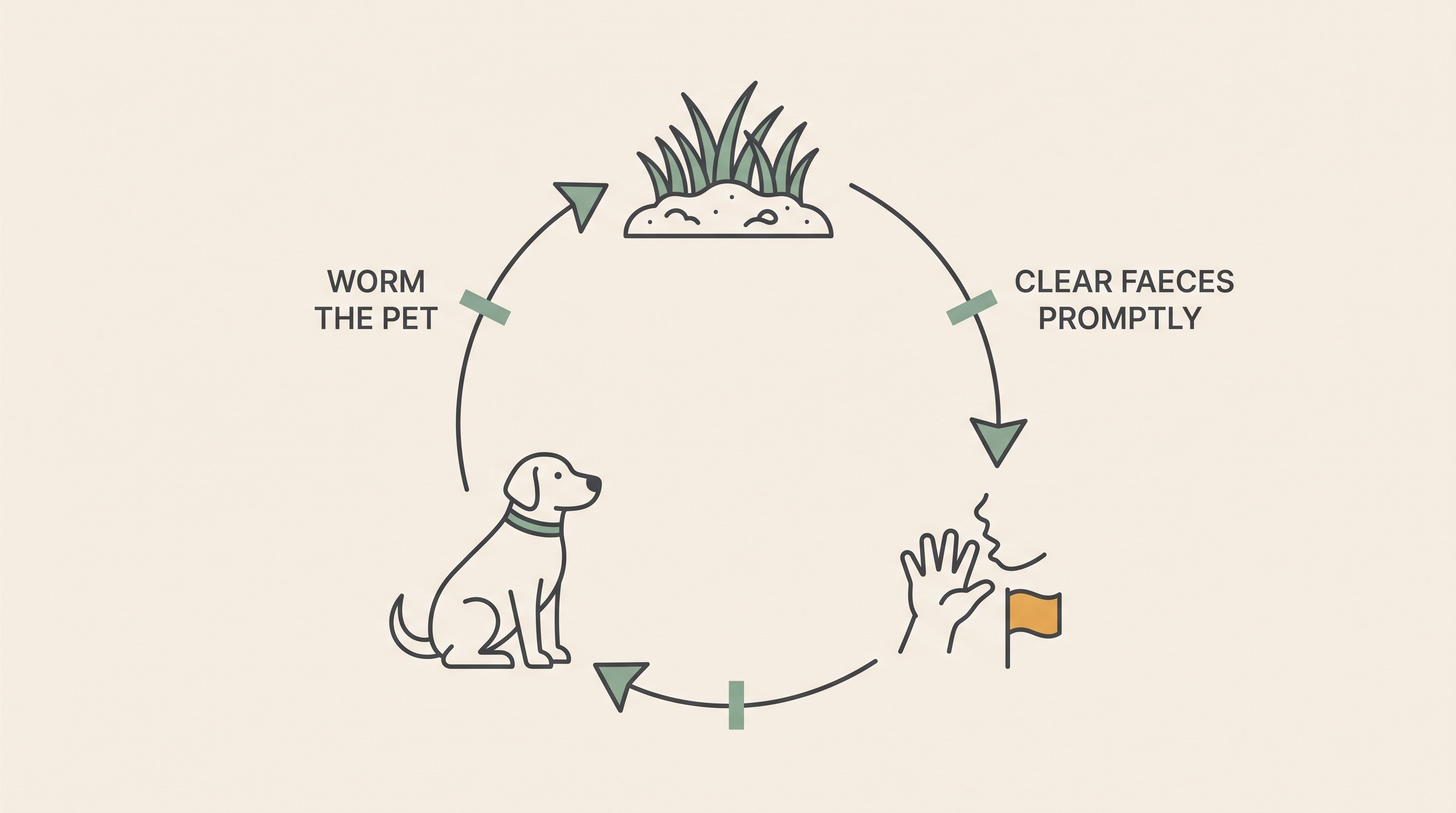
An infected dog or cat sheds roundworm eggs in its faeces. Crucially, those eggs are not infective the moment they're passed. They need a period in the environment, typically some weeks, to develop before they can infect anyone. That single fact is your biggest ally: it means fresh faeces cleared up promptly is a much smaller risk than faeces left to sit, and it's why picking up after your pet, straight away, is genuinely protective and not just good manners.
Once eggs have matured in soil, sand or grass, people are infected by accidentally swallowing them, usually via hands, and this is why children are the group most at risk. Toddlers put their hands in their mouths, play in soil and sandpits, and don't wash up unprompted. They're not doing anything wrong; it's simply how small children explore the world. The eggs are hardy and can persist in the environment, which is why contaminated soil, not your clean, cuddly pet directly, is the main exposure route.
So the risk isn't "my pet is dangerous to hold". It's "roundworm eggs in the environment can reach a child's mouth, and worming the pet keeps the number of eggs going into that environment low". That reframes the whole thing from fear to a manageable, two-part job: treat the pet, and manage the environment.
What worming does, and how often
Worming your pet reduces the number of roundworm eggs it sheds into your home and garden, which is precisely how it protects the people around it. This is why worming is never truly "optional", even for an otherwise low-risk pet, and it's the sentence to hold onto: risk-based worming means adjusting the frequency to your circumstances, not deciding whether to bother at all.
On frequency, ESCCAP UK & Ireland sets a sensible baseline of at least four treatments a year (roughly every three months) for roundworm as the default for most pets. And this is where households like yours push the dial the other way: where there are young children, or anyone pregnant or immunocompromised in the home, monthly worming is often recommended, because the stakes of infection are higher. Risk-based, in other words, can mean more for a family, not less. This is the exact opposite of the "do less" message that applies to a low-risk adult pet in an adults-only home, and both can be true at once because they're the same principle applied to different circumstances. There's a fuller walk-through of the general schedule in worming: how often does your pet really need it?.
Puppies, kittens and the highest-risk window
If you've just brought home a puppy or kitten alongside young children, this deserves special attention, because young animals are both the most heavily infected and the ones your children will most want to cuddle and follow around.
Puppies and kittens are very commonly born already carrying roundworm, or acquire it from their mother's milk in the first days of life. Left untreated, they shed large numbers of eggs, so they need worming much more frequently than an adult in those early months, on a schedule your vet will set out. This is not the moment for a light-touch approach. There's more on getting a young animal's first months right, worming included, in the first-year roadmap for puppies and kittens.
The everyday hygiene that does the other half
Worming the pet is one half; managing the environment is the other, and together they make the risk very small. None of this is onerous, and it's mostly things you'd want to do anyway with small children about:
- Pick up your dog's faeces promptly, at home and out, and bin it. Because eggs need weeks to become infective, prompt removal genuinely interrupts the cycle.
- For cats, scoop litter trays daily and keep them well away from where children play or eat. Cover outdoor sandpits when not in use, since roaming cats may treat an uncovered one as a litter tray.
- Wash hands, yours and the children's, after playing with pets, after gardening, and always before eating. This is the single most effective habit.
- Wash home-grown vegetables and fruit that may have been in contact with soil.
- Discourage toddlers from eating soil or sand, and supervise play in areas animals may have fouled.
Do these alongside a sensible worming schedule and you've addressed both ends of the cycle.
Two things owners often get wrong
A couple of common misunderstandings are worth clearing up, because they lead people to either panic or drop their guard.
The first is the idea that a wormy pet looks obviously ill, so a healthy-looking cat or dog must be worm-free. That's not how it works. Plenty of infected adult animals look and act completely normal while quietly shedding eggs, which is exactly why worming is done on a schedule rather than only when something seems wrong. You can't tell by looking, and a bright, glossy pet is not proof of a clear gut.
The second is the belief that you can catch roundworm by being licked or by cuddling your pet. The main route to human infection is swallowing eggs that have matured in the environment over weeks, not direct contact with a freshly clean animal. So you don't need to keep your children away from the pet, and you don't need to feel squeamish about affection. What you need is the pet wormed and the faeces cleared promptly, which is a far more comfortable message than "hold your dog at arm's length". The relationship between children and pets is good for both; the job is simply to manage the environment around it.
The reassurance to leave with
I don't want you finishing this feeling you have to choose between your pet and your child, because you absolutely don't, and the whole message here is that this is controllable. Millions of families share their homes with dogs and cats and small children with no ill effects at all, precisely because worming and basic hygiene work. A previous scare, or the arrival of a new baby, is not a reason to rehome a pet or hold them at arm's length. It's a reason to make sure the boring bits, regular worming and prompt poo pick-up, are actually happening.
So here is the honest bottom line of this whole section, in one place. For a low-risk adult pet in an adults-only home, you can genuinely ease off the monthly-everything default. But roundworm control is where that stops, because it protects your family and not just your pet, and with children in the home the sensible move is often more frequent, not less. Take your household to your vet, be specific about who lives with the pet, and agree a worming frequency that fits, then set it in the Preventive Care Scheduler as a quarterly or monthly reminder so it simply happens. The parasite risk quiz is a good way to arrive at that conversation with your answers already mapped. This is the one part of the plan I'd never want an owner to quietly drop.
References
- ESCCAP UK & Ireland. *GL1 Worm Control in Dogs and Cats*, 7th ed (June 2025) (*Toxocara* zoonosis; risk-based deworming; ≥4 treatments/year baseline; monthly for higher-risk households including those with young children or immunocompromised people; young-animal worming).
- *Toxocara canis* and *Toxocara cati* zoonotic infection (toxocariasis; ocular and visceral larva migrans; environmental egg maturation; children as the principal at-risk group).
- BVA/BSAVA/BVZS (2021, updated 31 October 2025). *Responsible use of parasiticides in cats and dogs* (risk-based approach; roundworm control as a baseline within it).
Free downloads
Companion worksheets to put what you've read into practice. Free PDFs, print at home.
Keep track of how your pet is doing
The owners who cope best are the ones who notice changes early. A simple health log shows you what is working, and what is not, before the next vet visit.
Start tracking, freeYou're not doing this alone
Compare treatment journeys and talk to owners managing staying well. Free to join.
Join PetsLikeMine