

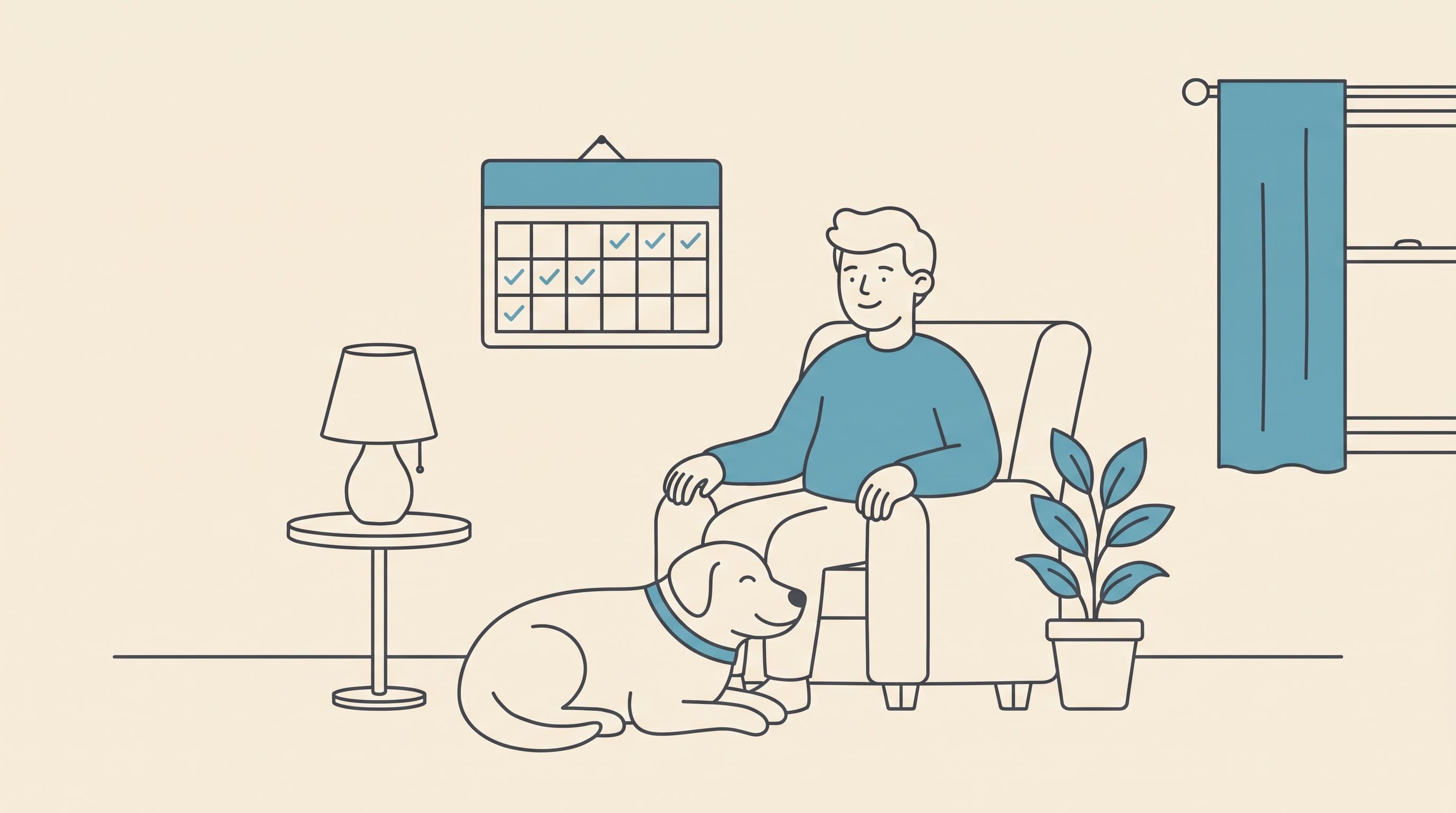
The First Two Weeks on Insulin: What To Expect
Alastair Greenway
BVM&S MRCVS
You're home from the vet with a little vial in the fridge, a box of tiny syringes, and a head full of half-remembered instructions. You've given the first injection, or you're about to, and the practical worry sits on top of a quieter question: how will I know if it's working? What if I'm getting it wrong?
I get a version of that call most weeks, usually a few days in, usually from someone apologising for ringing. "The thirst hasn't really stopped," they say, "is the insulin not working?" So let me take the pressure off before we start, the same way I would on the phone. The goal of these first two weeks is not perfect glucose control. It really isn't. It's a safe start, a routine you can live with, and clean information for your vet to work from. Getting the numbers right comes later, gradually, and on purpose, because the signs usually built up over weeks to months and they ease back over weeks too, not overnight (Behrend et al., 2018; Nelson, MSD Veterinary Manual). This fortnight is the first mile of a marathon, not a sprint.
This page is about that settling-in period: what's normal, what means pick up the phone, and why your vet started cautiously. How the dose actually gets adjusted over the coming weeks lives in insulin dose titration.
Read these two safety rules before anything else
Before anything about what's normal, two rules to hold from day one. They matter more than any number.
If your pet goes wobbly, weak, dull, trembling, disorientated, or collapses, treat it as a hypo. Too much insulin relative to food or activity can drop blood sugar dangerously low, and that is the emergency that kills, not the high readings. Rub glucose, honey or syrup onto the gums (the sugar absorbs through the lining of the mouth, so they don't have to swallow it), never pour liquid into a pet that can't swallow because it can go down the wrong way, then ring your vet straight away and follow with food once they can take it (Cornell Riney Canine Health Center; Behrend et al., 2018). The full version, causes, sign ladder and what to do afterwards, is owned by the hypoglycaemia emergency guide, worth reading today rather than in a panic at midnight.
Never increase the dose because a reading looks high, and never re-dose into a suspected hypo. Early high numbers are expected while the dose is still being found, so a high reading is not a cue to give more on your own. And if you're ever unsure whether a dose went in, a wriggle, a wet patch of fur, do not give it again. Skip it and wait for the next scheduled dose. The Caninsulin label puts it plainly: "do not attempt to re-dose. Wait and give your pet its usual dose at the next injection" (Caninsulin SPC). A missed dose is minor and self-correcting; a double dose can be fatal (Caninsulin SPC; Behrend et al., 2018).
Normal in the first fortnight
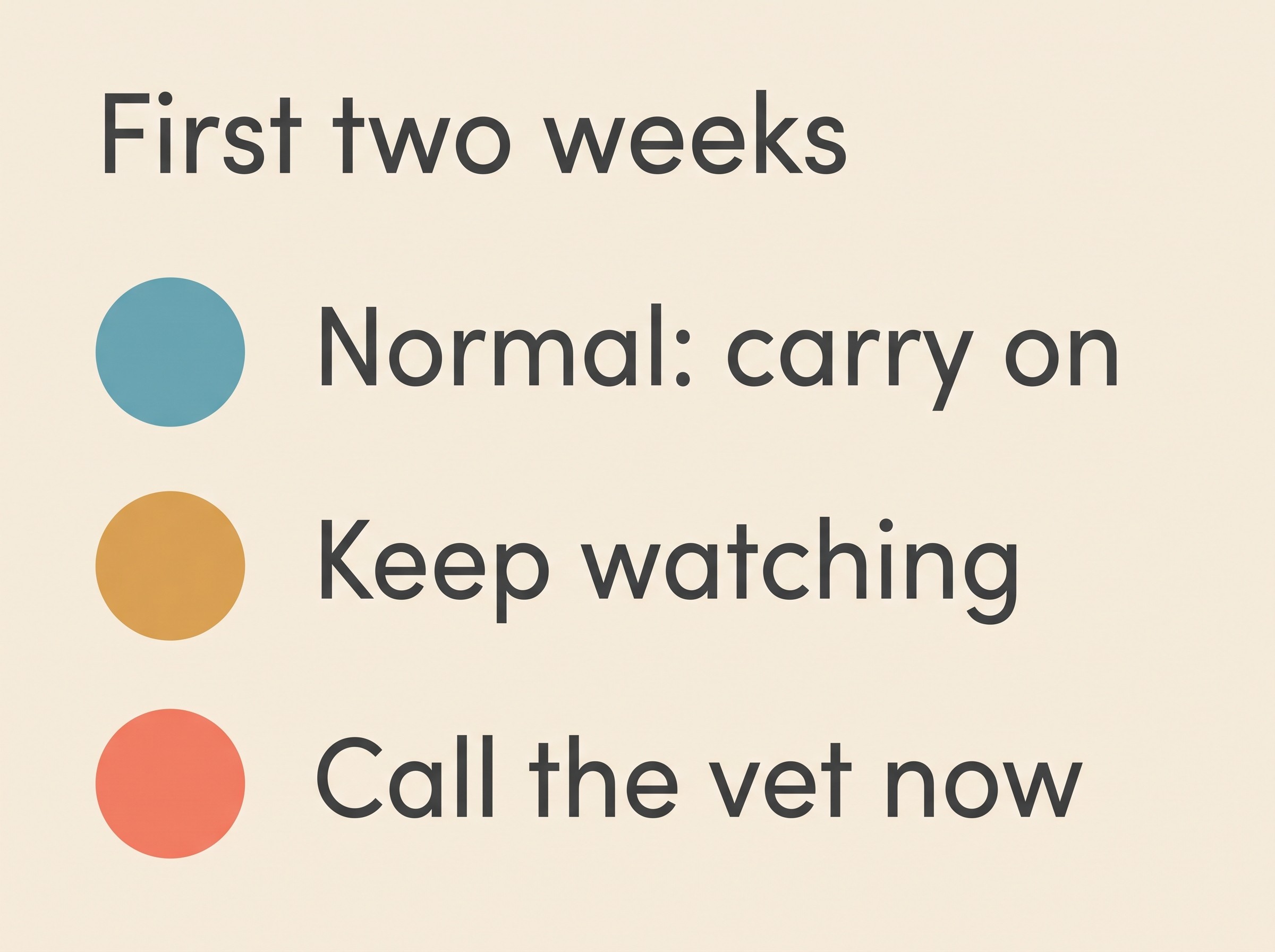
Here's the reassuring part, and it's most of the picture. For the first week or two, while your pet's body adjusts and you find your rhythm, things settle gradually rather than overnight (Cornell Riney Canine Health Center). The thirst and the endless trips to the water bowl should start to ease, but slowly, over days; the puddles and the over-full litter tray settle, appetite steadies, and weight, if your pet had been losing it, stabilises then slowly recovers. None of this is a switch you flick on day one, and a pet still drinking a little more than a non-diabetic in week one is not a treatment failure (Behrend et al., 2018). This is why your vet watches the trend rather than any single number: easing signs and a steady or rising weight mean the diabetes is very likely heading the right way (Behrend et al., 2018).
If you'd like to track thirst objectively, genuine excessive thirst means more than about 100 ml per kilogram of bodyweight a day (a normal dog sits nearer 50 to 60, a cat around 45), so measuring what goes into the bowl over 24 hours beats guessing (veterinary PU/PD consensus). The full watch-list belongs to what to watch at home; here you just need the early version: is the thirst easing, the appetite steady, the weight holding, your pet bright? Some ups and downs along the way are normal too.
The signs that mean pick up the phone
Now the other column. Ring your vet promptly if you see any of these:
- Any hypo signs (wobbly, weak, dull, trembling, disorientated, collapse or a seizure). Treat as above, sugar on the gums, then vet now. This is the urgent one.
- Your pet stops eating, or vomits, especially more than once. A diabetic pet who won't eat is a problem on two fronts: you shouldn't give a full dose of insulin into an empty stomach, and going off food with vomiting and dullness can be an early sign of diabetic ketoacidosis, the serious emergency that needs the vet the same day (Behrend et al., 2018). Add sweetish, acetone-smelling breath or fast breathing and it's vet-now, explained in the DKA guide.
- Thirst, urination or weight loss getting worse rather than better as the fortnight goes on. Gradual improvement is normal; going backwards is worth a call.
- Anything that frightens you. You will not be a nuisance. Practices expect calls in the first weeks, and we'd far rather hear from you over nothing.
Started low, goes slow, and that's the plan
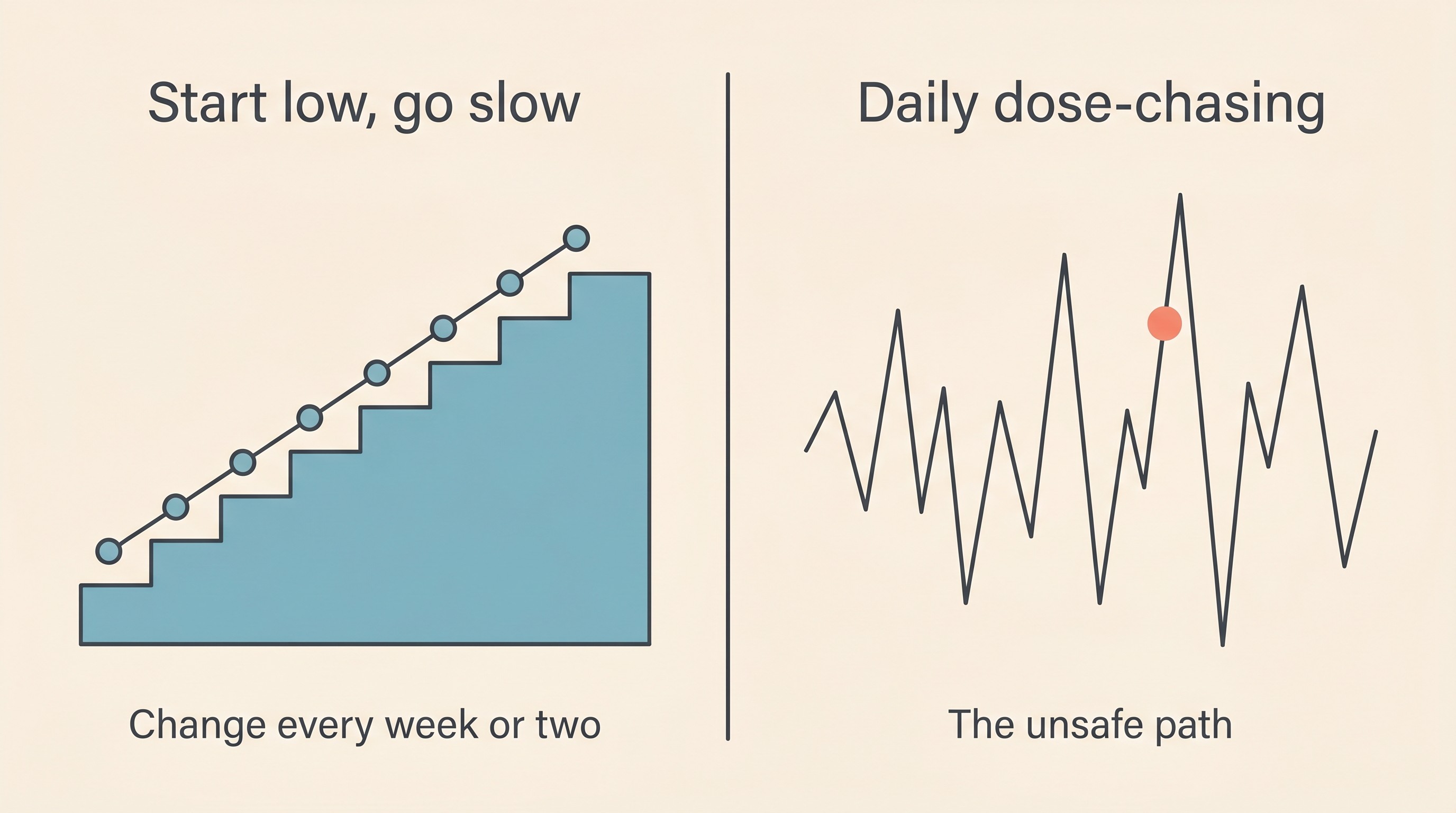
Your vet has almost certainly started on a deliberately cautious dose: the recommended starting points are small, around 0.25 to 0.5 units per kilogram twice daily for dogs, and smaller still for cats, often about a unit per cat and not exceeding two even in a large one (Behrend et al., 2018; Nelson, MSD Veterinary Manual; Thompson et al., 2015). Those figures aren't yours to change, that's your vet's job and the territory of insulin dose titration, but the logic matters: the dose starts low on purpose, to guard against the hypo that's far more dangerous than a few high readings. So it's normal, even expected, that your pet isn't perfectly controlled in week one. That's the design, not a fault.
The other half is time. The body needs several days to settle into each dose before anyone can judge it, so the guidance is to leave a new dose alone for at least several days and not increase it more often than every one to two weeks (Nelson, MSD Veterinary Manual). Cats are usually reassessed around five to seven days in before any change, unless a hypo develops, and then adjusted only gradually (Nelson, MSD Veterinary Manual; Taylor et al., 2025); for dogs it's much the same, a minimum of three days and ideally around seven to ten (Caninsulin/MSD dosing guidance). So don't expect a dose change every day, and don't push for one: chasing the numbers day to day isn't just unnecessary, it's unsafe, because you can stack changes faster than the body can show their effect.
Build the habit that makes the recheck work
Two things quietly turn an anxious fortnight into a useful one. Consistency is the first, and the lever that makes all of this work: same insulin, same dose, same food, same amount, same times, ideally around twelve hours apart (Cornell Riney Canine Health Center; Behrend et al., 2018). Steady inputs make your pet's insulin requirement predictable, so your vet sees real patterns instead of noise, which is exactly what these early trial-and-error weeks depend on (Cornell Riney Canine Health Center). Feed first, then inject; a pet that hasn't eaten shouldn't get a full dose, and portions, treats and the fussy eater live in feeding a diabetic pet (Behrend et al., 2018).
The second is to log it from day one: every injection (time, dose, which side), what the thirst, appetite and energy are doing, any day that felt off. Your vet's whole approach leans on these home records alongside the in-clinic tests (Behrend et al., 2018), and they feed the home blood glucose monitoring that comes next. This is the job the Glucose Companion does for you: log each dose, note the signs, flag a suspected hypo, and it builds the summary you bring to the recheck, turning two weeks of worry into clean data.
The first recheck, and one note for cat owners
Expect your first proper review around one to two weeks after starting, sooner if a hypo is ever suspected, with the same pattern after any future dose change (Behrend et al., 2018). That gap is the equilibration time again: the recheck lands once the dose has had a chance to show what it does. For now, just know it's coming, it's routine, and your log makes it count.
One important split before I let you go, because dogs and cats are really two different diseases here. For a dog, this fortnight is about settling in for the long, good haul: canine diabetes is lifelong and insulin-dependent, with no meaningful remission, and that's genuinely fine, the aim is a comfortable, well pet on a steady routine (Behrend et al., 2018; Nelson, MSD Veterinary Manual). For a cat, the early weeks carry an extra layer, because cats can improve quickly, so a dose that "was fine" three days ago can quietly become too much. As a cat's own pancreas starts coping again, its insulin need falls, and the dose has to come down to match or hypoglycaemia becomes likely (Gottlieb & Rand, 2018). So watch for hypo signs especially closely, and read consistently low pre-injection readings or disappearing sugar in the urine as a sign the dose may need reducing, not raising (Taylor et al., 2025).
There's a hopeful flip side. Getting control early genuinely matters for a cat, because bringing the glucose down quickly relieves the strain on the pancreas, reversing the glucotoxicity before too many insulin-producing cells are lost for good, and that opens the door to remission (Gottlieb & Rand, 2018; Marshall et al., 2009). Cats given strict control within six months of diagnosis are far more likely to come off insulin than those left late, in one protocol 84 per cent versus 35 per cent (Roomp & Rand, 2009; Gottlieb & Rand, 2018). Real-world rates are more modest, nearer half of cats at a median of about three months (Gottlieb et al., 2024), so it's a real, time-sensitive hope rather than a promise, and the playbook belongs to feline diabetic remission. For a cat, the effort this fortnight isn't only maintenance. It may be the remission window, quietly opening.
It gets easier from here, faster than you'd think: the injections become a non-event, the routine becomes background, and the next milestone is just that first recheck with a fortnight of good notes in your hand. Hold the routine steady, keep those two safety rules close, and let your vet do the slow work of finding the dose. That watchful, unglamorous part, you're already doing well.
References
- Behrend E, Holford A, Lathan P, Rucinsky R, Schulman R. 2018 AAHA Diabetes Management Guidelines for Dogs and Cats. Journal of the American Animal Hospital Association. 2018;54(1):1-21.
- Nelson RW. Diabetes Mellitus in Dogs and Cats. MSD (Merck) Veterinary Manual, online edition.
- MSD Animal Health. Caninsulin (porcine insulin zinc suspension): Dosing Overview / Stabilisation guidance for dogs. MSD Animal Health Hub (UK).
- MSD Animal Health. Caninsulin 40 IU/ml Suspension for Injection: Summary of Product Characteristics (UK/EU).
- Marshall RD, Rand JS, Morton JM. Treatment of newly diagnosed diabetic cats with glargine insulin improves glycaemic control and results in higher probability of remission than protamine zinc and lente insulins. Journal of Feline Medicine and Surgery. 2009;11(8):683-691.
- Roomp K, Rand J. Intensive blood glucose control is safe and effective in diabetic cats using home monitoring and treatment with glargine. Journal of Feline Medicine and Surgery. 2009;11(8):668-682.
- Gottlieb S, Rand JS, Anderson ST. Frequency of diabetic remission, predictors of remission and survival in cats using a low-cost, moderate-intensity, home-monitoring protocol and twice-daily glargine. Journal of Feline Medicine and Surgery. 2024;26(4):1098612X241232546.
- Taylor S, Cannon M, Church D, Fleeman L, Fracassi F, Gilor C, Mott J, Niessen S, et al. iCatCare 2025 consensus guidelines on the diagnosis and management of diabetes mellitus in cats. Journal of Feline Medicine and Surgery. 2025;27(11):1098612X251399103.
- Cornell University College of Veterinary Medicine, Riney Canine Health Center. Managing Canine Diabetes.
- Gottlieb S, Rand J. Managing feline diabetes: current perspectives. Veterinary Medicine: Research and Reports. 2018;9:33-42.
- Thompson A, Lathan P, Fleeman L. Update on insulin treatment for dogs and cats: insulin dosing pens and more. Veterinary Medicine: Research and Reports. 2015;6:129-142.
Keep track of how your pet is doing
The owners who cope best are the ones who notice changes early. A simple health log shows you what is working, and what is not, before the next vet visit.
Start tracking, freeYou're not doing this alone
Compare treatment journeys and talk to owners managing diabetes mellitus. Free to join.
Join PetsLikeMine