

What "done" looks like: your pet's lifetime record
Alastair Greenway
BVM&S MRCVS
You made it. The animal who arrived as a wobbly, sleep-stealing, expensive little disaster is now, more or less, a functioning adult. The vaccinations are done, the sleepless weeks are behind you, and one morning you notice you have gone a whole day without googling anything in a panic. If you feel a little proud, and a little wistful that the puppy or kitten phase went so fast, both of those are exactly right. You have finished a genuinely hard first year, and you did it well.
So what does "done" actually look like? I want to answer that honestly, because the truth is more interesting than a tick-list. You have not finished caring for your pet, obviously. But you have finished something specific and valuable: you have built the foundation of a health record that will follow this animal for the next twelve to fifteen years. This article is about what you have actually made, why it matters more than you might think, and what happens to it next.
The weight line is the spine of the whole thing
Start with the simplest and most powerful thing you built: the weight series. Every weekly weigh-in you plotted on the Growth Curve Tracker this year was not just a check that your pet was growing right. It was the first stretch of a single continuous line that now runs across your pet's whole life.
Here is why that matters. In the first year, that line climbed a centile on the WALTHAM growth curves and told you whether growth was healthy (Salt et al., 2017; kitten charts, 2022). But the line does not stop when growth does. It flattens into your pet's healthy adult weight, and from there it becomes a baseline, the single most useful number a vet can have. A pet whose normal adult weight is on record is a pet whose unexplained weight loss or gain gets caught early, because there is something real to compare against rather than a vague sense that they "look a bit thinner". Creeping weight is one of the earliest and most reliable signals of a great many problems, from dental pain to thyroid disease to the start of arthritis, and you cannot spot a drift from a baseline you never recorded.
That same line flows straight into the weight management space if the waistline ever creeps, into joint-risk context if your dog is a breed where that matters, and, many years from now, into the vitality picture that the senior pets space builds at the far end of life. One line, plotted a few grams at a time on ordinary evenings this year, quietly becomes the spine of a lifetime of monitoring. No training app can fake that, because it only exists if someone started early. You did.
What you actually built: three strands, woven together
The weight line is the spine, but the record is more than a graph. Across this first year you have, perhaps without noticing, been braiding together three strands that reinforce one another.
The knowledge. You have worked through the questions that ambush every new owner: when the vaccinations finish and when it was safe to go out, how to socialise without gambling on infection, what the puppy blues was and that it passed, when to neuter and, for cats, why four months is right rather than six. That is not trivia. It is a working understanding of your own animal that makes every future decision easier and every vet conversation sharper.
The people. If you leaned on the community at two in the morning when you were bitten, sleepless and secretly regretting the whole thing, you know something incumbents cannot bottle: that you were never actually alone in it. That connection does not expire when the puppy phase ends. It carries you through adolescence, and it will be there for the harder conversations that come with any long life.
The record. Underneath both sits the data: the growth curve, the vaccination and worming history, the neutering date, the microchip registration, the breed watch-list, the notes about what is normal for this particular animal. Content, community and monitoring, the three things nobody else weaves together, and the three things that turn out to matter most across a lifetime.
Why a record that starts at eight weeks is worth so much
There is a strategic reason we care so much about starting the record early, and it is worth being plain about because it directly benefits your pet.
Medicine, especially preventive medicine, runs on baselines. The value of knowing an animal is not in any single measurement, it is in knowing what has changed. A vet meeting your pet for the first time at seven years old is working blind on their history. A vet with a record that reaches back to eight weeks knows this animal's normal resting weight, their normal water intake, the demeanour and appetite that are ordinary for them, and the conditions their breed disposes them towards. When something shifts, that vet sees it against a decade of context, and early detection is very often the whole game in the diseases that matter most.
This is the real prize of the first year, and it is easy to miss while you are drowning in it. You were never only raising a puppy or a kitten. You were starting the longitudinal record of an entire life, and that record is the thing that feeds every condition space, every screening decision, and every "is this normal or should I worry?" moment for the next fifteen years.
The honest checklist: what "done" really means
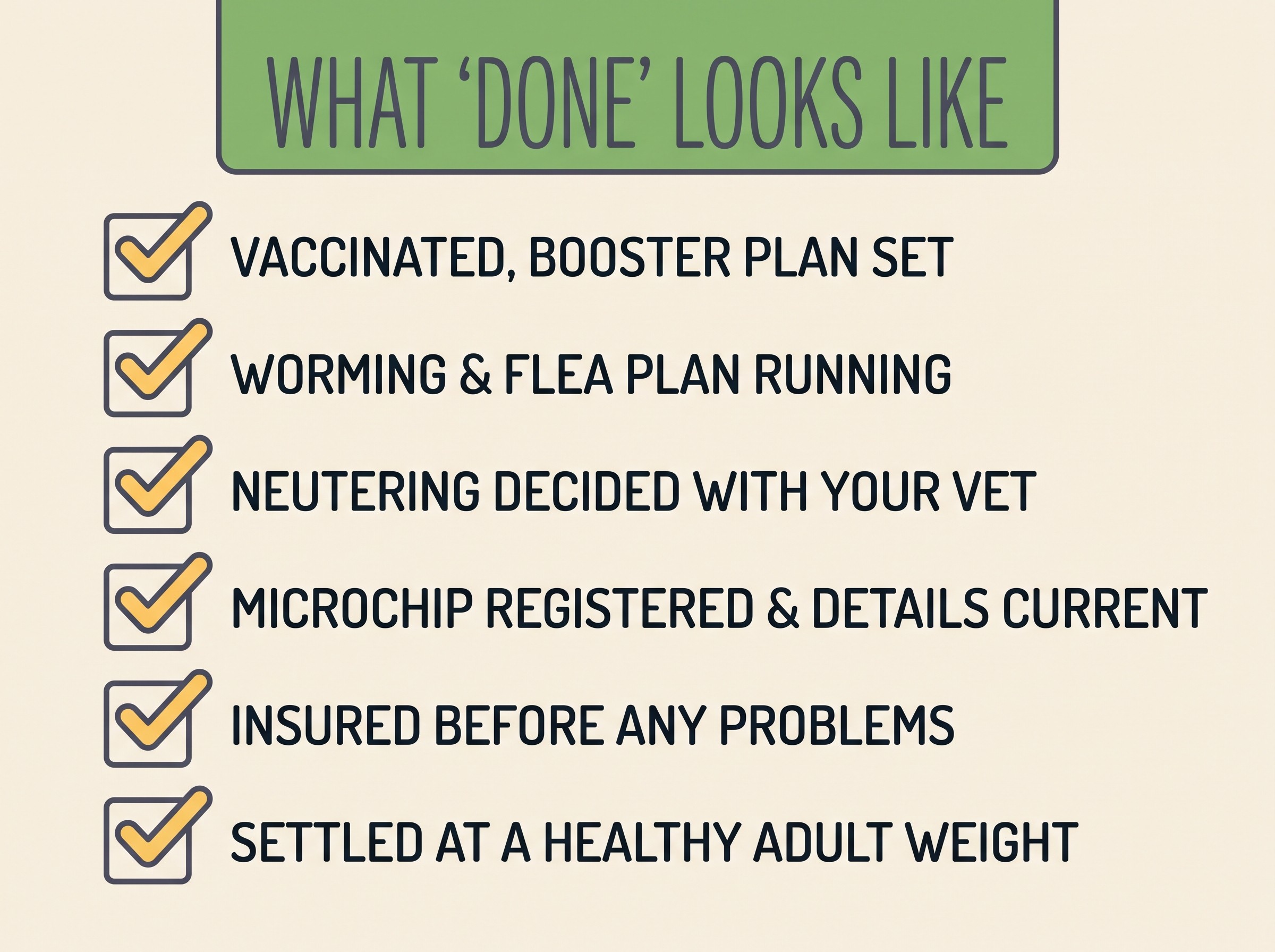
If you want a concrete answer to "have I done the first year properly?", here it is. Done looks like:
- Fully vaccinated, with a booster plan agreed. The primary course is complete and you know your practice's ongoing schedule (see the vaccination schedule).
- A parasite plan that runs itself. Worming and flea control have moved from the frequent puppy and kitten cadence to a sensible risk-based adult routine (worming and fleas), ideally on the scheduler so you are not relying on memory.
- The neutering decision made deliberately. Whether you have neutered or chosen, with your vet, to wait or not at all, it was a decision, not a drift. For dogs that was a breed-and-size conversation (neutering your dog); for cats it was almost certainly done by four months (neutering your cat).
- Microchipped and, crucially, registered with current details. It is a legal requirement, but the part that actually reunites a lost pet with you is keeping the registered details up to date. Check yours are right (the first vet visit and microchip law).
- Insured before a single problem existed. If you put lifetime cover in place early, before anything became "pre-existing", your future self will thank you more than you can currently imagine (pet insurance).
- Settled at a healthy adult weight, on a healthy line. Growth has plateaued along a good centile and you are keeping them lean (body condition score).
- Socialisation banked and being maintained. The early window was used, and you are keeping up the calm, ongoing exposure that carries a confident dog or cat through life.
If most of that is true, you are done in every sense that matters. If some of it is not, none of it is a failure, it is simply the next thing to pick up, and every item above links to exactly where to start.
What happens to the record next
The record does not sit still now that the first year is over. As your pet crosses into adulthood, their profile graduates automatically to the adult Care Hub, which becomes the home of the lifetime record: one place holding the weight line, the vaccination and worming history, the body condition trend, and the breed watch-list. The reminders keep running, the tracking keeps flowing forward, and the guidance shifts to match a grown-up animal rather than leaving you in first-year content. The mechanics of that handover, and the food and visit-cadence changes that come with it, are in the transition to adult food and adult care.
The breed lens is where the record starts to look ahead rather than back. Because you chose a breed at the very beginning, the record already carries a watch-list of what this particular animal is more prone to, and it deep-links into the condition spaces that matter for them: spinal awareness and IVDD for a long-backed dog, heart monitoring for a predisposed breed, joint and arthritis context for a large breed, dental care for the cat who will need it. Your pet's /breeds/<slug> page is the map of that, and it means adult prevention starts already knowing where to look.
The far bookend
I will finish with the part that makes this whole space worth building. The record you started this year has a natural other end, and it is a long, long way off. At the far bookend of your pet's life sits the senior pets space, the mirror of this one, where the same weight line that began as a puppy growth curve helps tell the story of a life well lived and well cared for. There is a whole life in between: years of walks and windowsills, of ordinary Tuesdays and daft moments and quiet company. That is what the record is for. Not to medicalise your pet, but to make sure that across all those years, the small changes that matter are caught early, and the good years are as many and as good as they can be.
So no, you are not really "done". You have done the hardest, most formative year, and you have laid a foundation that most pets never get. From here the work gets easier and the reward gets deeper. Take a moment to be proud of the animal asleep beside you, and of the record you started the day they came home. Then go and enjoy them. The whole point of building all this carefully was so that you could stop worrying and simply love the life you have begun.
References
- Salt C, Morris PJ, Wilson D, et al. Association between life span and body condition in neutered client-owned dogs / WALTHAM Puppy Growth Charts. PLOS ONE 2017.
- WALTHAM / PLOS ONE kitten growth charts, 2022. ⚠️ IP: confirm WALTHAM attribution or reconstruct from published percentiles before shipping branded charts.
- WSAVA. Vaccination Guidelines 2024 (booster cadence context).
- ESCCAP UK & Ireland. GL1 Worm Control, 7th ed, 2025 (adult risk-based cadence context).
- UK microchipping law: dogs compulsory since 2016; cats in England compulsory from 10 June 2024.
Keep track of how your pet is doing
The owners who cope best are the ones who notice changes early. A simple health log shows you what is working, and what is not, before the next vet visit.
Start tracking, freeYou're not doing this alone
Compare treatment journeys and talk to owners managing new puppy & kitten. Free to join.
Join PetsLikeMine