

The UK vaccination schedule explained (10-week vs 16-week finish)
Alastair Greenway
BVM&S MRCVS
If you have found this page, there is a fair chance you are confused, and honestly, that is not your fault. The breeder said one thing, your vet said another, a forum said a third, and somewhere along the way you have read something that made you wonder whether vaccines are "overdone" anyway. Meanwhile you have a small puppy or kitten at home and one urgent, practical question running underneath all of it: when can we safely go out?
Let me give you a calm, cited, genuinely UK-specific answer. The vaccination schedule is not actually a source of disagreement among vets. What looks like conflicting advice is usually two true facts sitting next to each other, and once you can see both, the picture becomes clear rather than frightening. So let us take it properly.
What the vaccines actually protect against
Before the timing, it helps to know what these injections are for, because the diseases are the reason any of this matters.
For dogs, the core vaccines protect against distemper, infectious hepatitis (caused by canine adenovirus) and parvovirus, often abbreviated together as DHP. In the UK, vaccination against leptospirosis is also considered essential because the disease is present here, spread through rodent urine and contaminated water, and is a genuine zoonosis, meaning it can pass to people (WSAVA, 2024; MSD/APHA UK guidance). Of all of these, parvovirus is the one that most often kills young puppies. It is a horrible, environmentally hardy virus that causes devastating bloody diarrhoea, and it is exactly why the "don't put them on the ground yet" instinct exists.
For cats, the core vaccines protect against panleukopenia (feline infectious enteritis, a parvovirus-like disease that is frequently fatal in kittens), and the two main components of the "cat flu" complex, feline calicivirus and feline herpesvirus (AAFP, 2020). A vaccine against feline leukaemia virus (FeLV) is recommended for cats at risk, which in practice means any cat with outdoor access or contact with other cats (AAFP, 2020). More on the cat picture, and on why there is no equivalent for FIV, below.
For young animals, panleukopenia and parvovirus are the ones that turn a happy kitten or puppy into an emergency within a day or two, so this is not box-ticking. It is the thing standing between your pet and diseases that used to be common.
The primary course, and the UK timing nuance
Here is where the "conflicting advice" comes from, so let us lay it out plainly.
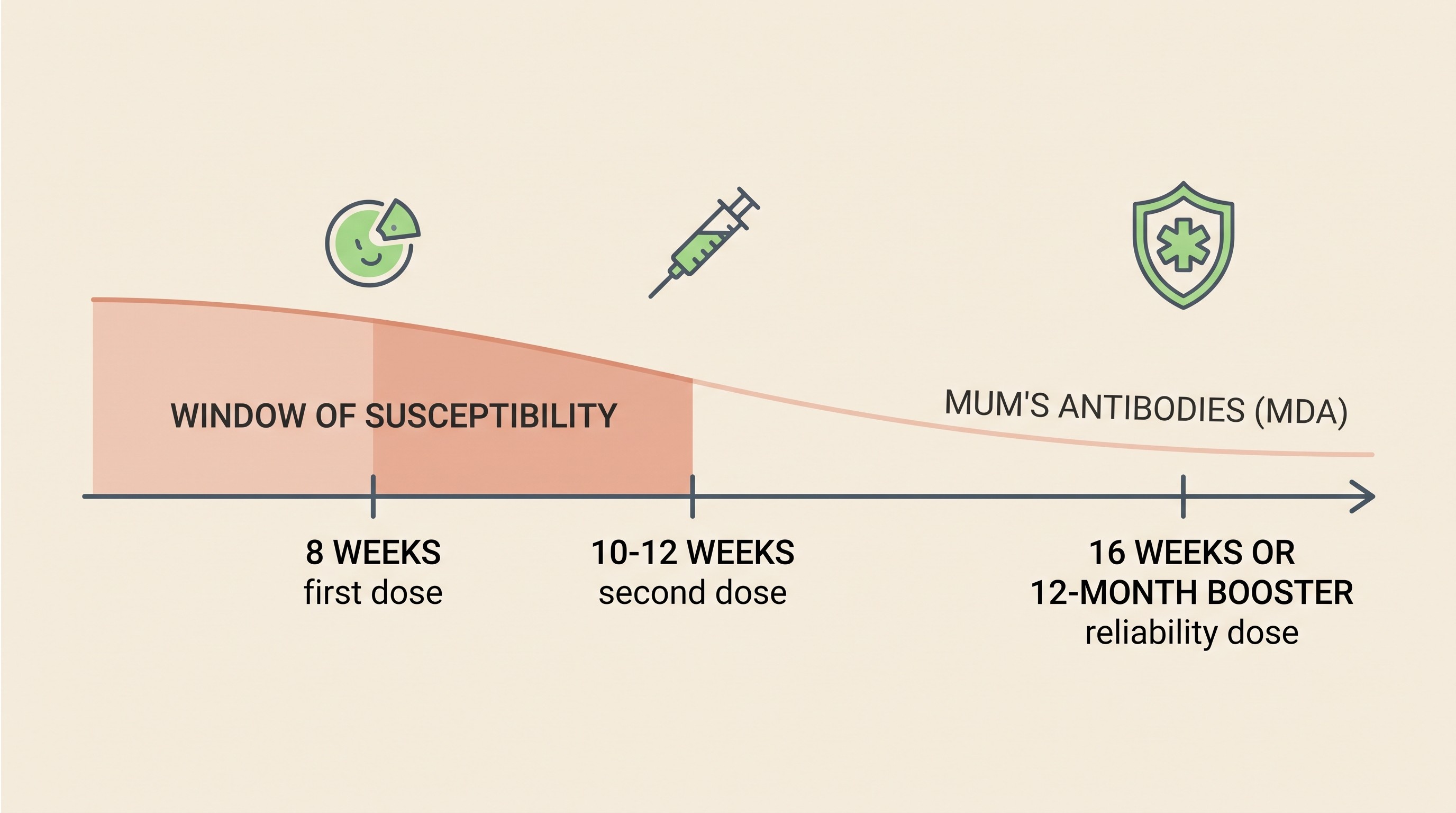
A puppy or kitten's first course is usually two injections. The first is given from around 8 weeks of age, and the second follows two to four weeks later (WSAVA, 2024; AAFP, 2020). Many UK vaccine products are licensed so that the primary course can finish at 10 weeks of age, with the second dose given around then. This is a real, legitimate licence, and it exists for a good reason: it lets owners begin taking their puppy out into the world sooner, which, as you will see, genuinely matters for behaviour and lifelong confidence.
So if your breeder or vet has told you the pup can be "done" at 10 weeks, they are not making it up, and they are not doing anything wrong. That is a licensed schedule.
Why WSAVA recommends a final dose at 16 weeks or older
Now the second true fact, which sits alongside the first rather than contradicting it.
The WSAVA (World Small Animal Veterinary Association) 2024 guidelines recommend that a puppy's final vaccine dose is given at 16 weeks of age or older (WSAVA, 2024). The reason is a piece of biology worth understanding, because once you get it, the whole schedule makes sense.
When a puppy or kitten is born, it receives antibodies from its mother, partly across the placenta and mostly through the first milk (colostrum). These maternally derived antibodies (MDA) protect the newborn in its earliest weeks, which is wonderful. The catch is that the very same borrowed antibodies can also neutralise a vaccine before the youngster's own immune system gets the chance to respond to it. MDA fades at different rates in different individuals, and it can persist in some pups until around 16 weeks of age (WSAVA, 2024).
This creates what vets call the window of susceptibility. There is a period, different for every animal and impossible to pin down without testing, when a pup may have too little maternal antibody left to be protected by mum, yet still enough to blunt a vaccine given at, say, 10 or 12 weeks. During that window the pup can be neither reliably protected by its mother nor reliably protected by the vaccine. Giving a dose at 16 weeks or later matters because, by then, maternal antibody has almost always faded far enough for the vaccine to take properly in essentially all puppies (WSAVA, 2024).
The honest reconciliation
So which is right, the 10-week finish or the 16-week dose? The honest answer, and the one you will not always get in a rushed conversation, is that they are both right, and they are answering slightly different questions.
An early-finish course, licensed to complete at 10 weeks, is legitimate and useful, because it lets your puppy start experiencing the world during the critical early period rather than being shut away. WSAVA does not say that course is wrong. What WSAVA adds is that, on top of that primary course, a puppy should receive an additional dose at or after 16 weeks to close the window of susceptibility reliably (WSAVA, 2024).
In UK practice this plays out in one of two ways, and both are reasonable. Some practices give that extra dose at around 16 weeks as a distinct visit. Others fold the reliable "top-up" into the first annual booster at 12 months, on the basis that any small remaining gap is low-risk in a well-managed pet. Neither approach is a mistake. What matters is that you and your vet have actively decided which one applies to your puppy, rather than assuming the 10-week finish is the end of the story.
The practical thing to do is simple: ask your vet directly, "does my puppy need a dose at 16 weeks, or are we relying on the 12-month booster, and why?" That single question turns the confusing bit into a clear plan. Please do not use any of this as a reason to skip or delay a dose your vet has recommended. The reconciliation is "an extra dose for reliability", never "vaccinate late" or "leave one out".
When can we actually go out?
This is the question underneath the whole page, and it deserves a direct answer, because it connects to the single most important safety message in the whole first year.
Until the primary course is complete, avoid the places where parvovirus lurks: dog faeces, unknown dogs, and high-traffic dog areas like busy parks and pavements outside vets. Parvovirus survives in the environment for a long time, so this caution is real.
But, and this is crucial, that does not mean keeping your puppy shut indoors and unsocialised. The behavioural sensitive period runs from roughly 3 to 14 weeks, and missing it carries its own serious, lifelong risk. You do not have to choose between protecting the body and protecting the mind. You can carry your puppy out to see the world, invite known, fully vaccinated adult dogs to your home, and attend a well-run puppy class that checks vaccination status. This is important enough to have its own article, and if you read one more thing after this, make it How to socialise before the vaccinations finish.
Boosters, and the "every year" myth
Once the puppy or kitten course is done, vaccination shifts to boosters, and here too there is a myth worth dismantling gently.
Not every vaccine is needed every year. Under WSAVA guidance, the core viral components (like DHP in dogs) generally provide longer-lasting immunity and are boosted less often, typically every three years once an animal is adult, while some components, notably leptospirosis in dogs and the cat-flu components in cats, are boosted annually because protection is shorter-lived (WSAVA, 2024; AAFP, 2020). So the reality is a mix, tailored to which diseases each vaccine covers, not a blanket "annual jab for everything". A reputable vet already vaccinates on this risk-based schedule.
This is also where you may have read about titre testing, blood tests that measure existing antibody levels to decide whether a core booster is needed yet. It is a real tool with real limits, and rather than let it become another source of confusion, we have set it out honestly in Titre testing, honestly.
Are vaccines safe? The side-effect question
Because you may have arrived here having read that vaccines are "overdone" or unsafe, this question deserves a straight, unspun answer rather than a brush-off, because you are right to want to know what you are agreeing to.
Vaccines, like anything that asks the immune system to do something, can have side effects, and being honest about them is part of trusting the process. The common ones are mild and short-lived: a bit of soreness at the injection site, a quiet or slightly off day, or a mild temperature for a day or so, all of which settle on their own (WSAVA, 2024). Genuinely serious reactions do happen but are rare, and vets are trained to recognise and treat them, which is one small reason the first vaccinations are given in the surgery rather than at home. Your vet will tell you what to look out for and when to call.
Set against that, the diseases these vaccines prevent, parvovirus and panleukopenia above all, are common where vaccination rates fall and can kill a young animal in a couple of days. So the honest risk-benefit picture is not close. The point of the schedule, and of not giving more doses than needed, is precisely to protect your pet against the diseases that matter while keeping the vaccine load sensible, which is exactly what the modern risk-based booster approach above is designed to do. A reputable vet is not "over-vaccinating"; they are following guidance built to give the most protection for the least intervention.
Cats specifically
Cats deserve their own clear section, not a footnote, because the feline picture has its own logic.
The kitten core course follows the same shape: a first vaccination from around 8 to 9 weeks, a second a few weeks later, and the same MDA reasoning applies, so a kitten's course should also extend to around 16 weeks for reliable protection (AAFP, 2020). The core cat vaccines cover panleukopenia and the two cat-flu viruses, and for kittens the cat-flu component matters enormously because young cats are hit hardest by it (Cat flu: what every kitten owner should know).
FeLV is the important extra. It is recommended for any kitten that will go outdoors or live alongside other cats, because feline leukaemia virus spreads between cats and is a serious, life-shortening infection. If you are not sure whether your cat is "at risk", the honest default for a cat that will ever go outside is yes (FeLV and FIV: should you test your kitten?).
One thing to state plainly, because it causes real confusion: there is no FIV vaccine available in the UK. Feline immunodeficiency virus is managed by testing, neutering and lifestyle, not by vaccination (AAFP, 2020). If anyone offers you an "FIV jab", something has been misunderstood, and the FeLV/FIV article explains why the two viruses are handled so differently.
Your next step
The clearest thing you can do right now is turn all of this into a simple, personal plan rather than a swirl of half-remembered advice. Book your first vet visit if you have not already (The first vet visit and the microchip law), and at that visit ask the two questions that cut through everything: which products is my pet having, and do we need a dose at 16 weeks or are we relying on the 12-month booster?
Then let the schedule look after itself. The Vaccination & worming scheduler can hold your pet's actual course, whether it finishes at 10 weeks or extends to 16, and remind you of each of the three or four vet contacts that fall in the first sixteen weeks, alongside the parasite plan in Worming and flea control in the first year. You do not have to carry the dates in your head, and you certainly do not have to carry the confusion. It was never really conflicting advice, just two true things that fit together once someone lays them side by side.
References
- WSAVA Vaccination Guidelines Group (2024). Guidelines for the Vaccination of Dogs and Cats. World Small Animal Veterinary Association.
- Stone, A.E.S. et al. (2020). 2020 AAHA/AAFP Feline Vaccination Guidelines. Journal of Feline Medicine and Surgery, 22(9), 813-830.
- APHA / UK product licensing (SPCs) for canine and feline vaccines.
- WSAVA (2024). Guidance on titre testing and duration of immunity for core vaccines.
Free downloads
Companion worksheets to put what you've read into practice. Free PDFs, print at home.
Keep track of how your pet is doing
The owners who cope best are the ones who notice changes early. A simple health log shows you what is working, and what is not, before the next vet visit.
Start tracking, freeYou're not doing this alone
Compare treatment journeys and talk to owners managing new puppy & kitten. Free to join.
Join PetsLikeMine