

FeLV and FIV: should you test your kitten?
Alastair Greenway
BVM&S MRCVS
If someone has mentioned "cat AIDS" or "feline leukaemia" to you, or you have seen the initials FeLV and FIV on a rescue's paperwork, you might be feeling a jolt of fear that is out of all proportion to what these viruses actually mean in 2026. The names are frightening, the internet is full of outdated doom, and it is easy to end up terrified before you even understand the question.
So let me be a calm voice here. These are two different viruses, they are not the death sentences the scary names suggest, and testing is a sensible, straightforward thing rather than something to dread. Whether you should test your kitten, and what a result actually means, depends on where your kitten came from and how it will live. Let me take you through it properly, because a little understanding replaces a lot of fear.
Two different viruses, often confused
FeLV and FIV get lumped together because they are both feline viruses tested for at the same time, but they are genuinely different, and keeping them straight is the first step to not being frightened.
FeLV (feline leukaemia virus) is the more serious of the two. It can suppress the immune system, cause anaemia, and lead to certain cancers, and it does shorten many affected cats' lives, particularly cats infected as kittens, who are more vulnerable than adults (AAFP, 2020; International Cat Care). It spreads through prolonged close contact between cats, mutual grooming, shared bowls, and from an infected mother to her kittens. Importantly, not every cat that meets the virus stays infected for life: some, especially healthy adults, fight it off, while kittens are more likely to become permanently infected.
FIV (feline immunodeficiency virus) is often nicknamed "cat AIDS", which does it a real disservice. It is a slow virus that gradually weakens the immune system over years, and it spreads mainly through deep bite wounds, which is why it is most common in entire (unneutered) tom cats that roam and fight (AAFP, 2020; International Cat Care). Here is the part that surprises people: many FIV-positive cats live long, happy, near-normal lives, often for many years, especially if they are kept indoors, well fed, neutered and protected from other illnesses. It is not a virus that spreads casually through a calm, neutered household, and it cannot infect humans or other species.
Should you test? It depends on where your kitten came from
Not every kitten needs testing on day one, but for many it is a genuinely good idea, and the deciding factor is background and lifestyle.
Testing is particularly worth doing if your kitten:
- Came from a rescue, a shelter, or was a stray, where its mother's status and history are unknown.
- Came from a source that did not test, or where you cannot be sure it was tested.
- Will go outdoors or live with other cats, where transmission is possible.
- Is being introduced into a home with an existing cat, so you can protect both.
Reputable breeders and many good rescues will already have tested, so ask to see the paperwork. If your kitten has a known, tested, negative background and will live as a single indoor cat, your vet may feel routine testing adds little, but this is exactly the sort of thing to decide together at the first vet visit rather than guess at.
There is one situation where testing moves from "good idea" to "really worth doing", and that is if you already have a cat at home. Bringing an untested kitten into a household with a resident cat means that if the kitten is carrying FeLV, you could unknowingly expose your existing cat, particularly through the mutual grooming and shared bowls that come with cats living together. Testing the new kitten before it mixes freely, and making sure your resident cat's own FeLV vaccination is up to date if it goes outdoors, protects both animals. It is a small, sensible step that saves a great deal of worry, and it is another good reason to have the conversation with your vet before the introductions begin.
How the test works, and the timing catch
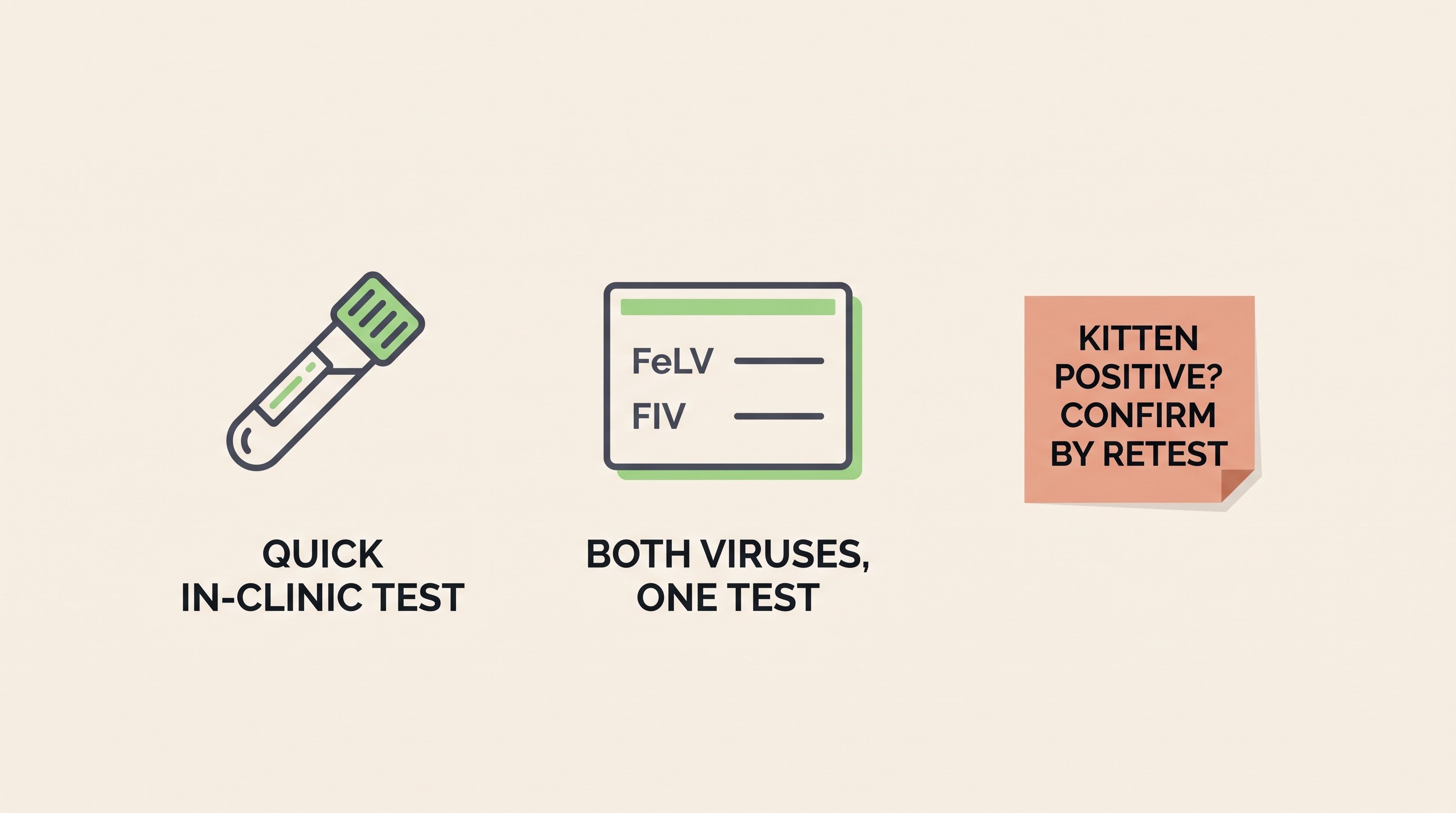
The good news is that testing is easy: it is usually a quick in-clinic blood test from a small sample, often giving a result the same day, that screens for both viruses at once. It is not a big or distressing procedure for your kitten.
There is one timing subtlety worth knowing, so a result is not misread. A test looks for signs of the virus or the body's response to it, and in a very young kitten a result can occasionally be misleading. For FIV in particular, kittens under about six months of age can carry maternal antibodies from an infected or vaccinated mother that make an antibody test come up positive even though the kitten itself is not infected (AAFP, 2020; International Cat Care). For this reason, a positive result in a young kitten is not the final word: your vet may recommend retesting after six months of age, or a confirmatory test, before drawing any conclusion. The practical message is simple: a single positive test in a kitten should always be confirmed, never acted on in a panic. Your vet will guide the retest.
What a positive result really means
If a test does come back positive, and is confirmed, please take a breath, because this is where the outdated internet does the most damage. A positive result is not an instruction to give up on your cat, and for most owners it changes far less than they fear.
For a confirmed FIV-positive cat, the outlook is genuinely encouraging. Many live long, happy lives with normal care. The plan is sensible and gentle: neuter (which also stops the fighting that spreads it), keep the cat indoors or contained to protect it from other infections and to stop it passing the virus to neighbourhood cats through fights, feed it well, and see your vet a little more often so that any illness is caught and treated early (International Cat Care). An FIV-positive cat can often live perfectly well alongside other cats in a calm, neutered household where there is no fighting, because casual contact is low-risk.
For a confirmed FeLV-positive cat, the picture is more serious and the conversation more involved, because FeLV shortens more lives and infected cats need careful monitoring for the problems it can cause. Even so, some FeLV-positive cats live comfortably for a good while with attentive care, and the right plan is very much a case-by-case discussion with your vet. What matters is that the cat is kept away from unprotected cats to avoid spreading the virus, and monitored closely for its health.
In both cases, the honest message is the same: a diagnosis is the start of a management plan, not the end of a story, and your vet will help you build a life around it.
Prevention: where the two viruses split apart
This is the single most important thing to get straight, because it is where FeLV and FIV are handled completely differently, and where a lot of confusion lives.
There is an FeLV vaccine, and it is available in the UK. It is recommended for cats at risk, which in practice means any cat that will go outdoors or have contact with other cats (AAFP, 2020). If your kitten will ever go outside, ask your vet about FeLV vaccination as part of its course. It is a genuine, useful protection against a serious virus.
There is no FIV vaccine available in the UK. I want to state this plainly, because it comes up a lot. An FIV vaccine was developed and marketed in some parts of the world, but it was never marketed in the UK and Europe and has been discontinued (AAFP, 2020; International Cat Care). So if anyone offers you an "FIV jab", something has been misunderstood. FIV is not managed by vaccination. It is managed by testing, neutering, and lifestyle: neuter your cat so it does not roam and fight, keep FIV-positive cats and vulnerable cats safe from bites, and know your cat's status through testing. Neutering is the biggest single lever, because it dramatically reduces the fighting that spreads the virus, which is one more reason the timing of neutering matters (When to neuter your cat: the four-month myth-buster).
This split is also why the indoor-versus-outdoor decision carries real weight for cats, and it is worth thinking through in Indoor or outdoor: making the decision for your cat.
The reassurance to hold on to
If you came to this page frightened by the names, I hope you leave it steadier. FeLV and FIV are real viruses that deserve respect, but the doom-laden picture painted by the older internet is out of date. FIV in particular is compatible with a long, happy life, and even FeLV is a manageable diagnosis with good veterinary care rather than an automatic tragedy. Neither virus can infect you or your family.
The sensible path is calm and clear: if your kitten's background is unknown, or it will go outside or meet other cats, test it, and do it with your vet so any result is interpreted properly. Confirm a young kitten's positive before drawing conclusions. Ask about the FeLV vaccine if your cat will go outdoors, and remember there is no FIV jab, so neutering and lifestyle do that job instead.
If your kitten also has the sniffles right now, that is a separate and very common issue covered in Cat flu: what every kitten owner should know. And whatever the result of any test, book the vaccination course and set up the Vaccination & worming scheduler so the protective side of things stays on track. Knowledge, not fear, is what looks after your kitten here.
References
- Stone, A.E.S. et al. (2020). 2020 AAHA/AAFP Feline Vaccination Guidelines. Journal of Feline Medicine and Surgery, 22(9), 813-830.
- Little, S. et al. (2020). 2020 AAFP Feline Retrovirus Testing and Management Guidelines. Journal of Feline Medicine and Surgery.
- International Cat Care / iCatCare. Feline leukaemia virus (FeLV) and Feline immunodeficiency virus (FIV).
- European Advisory Board on Cat Diseases (ABCD). Guidelines on FeLV and FIV.
Keep track of how your pet is doing
The owners who cope best are the ones who notice changes early. A simple health log shows you what is working, and what is not, before the next vet visit.
Start tracking, freeYou're not doing this alone
Compare treatment journeys and talk to owners managing new puppy & kitten. Free to join.
Join PetsLikeMine