

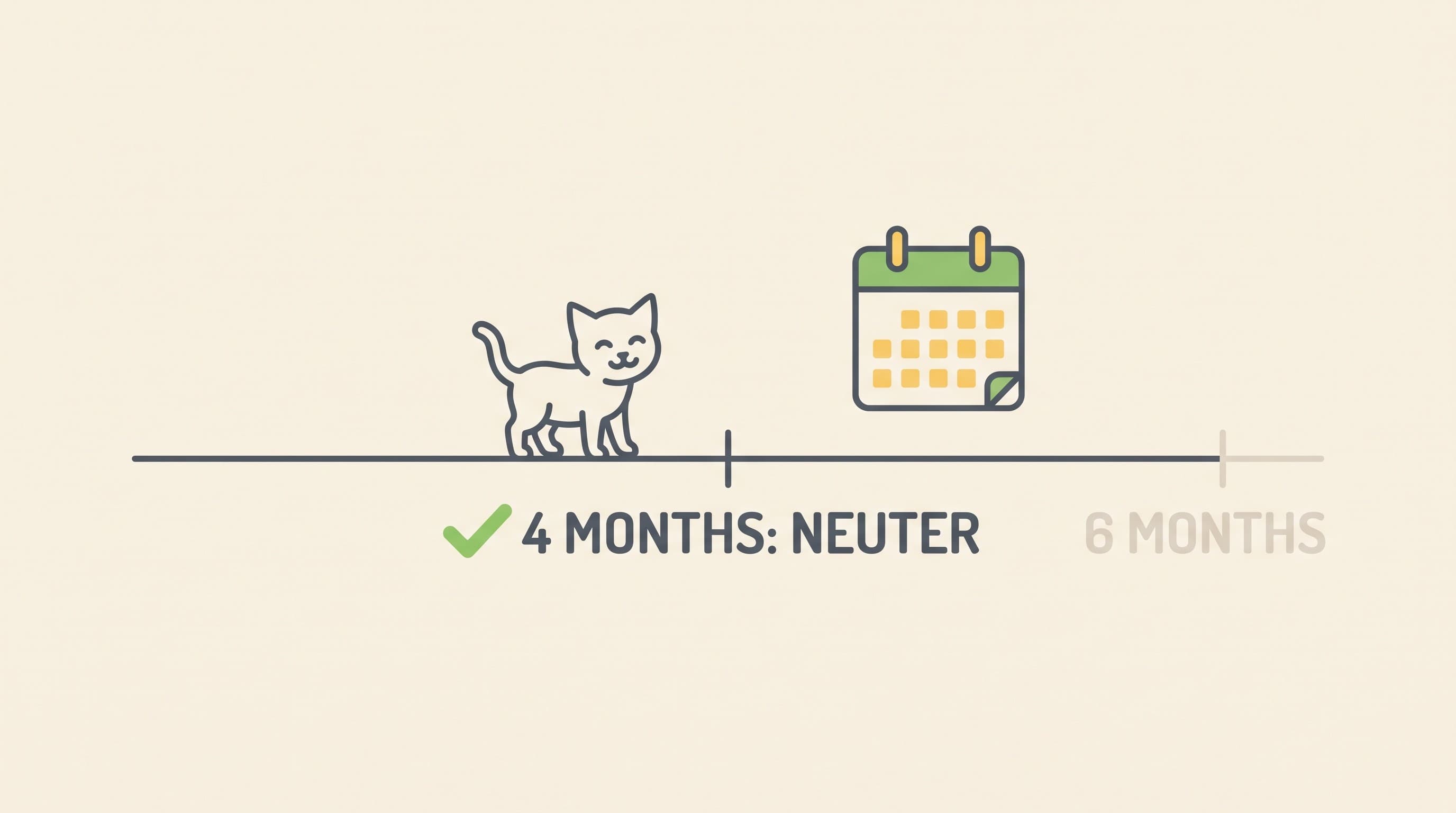
When to neuter your cat: the four-month myth-buster
Alastair Greenway
BVM&S MRCVS
Let me start with the sentence that matters most, because it is the one an older leaflet, a well-meaning relative or an out-of-date breeder may have got wrong. For cats, the right time to neuter is by four months of age. Not six. The "wait until six months" rule is a hangover from decades ago, and it is one of the biggest reasons the UK still has so many unplanned kitten litters.
If you have been told to wait, you are not being careless, you are being sensible with the information you were given. But the information has moved on, and the reason is simple biology: a female kitten can become pregnant startlingly young, often before her owner has any idea she is old enough. So this piece is a gentle correction, not a telling-off. By the end you will know why four months is right, why it is safe, and why it is worth booking before your kitten hits that mark.
One thing to set aside straight away. If you have also read our advice on neutering dogs, or heard that "you should wait for them to grow up first", please put it completely to one side here. Cats are the exact opposite case, and that is not a contradiction, it is two different species with two different clocks. I will come back to it, but do not let the dog message anywhere near this decision.
Why the clock is faster than you think
The whole case for four months rests on one fact: cats mature quickly. A female kitten can reach sexual maturity and become pregnant from around four months of age, sometimes even a little before, particularly in the lighter months of the year. That is well before she looks fully grown, and well before most owners would ever think of her as an adult.
This is exactly where the old six-month rule does its damage. A kitten neutered at six months may already have come into season, or already be pregnant, by the time the appointment comes round. The result is the accidental litter that nobody planned for, from a mother who is barely more than a kitten herself. Multiply that across the country and you have the ongoing tide of unwanted cats and kittens that the rescue charities spend every year trying to keep up with.
For male kittens the pressure is different but just as real. As toms mature they start to roam further in search of females, get into fights over territory and mates, and begin spraying strong-smelling urine to mark. Roaming toms are the ones most likely to be hit by cars, to pick up disease, and to father the very litters we are trying to prevent. Neutering settles all of that before it starts.
The evidence that four months is safe
The reason we can recommend four months with confidence is that the safety of early neutering is well established and backed by every major feline welfare body. Cats Protection, the Governing Council of the Cat Fancy (GCCF), International Cat Care (iCatCare) and the Kitten Neutering Database all support neutering by four months of age. This is not a fringe view or a cost-cutting shortcut; it is the settled consensus of the people who look after cats for a living.
Early neutering at four months has been studied and found to be safe, with kittens generally tolerating the anaesthetic and surgery well and recovering quickly. Anaesthetic and surgical techniques for kittens are routine in practice. The honest problem has never been safety; it has been uptake. Historically, only a small minority of owners have had their cats neutered by four months, with most still waiting longer, and that gap between what is recommended and what actually happens is precisely where the unplanned litters come from.
So if a worry about "doing it too young" has been holding you back, please let that worry go. Four months is not early in any way that matters to your kitten. It is simply on time.
What neutering does for your cat
Beyond preventing litters, neutering brings real, direct benefits to the cat in front of you, and it is worth spelling them out.
It removes the risk of pregnancy and, in females, the risk of pyometra (a serious womb infection later in life) and reduces the risk of mammary tumours. It reduces roaming and fighting, which matters enormously for an outdoor cat, because fewer fights and less wandering means a lower risk of road accidents and of the diseases that spread through cat-to-cat contact. That last point is not a side note: fighting is a main route by which feline immunodeficiency virus (FIV) spreads, through bite wounds, so neutering a tom genuinely lowers his infection risk, which is why it sits so closely alongside the FeLV and FIV testing conversation. Neutering also reduces or prevents spraying and the pungent smell of an entire tom's urine, and it tends to make cats more settled and homely.
For a cat who will have any outdoor access at all, these are not minor conveniences. An entire cat outdoors, especially a tom, faces measurably more danger, and neutering is one of the clearest things you can do for their long-term welfare.
The dog comparison, stated plainly
Here is the contrast I promised, because it trips up owners who have both species or who have read general advice about "waiting until they are grown".
For dogs, current advice has moved towards an individualised decision, and for many larger breeds there is a genuine case for waiting closer to skeletal maturity, sometimes well beyond a year, to protect the developing joints. You can read that whole argument in when to neuter your dog. For cats, none of that applies. Cats do not carry the same large-breed joint concern that drives the "wait" advice in big dogs, and the overriding factor for cats, early fertility, points firmly the other way. The single most common mistake I see is an owner carrying the sensible dog caution across to their kitten and, in doing so, waiting straight into an accidental litter. Two species, two clocks. For your kitten, four months.
What actually happens on the day
Knowing what to expect takes the fear out of it. Neutering is a routine day procedure. Your kitten comes in during the morning, usually having been starved from the night before (your practice will give you exact instructions), has the operation under a general anaesthetic, and in the great majority of cases goes home the same afternoon.
For a male, castration is a quick procedure with a very fast recovery; many toms are back to their normal selves within a day or two. For a female, spaying is a little more involved as it is abdominal surgery, but kittens generally bounce back quickly, with a short spell of taking it easy and keeping the wound clean while it heals. Your vet will talk you through pain relief and aftercare, and any concerns afterwards are always a phone call to the practice.
The four-month point is also a natural moment to tie up the other early-life admin. It sits close to the age when the primary vaccinations are wrapping up, it is a sensible time to make sure the microchip details are registered and correct (remember that cat microchipping became a legal requirement in England on 10 June 2024 for cats over 20 weeks), and it dovetails with any FeLV or FIV testing your kitten needs. One trip, several boxes ticked.
What to do next
The action here is refreshingly simple. Ring your vet and book your kitten's neutering for around four months of age, and do not wait for six. If your kitten is already past four months and not yet neutered, book it now rather than putting it off further, because every week an entire cat goes un-neutered is a week the risk sits with you.
While you are thinking about it, two related decisions belong in the same conversation: whether your cat will go outdoors, which shapes so much of their risk and is worked through in indoor or outdoor: making the decision for your cat, and whether your kitten needs FeLV and FIV testing. But the headline stands on its own, and it is worth repeating one last time, because it is the whole point of this article: for cats, four months is right, it is safe, and it is on time.
References
- Cats Protection. Neutering advice / "kittens can be neutered from four months of age" and early-neutering position.
- GCCF (Governing Council of the Cat Fancy) neutering position.
- International Cat Care (iCatCare) neutering guidance.
- Kitten Neutering Database (KIND), early neutering resource.
- UK microchipping law: cats in England compulsory from 10 June 2024 (over 20 weeks).
- Cross-reference (deliberate contrast): [when to neuter your dog](/articles/neutering-dogs).
Keep track of how your pet is doing
The owners who cope best are the ones who notice changes early. A simple health log shows you what is working, and what is not, before the next vet visit.
Start tracking, freeYou're not doing this alone
Compare treatment journeys and talk to owners managing new puppy & kitten. Free to join.
Join PetsLikeMine