

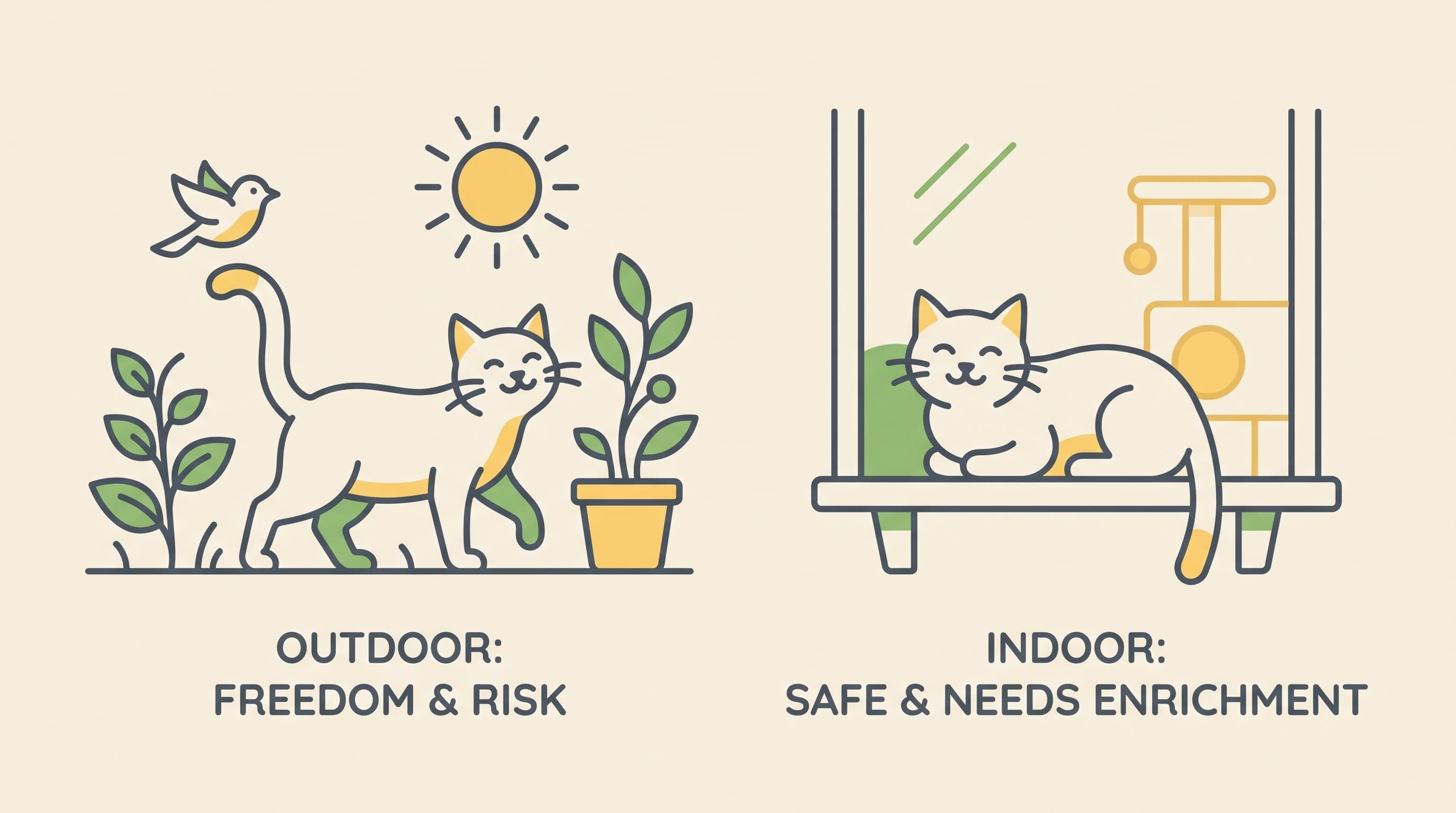
Indoor or outdoor: making the decision for your cat
Alastair Greenway
BVM&S MRCVS
Of all the decisions a new cat owner agonises over, this is the one that seems to carry the most guilt in either direction. Let them out and you picture the road. Keep them in and you worry you are caging a creature that is meant to prowl and hunt and climb. Friends have firm opinions, the internet has firmer ones, and both sides can point to a happy cat to prove their case.
I want to take the guilt out of it, because there is no single right answer that fits every cat. Whether your cat lives indoors, has free run of the garden, or something in between is a decision to make for your cat, in your home, on your street. What matters is not which choice you make, but that whichever you make comes with the things that particular life needs to be a good one. This article is here to help you weigh it honestly.
The case for outdoor access
Cats are, at heart, hunters and explorers, and outdoor access lets them do the things their bodies and brains are built for: patrolling territory, climbing, stalking, sunbathing, and choosing where to be. International Cat Care and other welfare bodies recognise that being able to express these natural behaviours is genuinely good for a cat's wellbeing. A cat with a garden to roam tends to get more exercise and more mental stimulation for free, and is less likely to become bored, frustrated or overweight, all of which take real effort to provide for an indoor cat.
For many cats in the right setting, a quiet street, a decent garden, a sensible temperament, outdoor access is a rich and rewarding life, and denying it would take something meaningful away. If that is your situation, the outdoor route is a perfectly good one, provided you manage the risks that come with it.
The risks that come with the door
Those risks are real, and it would be dishonest to soften them. The biggest, by a distance, is road traffic. Cars are a leading cause of injury and death in outdoor cats, and the danger rises sharply the busier and faster the roads near you are. A cat on a quiet cul-de-sac faces a very different risk from one whose garden backs onto a main road.
The other outdoor risks are worth naming plainly so you can judge them against your own street:
- Fights and injuries with other cats, which cause painful abscesses and, importantly, spread disease.
- Infectious disease, especially feline immunodeficiency virus (FIV), which passes mainly through bite wounds during fights, and feline leukaemia virus (FeLV), spread through close contact. This is why outdoor access and the FeLV and FIV conversation belong together, and why the FeLV vaccine is recommended for cats who go out or mix with other cats.
- Poisoning, from antifreeze, slug pellets, lilies and other garden and household hazards, and from eating poisoned prey.
- Getting lost, trapped or stolen, particularly for friendly or pedigree cats.
Two things are non-negotiable before any cat goes outside. They must be neutered, because an entire cat outdoors roams further, fights more and, in females, comes home pregnant (the whole argument is in when to neuter your cat). And they must be microchipped and the details kept up to date, which for cats in England is now a legal requirement in any case. Get those two done, and you have removed a large slice of the outdoor risk before your cat ever crosses the threshold.
The case for keeping a cat indoors
An indoor life removes almost all of those dangers at a stroke, and for some cats it is clearly the kinder choice. A cat living entirely indoors is protected from traffic, fights, most infectious disease and theft, and on average that safety can add up to a longer life.
For certain cats, indoors is not just an option but the responsible default. A cat who has tested FIV positive should be kept indoors or securely contained, both to protect them from picking up other infections and to stop them passing FIV to neighbourhood cats through fights. Cats who are blind, deaf, elderly or have limited mobility are safer in. Homes on a busy main road, or in a flat with no safe outdoor access, point strongly towards an indoor life. And some nervous or pedigree cats are simply better off not out.
But an indoor life comes with a bargain attached, and this is the part owners sometimes miss. When you take away the world outside, you take on the job of bringing enough of it indoors, because a bored indoor cat is not automatically a happy one.
The indoor duty: keeping it a good life
A cat kept in without enough to do can become overweight, frustrated, and prone to behaviour problems, from over-grooming to house-soiling to redirected aggression. Preventing that is entirely doable, but it is active work, not a default. The essentials of a good indoor life are:
- Vertical space and hiding spots: shelves, cat trees, window perches and high places to survey the room from. Cats live in three dimensions, and height matters to them.
- Scratching outlets: sturdy posts and boards so the urge to scratch lands somewhere you both approve of, covered in litter training and scratching.
- Daily play and hunting substitutes: wand toys, food puzzles and scattered feeding that let a cat stalk, chase and "catch", which is how an indoor cat gets the mental exercise a garden would otherwise give.
- Litter provision done properly: enough trays, in the right places, kept clean, again in the litter and scratching piece.
- Company and routine, and for some households a compatible feline companion, though that is its own careful decision.
Do these, and an indoor cat can be every bit as content and fulfilled as one with a cat flap. Skip them, and "safe indoors" can quietly become "understimulated and unhappy". The safety is only half the deal; the enrichment is the other half.
The middle paths worth knowing about
The choice is not simply in or out. A growing number of owners find a version in between that gives much of the freedom with far less of the risk:
- A catio or cat run, an enclosed outdoor space attached to the house, lets a cat feel the weather, watch the birds and get fresh air completely safely.
- Cat-proof fencing can turn an ordinary garden into a secure one a cat cannot leave, keeping the roaming inside your own boundary.
- Harness and lead training, started young and patiently, suits some confident cats for supervised garden or walk time.
- Timed access, letting a cat out only during daylight and calling them in before dusk, when traffic and territorial fights peak, reduces the highest-risk hours. A microchip-activated cat flap keeps the neighbourhood cats out of your kitchen while letting yours come and go.
None of these suit every cat, but they are worth knowing about, because the honest answer for many families is not a stark either-or but a considered somewhere-in-between.
Making the call for your cat
So how do you actually decide? Weigh these together, honestly, for your own situation:
- Your roads. A busy main road tips the balance firmly towards indoors or a contained option; a quiet lane is a different calculation.
- Your cat. Their health (an FIV-positive or disabled cat should stay in or contained), their temperament, and whether they are pining at the window or perfectly content on the sofa.
- Your home. Whether you have a garden, a flat, the space and time to enrich an indoor life or to build a catio.
- Your cat's history. A cat used to going out may struggle to be confined suddenly, while a kitten raised indoors from the start often settles happily to that life.
A kitten is the easiest time to set the pattern, and a cat brought up to one way of living generally accepts it as normal. If you are leaning towards outdoor access, wait until your kitten is neutered, microchipped, fully vaccinated and properly settled in your home before the first supervised trips out, and start in the garden, briefly, before a meal, so they learn where home and dinner are.
Whatever you choose, it is not a betrayal of your cat to keep them safe, and it is not reckless to let a well-managed cat enjoy the outdoors. Both can be a good life. The decision that matters is made calmly, for the animal you actually have, and it sits naturally alongside the two conversations either side of it: getting them neutered by four months, and knowing their FeLV and FIV status before they ever meet the cat next door.
References
- International Cat Care (iCatCare). Indoor versus outdoor cats / providing for a cat's needs and natural behaviour.
- AAFP / iCatCare. FIV transmission via bite wounds; recommendation to keep FIV-positive cats indoors/contained.
- FeLV vaccine recommended for cats with outdoor access or contact with other cats (AAFP 2020).
- UK microchipping law: cats in England compulsory from 10 June 2024.
- Cross-reference: [when to neuter your cat](/articles/neutering-cats), [FeLV and FIV testing](/articles/felv-fiv-testing), [litter training and scratching](/articles/litter-and-scratching).
Keep track of how your pet is doing
The owners who cope best are the ones who notice changes early. A simple health log shows you what is working, and what is not, before the next vet visit.
Start tracking, freeYou're not doing this alone
Compare treatment journeys and talk to owners managing new puppy & kitten. Free to join.
Join PetsLikeMine