

How to socialise before the vaccinations finish
Alastair Greenway
BVM&S MRCVS
You have almost certainly been given two pieces of advice that seem to flatly contradict each other. One says: keep your puppy off the ground and away from the world until the vaccination course is finished, or you risk parvovirus. The other says: the socialisation window is short, it is closing fast, and if you miss it you can leave your dog fearful for life. Both of those things are true. The good news, and the whole point of this article, is that you do not have to choose between them. There is a safe, specific way to socialise your puppy properly while the vaccination course is still finishing, and once you can see it, the panic lifts.
This is the single most important message in the whole first-year space, so we are going to take it slowly and get it right.
Why this feels like an impossible choice
The conflict is real, and it comes from two clocks running at once.
The first clock is behavioural. Puppies have a sensitive period for socialisation of roughly 3 to 14 weeks of age (AVSAB, 2008). During that window their brain is unusually open to deciding what is normal and safe: people of all kinds, other dogs, traffic, hoovers, umbrellas, floor surfaces, being handled. Experiences met calmly in this window tend to be filed as "fine for life". Things they never meet, or meet in a frightening way, can become lifelong sources of fear. And here is the hard part: much of this window has already passed by the time you bring an 8-week-old puppy home, and the rest closes within a few weeks.
The second clock is infectious. The primary vaccination course is not finished on the day you collect your puppy. Parvovirus in particular is a serious, sometimes fatal disease of unvaccinated puppies, and the virus is environmentally hardy, so the instinctive advice is to keep the pup indoors and off public ground until it is fully covered (WSAVA, 2024).
So you are told to keep the puppy in, at exactly the age when getting the puppy out safely matters most. No wonder owners freeze.
The fact that resolves it
Here is the piece almost nobody hands new owners, and it changes the whole calculation.
The American Veterinary Society of Animal Behavior is explicit that behavioural problems, not infectious disease, are the number one cause of death for dogs under three years of age (AVSAB, 2008). Dogs are far more likely to be given up, rehomed repeatedly, or put to sleep because of fear, aggression and other behaviour problems than they are to die of an infection caught during the socialisation window. Under-socialising a puppy is, for most families in most settings, the bigger risk of the two.
That is not a licence to be reckless with parvo. It is the reason the veterinary and behaviour bodies are united on the answer: you socialise the puppy during the window, and you do it in ways that manage the infection risk down to something small. AVSAB puts it plainly, and WSAVA agrees: puppies can and should begin socialising before the vaccine course is complete, provided sensible precautions are taken (AVSAB, 2008; WSAVA, 2024).
It helps to understand why the "keep them in until fully vaccinated" advice is so sticky even though the experts have moved on from it. It is intuitive: infection is a concrete, frightening picture (a tiny puppy on a drip), whereas the harm of under-socialisation is invisible and delayed (a two-year-old dog who lunges at strangers, or is rehomed for biting). We are wired to fear the vivid, immediate danger and to discount the slow one. But the numbers, and the professional consensus, point the other way. The reconciliation below lets you respect both risks at once instead of trading one for the other.
The reconciliation protocol: how to do it safely
This is the part to actually use. Every item here gets your puppy real, formative experience during the window without putting them on high-risk ground. Think of it as "protect the body and the mind at the same time".
Carry, do not walk
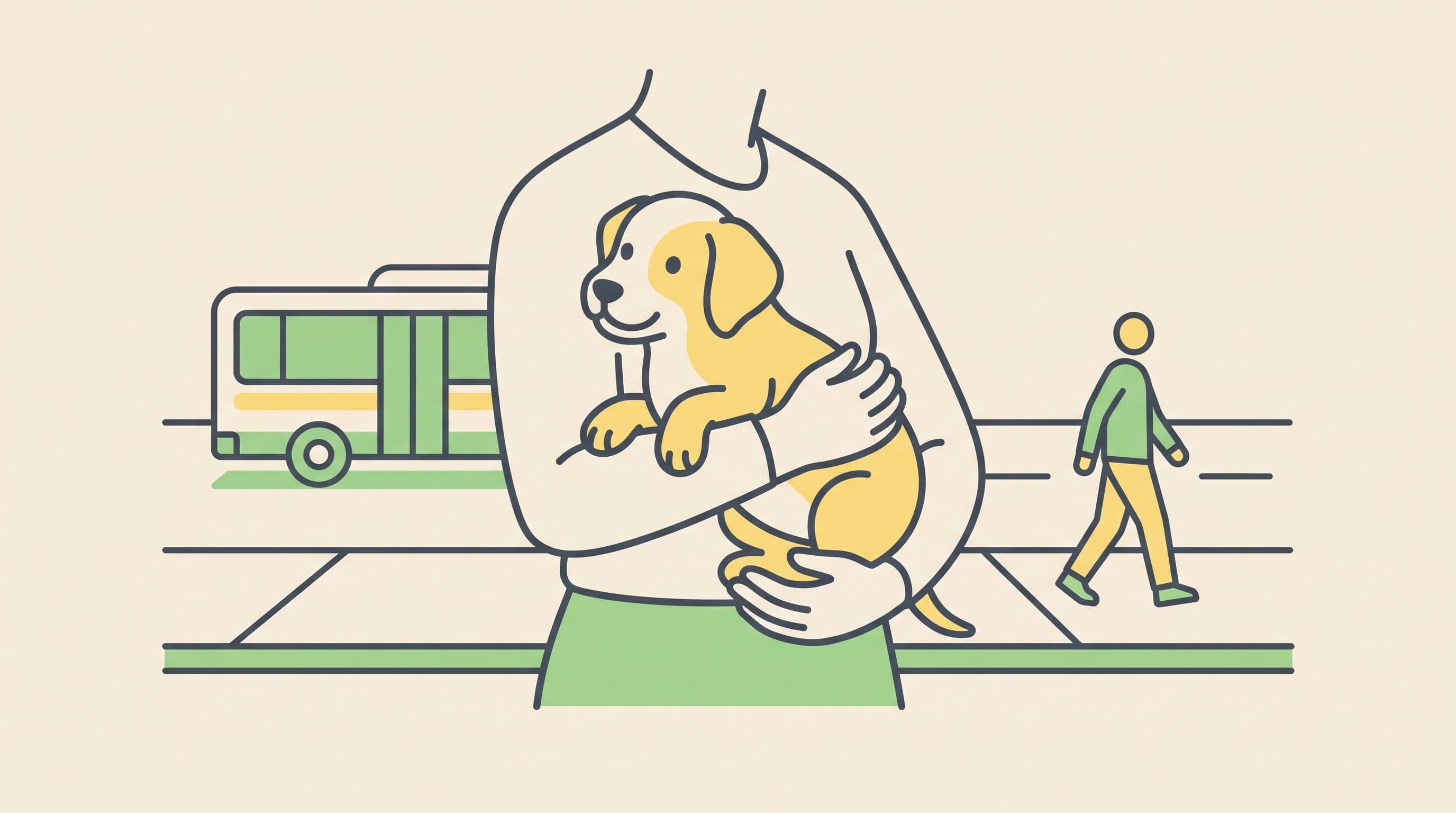
Before the course is finished, your puppy does not need paws on public pavements to experience the world. Pick them up and carry them. From your arms they can watch traffic go past, see and hear buses and bikes, meet children and men with beards and people in hi-vis and hats, feel the wind and the rain, and take in the sheer noise and movement of a street or a car park. Carrying gives you almost all of the sensory socialisation of a walk with almost none of the ground-contact infection risk. Sit on a bench near a school gate at pick-up time and let your puppy simply watch the world for ten minutes. That is a socialisation session.
Invite the world into your home and garden
Your own home and garden are a safe stage. Ask friends and family to visit, deliberately choosing a variety of people: tall and short, loud and quiet, someone in a uniform, someone in a big coat, someone using a stick. Let your puppy meet them at their own pace, with treats and no pressure.
For dog-to-dog contact, use vaccinated-dog playdates: invite a known, healthy, fully vaccinated, friendly adult dog into your home or garden. A calm adult dog teaches a puppy more about dog manners than almost anything else, and because you know that specific dog's health and vaccination status, the risk is controlled. Avoid the dog park lottery of unknown dogs for now.
Go to a well-run puppy class
A good puppy class is purpose-built for exactly this dilemma. The better ones require proof of an up-to-date first vaccination, keep numbers small, clean the floors between sessions, and run entirely on reward-based methods. They give your puppy safe, supervised interaction with other vaccinated puppies during the window. What a good class looks like, and the red flags of a bad one, is a whole topic in itself, covered in Puppy classes: what good actually looks like.
Desensitise to sounds, indoors
Fear of fireworks, thunder and household bangs is common and very preventable. You can do this work entirely indoors, at no infection risk at all, using free sound-desensitisation recordings such as the Dogs Trust Sound Therapy / Sounds Sociable programme (Dogs Trust). Played quietly at first while your puppy eats or plays, then gradually louder over days and weeks, these recordings teach a puppy that fireworks and traffic are simply part of the background, not a threat.
Handle, and expose to home life
The window is also for the small, ordinary things. Handle your puppy's paws, ears, mouth and belly gently every day so vet visits and nail trims are easy for life. Let them walk on different surfaces you can bring to them: a doormat, tiles, a wobble cushion, wet grass in your own garden. Introduce the car with short, positive trips. Run the hoover, the washing machine and the doorbell while they are busy with something nice. None of this requires public ground.
What to still avoid until the course is complete
Being pro-socialisation does not mean being careless. Until your vet confirms the primary course is complete and protective, keep away from:
- Unknown dogs, and any dog whose vaccination and health status you cannot personally vouch for.
- Dog faeces and areas fouled by other dogs. Parvovirus is shed in faeces and survives a long time in the environment.
- High-traffic dog areas while your puppy is on the ground: public parks, popular walking routes, pet shops floors, and anywhere lots of unknown dogs pass through.
The rule of thumb is simple. Controlled and known equals fine. Unknown, shared ground equals wait. You lose almost nothing by carrying past the park for a few weeks. You lose a great deal by keeping a puppy shut indoors through the whole sensitive period.
One practical note on your own garden: if it is genuinely your own and not visited by unknown dogs, it is a reasonably safe space for on-ground play and toilet training even before the course is complete. The high-risk ground is shared, public and frequented by dogs whose health you cannot vouch for. A back garden used only by your household, and by the vaccinated adult dog you have invited round, is a different proposition from a communal green or a popular park.
The myths that keep owners frozen
A few well-meant but mistaken beliefs do more than anything else to trap owners into wasting the window. It is worth naming them.
- "They can't go out at all until the last jab." They cannot walk on high-risk public ground yet, but they can be carried anywhere, meet vaccinated dogs at home, attend a good class and do all their sound and handling work. "Out" and "on the ground in the park" are not the same thing.
- "Socialisation just means meeting other dogs." Dog-to-dog contact is one part of it. Meeting people, sounds, surfaces, traffic, handling and household life all matter at least as much, and most of that carries no infection risk at all.
- "I'll do it once they're fully vaccinated, at four or five months." By then the sensitive period is closing or closed. Experiences met for the first time after the window are much harder to file as "normal", which is the whole reason the window exists.
- "My breed is confident, so it'll be fine." Temperament is genetic and environmental. Even a bold breed benefits from good early experiences, and a poorly socialised confident dog can become a large, pushy, difficult adult rather than a fearful one. Your puppy's breed page is worth reading for what to prioritise, but no breed is exempt from needing the window.
A rough week-by-week feel
Every puppy is different, and this is a feel rather than a prescription, but it helps to have a shape.
- From the day you collect them (around 8 weeks): start immediately. Home visitors, handling, surfaces, sounds at low volume, first carried outings.
- Weeks 9 to 12: widen it. More carried trips to busier places, the first vaccinated-dog playdate, and enrolling in a puppy class once the first vaccination is in.
- Weeks 12 to 16 and to course completion: keep going, keep it positive, and start adding short on-ground experiences in low-risk, clean places as your vet advises, building towards normal walks once protection is confirmed.
The best way to make sure you are covering the full range and not accidentally missing something is to work from a structured list. The Socialisation checklist tool turns weeks 3 to 14 into a tickable plan of people, sounds, surfaces and handling, so you can see at a glance what your puppy has met and what is still to come. The companion article, The socialisation checklist: weeks 3 to 14, walks through how to use it.
Kittens: the window is earlier, and mostly before they come home
Cats have a sensitive period too, and it matters just as much, but the timing is different and it catches many owners out. The feline sensitive period is earlier and shorter, roughly 2 to 7 weeks of age, extending to around 9 weeks (International Cat Care). That means a huge amount of a kitten's socialisation happens at the breeder's or in the rescue's care, before you ever meet them. This is one of the strongest reasons to get a kitten from someone who raises litters underfoot in a busy household, handled daily by a range of people, rather than shut away in a shed.
That does not let you off the hook, though. Kittens usually come home at around 8 to 9 weeks, right at the tail of the window, and the gentle, positive work you do in the first days and weeks still counts. The emphasis for a kitten is calm, frequent, positive handling by several different people, good experiences with the carrier and the car, and gentle exposure to normal household life. Unlike puppies, kittens are not usually taken out to meet the world, so the socialisation happens at home. The full approach is in Handling your kitten: the 2 to 9 week window.
Reassuringly, the infection dilemma is smaller for indoor kittens, but the principle is identical: use the window you have, gently and positively, and do not waste it waiting.
The one thing to take away
You have been told two true things that seemed to force an impossible choice. They do not. Carry your puppy so they meet the world from your arms, invite vaccinated dogs and a variety of people to your home, book a well-run puppy class, play the sound recordings indoors, handle them daily, and simply keep away from unknown dogs and fouled public ground until your vet confirms the course is complete. Done this way, you protect the body and the mind at the same time, which is exactly the point.
Two next steps. Read The UK vaccination schedule explained so you know precisely where your puppy is in the course and when the ground opens up, and open the Socialisation checklist tool today so nothing in the window slips past you. And if you would like reassurance from people going through the same weeks, the New Puppy & Kitten community is full of owners at exactly this stage.
References
- American Veterinary Society of Animal Behavior. AVSAB Position Statement on Puppy Socialization. AVSAB. 2008.
- World Small Animal Veterinary Association (WSAVA) Vaccination Guidelines Group. WSAVA Guidelines for the Vaccination of Dogs and Cats. WSAVA. 2024.
- Dogs Trust. Sound Therapy for Pets (Sounds Sociable). Dogs Trust.
- International Cat Care. Kitten development and behaviour / the socialisation period. International Cat Care.
Free downloads
Companion worksheets to put what you've read into practice. Free PDFs, print at home.
Keep track of how your pet is doing
The owners who cope best are the ones who notice changes early. A simple health log shows you what is working, and what is not, before the next vet visit.
Start tracking, freeYou're not doing this alone
Compare treatment journeys and talk to owners managing new puppy & kitten. Free to join.
Join PetsLikeMine