

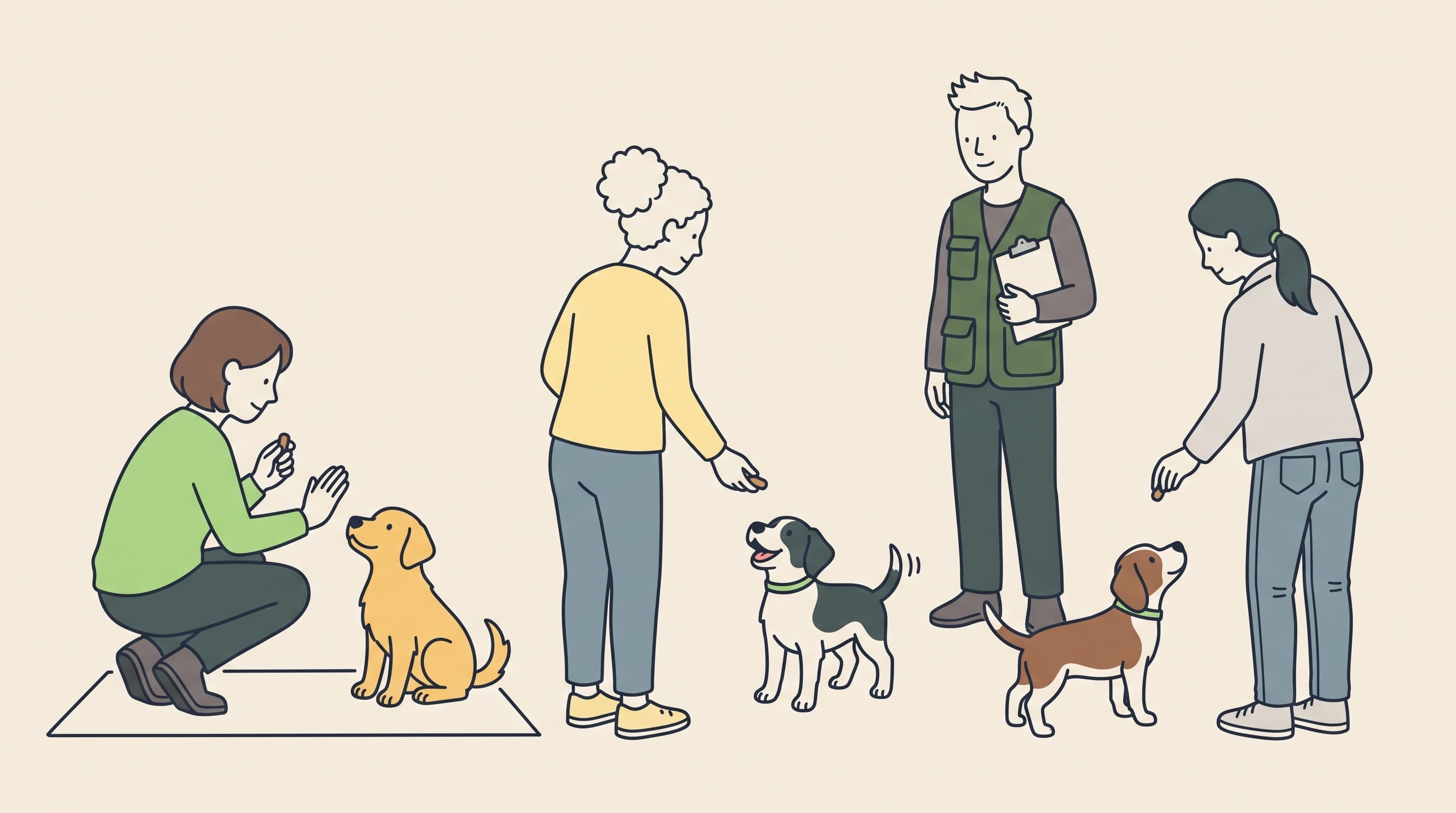
Puppy classes: what good actually looks like
Alastair Greenway
BVM&S MRCVS
A good puppy class is one of the best things you can do for your dog in the first few months. A bad one can do real harm, teaching your puppy that other dogs are overwhelming, or worse, teaching you methods that damage the trust you are trying to build. The trouble is that dog training is an unregulated field in the UK: anyone can call themselves a trainer, hire a hall, and take your money, whatever their methods or knowledge. This article is about how to tell the difference, so you can book with confidence and walk away from the ones that are not right for your puppy.
Why a good class is worth it
Puppy classes do several things at once during the critical socialisation window. They give your puppy structured, supervised experience of other vaccinated puppies, which teaches vital dog-to-dog manners like bite inhibition and reading another dog's signals. They expose your puppy to a new environment, new people and new sounds in a controlled way. They teach you, the owner, how to train kindly and effectively, which matters more than what your puppy learns in the room itself. And a well-run class runs entirely on reward-based methods, which are both more effective and better for your dog's welfare than punishment-based approaches (AVSAB, 2021; Ziv, 2017).
Classes also fit neatly into the safe-socialisation plan for a puppy whose vaccinations are not yet finished. A responsible class is designed to bridge exactly that gap, which is why it appears in the reconciliation protocol in How to socialise before the vaccinations finish.
The non-negotiables: safety first
Before anything else, a class must be safe for a partially vaccinated puppy. These are the things a good class insists on, and their absence is a reason to look elsewhere.
Proof of an up-to-date first vaccination. A responsible class requires every puppy to have started its vaccination course, and will ask to see proof. This is the balance the veterinary bodies endorse: puppies can attend and socialise before the full course finishes, provided sensible precautions are in place (WSAVA, 2024; AVSAB, 2008). A class that lets any puppy in with no questions asked is not protecting your dog.
Clean, disinfected floors and a suitable venue. Because attending puppies are not yet fully vaccinated, the venue matters. Floors should be cleanable and cleaned, ideally indoors on a hard, disinfected surface rather than on public grass where unknown dogs have toileted. Ask what they use and how often.
Small groups and proper supervision. Good classes keep numbers low (commonly around four to six puppies) so every puppy and owner gets attention and no one is overwhelmed. A cheap, cheerful free-for-all of a dozen puppies is not socialisation; it is chaos, and it can frighten a shy puppy badly.
Appropriate age range. Puppy classes are for young puppies, typically up to around 16 to 20 weeks, so your puppy is with others at a similar stage rather than being bowled over by near-adult dogs.
The method test: reward-based, always
This is the part that separates a genuinely good class from a harmful one, and it is worth being firm about. The clear position of the veterinary behaviour community is that dog training should be based on rewarding wanted behaviour, not on fear, pain or intimidation (AVSAB, 2021). Reward-based training is more effective and avoids the well-documented risks of aversive methods, which include increased fear and aggression (Ziv, 2017).
Good signs (walk in):
- Treats, toys and praise are the main tools. Puppies are set up to succeed and rewarded for getting it right.
- The trainer talks about what to do instead of an unwanted behaviour, and about managing the environment.
- Owners are coached patiently; the class is teaching you as much as your puppy.
- Frightened or overwhelmed puppies are given space and time, never forced.
- The atmosphere is upbeat and the dogs look happy.
Red flags (walk out):
- Any talk of "dominance", "pack leader", "alpha", showing your puppy "who's boss", or "being the boss".
- Choke chains, prong collars, slip leads used to jerk, electronic/shock collars, or spray/rattle devices. Some of these are being restricted or banned in parts of the UK; none belong in a puppy class.
- Physical corrections: alpha rolls, pinning, scruffing, smacking, "bopping" the nose.
- Shouting, or a puppy left to "cry it out" or "get over it" while distressed.
- A trainer who dismisses your concerns or cannot explain why they do what they do.
The dominance model of dog training is outdated and based on a misunderstanding of wolf behaviour, and it has been rejected by the veterinary behaviour profession (AVSAB, 2021). If a trainer leans on it, their whole approach is suspect, however confident they sound.
Checking the trainer's credentials
Because the industry is unregulated, the letters after a trainer's name and the organisation they belong to tell you a lot. Look for membership of bodies that require assessed, reward-based practice and continuing education. In the UK these include the Association of Pet Dog Trainers UK (APDT UK), the Institute of Modern Dog Trainers (IMDT), the Pet Professional Guild British Isles, and, for qualified clinical behaviourists, the Animal Behaviour and Training Council (ABTC) register and the Association of Pet Behaviour Counsellors (APBC) (ABTC). Membership is not a cast-iron guarantee, but it means someone has assessed the trainer against a standard and expects kind methods.
It is also completely reasonable to ask a trainer directly:
- What methods do you use, and what happens if a puppy gets it wrong?
- What equipment do you use and not allow?
- What are your qualifications and which organisations are you a member of?
- Can I come and watch a class before I book?
A good trainer will welcome every one of these questions. One who bristles is telling you something.
Watch a class before you commit
The single most useful thing you can do is ask to observe a class without your puppy. In ten minutes you will see far more than any website tells you. Watch for:
- Do the puppies look happy and relaxed, or frightened and overwhelmed?
- Are owners being taught kindly and clearly?
- Is play supervised and broken up before it tips into bullying or panic?
- Are shy puppies protected and given space?
- What equipment is on the dogs?
- Is the room clean and the group small?
Trust your instincts. If something feels unkind, or a puppy is being frightened "for its own good", it is not the class for you, whatever its reputation or price.
Puppy party or puppy class?
You may be offered a "puppy party", often run at a vet practice, as well as, or instead of, a structured class. The two are not the same thing, and it helps to know the difference. A puppy party is usually a one-off or short, informal session, valuable mainly for a positive early experience of the vet practice and some gentle exposure to other puppies. A puppy class is a structured course over several weeks that teaches you and your puppy foundation skills as well as socialisation. Both can be good, but a single puppy party is not a substitute for the ongoing work of a proper class, and neither is worth attending if it is chaotic, over-crowded or run without regard to the safety points above. A calm, well-supervised puppy party at your own vet can be a lovely start; a free-for-all is not.
What a class costs, and getting your money's worth
Puppy classes vary a lot in price, and the most expensive is not automatically the best; the method and the trainer matter far more than the price tag. Whatever you pay, you get the most value by treating the class as coaching for you, not daycare for your puppy. Turn up having practised, take notes, ask questions, and do the homework between sessions, because a dog is trained in the hours at home far more than in the one hour a week in the hall. Bring high-value treats your puppy loves, arrive a little early so they can settle, and do not feed a big meal right before, so the treats actually motivate. If your puppy is tired or overwhelmed on a given day, it is fine to hang back and just watch; a stressed puppy learns little.
What a good class will and will not do
Set your expectations sensibly. A good puppy class is primarily about socialisation and foundations, not obedience polish. Expect gentle work on coming when called, sitting, settling, walking nicely, being handled, and coping calmly around other puppies and people. Expect to be given things to practise at home, because a weekly class is only as good as the daily work around it.
Do not expect a class to fix a serious behaviour problem, cure fearfulness, or turn out a perfectly trained dog in six weeks. And do not expect the socialisation window to be "done" once the course ends. A class is one important strand of a wider plan that also includes the carried outings, home visitors and sound work in How to socialise before the vaccinations finish and the structured coverage in The socialisation checklist: weeks 3 to 14.
When your puppy finds class hard
Some puppies are shy, and a busy class can be too much at first. A good trainer will let a nervous puppy watch from a distance, work at the edge of the room, and build up slowly, rather than throwing them into the middle. If your puppy is consistently overwhelmed, talk to the trainer, and if a genuine fear is not easing, ask your vet about a one-to-one with a qualified, reward-based behaviourist, which can be gentler and more effective for a sensitive dog than a group. The land-shark biting phase can also collide with class time; if you are in the thick of it, Teething and biting: surviving the land-shark phase will help you keep your sense of humour.
Your next step
Find a class that requires a first vaccination, cleans its floors, keeps groups small, trains only with rewards, and whose trainer belongs to a recognised reward-based body and welcomes your questions. Ask to watch one before you book. Slot the class into your wider plan using How to socialise before the vaccinations finish and the Socialisation checklist tool, and keep practising at home between sessions. If you want recommendations or to compare experiences, other owners in the New Puppy & Kitten community are a good, honest source.
References
- American Veterinary Society of Animal Behavior. AVSAB Position Statement on Humane Dog Training. AVSAB. 2021.
- American Veterinary Society of Animal Behavior. AVSAB Position Statement on Puppy Socialization. AVSAB. 2008.
- World Small Animal Veterinary Association (WSAVA) Vaccination Guidelines Group. WSAVA Guidelines for the Vaccination of Dogs and Cats. WSAVA. 2024.
- Ziv G. The effects of using aversive training methods in dogs: a review. Journal of Veterinary Behavior. 2017.
- Animal Behaviour and Training Council. Find a qualified trainer or behaviourist. ABTC.
Free downloads
Companion worksheets to put what you've read into practice. Free PDFs, print at home.
Keep track of how your pet is doing
The owners who cope best are the ones who notice changes early. A simple health log shows you what is working, and what is not, before the next vet visit.
Start tracking, freeYou're not doing this alone
Compare treatment journeys and talk to owners managing new puppy & kitten. Free to join.
Join PetsLikeMine