

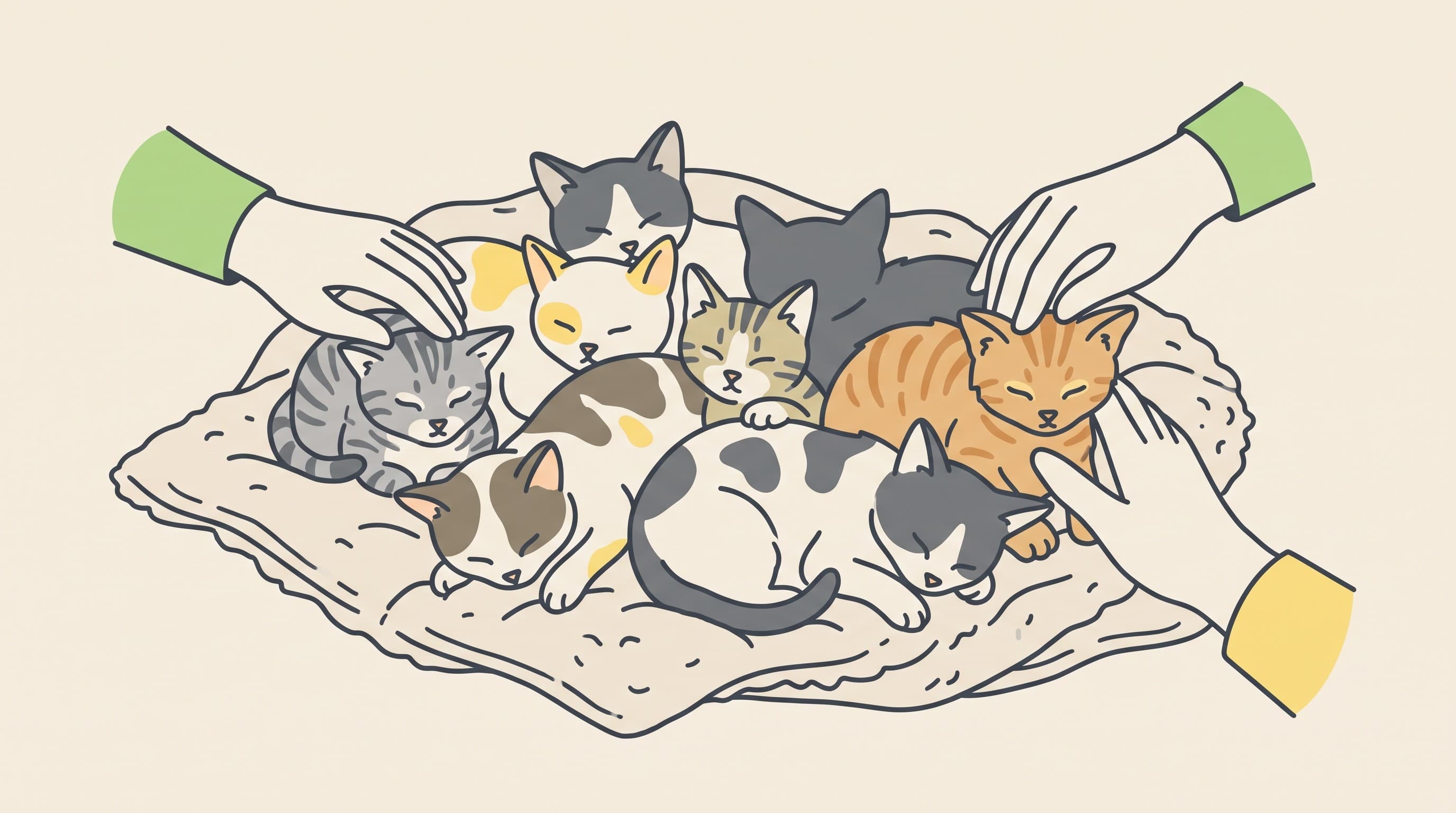
Handling your kitten: the 2 to 9 week window
Alastair Greenway
BVM&S MRCVS
Most of us think of socialisation as a dog thing: puppy classes, meeting other dogs, walks in the park. It is easy to assume cats simply are what they are, aloof or affectionate by luck of the draw. That is not true. Whether a cat grows into a confident, people-loving companion or a nervous one who hides from visitors for life is shaped enormously by what happens in a short window very early in kittenhood. The catch, and the reason this matters so much when you are choosing and settling a kitten, is that the most important part of that window happens before you ever bring them home. This article explains the window, what good early handling looks like, and how to keep the work going once your kitten arrives.
The feline sensitive period
Kittens have a socialisation window, just as puppies do, but it is earlier and shorter: roughly 2 to 7 weeks of age, extending to around 9 weeks (International Cat Care). During this period a kitten's brain is primed to decide what is safe and normal, and gentle, positive human contact in these weeks is what builds a friendly, handleable adult cat.
The evidence behind this is unusually clear for a behaviour question. Classic research found that kittens handled by people during this early window grew up markedly friendlier and more confident with humans, and that the number of different people who handled them, and the amount of gentle handling, both mattered (Karsh and Turner, cited in International Cat Care). A kitten handled by several people for short, kind sessions each day is being set up to enjoy human company for the rest of its life. A kitten raised with little or no gentle human contact in these weeks can remain wary or fearful, sometimes permanently, however much love it is offered later.
The practical, slightly uncomfortable consequence is this: by the time a kitten is old enough to leave its mother, at around 8 to 9 weeks, the window is almost closed. So the biggest single thing you can do for your kitten's temperament is choose where it comes from carefully.
Why where you get your kitten from decides so much
Because the window falls mostly before you meet the kitten, the single most powerful choice is the source.
A kitten raised underfoot in a busy home, handled daily by adults and (gently, supervised) children, exposed to the ordinary sounds of a household (the television, the hoover, the doorbell, the kitchen), tends to arrive already confident and sociable. That early exposure has done the hard part for you.
A kitten raised in isolation, in a shed, an outbuilding or from a feral or semi-feral mother with little human contact, may be beautiful and healthy and still find people frightening, because it missed the window. This is not the kitten's fault and it is not hopeless, but it is much harder work and no amount of later devotion fully replaces early handling.
This is one of the practical reasons the Kitten Checklist and buying-safely guidance matter so much: seeing the kitten with its mother, in the home where it was raised, tells you not just that the seller is legitimate but that the kitten has had the early socialisation it needs. A kitten offered from a car park, or from a seller who will not show you the home, has often missed exactly the experiences that make a good pet. The full guide to buying safely is in Buying safely: Lucy's Law and spotting a bad seller.
What good early handling looks like
If you are involved with a litter, or you have taken on a very young kitten, or you are guiding a breeder, this is what the work should look like during the window:
- Several different people, gently. Variety matters: men, women, calm children, so the kitten learns that "humans" as a category are safe, not just one familiar person.
- Short and frequent rather than long and overwhelming. A few minutes of gentle stroking and holding, several times a day, beats one long session.
- All over the body. Handle paws, ears, mouth, belly and tail, so that future nail trims, ear checks, tooth-brushing and vet examinations are unremarkable.
- Positive and calm. Pair handling with warmth, quiet voices and, once weaned, tasty food. Never force a frightened kitten to be held; let it come to you.
- Ordinary household life. Let the litter hear normal sounds at a gentle level: the hoover, the washing machine, the doorbell, cooking, the television. A kitten who grows up with these sounds is not startled by them later.
- The carrier and gentle restraint. Even brief, positive experiences of being picked up, briefly held still, and going in and out of a carrier pay off for a lifetime of stress-free trips.
Continuing the work once your kitten comes home
Your kitten usually arrives at around 8 to 9 weeks, right at the tail of the window, so while the most sensitive weeks are behind you, the first days and weeks at home still count. Keep going.
Let them set the pace. A new kitten needs to feel safe first. Start them in one quiet room with everything they need (litter tray, food, water, bed, hiding places) and let them explore in their own time before opening up the house. The settling-in approach is covered in Preparing your home and the first 72 hours.
Handle gently and often. Continue daily, short, positive handling: paws, ears, mouth, being lifted, being briefly held. This keeps a confident kitten confident and helps a slightly shy one warm up.
Introduce many gentle people. Ask visitors to let the kitten approach them rather than swooping in. Sit on the floor, be still, and let curiosity do the work. Supervise children closely and teach them to be calm and quiet.
Make the carrier and the vet good. Leave the carrier out as a cosy bed rather than something that only appears before frightening trips. Take your kitten for a "happy visit" to the vet if the practice allows, for a weigh-in and a treat, so the clinic is not only associated with vaccinations.
Reward-based only. Cats do not respond to punishment, and it damages trust and increases fear. Shape behaviour with rewards, patience and by managing the environment, never with shouting, spraying with water or scruffing.
Handling the shy or under-socialised kitten
If you have taken on a kitten who missed early handling (a rescue, a stray, a semi-feral litter), do not despair, but do adjust your expectations and your method. Progress is measured in weeks and small steps.
- Give a safe, quiet base with plenty of hiding places, and do not drag them out of hiding.
- Sit nearby, low and calm, without staring (a direct stare is threatening to cats), and let them observe you.
- Use food as the bridge: hand-feeding, or placing tasty food a little closer to you each day, builds positive association at the kitten's own pace.
- Interactive play with a wand toy lets a nervous kitten engage with you without the pressure of being touched.
- Be patient and consistent. Forcing contact sets progress back; every good, un-frightening interaction adds up.
The bond with a shy kitten, once earned, is one of the most rewarding in pet ownership. It simply takes time, and there is no shame in asking your vet for advice or a referral to a qualified feline behaviourist if a kitten stays very fearful.
Reading your kitten's body language
The whole approach depends on being able to tell a relaxed kitten from a worried one, and slowing down when you see worry. Cats are subtle, and a kitten that is not enjoying handling rarely lashes out first; it usually tries to escape or freeze. Signs to watch for and to respond to by giving space include:
- Ears turning back or flattening.
- A tail flicking, thumping or held low and tucked.
- Crouching, trying to move away, or freezing very still.
- Skin twitching along the back, or a sudden stop in purring.
- Dilated pupils, and any hissing or a low growl.
If you see these, stop, let the kitten move away, and make the next attempt shorter and gentler. A kitten that is repeatedly handled past its comfort learns that hands are unpleasant, which is the exact opposite of the friendly cat you are trying to raise. Equally, learn the good signs, a relaxed body, a gently upright tail, kneading, slow blinks and purring, so you know when you are getting it right and can do more of it.
Teaching children this is just as important. A kitten is not a toy, and a child who chases, grabs or squeezes a kitten can undo a great deal of good and get scratched in the process. Show children how to sit calmly and let the kitten come to them, how to stroke gently along the back and cheeks (most cats dislike having their tummy handled), and that when the kitten walks away, the game is over.
How handling connects to the rest of the first year
Early, positive handling is the foundation that everything else in your kitten's first year stands on. A kitten who is comfortable being handled is easier to litter train and redirect from the sofa (Litter training and scratching: setting a kitten up right), easier to introduce to resident pets and children (Introducing your new pet to resident pets and children), and far less stressed by the vet visits, the microchip, the vaccinations and the four-month neuter that punctuate the first year. Good handling is not a separate task; it is what makes all the other tasks kinder.
Your next step
If you are still choosing a kitten, make early socialisation a deciding factor: pick one raised underfoot in a busy home, seen with its mother, and use Buying safely: Lucy's Law and spotting a bad seller and the Kitten Checklist to guide you. If your kitten is already home, keep up short, daily, gentle handling by a variety of people, let them set the pace, and make the carrier and the vet positive places. To think ahead about the indoor-or-outdoor question and the four-month neuter that are coming up, see Indoor or outdoor: making the decision for your cat. And if you have a shy kitten and want encouragement from owners who have won that trust, the New Puppy & Kitten community is full of them.
References
Free downloads
Companion worksheets to put what you've read into practice. Free PDFs, print at home.
Keep track of how your pet is doing
The owners who cope best are the ones who notice changes early. A simple health log shows you what is working, and what is not, before the next vet visit.
Start tracking, freeYou're not doing this alone
Compare treatment journeys and talk to owners managing new puppy & kitten. Free to join.
Join PetsLikeMine