

Buying safely: Lucy's Law and spotting a bad seller
Alastair Greenway
BVM&S MRCVS
Of all the decisions you'll make in your pet's first year, where you get them from is the one that sets the most. It quietly shapes their health, their temperament and how the next twelve to fifteen years go, and it's the one decision that's almost impossible to undo once it's made. So before you send a deposit or drive out to meet a litter, give this ten minutes. Not because you're likely to get it wrong, but because the people who run bad breeding operations are good at their job, and knowing how they work is the best protection there is.
I want to frame this as "here's how to buy well", not "here's how you might fail". You're not naive for being drawn in by a lovely photo and a kind-sounding message. That's the whole point of the photo and the message. Let's make sure the animal behind them is real, healthy, and raised the way you'd hope.
Why where you buy from matters more than almost anything else
A puppy or kitten's earliest weeks build the animal you'll live with for the rest of their life. Those weeks decide whether they were kept warm and clean, whether they were fed and wormed properly, whether they met their mum's calm example and gentle human handling, and whether they were exposed to the ordinary sounds and surfaces of a home. An animal raised well in those weeks starts life healthy and confident. An animal churned out in a shed, taken from mum too early and sold through a middleman starts life behind, and often stays there.
That's why this isn't just consumer advice. It's a health and welfare decision, and it's the reason the law changed.
What Lucy's Law actually is
Lucy's Law came into force in England on 6 April 2020, and there are equivalent bans across the rest of the UK. In plain terms, it bans the third-party commercial sale of puppies and kittens. That means a puppy or kitten can no longer legally be sold through a pet shop, a dealer or any commercial middleman. If you're buying rather than adopting from a rescue, you must buy directly from the breeder, and you must see the animal with its mother, at the place it was born.
That last part is the heart of it, and it's your single most powerful right as a buyer. A good breeder expects you to come to their home, meet the mum, and see the puppies or kittens with her in the environment they were raised in. Anyone who won't let you do that is, at best, not a breeder you want to deal with, and at worst is hiding a puppy farm or an illegally imported litter. The law is on your side here. Use it.
The red flags, concretely
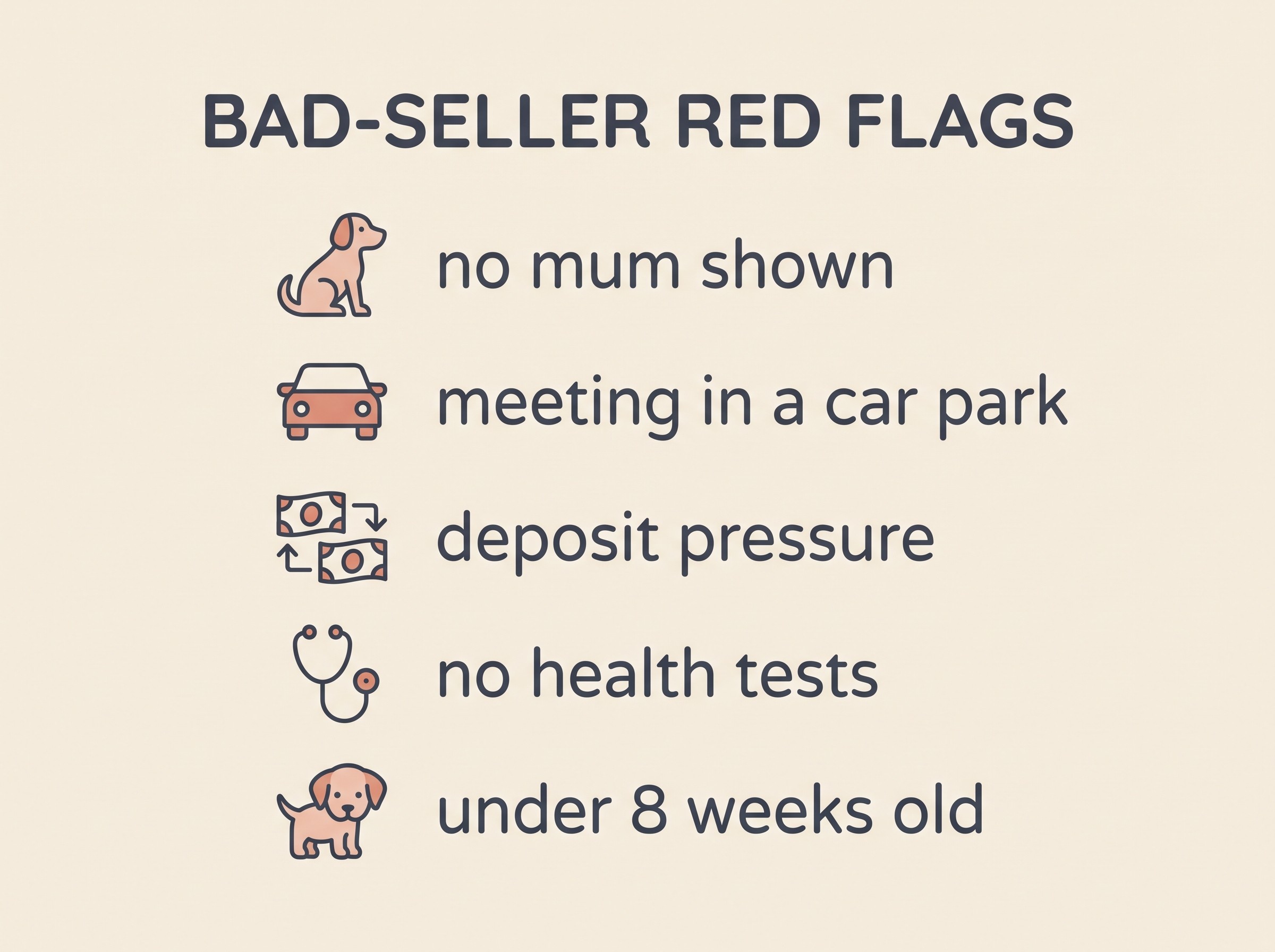
Bad sellers use a surprisingly consistent script. Learn it once and you'll spot it instantly. Be very cautious, or walk away entirely, if you meet any of these.
- You can't see mum. "Mum's at the vet today", "she's not great with strangers", "she's back at our other place". The mother should be present, and should be interacting normally with her litter. No mum, no deal.
- They want to meet you somewhere other than home. A car park, motorway services, their car, or "halfway to save you the drive". This is the classic way a middleman sells a farmed or smuggled animal while hiding where it really came from.
- There's always a litter available. Multiple breeds, several litters, or a puppy ready whenever you want one. A genuine home breeder has occasional, planned litters, not a rolling supply.
- No health testing. For most breeds there are recognised health tests the parents should have (hips, eyes, heart, or breed-specific DNA tests). A good breeder shows you the certificates unprompted. "They're all healthy, don't worry about that" is not an answer.
- Pressure to pay a deposit fast. "Two other families are interested", "I'll need a deposit today to hold it". Urgency is a sales tactic. A good breeder would rather wait for the right home.
- The animal is offered under eight weeks old. A puppy or kitten should not leave its mum before eight weeks. Offering earlier is a serious warning sign, both of welfare and of the animal's future behaviour.
- The paperwork doesn't add up. Vaccination records with no vet's stamp, a microchip number that doesn't match, a pedigree that can't be verified, or vague answers about worming and vet checks.
None of these on its own proves someone is a bad seller. But two or three together is a pattern, and the pattern is the point.
What good looks like
It's just as useful to know what you're aiming for, so you recognise it when you see it and feel confident saying yes.
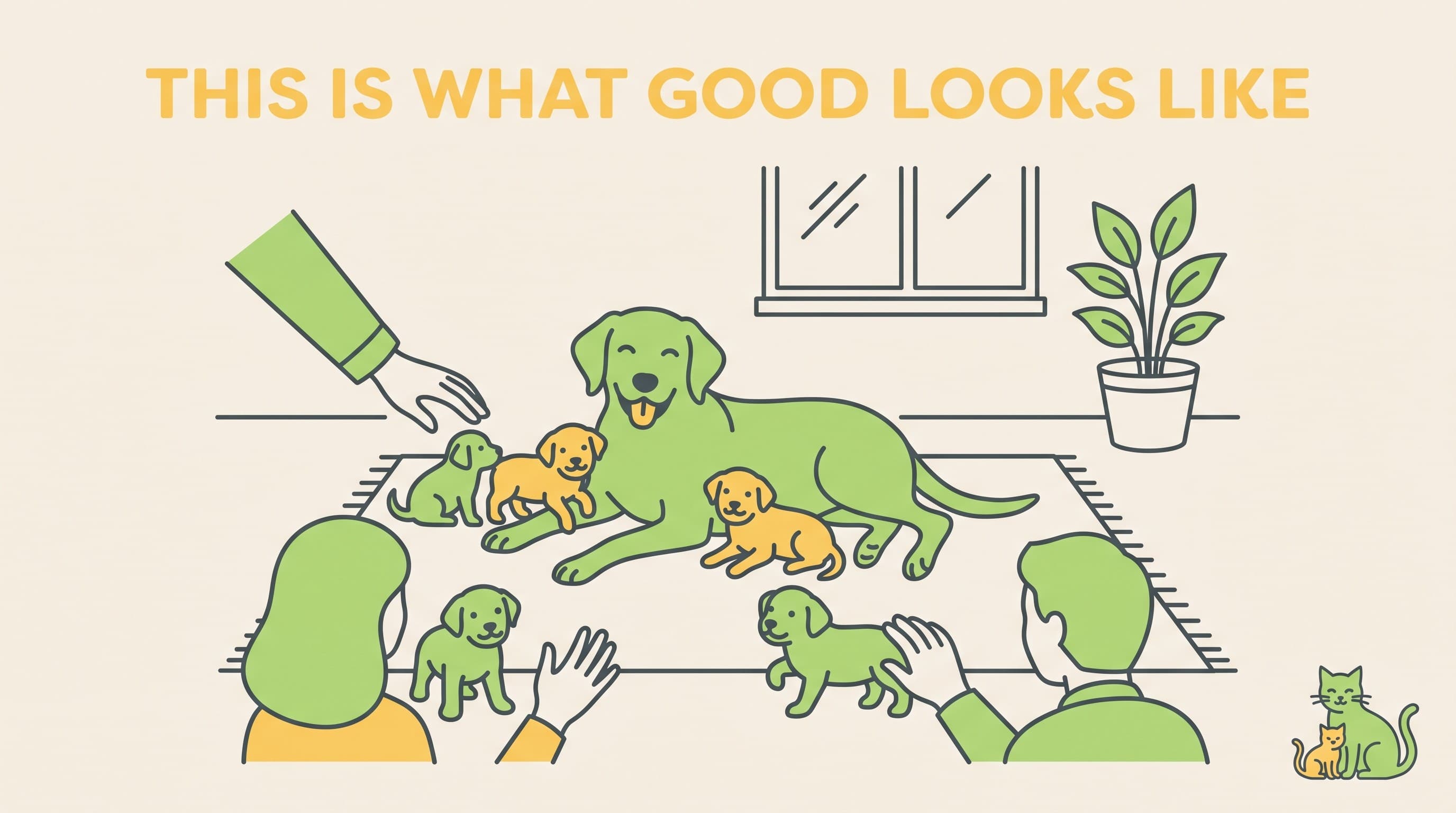
A good breeder invites you to their home and is happy for you to see where the litter is raised. Mum is there, relaxed, and clearly bonded with her puppies or kittens. They show you health-test results for the parents without being asked. They ask you plenty of questions, because they care where their animals end up, and a breeder who grills you about your home and your plans is a breeder who's doing it right. They're happy to stay in touch after you take the animal home, and often want to. And for a puppy, a responsible breeder will use the Puppy Contract, the free document developed by the Animal Welfare Foundation and the RSPCA that records the animal's health, breeding and early care. For a kitten, the equivalent is The Kitten Checklist, produced by the Cat Group and iCatCare. We've explained both, and what a good version looks like, in the paperwork decoded.
If a seller ticks these boxes, you can relax. This is what buying well looks like.
Kittens: the same rules, quietly overlooked
Everything above applies to kittens, and it's worth saying clearly, because kitten buyers get far less warning than puppy buyers do. Lucy's Law covers kittens too. You should still see the kitten with its mum, at the place it was born, and it still shouldn't leave before eight weeks.
Kittens carry one extra risk that puppy buyers hear more about: infectious disease that isn't obvious on the day. A kitten from an overcrowded or poorly-run source can be incubating cat flu, a respiratory infection that can become a lifelong problem, and can also be carrying FeLV or FIV if it hasn't been tested. A runny-eyed, sneezy kitten in a grubby setting is not a kitten to "rescue", it's a warning about how they've all been kept. We cover what to look out for and what to do in cat flu. As with puppies, a healthy, confident kitten that's been handled gently and often is the product of a good early environment, and that's exactly what you're trying to buy.
Rescue is the other good route, not a lesser one
If all this makes buying feel fraught, remember there's a whole other honest path: adopting from a reputable UK rescue. A good rescue does the due diligence for you. It assesses the animal's health and temperament, tells you the truth about it, usually starts or completes vaccination, neutering and microchipping, carries out a home check, and offers backup and advice afterwards. That's a safety net you simply don't get from a private sale.
Rescue isn't second best, and it isn't only older animals. Rescues take in puppies and kittens too, though they go fast. If you want to sidestep the whole bad-seller minefield, a reputable rescue is one of the safest and kindest ways to bring a pet home.
Illegal imports, smuggling and Petfished
There's a particularly ruthless corner of the bad-seller world worth naming: illegally imported puppies and kittens, often bred abroad in dreadful conditions, moved into the UK underage and unvaccinated, then sold through convincing online listings as if they were home-bred. These animals frequently arrive incubating disease, most dangerously parvovirus in puppies, which is often fatal and which spreads through an environment that's hard to disinfect. They're also frequently poorly socialised, so behavioural problems follow. The heartbreak, and the vet bills, land on the family who bought in good faith.
The UK government runs a buyer-awareness campaign called Petfished specifically to help people spot deceitful sellers and check a seller out before committing. Its advice mirrors what's above: research the seller, insist on seeing the animal with mum in its home, be wary of anyone who won't, and don't let a sad story rush you.
The hardest rule: never "rescue" a sick pup from a bad seller
This is the one that catches kind people, so I want to be direct. If you turn up and the puppy or kitten looks poorly, or the setting is grim, every instinct will scream at you to hand over the money and get that animal out of there. Please don't.
Buying that animal does not rescue it. It funds the trade, confirms the seller's business works, and pays for the next litter to be bred into the same misery. You'd be buying a heartbreak, often a very expensive one, and paying the person responsible to do it all again. If you see this, the right action is to walk away and report the seller (to the RSPCA, Trading Standards or via the Petfished route). It feels wrong in the moment, I know. But the guilt fades, and the seller's supply chain is what you actually break by refusing to buy.
A related, gentler version of the same rule: if a listing or a seller just feels off, trust that feeling and walk away. There will be another litter, from someone doing it properly. The guilt passes. The parvovirus bill, or a lifetime of a fearful, unwell animal, does not.
Your next step
Before you commit to any puppy or kitten, do two concrete things. Read the paperwork decoded so you know what good documentation looks like and can use the Puppy Contract or Kitten Checklist as your checklist on the day. And be genuinely willing to walk away if the seller can't show you the animal with its mum, at home. Get those two things right and you've protected your family from the single biggest avoidable heartbreak in pet ownership.
When you've found the right animal from the right source, your next reads are pet insurance, which is best in place before the first vet visit, and the first vet visit itself. And if you're still weighing up breed or rescue in the first place, start with choosing well and your breed's breed hub.
References
- Lucy's Law: The Animal Welfare (Licensing of Activities Involving Animals) (England) (Amendment) Regulations 2019, in force 6 April 2020; ban on third-party commercial sale of puppies and kittens in England.
- Minimum rehoming age of 8 weeks for puppies and kittens (UK).
- Petfished: UK Government (DEFRA) buyer-awareness campaign on deceitful puppy and kitten sellers.
- The Puppy Contract: Animal Welfare Foundation (AWF) and RSPCA.
- The Kitten Checklist: The Cat Group / International Cat Care (iCatCare).
- Links between puppy farms / illegal imports and parvovirus, poor socialisation and behavioural problems.
Free downloads
Companion worksheets to put what you've read into practice. Free PDFs, print at home.
Keep track of how your pet is doing
The owners who cope best are the ones who notice changes early. A simple health log shows you what is working, and what is not, before the next vet visit.
Start tracking, freeYou're not doing this alone
Compare treatment journeys and talk to owners managing new puppy & kitten. Free to join.
Join PetsLikeMine