

Preparing your home and the first 72 hours
Alastair Greenway
BVM&S MRCVS
Collection day is one of the most exciting days you will have as a new owner, and if you are anything like most people, it also comes with a low hum of anxiety underneath. You want to get it right. You have probably got a boot full of new kit, a head full of advice from six different people, and a slightly wobbly feeling that you have forgotten something important.
Here is the reassuring truth to start with. Your puppy or kitten does not need a perfect home, and it does not need you to have read every book. It needs a safe space, a calm start, and a person who is paying attention. The first three days are not about training or teaching, they are about letting a small, disorientated animal work out that this new place is safe and that you are kind. Get that right and everything else has room to follow.
Before they arrive: preparing the home
A little preparation now saves a lot of stress later, and most of it is about making the house safe rather than buying more things.
Think of it the way you would baby-proofing, because a puppy or kitten will investigate the world with its mouth and its paws. Get down to their height and look around. Trailing cables, houseplants (several common ones are toxic to cats and dogs), cleaning products, medicines, and small swallowable objects all need to go up or away. Puppies in particular are champion chewers, and a swallowed sock or a chewed charger is a genuinely common reason for an emergency visit in the first weeks.
Set up a safe space before they come through the door. For a puppy, that usually means a crate or a pen in a quiet corner of a room you use, lined with soft bedding, with water, a couple of chew-safe toys, and puppy pads nearby. A crate is not a cage, it is a den, and used kindly it becomes the place your puppy chooses to relax. For a kitten, safety looks like starting them in a single, calm room rather than giving them the run of the house. Kittens are small and easily overwhelmed, and one room with a bed, a litter tray, food, water and a hiding place lets them build confidence before the world expands. There is much more on this in Sleep, crates and settling in.
A quick shopping list, so you are not caught short:
- Food. Ideally the exact food the breeder or rescue was using, at least for the first week or two. Sudden diet changes upset young stomachs, so any switch should be gradual (more on that in Feeding a puppy or kitten).
- Bowls, a bed, and a hiding place. Cats especially need somewhere to retreat. A cardboard box on its side does the job perfectly well.
- For kittens, a litter tray and litter. One tray per cat plus one spare is the rule of thumb, and start with the litter type they already know if you can.
- A collar and, for dogs, a lead and harness. By law your dog must wear a collar and ID tag in a public place, and both dogs and cats now need to be microchipped (the legal detail is in The first vet visit and the microchip law).
- Toys and something to chew. Appropriate for a young animal, nothing small enough to swallow.
Collection day: the journey home
The car journey is often the very first thing that happens, and it sets the tone. Your puppy or kitten has just left everything it has ever known, so keep it low-key.
Bring someone with you if you can, so one person drives and the other stays with the animal. A puppy is safest secured in a crate or with a car harness, and a kitten should always travel in a secure carrier, never loose. A blanket or a piece of bedding that smells of the litter and mum can be genuinely comforting, so ask the breeder or rescue for one. Expect some crying, some drooling, and possibly a little travel sickness, none of which means anything has gone wrong. Drive calmly and resist the urge to constantly reach back and reassure a distressed animal, which can wind things up further. A steady, boring journey is the kind one.
The first few hours home
When you get home, slow everything down. This is the single most common mistake, and it is the easy one to fix: a house full of excited relatives and children all wanting a cuddle is overwhelming for a tiny animal that has just lost its family.
Take a puppy straight to the garden for a toilet opportunity, then let it explore one or two rooms on its own terms, sniffing and settling. Take a kitten straight to its safe room, open the carrier, and then leave it be. Let them come to you. Sit on the floor, be quiet and unhurried, and let curiosity do the work. Some puppies bounce straight in, some kittens sit frozen in the corner for an hour, and both are completely normal.
Keep the first day genuinely quiet. Save the introductions to the wider family, the neighbours and the other pets for later, when the animal has found its feet. Resident pets in particular deserve a careful, staged introduction rather than a nose-to-nose meeting on day one, and there is a proper plan for that in Introducing your new pet to resident pets and children.
The first night
The first night is often the hardest, and it is worth bracing for it honestly. Your puppy or kitten has gone from a warm pile of littermates to sleeping alone, and it will very likely cry.
You have a genuine choice here, and both approaches work. Many people find the first nights far easier if the puppy sleeps near them, for example in a crate beside the bed, so it is not truly alone, and then gradually move the crate over the following weeks if they want the pup elsewhere long term. A warm, safe bed, a recent toilet trip, and a predictable wind-down routine all help. What tends not to help is repeatedly going down to a crying puppy in a distant room, teaching it that crying brings you, then abruptly stopping. Kittens usually settle faster if their safe room has a cosy covered bed and the door stays shut so they cannot wander and panic in the dark.
Expect broken sleep. Puppies especially have small bladders and will need a toilet break in the night for a while. This is temporary, it passes within weeks as their bladder grows and a routine forms, and it is one of the most common things new owners quietly struggle with. If the exhaustion is tipping into something heavier, you are far from alone, and it is worth reading The puppy blues: it's real, it's common, and it passes.
Toileting and the first routine
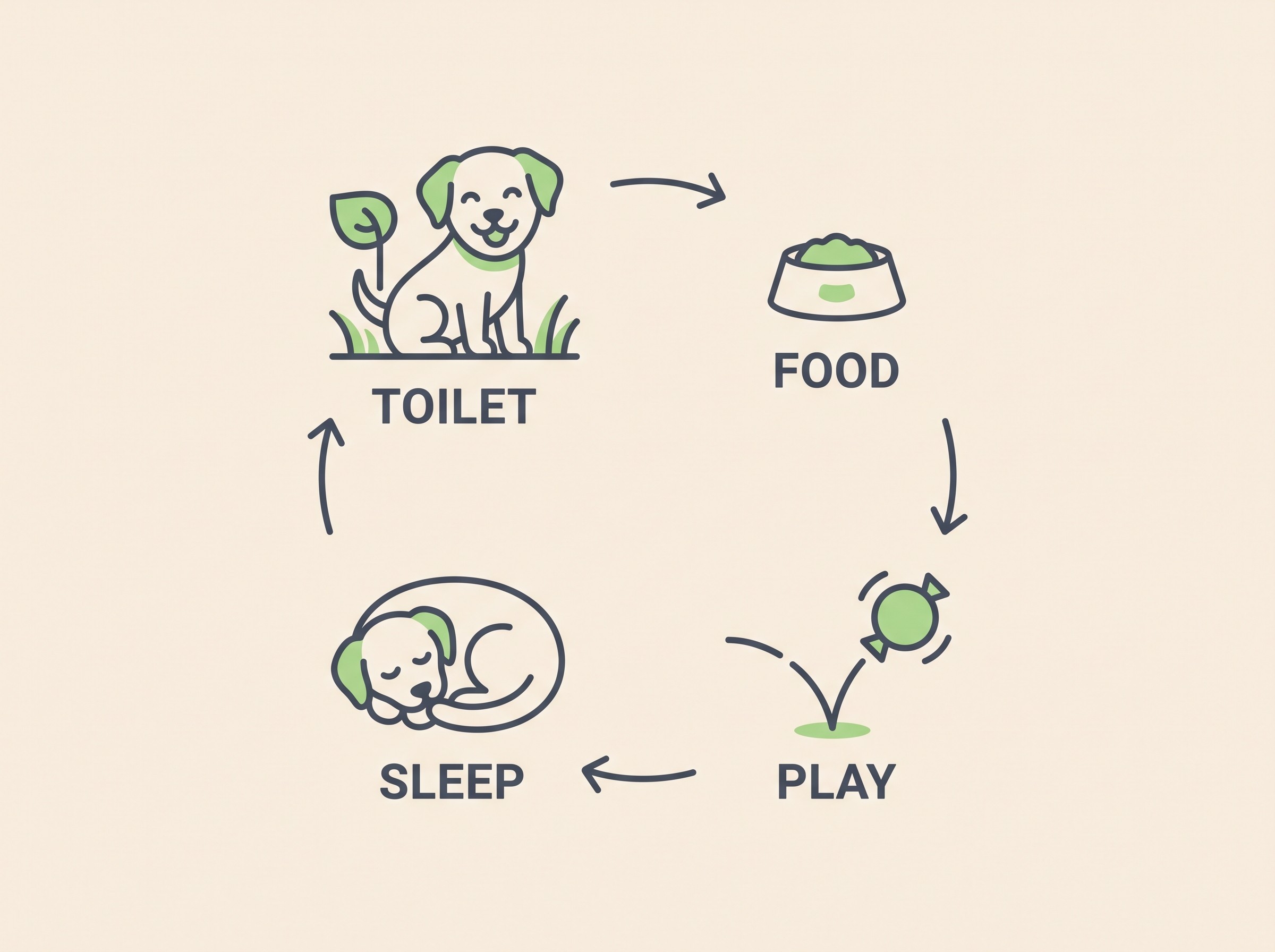
From the first morning, start gently building a rhythm, because young animals thrive on predictability.
For a puppy, take it out to the same spot after every sleep, every meal, every play session, and roughly every hour in between at first, and praise calmly the moment it goes. Accidents indoors are not naughtiness, they are a puppy that simply cannot hold on yet, so clean up without any fuss (an enzymatic cleaner stops them being drawn back to the same spot) and never punish. The full method is in House-training that actually works.
For a kitten, most take to a litter tray almost immediately because the instinct to dig and cover is strong. Keep the tray in a quiet, private spot away from food and water, show the kitten where it is after meals and naps, and keep it scrupulously clean. If a kitten starts missing the tray, that is usually telling you something about the tray, the location or its health rather than being deliberate, and Litter training and scratching walks through it.
Eating, drinking and what is normal
Do not be alarmed if your new arrival is off its food for the first day or two. A change of home, water and routine commonly dampens the appetite briefly, and most eat properly within a day once they settle. Offer the food they are used to, at the frequency the breeder or rescue advised (young animals eat little and often, typically several small meals a day), and make sure fresh water is always available.
It is worth knowing what would genuinely warrant a call to a vet, because a settling wobble and a real problem can look similar to a worried new owner. Contact your vet promptly if you see repeated vomiting or diarrhoea (especially with blood), a puppy or kitten that is completely refusing food and water beyond a day, lethargy or collapse, laboured breathing, or a kitten with runny eyes and nose and sneezing, which can be the start of cat flu (Cat flu: what every kitten owner should know). Young animals can go downhill faster than adults, so when in doubt, ring. No good vet will mind.
Booking the first vet visit
One practical job for these first days is to book a check-up with your own vet, ideally within the first few days of getting your pet. This visit is where the health check happens, where the vaccination and worming plan gets set for your individual animal, and where the microchip details get sorted. It is genuinely worth doing early, and The first vet visit and the microchip law tells you exactly what to expect and bring.
This is also the moment the longitudinal record starts. If you create your pet's profile now and note the breed, that profile can begin to surface the things worth watching for your particular breed through the breed lens at /breeds, and the Vaccination & worming scheduler can start reminding you of the three or four vet contacts that fall in the first sixteen weeks, so nothing slips.
What the first 72 hours are really for
If you take one thing from all of this, let it be that these first days are not a test. You are not behind if your puppy cries all night or your kitten hides under the sofa for a day. That is exactly what a small animal that has just changed its entire world is supposed to do.
Your job for 72 hours is small and kind: keep them safe, keep it quiet, keep a gentle routine, and let them discover in their own time that you are the good thing that happened to them. Everything else, the training, the walks, the socialising, the friendships, has weeks and months ahead of it. Right now, book that first vet check, start the socialisation groundwork indoors with the Socialisation checklist, and give yourself permission to just get through the first few nights. It gets easier, usually faster than you fear.
References
- Dogs Trust (2024). Puppy settling in and the first few days. Dogs Trust guidance.
- Cats Protection (2024). Bringing your kitten home / Essential guides. Cats Protection.
- RSPCA (2024). Preparing for a puppy / kitten and settling in. RSPCA advice.
- Blue Cross (2024). Bringing your new puppy or kitten home. Blue Cross.
- ISFM / International Cat Care (2024). Settling a new kitten and the safe room. iCatCare.
Free downloads
Companion worksheets to put what you've read into practice. Free PDFs, print at home.
Keep track of how your pet is doing
The owners who cope best are the ones who notice changes early. A simple health log shows you what is working, and what is not, before the next vet visit.
Start tracking, freeYou're not doing this alone
Compare treatment journeys and talk to owners managing new puppy & kitten. Free to join.
Join PetsLikeMine