

Sleep, crates and settling in
Alastair Greenway
BVM&S MRCVS
The first nights with a new puppy or kitten are, for a lot of people, a genuine shock. The crying starts the moment the lights go off, it does not stop, and you lie there torn between "I should go to them" and "if I go, I'll teach them to cry". By day three, running on almost no sleep, the whole thing can feel like a mistake. If that is where you are right now, take heart: the first nights are the hardest ones you will have, sleep improves quickly, and there is a kind, sensible way through that neither leaves your pet distressed nor traps you in months of broken nights.
Let us take the fear out of the first nights, and set your puppy or kitten up to sleep well and feel safe.
Why the first nights are so hard
It helps enormously to understand what your pet is actually going through, because it turns the crying from "manipulation" into something you can genuinely sympathise with and answer well.
Your puppy or kitten has just been taken away from everything it has ever known: its mother, its littermates, the smells and warmth and background sounds of the only home it remembers. For the first time in its life it is completely alone, in the dark, in a strange place. The crying is not a tantrum or an attempt to train you, it is real distress at being isolated, and for a baby animal whose survival has always depended on staying close to the group, being alone genuinely feels frightening. Once you see the crying as fear rather than defiance, the right response becomes much clearer: the job of the first nights is to help them feel safe, not to "win".
There is also a simple biological fact behind a lot of the exhaustion. Puppies and kittens sleep a great deal, far more than adult animals, often the majority of the day and night, but in the early days that sleep is broken and their body clock has not settled into your household's rhythm yet. Good settling is largely about helping that rhythm form.
Choosing where they sleep
There is no single correct answer to "where should they sleep", but there are principles that make it work.
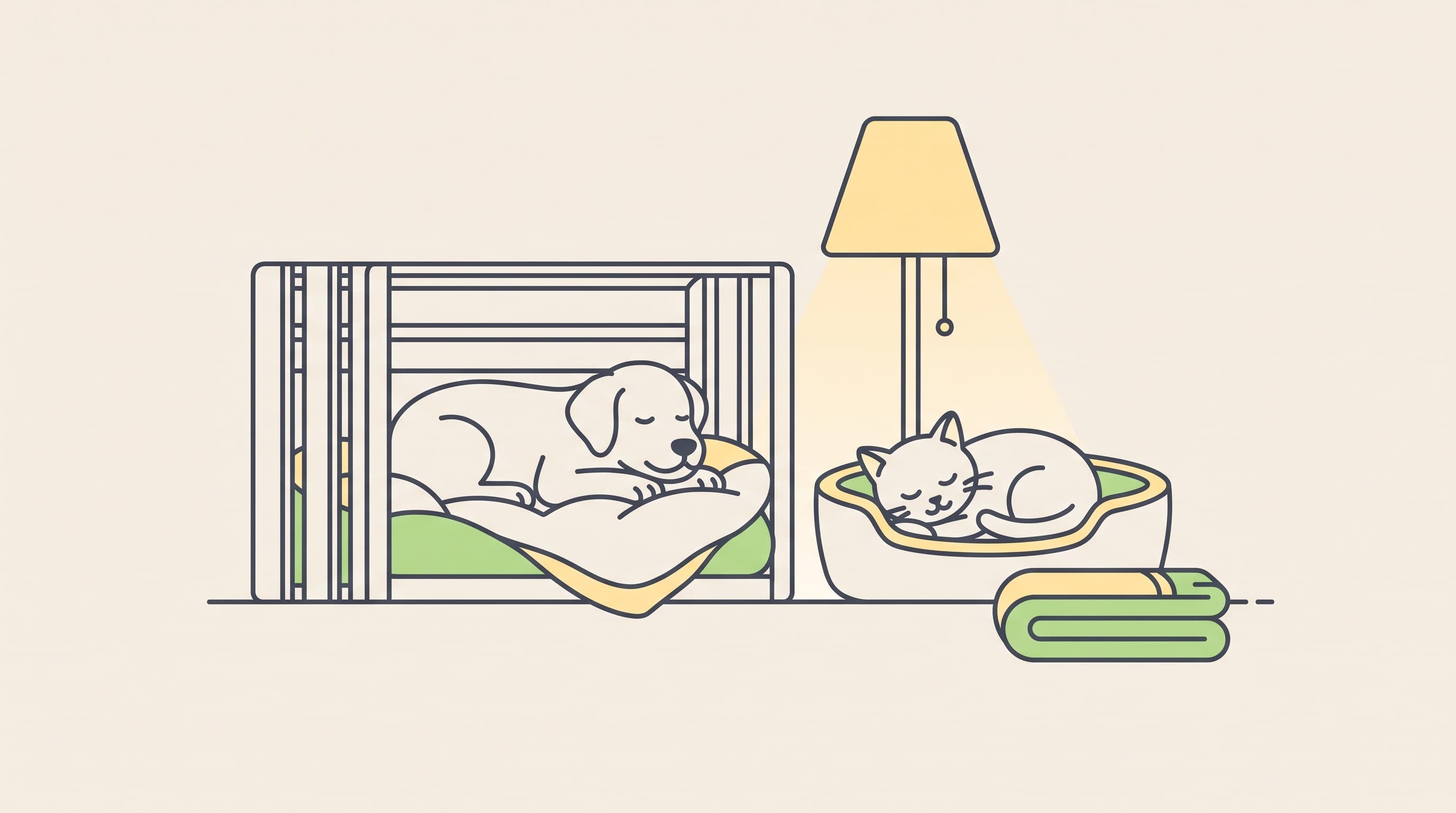
Give them a defined, cosy, safe space. Whether that is a crate, a pen, a covered bed, or a basket in a puppy-proofed corner, animals settle best with a den-like spot that is theirs: enclosed enough to feel secure, soft, warm and quiet. For kittens, a snug covered bed or an igloo in a calm room works beautifully. For puppies, many people use a crate, and used kindly it is one of the most useful tools you have.
Keep them close at first. One of the most effective things you can do to reduce first-night crying is simply to have your puppy or kitten sleep in the same room as you to begin with, rather than shut away alone. Knowing you are there, hearing you breathe, is deeply reassuring to a frightened baby animal. You can have the crate or bed next to your own bed, and over the following days and weeks, if you want them to sleep elsewhere eventually, move it gradually further away, a little at a time, so the change is never a sudden abandonment. Research and behaviour guidance both point to proximity in the early days meaning far less distress and, in practice, more sleep for everyone.
Make it smell and feel like safety. A blanket or soft toy that carries the scent of the litter, the mother or the breeder's home is a comfort worth its weight in gold, so ask for one when you collect your pet. A warm (never hot) covered hot-water bottle or a heat pad designed for pets, and something that gently mimics the warmth and closeness of littermates, can help too. Some owners find a soft ticking clock or quiet background sound soothing, though this varies by animal.
Using a crate kindly
Because crates get a bad name from people who use them wrongly, it is worth being clear. A crate is not a cage to lock a puppy away in, and it is not a punishment. Used properly, it is a den: a safe, cosy space the puppy chooses to relax in, that keeps them out of danger when you cannot watch, and that supports house-training, because most puppies will not soil their own bed. Used improperly, as long-hours confinement or a place they are banished to in anger, it becomes a source of stress. The whole difference is in how you introduce it.
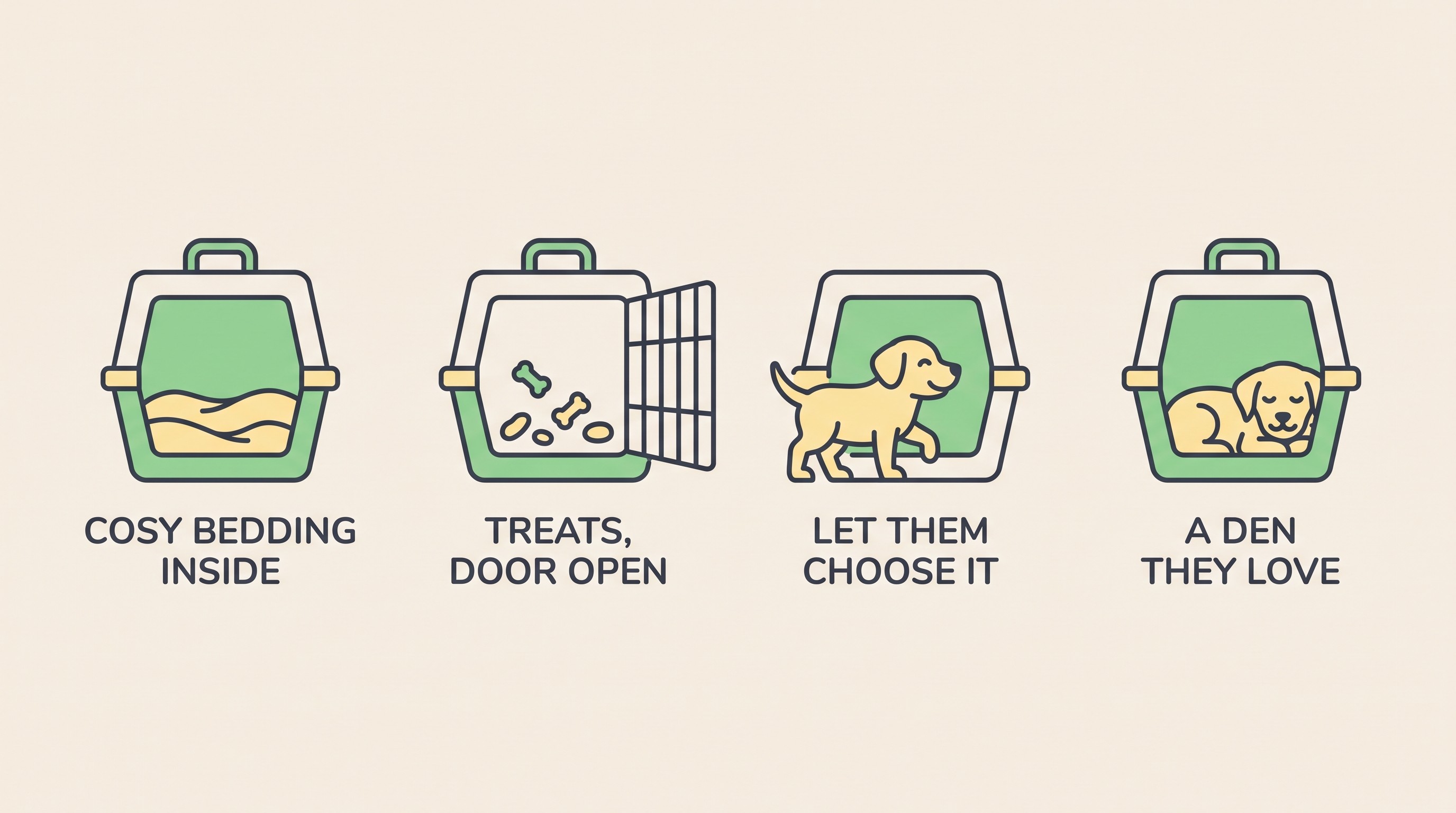
The golden rule is that the crate must be a wonderful place, never a scary one, and the puppy should always be helped to love it before it is ever shut:
- Set it up cosy, with soft bedding and the comforting scent blanket, in a spot near the family.
- Feed meals in it, and scatter treats and favourite toys inside, so going in always pays off. Leave the door open at first and let them wander in and out freely.
- Once they are happily going in on their own, begin closing the door for a few seconds at a time while you are right there, building up very gradually and always at the puppy's pace, so being shut in never comes as a shock.
- Never use the crate as a telling-off, and never leave a puppy crated for long stretches. It is for short daytime rests and night-times, not all-day confinement.
Done this way, most puppies come to love their crate and take themselves off to it, which is exactly what you want: a portable safe place they carry through life. There is more on redirection and calm handling in the daytime in Teething and biting, and the crate dovetails with House-training that actually works.
Kittens do not usually need a crate, but the same principle applies: a defined, cosy, safe base in a quiet room, gradually expanding to more of the house as they gain confidence, is the settling recipe.
The first nights, step by step, and the crying question
Here is the honest middle path between "ignore all crying" and "leap up at every squeak", which is what most modern behaviour advice supports.
Before bed, make sure your puppy or kitten has had a chance to toilet, a little gentle play to take the edge off, and a calm wind-down. Settle them in their cosy spot, in your room, with the scent blanket and warmth.
When the crying starts, as it very likely will, the guiding question is: are they distressed, or do they simply need something? A very young puppy genuinely may need to toilet in the night, and ignoring a real need is neither kind nor good for house-training. So it is fine, and right, to respond to genuine need, calmly take a puppy out to toilet, then straight back to bed with no fuss, no play, no chat, so night-time stays boring. What you are avoiding is turning the night into an exciting event with games and attention, because that is what teaches a pet to wake you for fun.
For pure loneliness-crying, the fact that you are in the same room does most of the work. A hand resting near the crate, a quiet, calm voice, and your simple presence reassure far more than lifting them out and starting a party. You are not "giving in" by comforting a frightened baby animal; you are teaching them that the world is safe and you are dependable, which is the foundation of a confident adult. As the nights pass, the crying shrinks fast. Most puppies and kittens settle within the first week or two.
Keep the days structured too, because good nights are built in daylight. A predictable rhythm of meals, play, toilet trips and, crucially, enforced nap times (overtired babies sleep worse, not better, just like toddlers) sets the body clock and makes the nights easier.
Those calm daytime rests do a second useful job. Learning to settle alone in a cosy spot while you are pottering nearby is the very first, gentle building block of being comfortable on their own, which heads off separation problems down the line. You do not need to do anything formal yet, simply letting your pet nap in its safe space rather than always on your lap begins the habit. There is a whole piece on this once you are through the first weeks (Preventing separation problems from day one).
Look after your own sleep, because this is the hard part
Here is the thing few articles say plainly: the sleep deprivation of the first weeks is brutal, and it is one of the single biggest reasons new owners crash emotionally. Almost everything about a new pet feels manageable on decent sleep and unbearable without it. So treat your own rest as a genuine priority, not a luxury. If there are two of you, tag-team the nights so one person always gets an unbroken stretch. Nap when the pet naps. Lower every other standard for a fortnight, the housework can wait.
And if the broken nights have you feeling low, tearful, or quietly wondering what you have done, please know that is an incredibly common reaction to this exact stage, and it is not a sign you are failing. It is largely the sleep debt talking, and it lifts as the nights lengthen. The puppy blues: it's real, it's common, and it passes is written for that feeling, and there is a whole community of people getting through the same nights right now.
The one thing to do tonight: put the bed or crate right next to yours, tuck in a blanket that smells of home, and plan to respond calmly to genuine need while keeping the night boring. Do that, protect your own sleep however you can, and trust that this passes, quickly, because it does.
References
- Dogs Trust. Settling a new puppy, first nights and crate training guidance.
- International Cat Care / iCatCare. Settling a new kitten and providing a safe base.
- AVSAB (2021). Position Statement on Humane Dog Training. American Veterinary Society of Animal Behavior. [reward-based, non-aversive approach to settling and crate use]
Free downloads
Companion worksheets to put what you've read into practice. Free PDFs, print at home.
Keep track of how your pet is doing
The owners who cope best are the ones who notice changes early. A simple health log shows you what is working, and what is not, before the next vet visit.
Start tracking, freeYou're not doing this alone
Compare treatment journeys and talk to owners managing new puppy & kitten. Free to join.
Join PetsLikeMine