

Preventing separation problems from day one
Alastair Greenway
BVM&S MRCVS
Here is a truth that catches out a lot of loving new owners: the more time you spend glued to your puppy in the first weeks, the harder you can make it for them to cope when you eventually leave. It feels kind to be there every second, and in those early days you often are, working from home, on annual leave, or simply besotted. But a dog who has never learned that being alone is normal and safe can grow into one who panics, barks, chews and toilets the moment the door closes. The good news is that this is one of the most preventable problems in the whole first year, and the prevention is gentle. This article shows you how to teach your puppy, or kitten, that alone time is nothing to fear, starting from the very first days.
Why prevention beats cure
Separation-related behaviour, where a dog becomes distressed when left alone, is common and genuinely miserable for both dog and owner. It can show up as howling, barking, destructive chewing (often around doors and windows), toileting despite being house-trained, drooling, pacing and self-injury, and it is a frequent reason dogs are given up (Dogs Trust). Treating an established separation problem takes patience and often professional help. Preventing one, by contrast, is mostly a matter of building the right habits early and never rushing.
The core idea is simple. Being alone is a skill, and like any skill it is learned in small, successful steps. A puppy who from the start experiences short, calm, undramatic absences that always end fine learns that alone is boring and temporary, not frightening. Your job in the first weeks is to teach that lesson deliberately, before life forces a long absence on you both.
Start small, from the first days
You can begin the moment your puppy is settling in, and it costs nothing.
Absences within the home. Long before you leave the house, practise simply being in a different room. Pop to the loo, step into the kitchen, go upstairs, all without your puppy. These micro-absences, measured in seconds and then minutes, teach a puppy that you disappearing is ordinary and that you always come back. Do it many times a day, casually.
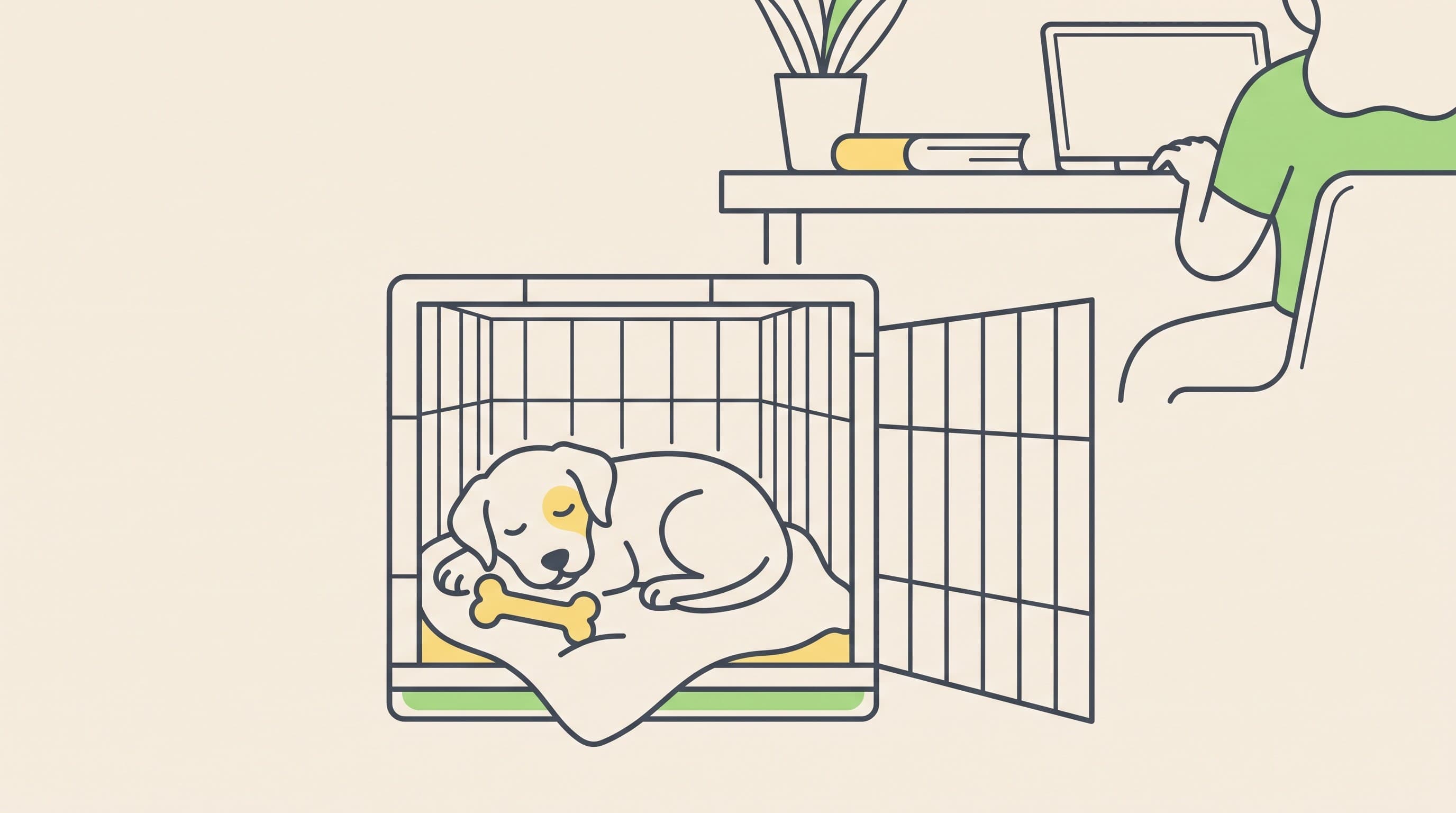
A safe, comfortable space. Give your puppy a defined place they associate with calm and good things: a crate (introduced positively, never as punishment) or a puppy-proofed area with a comfy bed. A well-loved crate becomes a den your puppy chooses to rest in, which makes alone time feel safe rather than imposed. How to build positive crate and settling habits is covered in Sleep, crates and settling in.
Reward calm, settled behaviour. When your puppy settles quietly on their own, even for a moment, that is the behaviour you want more of. Notice it and reward it calmly. Do not only give attention when they are demanding it.
Make comings and goings boring
One of the most effective and most counter-intuitive tools is to strip the drama out of leaving and returning.
Low-key departures. Emotional goodbyes ("I'll miss you so much, be a good boy, mummy won't be long") wind a puppy up right before you leave, exactly when you want them calm. Instead, leave quietly and matter-of-factly, having already settled them with something to do.
Low-key returns. Equally, if every homecoming is a joyful explosion of fuss, you teach your puppy that your return is the emotional peak of the day, which makes your absence the low they are desperate to end. Come in calmly, ignore any frantic greeting for a minute or two, and give attention once they have settled. This is not cold; it is teaching them that your presence and absence are both no big deal.
A positive association with leaving. Give something good that only appears when you go: a stuffed food toy, a long-lasting chew, a treat-scattering puzzle. A puppy busy and content with a filled Kong barely notices you slip out, and comes to see your departure as the cue for a nice thing.
Build up the time gradually
Once micro-absences within the home are easy, extend to real departures in small, successful steps. The principle throughout is to keep your puppy under the threshold at which they would start to worry.
- Begin with genuinely short absences: step outside the front door for a few seconds, then come back in before they have a chance to panic.
- Build up gradually over days and weeks: a minute, a few minutes, ten minutes, longer, always returning while your puppy is still calm.
- Vary the length so it is not predictable, and mix short absences in with longer ones so leaving does not always mean a long, worrying stretch.
- Practise your leaving routine (picking up keys, putting on shoes, opening the door) separately and calmly, so those cues stop being alarm signals.
The aim is that by the time you genuinely have to leave your puppy for a couple of hours, they have a long history of shorter absences that all ended fine.
Know the ceiling: how long is too long
Building tolerance does not mean puppies can be left for long stretches. Puppies have small bladders and big needs for company, and they should not be left alone for long, especially at first. As a widely used guideline, adult dogs should not routinely be left alone for more than around four hours (Dogs Trust; RSPCA), and puppies far less than that while they are learning. A puppy left too long, too soon, is set up to fail: they cannot hold their bladder, they get distressed, and they learn that alone means misery, which is the exact opposite of what you are trying to build.
If your working life means long days, plan for it before the puppy arrives: a dog walker, a trusted neighbour, doggy day care, staggered household schedules, or delaying getting a dog until your circumstances suit one. This is not a small detail; it is a welfare decision, and it is far kinder to sort it out in advance than to discover the problem once a distressed puppy is already learning bad lessons.
The first weeks are the trap, and the opportunity
It is worth being honest about the specific moment this goes wrong for so many people. A puppy usually comes home at the start of a burst of togetherness: annual leave booked, everyone working from home, the whole family enchanted and reluctant to leave the puppy for a second. The puppy spends its first fortnight never once alone. Then real life resumes, someone goes back to the office, and the puppy who has never experienced a closed door suddenly faces hours of it. That cliff-edge is exactly what triggers distress.
The fix is to build alone time into those first togetherness-heavy weeks on purpose, even when you do not need to. On the days you are home, deliberately leave your puppy settled and alone for short spells, so that "being by myself is normal" is learned during the easy period rather than sprung on them during the hard one. If you have booked time off to settle a new puppy, spend part of it teaching them to be alone, not just enjoying their company. It feels almost unkind, and it is one of the kindest things you can do.
Recognising a genuine problem early
Prevention works for most dogs, but some, through temperament, past experience (rescue dogs who have been abandoned) or simply bad luck, develop separation-related distress despite your best efforts. Catching it early makes it far more treatable.
Warning signs, ideally spotted by setting up a camera to record what your dog does when alone, include:
- Barking, howling or whining that starts soon after you leave.
- Destructive behaviour focused on exit points (doors, window frames) or your belongings.
- Toileting when left, despite being reliably house-trained otherwise.
- Drooling, panting, pacing or trembling.
- Refusing food you have left, or frantic behaviour as you prepare to leave.
If you see these, do not punish your dog. Separation distress is fear, not naughtiness, and punishment makes fear worse (AVSAB, 2021). Talk to your vet, who can rule out medical causes and refer you to a qualified, reward-based behaviourist. Early, professional help resolves many cases that would otherwise entrench.
Kittens and cats: the same idea, a gentler version
Cats are often assumed to be perfectly happy alone, and many are more independent than dogs, but this can be overstated. Cats do form strong attachments, and some, particularly those hand-reared, weaned too early or very bonded to one person, can show separation-related behaviours such as over-grooming, inappropriate toileting, excessive vocalisation or destructive scratching when left (International Cat Care).
The prevention is similar in spirit and gentle in practice:
- Provide a rich, safe environment so an alone cat is occupied, not just waiting: climbing space, hiding places, window views, and puzzle feeders that make mealtimes an activity.
- Encourage independence rather than constant contact, so your kitten is comfortable doing its own thing.
- Keep comings and goings low-key, as with dogs.
- Do not leave a single young kitten alone for very long stretches; company, or a suitable feline companion, can help, though introductions must be done carefully (Introducing your new pet to resident pets and children).
Your next step
Start today, gently and in tiny steps: practise short absences within the home, give your puppy or kitten a comfortable safe space they love, keep departures and returns calm, and build alone time up gradually so it always ends before any worry begins. If your daily routine will involve long absences, sort the practical cover out now rather than later. For the crate and settling foundations that make all of this easier, read Sleep, crates and settling in, and remember that adolescence can test even a well-prepared dog, so keep the good habits going as they grow (Surviving adolescence). If leaving your pet is worrying you, or you have spotted early signs of distress, the New Puppy & Kitten community and your vet are both good places to turn.
References
- Dogs Trust. Home alone: helping your dog cope with being left. Dogs Trust.
- RSPCA. Dog behaviour: leaving your dog alone. RSPCA.
- American Veterinary Society of Animal Behavior. AVSAB Position Statement on Humane Dog Training. AVSAB. 2021.
- International Cat Care. Separation-related problems in cats. International Cat Care.
Free downloads
Companion worksheets to put what you've read into practice. Free PDFs, print at home.
Keep track of how your pet is doing
The owners who cope best are the ones who notice changes early. A simple health log shows you what is working, and what is not, before the next vet visit.
Start tracking, freeYou're not doing this alone
Compare treatment journeys and talk to owners managing new puppy & kitten. Free to join.
Join PetsLikeMine