

Surviving adolescence: when your good puppy "forgets everything"
Alastair Greenway
BVM&S MRCVS
There is a moment, usually somewhere around six to eight months, when a lot of owners quietly panic. The puppy who sat beautifully at four months, who came running the instant you called, who was basically a small furry genius, has apparently been replaced. Recall has become optional. The sit you drilled a hundred times earns you a blank stare. He is barking at the wheelie bin he ignored yesterday, pulling like a train, and looking at you as though he has never met you. You start to wonder whether you got it all wrong, whether the training never really stuck, whether this is just who your dog is now.
I want to say the most reassuring thing first, because it is also the truest. Your dog has not forgotten anything, and you have not failed. What you are living through is adolescence, a real and well-documented developmental phase, and it is not a sign that anything has gone wrong. It is a sign that your puppy is growing up.
This is a real phase, not a training failure
For years, "the teenage dog" was treated as a bit of folklore, the kind of thing trainers said with a knowing sigh. Then the science caught up. A study of dogs going through puberty found genuine, measurable evidence of an adolescent-phase conflict period, where dogs became less responsive to commands from their own caregiver specifically, right around the onset of puberty at roughly eight months, and were more trainable again afterwards (Asher et al., 2020). Interestingly, the effect was strongest towards the person the dog was most attached to, which is why it so often feels personal. It genuinely is aimed at you, in the way a human teenager saves their worst eye-rolling for the parent they love and trust most.
Under the bonnet, this is a brain rebuild. Adolescence is a period of intense remodelling in the parts of the brain that handle impulse control, risk and emotional regulation, and that remodelling is not finished when the body looks grown up. The result is a dog whose feelings and impulses have raced ahead of the brakes that are meant to manage them. He is not being dominant, spiteful or stubborn. He is a work in progress with a nearly-adult body and a still-under-construction set of controls.
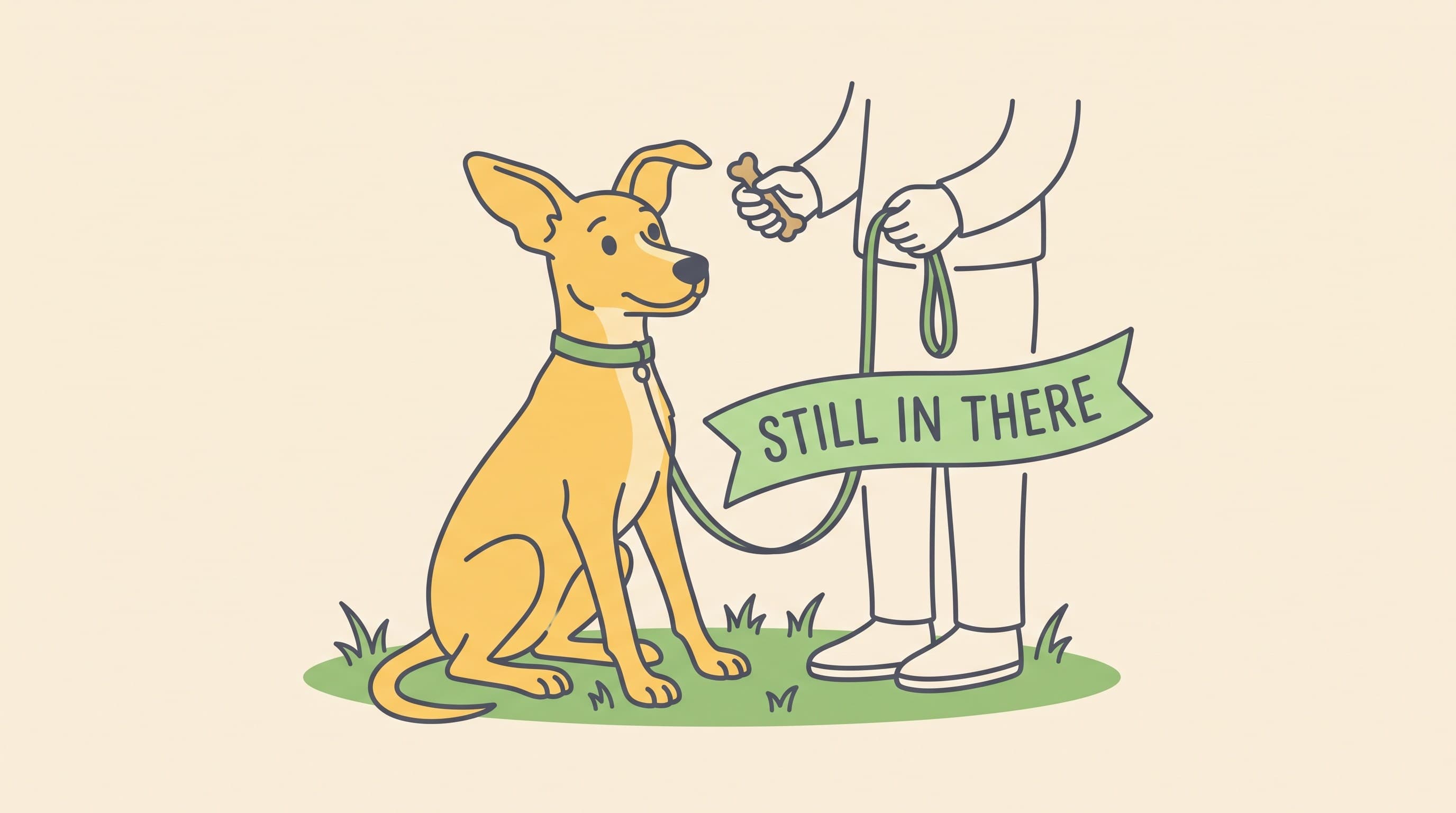
Roughly speaking, this phase runs from around six months to somewhere between twelve and eighteen months, though in large and giant breeds the mental maturity can lag behind the physical size well into the second year. The single most useful thing you can hold on to is that it ends. The dog you patiently taught is still in there, and he comes back.
What adolescence actually looks like
It helps to recognise the specific ways this shows up, because each one is easier to weather when you can name it.
Selective deafness and recall breakdown. The recall that was rock-solid falls apart, usually outdoors, usually when something more interesting than you is on offer. This is partly the impulse-control gap and partly the world getting bigger and more exciting. It is the single most common complaint of this age, and it is not defiance.
Testing what still works. Behaviours you thought were finished, jumping up, mouthing, ignoring known cues, can resurface as your dog re-checks the boundaries. Think of it less as rebellion and more as an experiment: does this still get a result?
A second wobble of fear. Many dogs go through a second fear period during adolescence, where things they were previously fine with, the vacuum, a man in a hat, other dogs, suddenly seem alarming. Sudden, out-of-character spookiness at this age is developmental, not a character flaw, and how you handle it matters a great deal.
More energy, shorter fuse. Bigger body, more stamina, more frustration when needs are not met. A bored, under-exercised, under-slept adolescent is a difficult adolescent.
Reactivity that seems to come from nowhere. Some dogs start reacting to other dogs or to people on lead in this window. This is worth taking seriously early rather than waiting it out, and I will come back to it.
None of this means your dog is broken. All of it is normal, and all of it responds to the same calm, kind approach.
The one thing you must not do
There is a great deal of advice out there, and a good amount of it is actively harmful. When a previously biddable dog starts ignoring you, the internet and the odd old-school trainer will tell you the problem is that your dog is challenging your authority, and that the fix is to be firmer, to dominate, to use a check chain or a shock collar or an "alpha roll", to show him who is boss.
Please do not. This is where I want to be completely clear, because the stakes are high. Adolescence is not a dominance contest, and treating it as one does real damage. The dominance model of dog behaviour has been discredited for years. Confrontational and aversive methods are associated with increased fear, anxiety and aggression, not less, and dogs trained with aversive methods show poorer welfare than those trained with reward-based methods (Vieira de Castro et al., 2020). Studies comparing training approaches consistently find reward-based training is at least as effective and does not carry the fallout of the punishment-based approach (China et al., 2020).
The practical problem is this. Your adolescent dog is already going through a phase where his attachment to you is being tested and where his fear responses are heightened. Meet that with intimidation and you confirm the worst thing his changing brain is suspecting, that the world, and sometimes you, are not safe. You can suppress a behaviour with fear, but you do it by frightening your dog and by spending the trust you spent months building. And a second fear period is the worst possible time to add a bad experience, because associations formed now can last. Reward-based training is not the soft option here. It is the effective one, and it is the one that keeps your relationship intact for the decade that follows.
What genuinely helps
The good news is that the approach that works is also the kind one, and most of it is about management and patience rather than clever tricks.
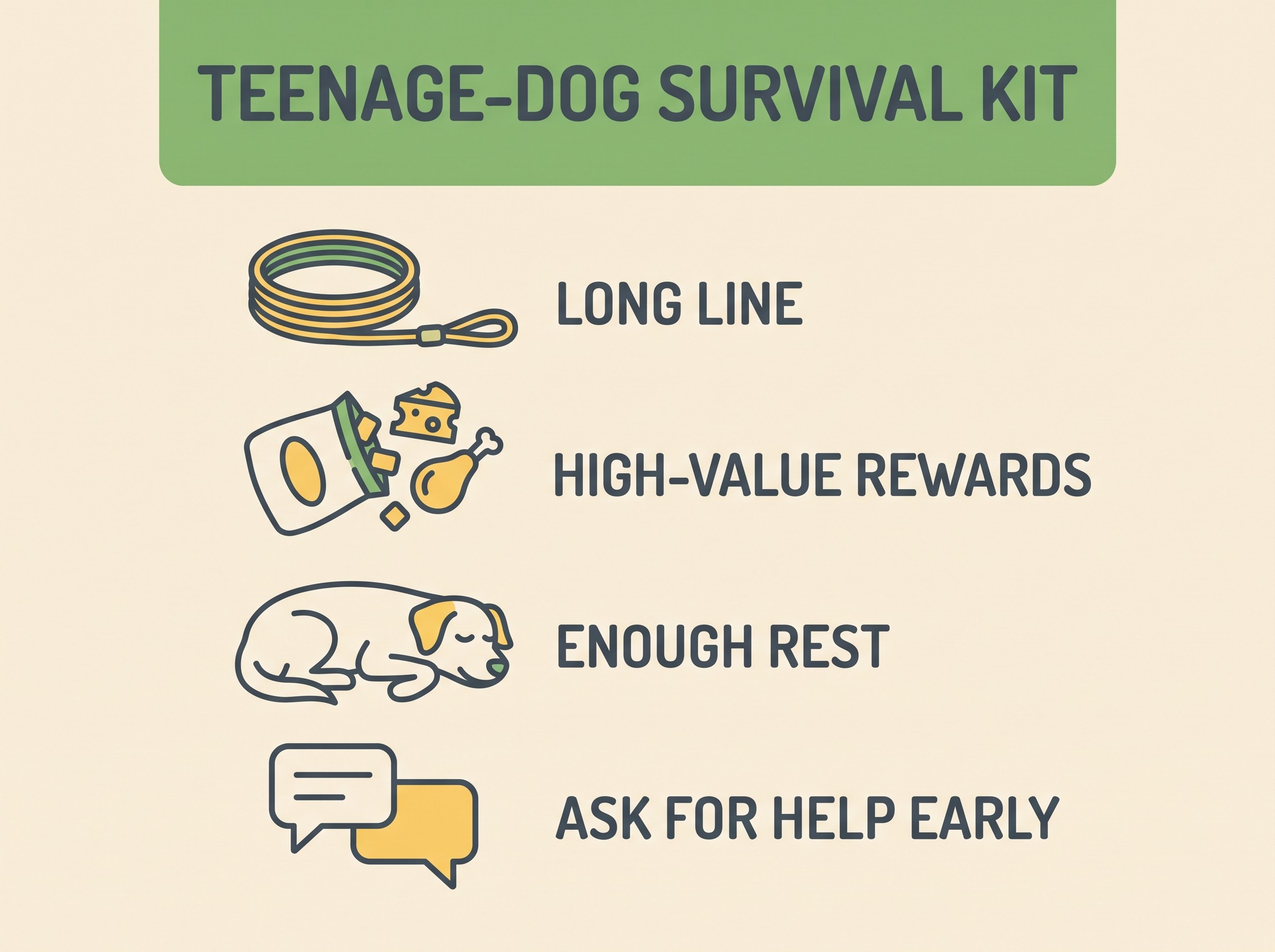
Go back to basics, without shame. Treat your adolescent as though he is learning cues for the first time, because in a sense his brain is renegotiating them. Shorten your sessions, raise the value of your rewards (this is the time for chicken and cheese, not dry biscuit), and make yourself the most interesting thing in the environment. A good adolescent or continuing-education class can help here, run the same reward-based way a puppy class should be, giving you structure, expert eyes and practice around distractions. You are not starting from zero, you are reinforcing foundations that will hold for life.
Protect your recall with a long line. Do not give your adolescent the chance to practise ignoring you off lead in an exciting place, because every successful blow-off makes the next one more likely. A long training line lets him have freedom while you keep the ability to reconnect, so you keep winning the recall game rather than losing it. Reward every single return lavishly, even the slow, reluctant, teenage ones.
Meet the needs behind the behaviour. A lot of adolescent difficulty is an unmet-needs problem wearing a behaviour costume. Enough appropriate physical exercise, plenty of sniffing and mental enrichment, chews and problem-solving toys, and, crucially, enough sleep. Adolescents, like toddlers, are often worse when overtired and can need a great deal more rest than owners expect. An over-aroused dog who cannot switch off needs help winding down, not more stimulation.
Manage the environment so he can succeed. If he cannot cope with something yet, arrange things so he does not have to face it at full strength. Distance, calmer walking times, and gentle, gradual exposure at a level he can handle all beat flooding him and hoping. During the fear wobble especially, do not force him towards anything that scares him. Let him retreat, pair the scary thing with something good from a comfortable distance, and let his confidence rebuild.
Keep up the socialisation and habituation work. The intense early window has closed, but adolescence is when a lot of the early good work gets tested, and it is a use-it-or-lose-it stage. Keep giving him calm, positive, ordinary experiences of the world. If separation is a worry, this is a phase where it can resurface, so it is worth revisiting preventing separation problems rather than assuming that job is done.
Neutering, hormones and behaviour
Adolescence is also when the neutering question lands, and the two get tangled together in owners' minds, often unhelpfully. It is tempting to hope that neutering will "calm him down" and switch off the difficult teenage behaviour. I would gently steer you away from that expectation. Neutering is not a behavioural fix, and for some anxiety-driven or fear-based behaviours it can make things slightly worse rather than better. The behaviours you are seeing are developmental and are addressed with training and time, not with surgery.
The timing of neutering itself is a genuine, breed-and-size-specific decision that deserves its own careful conversation, and the old "just do it at six months" rule is out of date. I will not restate the evidence here, because it is covered properly in when to neuter your dog. The point for this article is simply not to reach for neutering as a shortcut through adolescence. Handle the behaviour on its own terms, and make the neutering decision on its own merits with your vet.
When it is more than adolescence
Most adolescent difficulty is exactly that, difficulty, and it resolves with the approach above. But it is worth knowing where the line is, because "it's just a phase" should never become a reason to leave a struggling dog without help.
If your dog is showing genuine fear or aggression, reacting to other dogs or people in a way that is escalating, panicking when left alone, or if the behaviour is getting worse rather than slowly better despite your best kind efforts, please get professional help, and get it early. Ask your vet for a referral to a qualified, reward-based behaviourist, one accredited through a recognised body such as the ABTC or APBC, and steer clear of anyone who talks about dominance, pack leadership or "balanced" training that includes aversives. Early, kind intervention in adolescence is far easier than trying to unpick an entrenched adult problem, and it is one of the best investments you will make in your dog's whole life. A vet check is also worth doing, because occasionally a change in behaviour has a physical cause, such as pain, sitting underneath it.
You are nearly through the hardest part
If you are reading this at eleven at night after a day where your dog seemed to have unlearned everything, hold on to two things. First, this is a documented developmental stage, not a verdict on your dog or on you. Second, it passes, and the dog who comes out the other side is the one you trained, now with an adult brain to run all of it. Owners often feel very alone in this phase, convinced everyone else's dog is perfect, so it is worth leaning on the community here, where you will find a great many people whose "ruined" teenage dogs turned into wonderful adults.
The far side of adolescence is adulthood, and with it the ordinary, settled rhythm of grown-up care. When you are ready for what that looks like, the transition to adult food and adult care walks you through it, and your pet's lifetime record is where all the work of this first year finally adds up. For tonight, though, just know this: keep being kind, keep being consistent, keep the trust intact, and your good dog comes back. He was never really gone.
References
- Asher L, England GCW, Deeming R, Harvey ND. Teenage dogs? Evidence for adolescent-phase conflict behaviour and an association between attachment to humans and pubertal timing in the domestic dog. Biology Letters 2020; 16(5): 20200097.
- Vieira de Castro AC, Fuchs D, Morello GM, et al. Does training method matter? Evidence for the negative impact of aversive-based methods on companion dog welfare. PLOS ONE 2020; 15(12): e0225023.
- China L, Mills DS, Cooper JJ. Efficacy of dog training with and without remote electronic collars vs. a focus on positive reinforcement. Frontiers in Veterinary Science 2020; 7: 508.
- AVSAB (American Veterinary Society of Animal Behavior). Position Statement on Humane Dog Training.
- Dogs Trust. Dog School / adolescent-dog and reward-based training guidance.
Free downloads
Companion worksheets to put what you've read into practice. Free PDFs, print at home.
Keep track of how your pet is doing
The owners who cope best are the ones who notice changes early. A simple health log shows you what is working, and what is not, before the next vet visit.
Start tracking, freeYou're not doing this alone
Compare treatment journeys and talk to owners managing new puppy & kitten. Free to join.
Join PetsLikeMine