

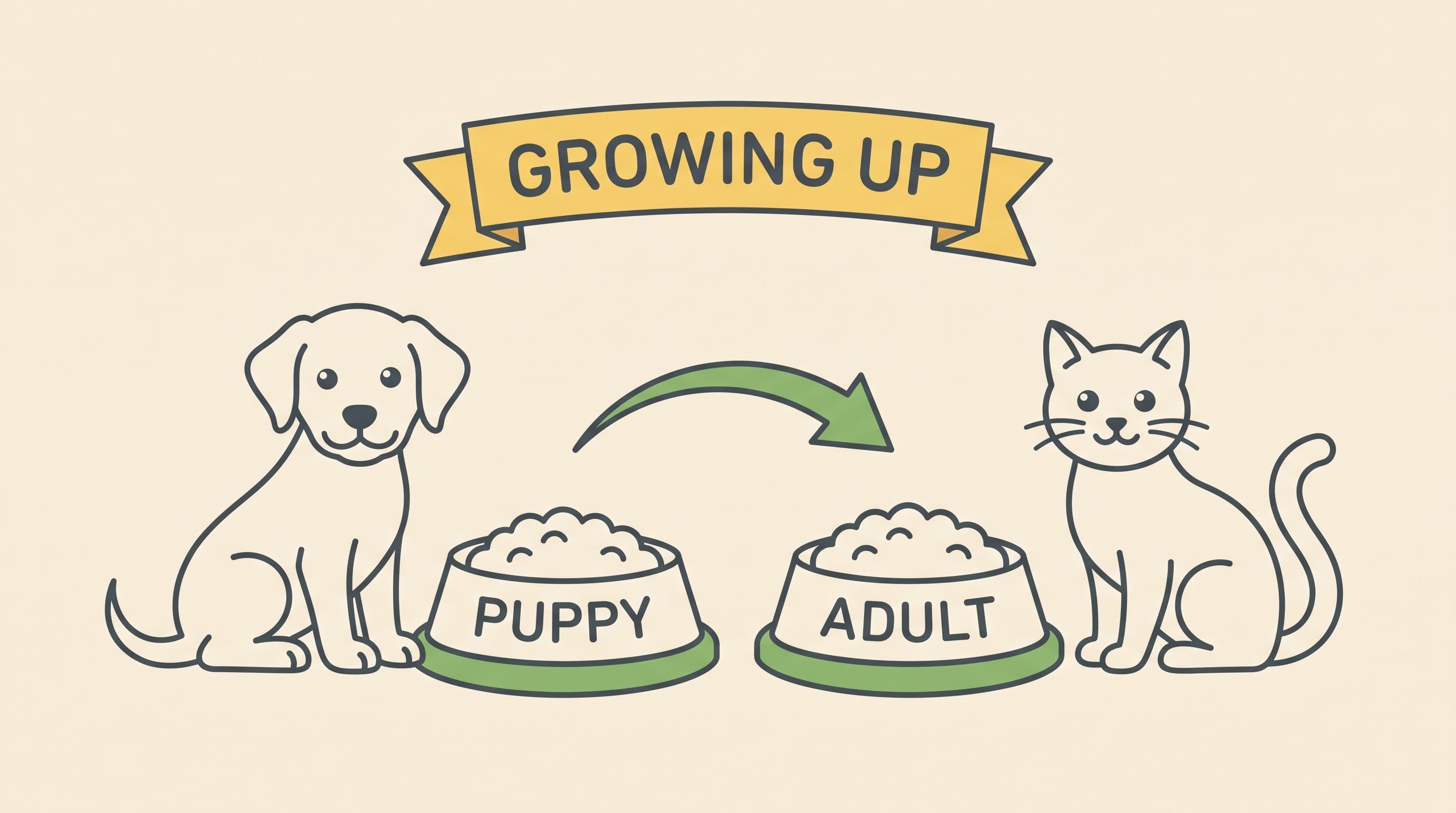
The transition to adult food and adult care
Alastair Greenway
BVM&S MRCVS
Somewhere in the second half of the first year, the frantic pace of new-pet life starts to slow. The jabs are done, the toilet training has held, the biting phase is a memory, and your puppy or kitten is beginning to look less like a baby and more like the animal they are going to be. And then a quiet question arrives: when do we stop treating them like a puppy or kitten? When do we switch the food, drop the constant vet visits, and settle into normal life?
This article is about that handover. It is not a single dramatic moment but a gentle shift of gears, and getting the timing right, especially on food, matters more than most owners realise. The good news is that adult care is simpler and calmer than the first-year whirlwind. You have done the hard part. This is where it gets easier.
When to switch from puppy or kitten food to adult food
This is the question I am asked most, and the honest answer is: it depends on when your pet stops growing, which depends a great deal on their size. Puppy and kitten diets are formulated for growth. They are more energy-dense and carry a different balance of nutrients, particularly the calcium and phosphorus that build the skeleton, than an adult body needs. Feed them for growth long after growth has finished and you tip a young adult towards excess weight. Switch too early, especially in a large-breed pup, and you cut off the support a still-growing frame needs.
For cats, it is fairly straightforward. Most kittens reach adult size by around twelve months, so the move to an adult diet at about a year is a reasonable default for the average cat. Some slower-maturing breeds, such as the Maine Coon, keep growing for longer, so as ever, check with your vet for your individual cat.
For dogs, the timing tracks size and can vary widely.
- Small and toy breeds often finish growing by around ten to twelve months, so they typically move to adult food around then.
- Medium breeds are usually there by around twelve months.
- Large and giant breeds keep growing for much longer, often until eighteen months and sometimes closer to two years, and should stay on an appropriate large-breed growth diet until they have finished, rather than being switched early.
That large-breed point matters, because too-fast growth is a genuine orthopaedic risk, not a cosmetic one. If your dog is a big breed, the goal through the first year is steady growth along a healthy line rather than getting them big quickly, which is exactly what the growth charts piece and the Growth Curve Tracker are there to help you watch. When the weight line flattens out and plateaus, that is your real-world signal that growth is finishing, and it is a far better guide than the calendar alone.
How to change the food without upsetting their stomach
Whenever the moment comes, change the food gradually rather than overnight. A sudden diet switch is a classic cause of a runny tummy in a young animal. The usual approach is to mix a little of the new food into the old and shift the ratio across roughly a week to ten days, so the gut has time to adjust. If you see loose stools or your pet goes off their food during the change, slow it down, and if it does not settle, talk to your vet. Persistent digestive upset is worth taking seriously rather than pushing through, and there is more detail in the digestive health space if you need it.
There is no dosing advice I can give you on exact portions here, because the right amount depends on the specific food, your pet's weight, whether they have been neutered, and their activity. The feeding guide on the pack is a starting point, not gospel, and your vet or vet nurse can help you dial it in. For the how-much-and-how-often groundwork, feeding a puppy or kitten is the companion piece.
The neutering effect: watch the waistline
If your pet has been neutered, and most will have been by this stage, there is one thing to keep a close eye on as they move into adult life. Neutering lowers the body's energy requirement, so a neutered pet needs meaningfully fewer calories than an entire one of the same size, and appetite does not always fall to match. This is the single most common reason young adults quietly become overweight in the months after neutering.
The fix is simple and worth building in now: reduce the portion to match the lower need, choose a food appropriate to a neutered adult if that suits, and keep checking their shape rather than just the scales. Learning to run your hands over the ribs and waist, the body condition score check, tells you far more than a number does, and catching a creeping waistline at this age is much easier than reversing established obesity later. If weight does start to climb, the weight management space has the tools to help. Keeping your young adult lean is one of the most powerful things you will ever do for their long-term joint and metabolic health.
Exercise grows up too
Food is not the only thing that changes as your pet matures, and exercise is worth a word because the first-year rules relax here as well. Through puppyhood, particularly in larger breeds, the sensible advice is to keep forced exercise moderate and to protect the growing joints while the growth plates are still open, favouring free play and short outings over long, repetitive, high-impact work. Once your dog has finished growing, and the weight line has plateaued to confirm it, you can safely build up to the full adult exercise their breed and temperament are built for, which for many working and sporting types is a great deal. Getting this right protects the joints you spent the first year growing carefully, and it channels the last of that adolescent energy somewhere useful. Cats, meanwhile, keep needing daily play well into adulthood, and an indoor adult cat especially relies on you for the hunting-style games that keep them fit, lean and mentally satisfied.
The visit cadence drops, but does not disappear
The first four months of a pet's life involve more vet contact than almost any other stretch until old age: the primary vaccination course, worming, the neutering conversation, microchipping, weigh-ins. It is intense by design. Once that groundwork is laid, the rhythm relaxes into the adult pattern, which for most healthy young adults means an annual health check with boosters.
I would gently push back on thinking of the annual check as "the jab appointment". It is the keystone of preventive care, and often the only time a healthy adult is examined nose to tail by a professional each year. Your vet weighs them, checks teeth, listens to the heart, feels the abdomen, looks at eyes and ears and skin, and picks up the small changes you live with day to day and stop noticing. Many practices split vaccine components across a sensible schedule rather than giving everything every year, and if you have read about titre testing, titre testing, honestly sets out where it does and does not fit. The point is that the visit is the health check, and the vaccine is one item on it.
The reminders do not have to live in your head. The same Vaccination and worming scheduler that pinged you through the busy first months carries on into adult life, nudging you towards the annual check and keeping the parasite plan on track, which for adults becomes a risk-based routine rather than the frequent puppy and kitten cadence covered in worming and flea control.
Adult cat life, specifically
Cats deserve their own note here, because "adult care" looks a little different for them and it is easy for a cat's needs to fade into the background once the busy kitten stage passes. By around a year, your cat's world has usually settled: the indoor or outdoor decision is made (and if you are still weighing it, indoor or outdoor is there), the litter and scratching routines are established, and the tearaway kitten energy is mellowing into a calmer adult rhythm.
Two things are worth carrying forward. First, cats are quietly stoic and superb at hiding illness, so the annual check matters just as much for them as for dogs, arguably more, because you will get less obvious warning at home. Second, adult life is when dental disease starts to build, and it is one of the most common and most under-treated problems in cats. Getting your cat used to having their mouth looked at, and asking your vet to check the teeth at every visit, pays off for years, and the dental space has the detail. Adult cats also settle better when their routine, their feeding, their safe spaces and their vertical territory stay predictable, so the calmer you keep their world, the calmer the cat.
Graduating to adult care in the app
Here on PetsLikeMine, the handover is built to happen without you having to manage it. As your pet crosses out of the puppy and kitten life-stage band, their profile graduates to the adult Care Hub, so the guidance, reminders and tracking shift with them rather than leaving you stuck in first-year content that no longer fits. Nothing you have recorded is lost. It flows forward, which is precisely the point of having started early.
This is also the stage where the breed lens starts to earn its keep. The breed you chose at the very beginning pre-seeds a watch-list of the conditions your dog or cat is more prone to, so as they enter adulthood the record already knows what to keep an eye on, whether that is early hip and joint screening for a large breed, heart checks for a predisposed breed, or spinal awareness for a long-backed dog. Your pet's /breeds/<slug> page and the relevant condition spaces are linked from their profile, so adult prevention starts targeted rather than generic.
This is a beginning, not an ending
The move to adult food and adult care can feel oddly poignant, the official end of the puppy or kitten chapter. But it is not really an ending. It is the moment your pet steps into the long, settled middle of their life, and everything you built this year, the vaccination protection, the healthy growth curve, the socialisation, the habits, becomes the foundation the next decade rests on.
There is one more piece to close out the first year, and it is the one that ties all of this together: what "done" looks like: your pet's lifetime record. It is worth reading, because it shows you exactly what you have built, and why starting the record at eight weeks old turns out to be one of the most useful things you will ever have done for the animal asleep at your feet.
References
- WSAVA Global Nutrition Committee. Nutritional guidelines and life-stage feeding recommendations.
- WSAVA. Vaccination Guidelines 2024.
- International Cat Care / AAFP. Feline life-stage and nutrition guidance.
- RCVS / practice norms for the annual adult health check.
Free downloads
Companion worksheets to put what you've read into practice. Free PDFs, print at home.
Keep track of how your pet is doing
The owners who cope best are the ones who notice changes early. A simple health log shows you what is working, and what is not, before the next vet visit.
Start tracking, freeYou're not doing this alone
Compare treatment journeys and talk to owners managing new puppy & kitten. Free to join.
Join PetsLikeMine