

Body condition scoring: the hands-on check that beats the scales
Alastair Greenway
BVM&S MRCVS
If a vet has ever run their hands down your pet's sides, pressed gently over the ribs and along the back, and then said something like "he's carrying a bit of condition" or "she's looking lovely and lean", you have watched body condition scoring in action. It takes about half a minute, it needs no equipment, and it tells you something the scales genuinely cannot: not how heavy your pet is, but whether the weight they carry is muscle and frame, or fat.
That distinction is why we teach it to owners. A number on the scales is only meaningful next to a hands-on read, and once you know the check you can do it at home, on the sofa, as part of a cuddle. For a growing puppy or kitten, whose "ideal weight" is a moving target that changes week to week, the hands-on read is arguably more useful than the scales, because your hands do not care how old they are or what they should weigh. They only tell you what is actually there.
Why the scales alone will mislead you
Weight is a brilliant thing to track over time, which is exactly why we ask you to plot it weekly on the Growth Curve Tracker. But a single weight, taken on its own, cannot tell you three things you need to know.
It cannot tell you muscle from fat. A lean, well-muscled young Boxer and a soft, under-exercised one can weigh the same and be in completely different condition. It cannot account for frame, because "the right weight for a Labrador" spans a wide range depending on whether the dog is a petite female or a big-boned male. And for a growing pet it cannot tell you whether the weight is appropriate for this week, because the correct number is climbing all the time.
Body condition scoring solves all three at once, because you are not measuring weight, you are assessing the animal in front of you. It is the reason your vet reaches for your pet's ribs before they reach for the scales, and it is the check that turns a growth chart from a line into a picture you can trust.
The scale that vets actually use
The standard tool is the WSAVA body condition score, a nine-point scale where 1 is emaciated, 9 is grossly obese, and the ideal for most dogs and cats sits at 4 to 5 out of 9. Some charts use a five-point version, but the nine-point scale is the one on the WSAVA charts and the one most UK practices record, so it is worth learning. WSAVA publishes free, illustrated body condition score charts for both dogs and cats, and they are well worth pinning up somewhere.
The number is less important than what it maps to. A 4 to 5 pet has ribs you can feel easily, a visible waist, and a tummy that tucks up. Above that, the ribs get harder to find under a fat layer, the waist disappears, and the tummy sags. Below it, the ribs, spine and hip bones start to become prominent and obvious. You are learning to feel your way to a 4 or 5 and to notice drift in either direction.
The three checks, hands-on
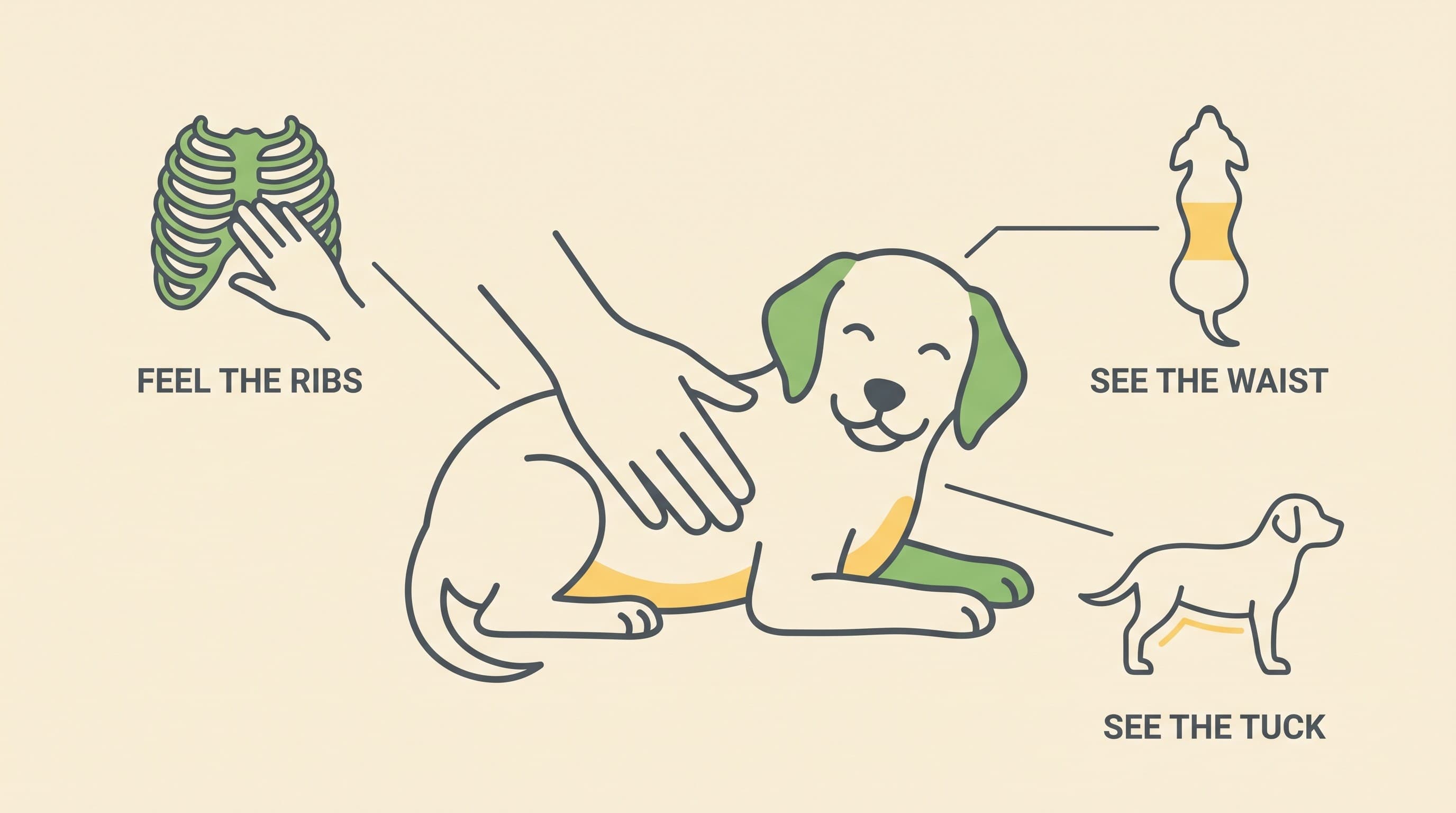
You do not need to memorise nine drawings. You need three checks, and you can do all of them in under a minute.
Feel the ribs. Run your fingertips lightly over your pet's ribcage, just behind the front legs. In ideal condition you should be able to feel each rib easily through a thin covering, with a little pressure, in much the way you can feel the bones on the back of your own hand. If you have to press hard to find ribs under a soft layer, that is a pet carrying too much. If the ribs feel sharp and stick out with no covering at all, that is too little. This is the single most reliable check, because ribs are honest.
See the waist from above. Stand over your pet and look down. Behind the ribs and before the hips, you want to see the body narrow into a waist, giving a gentle hourglass shape. A straight line from ribs to hips, or a body that bulges outward, means excess condition. A very obvious, deeply pinched waist with prominent hip bones means too little.
See the tummy tuck from the side. Crouch down and look at your pet in profile. The underline should slope up from the bottom of the ribcage towards the back legs, giving a tucked-up tummy rather than a straight or sagging belly. A belly that hangs level or droops is a sign of extra weight, though in puppies a slightly rounder tummy just after a meal is normal.
Put those three together, ribs easily felt, a visible waist, a tummy that tucks, and you have a pet in good condition without ever weighing them.
The feline footnotes that catch people out
Cats need two specific notes, because a couple of normal feline features get mistaken for fat or for muscle wastage.
The first is the primordial pouch, the loose flap of skin and a little fat that hangs along a cat's lower belly, in front of the back legs, and swings gently when they walk. This is completely normal feline anatomy, present in fit, lean cats, and it is not the same as being overweight. Do not try to diet away a primordial pouch. Judge a cat's condition by the ribs, waist and overall covering, not by that swinging flap.
The second is that cats, especially as they grow and later as they age, are assessed for muscle as well as fat, using a separate muscle condition score. In a growing kitten this rarely matters, but it is worth knowing that "condition" is about both, which is another reason the hands-on check beats a bare number.
Doing it on a wriggly, growing animal
A puppy or kitten will not stand still for an inspection, and that is fine, because the check works just as well woven into a cuddle. Once a week, while they are relaxed on your lap or the floor, run your hands over the ribs, glance down at the waist, and note the tummy tuck. Make it calm and pleasant, with a bit of fuss, and you also get a bonus: a pet who is used to being handled all over is far easier for your vet to examine and for you to check for lumps, ticks and sore spots for the rest of their life. That gentle, all-over handling is exactly the sort of thing the socialisation work is building anyway.
For a growing pet, aim to keep them feeling lean rather than plump. Puppy fat is not a health goal, and a young animal in good condition should have ribs you can find easily. It is far kinder to keep a growing pet trim from the start than to slim down an overweight adult later, and it protects the developing joints, a point that runs right through the growth charts piece.
What to do with what you find
The whole value of the check is that it tells you which way to steer.
If your pet is drifting above ideal, ribs getting harder to feel, waist filling in, the answer is usually a modest trim to the portions and a look at the treats, exactly the adjustments covered in feeding a puppy or kitten. Small, early corrections work; you are nudging a growing animal, not crash-dieting them, and any real weight-loss plan for a young pet should be steered by your vet. If condition keeps climbing despite sensible feeding, or your pet is already an overweight adolescent, the Weight Management space is built for exactly that, and it reads from the same weight history you are already keeping.
If your pet is drifting below ideal, ribs and spine becoming prominent when they should not be, resist the reflex to simply pile in more food. Unexpected weight or condition loss in a young animal can mean worms, a diet that is not being absorbed, or illness, so it is a vet conversation first, not a bigger bowl. This is the same rule as on the growth chart: a downward drift is a "show your vet" signal.
And keep the two checks married. The scales and the growth curve give you the objective line over time; the hands-on score tells you what that line is made of. Neither is complete alone. Together, they are precisely what your vet uses, and now you can bring both to the appointment.
The thirty-second habit worth keeping
Body condition scoring is not a one-off. Make it a weekly ritual alongside the weigh-in, note roughly where your pet sits on the 4-to-9 scale, and you will spot drift long before it becomes a problem. It costs nothing, it needs no kit, and it is one of the few genuinely predictive things you can do at home.
Next time you are at the practice, ask your vet to show you what a 4 or 5 feels like on your own pet, so your hands calibrate to the real thing. After that, you will feel a change coming before the scales confirm it, and that early warning is worth more than any number on a bag of food.
References
- WSAVA Global Nutrition Committee. Body Condition Score charts (dog and cat), 9-point scale; ideal 4-5/9.
- WSAVA Global Nutrition Committee. Muscle Condition Score chart (cat/dog).
- Cross-reference: [growth charts](/articles/growth-charts), [feeding a puppy or kitten](/articles/feeding-young-pets), [Weight Management space](/spaces/weight-management).
Keep track of how your pet is doing
The owners who cope best are the ones who notice changes early. A simple health log shows you what is working, and what is not, before the next vet visit.
Start tracking, freeYou're not doing this alone
Compare treatment journeys and talk to owners managing new puppy & kitten. Free to join.
Join PetsLikeMine