

Feeding a puppy or kitten: how much, how often, and switching food
Alastair Greenway
BVM&S MRCVS
Feeding a new puppy or kitten ought to be the simple bit. Then you stand in the pet-food aisle, or scroll a brand's website, and you are hit with grain-free, ancestral, human-grade, hypoallergenic, cold-pressed, breed-specific and a photograph of a wolf, and the simple bit evaporates. Add the panic of the first upset tummy after you switched from whatever the breeder used, and it is no wonder feeding becomes one of the most anxious jobs of the early weeks.
Let me take the marketing out of it. A growing pet needs a diet that is complete and balanced for their life stage, fed in the right amount, split across the right number of meals, and changed over gently when you change it. That is genuinely most of it. The rest of this article is how to get each of those four things right, for puppies and kittens both, without being talked into anything by a picture of a wolf.
First, cut through the label
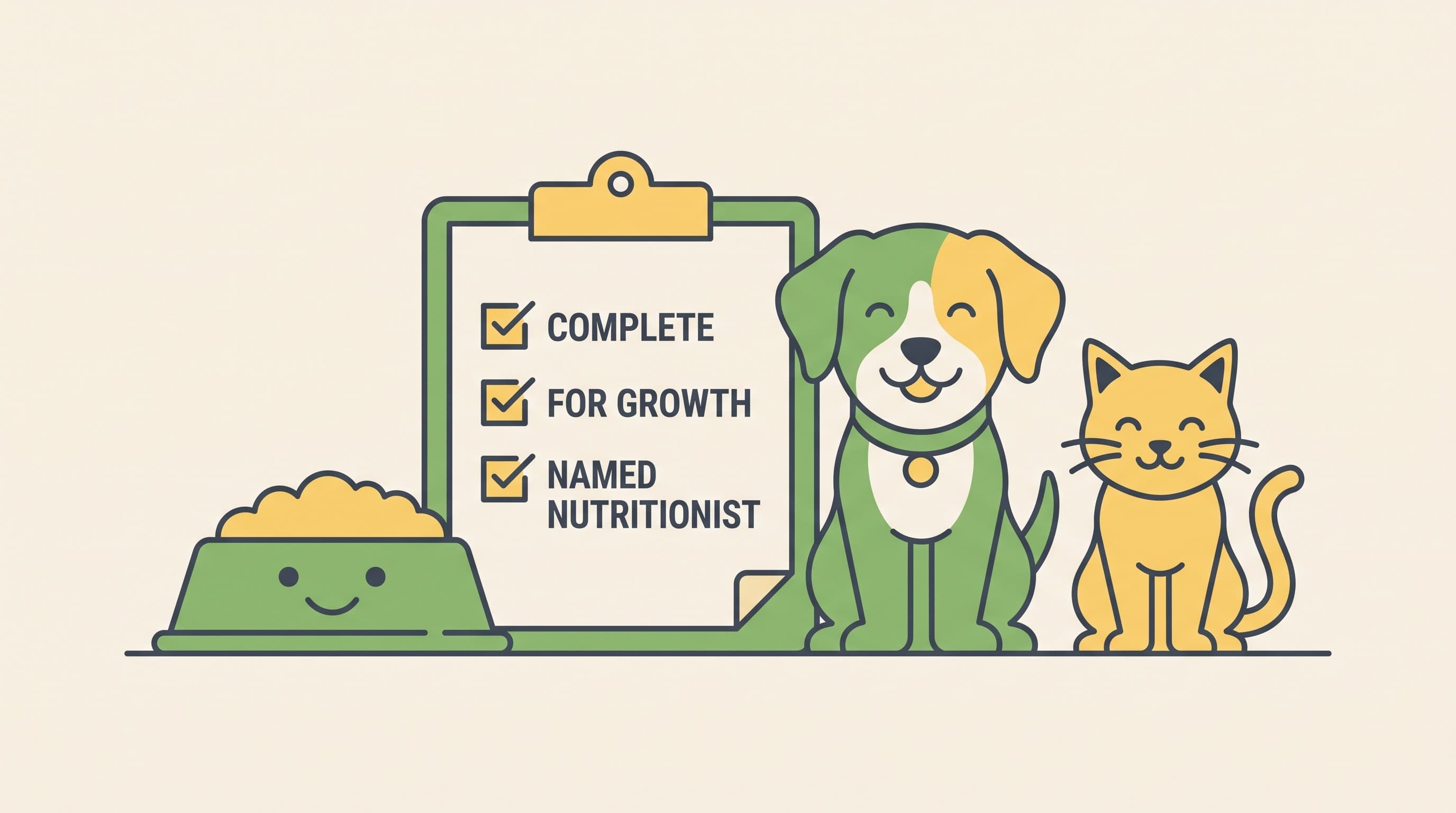
The single most useful word on any pet food is not on the front of the bag. It is the phrase "complete" (as opposed to "complementary"), usually tucked into the small print. A complete food is formulated to provide everything your pet needs in the right proportions. A complementary food, treats and toppers included, is not, and is only meant to sit alongside a complete diet.
The second useful thing to check is that the food is formulated for growth, meaning a puppy, kitten, or "all life stages" food, rather than an adult maintenance diet. Growing animals need more energy, protein and specific minerals per mouthful than adults do, and getting those proportions right matters, especially the calcium and phosphorus balance in growing dogs.
Beyond that, the trustworthy signal is not the buzzwords, it is the company behind the food. The WSAVA Global Nutrition Committee suggests a short list of questions worth asking any manufacturer: do they employ a qualified nutritionist, who formulates the diet, do they run feeding trials or meet a recognised nutritional standard (in the UK that is FEDIAF; in the US, AAFCO), and can they give you the energy content and a full nutrient analysis on request. A good company answers these easily. A brand selling mainly on a story often cannot. Grain-free, incidentally, is a marketing choice rather than a health requirement for most pets, and has been the subject of an ongoing safety question in dogs regarding diet and heart disease, so it is not a default to reach for.
Cats deserve a specific note here, because they are not small dogs. They are obligate carnivores, which means they have a genuine dietary need for nutrients found in animal tissue, taurine above all. A taurine-deficient diet can cause heart disease and blindness in cats, which is exactly why feeding a kitten on dog food, or on a vegetarian diet not formulated for cats, is not safe. A complete kitten food has this handled. A homemade or improvised one may not.
The large-breed exception that actually matters
If your puppy is going to be big, a Labrador, a German Shepherd, a Rottweiler, a Great Dane or similar, a large-breed puppy food is not an upsell. It is a genuinely different formulation, with controlled energy and carefully managed calcium, designed to grow the skeleton steadily rather than fast. Too-rapid growth in a big-breed pup is linked to developmental orthopaedic problems, so the goal is a slow, even climb, not a sprint to full size.
This is the same message that runs through the growth charts piece from the other direction: with a giant-breed pup, "getting them big quickly" is a risk, not an achievement. Feed a large-breed growth diet, resist the urge to over-feed, and let your dog's breed page flag the joint issues worth watching from the start. Small and medium breeds do not need this special formulation, and every kitten, whatever their eventual size, does fine on a standard complete kitten diet.
How much: the pack is a starting point, not a rule
Every complete food carries a feeding guide, usually a table of grams per day against expected adult weight and age. Use it, but treat it as an opening estimate rather than a prescription. These guides are population averages, and your individual pet may be more or less active, more or less efficient, and neutered or not, all of which shift the real requirement.
The honest way to set the amount is to feed roughly what the guide suggests, then let your pet's body tell you whether it is right. That means two habits, both covered elsewhere on the site. Weigh weekly and watch the trajectory on the Growth Curve Tracker, so you can see if they are drifting up or down the curves. And run your hands over them every week or two using body condition scoring, so you are judging actual condition, not just a number. If they are climbing across the centiles and feeling soft over the ribs, trim the portion. If they are dropping away and feeling bony, that is a vet conversation, not simply a bigger bowl, because a pet losing condition may be unwell rather than underfed.
Please do not free-feed a puppy by leaving the bowl down to graze at will, particularly a large-breed one, because it makes over-nutrition almost inevitable and takes away your ability to see how much they are actually eating. Cats are a partial exception, as many do well grazing small amounts across the day, but that only works with a measured daily ration put out in portions, not a bottomless bowl topped up on sight. Measure the day's food in the morning and feed from that.
How often: meals across the day
Small stomachs need feeding little and often, and the frequency tapers as they grow. As a general pattern for puppies, expect around four meals a day up to about three to four months, dropping to three meals to roughly six months, then two meals a day into adulthood. Kittens follow a similar arc, three to four small meals a day when young, easing to two or more as they mature, with grazing an option once they are established on a measured ration.
Two meals a day for life, rather than one, suits most adult dogs and cats, so you are simply working down to that. Regular mealtimes also make house-training easier in puppies, since what goes in on a schedule tends to come out on a schedule, a link worth reading alongside house-training that actually works.
Switching food without the upset tummy
Here is the one that causes the most week-one panic. Your breeder or rescue fed one food, you have bought another, and a sudden swap gives a lot of puppies and kittens loose motions. It is almost always the abruptness, not the new food, that does it.
The fix is to go slowly. For the first few days, keep feeding whatever they came home on, because a new pet has enough change to cope with already. When you do switch, blend the new food in gradually over about a week: a little new mixed into mostly old to start, shifting the ratio a bit more each day until you are fully onto the new diet by around day seven. If their tummy gets unsettled, slow the pace down rather than pushing on. A pet that is being wormed to schedule is also less likely to have gut upset blamed on food when it is actually parasites, which is one reason the worming and flea plan and the feeding plan belong together in the early weeks.
If loose motions are severe, bloody, or come with a flat, off-colour pet, that is not a food-transition issue and needs a vet the same day, particularly in an unvaccinated puppy where parvovirus is a real fear.
Treats, milk and the things off your plate
Treats are part of training and part of the bond, so use them, but keep them to no more than around a tenth of daily calories and take that amount off the main meals so it does not simply add up. Training treats can be tiny; a puppy does not count the size, only the moment.
A few specifics worth stating plainly. Cow's milk is not a good idea for kittens or puppies once weaned, as many cannot digest the lactose and it causes diarrhoea; a bowl of water is what they need, and kitten milk replacers exist only for hand-rearing. Keep the human favourites off the menu too: chocolate, grapes and raisins, onions and garlic, xylitol (in sugar-free gum and some peanut butters) and cooked bones are all genuinely dangerous, and "a little bit won't hurt" is how a lot of emergency visits start.
On raw feeding, I will be even-handed. Some owners feel strongly about it, and a properly formulated raw diet can be complete, but raw meat carries real food-safety and bacterial risks, to your pet and to the humans in the house, and getting the balance right for a growing animal is harder than it looks. If you want to go that way, do it with a diet formulated to a recognised standard and a conversation with your vet, not off a social-media recipe.
What to do next
Pick a complete food formulated for growth from a company that can tell you who formulates it, feed the pack guide as a starting amount, split it across the right number of meals for their age, and transition gently over a week from whatever they came home on. Then let their body fine-tune the amount: weigh weekly on the Growth Curve Tracker and feel their condition with body condition scoring, and adjust from what you see and feel rather than from the bag.
This is not forever. As your pet approaches maturity the diet, the portions and the frequency all shift again, which is the subject of the transition to adult food and adult care. For now, complete, for growth, measured, and changed gently is very nearly the whole of it.
References
- WSAVA Global Nutrition Committee. Global Nutrition Guidelines, and "Selecting the Best Food for your Pet" / questions to ask a manufacturer.
- FEDIAF (European Pet Food Industry Federation). Nutritional Guidelines for Complete and Complementary Pet Food for Cats and Dogs.
Free downloads
Companion worksheets to put what you've read into practice. Free PDFs, print at home.
Keep track of how your pet is doing
The owners who cope best are the ones who notice changes early. A simple health log shows you what is working, and what is not, before the next vet visit.
Start tracking, freeYou're not doing this alone
Compare treatment journeys and talk to owners managing new puppy & kitten. Free to join.
Join PetsLikeMine