

Titre testing, honestly
Alastair Greenway
BVM&S MRCVS
Somewhere in the first year, often around the time of the first booster, many owners come across the idea that vaccines are "overdone", that yearly jabs are unnecessary, and that a blood test called a titre test could replace them. Some of what you will read on this is sensible and supported by the veterinary guidelines. Some of it is anti-vaccine framing dressed up as caution, and following it can leave a dog or cat unprotected against diseases that kill. This article lays out what titre testing actually is, what it can and cannot tell you, and where it genuinely fits, so you can make an informed choice rather than an anxious or a persuaded one.
Let us be clear at the outset about what this article is not. It is not an argument against vaccinating. Core vaccines prevent serious, often fatal diseases, and the goal here is a well-protected pet, not a lightly protected one.
What a titre test is
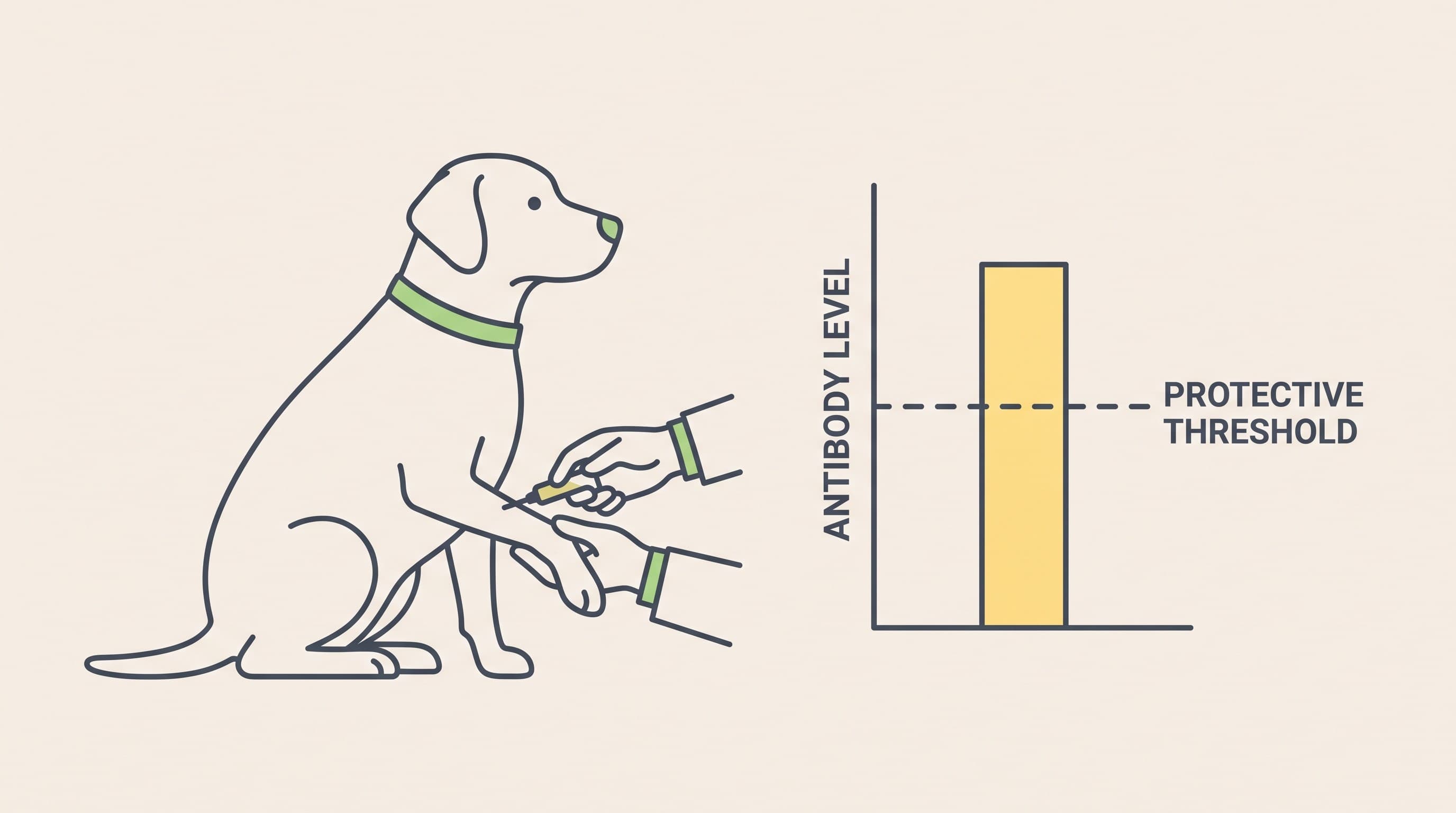
A titre test (you may see it spelled "titer") is a blood test that measures the level of antibodies against a specific disease in your pet's blood. A high enough antibody level suggests the immune system has met that disease, through vaccination or natural exposure, and has mounted a response that is likely to be protective. In dogs, titre testing is most meaningful for the core viral diseases: distemper, adenovirus (hepatitis) and parvovirus, the "DHP" group. In cats it can be used for panleukopenia (WSAVA, 2024).
The idea that appeals to owners is straightforward: instead of automatically revaccinating, test first, and only revaccinate if the antibody level has dropped. Used properly, that is a legitimate approach, and it is one the vaccination guidelines themselves discuss.
What the guidelines actually say
This is where honesty matters, because titre testing is neither the miracle nor the con it is sometimes made out to be.
The WSAVA Vaccination Guidelines (2024) are explicit that the core vaccines producing long-lasting immunity, distemper, adenovirus and parvovirus in dogs and panleukopenia in cats, do not need to be given every year. After the puppy or kitten course and the first-year booster, these core components are typically given no more often than every three years, and often the protection lasts considerably longer than that (WSAVA, 2024). So the person who tells you "yearly core jabs are unnecessary" is, for these specific diseases, largely correct, and your vet already works to this schedule. You do not need a titre test to avoid over-vaccinating with core components; the modern protocol already spaces them out.
WSAVA also recognises titre testing as a valid tool. For the core viral diseases, a positive titre indicates protective immunity and can be used to decide whether a booster is needed, and it is a reasonable option for owners who want it (WSAVA, 2024). That is the honest, guideline-backed place for titre testing: as a way to check core immunity and potentially extend the interval between core boosters, in discussion with your vet.
The crucial limits: what titres cannot do
Here is the part the "titre instead of vaccines" content usually leaves out, and it is the reason a titre test is not a wholesale replacement for your pet's vaccination programme.
Titres do not work for every disease. Titre testing is meaningful for the core viral diseases above. It is not a reliable guide for several important vaccines whose protection is shorter-lived or not well reflected by circulating antibody levels, including leptospirosis in dogs (a serious bacterial disease and a zoonosis, meaning it can pass to people), and the components of cat flu and feline leukaemia virus (FeLV) in cats. These need to be given on their recommended schedule regardless of any titre result, because a titre simply does not tell you what you need to know for them (WSAVA, 2024). Leptospirosis in particular is a real and sometimes fatal UK risk, and it is not covered by a DHP titre.
A titre is not a perfect guarantee. A protective antibody level is strong evidence of immunity, but the absence of a measurable titre does not always mean an animal is unprotected, because immune memory involves more than circulating antibodies. Interpreting the result well is a job for your vet, not a home kit.
A titre costs money and a blood draw. Depending on the test and where it is run, titre testing can cost as much as, or more than, simply revaccinating with a core booster. It is a genuine option, not automatically the cheaper or easier one.
Puppies and kittens: titres are not a substitute for the primary course
This point is important enough to state on its own. A titre test is a tool for the adult booster decision. It is not a way to skip or shortcut the puppy or kitten vaccination course. Young animals need their primary course to become protected in the first place, and because of maternally derived antibodies, the timing of that course, including a final dose at or after 16 weeks of age recommended by WSAVA, is what closes the dangerous window of susceptibility (WSAVA, 2024). The full explanation of that timing is in The UK vaccination schedule explained. No one should be using titre testing as a reason to leave a puppy or kitten under-vaccinated during the period when parvovirus and panleukopenia are most likely to kill them.
Spotting anti-vaccine framing
Because this topic sits next to a lot of misinformation, it helps to recognise when "just do titres" tips from reasonable into risky. Be wary of any source that:
- Tells you core vaccines are unnecessary or dangerous, rather than that they are needed but not annually.
- Suggests titre testing can replace all vaccines, including leptospirosis, cat flu or FeLV.
- Encourages skipping or delaying a puppy or kitten's primary course.
- Frames vets as pushing vaccines for profit, when the modern guidelines your vet follows already reduce core-vaccine frequency.
- Offers home titre kits as a reason to avoid the vet altogether.
The reassuring reality is that your vet is already working from guidelines designed to give the right protection with the fewest necessary vaccines. Titre testing is a conversation to have with them, not an alternative to them.
Core versus non-core: the distinction that clears up most of the confusion
A lot of the muddle around titres and "over-vaccination" evaporates once you understand that not all vaccines are the same kind of thing. The guidelines divide them into core and non-core (WSAVA, 2024).
Core vaccines protect against diseases that are severe, widespread or both, and every dog or cat should receive them. In dogs that is distemper, adenovirus and parvovirus; in cats, panleukopenia, calicivirus and herpesvirus (the cat-flu components). The core viral components tend to produce long-lasting immunity, which is why they are given no more than every three years in adulthood, and why they are the ones a titre can meaningfully measure.
Non-core vaccines are given based on a pet's individual risk: where you live, whether your cat goes outside, whether your dog swims in or drinks from places where leptospirosis lurks. Leptospirosis for dogs and FeLV for at-risk cats are the common UK examples. These generally need more frequent boosting, their protection is not well reflected by a simple antibody titre, and so they are given on schedule rather than titre-tested.
Once you hold that distinction in mind, the honest position falls out naturally: titres are a reasonable way to check and space out the long-lasting core viral protection, and they are not a tool for the non-core vaccines your pet also needs. Anyone telling you a titre lets you drop everything is glossing over the second half of that sentence. The full schedule, core and non-core, is laid out in The UK vaccination schedule explained.
Cats specifically
For cats, titre testing is most applicable to panleukopenia, a severe and often fatal viral disease of kittens, where a protective titre is meaningful (AAFP, 2020; WSAVA, 2024). The cat-flu components (calicivirus and herpesvirus) are more complicated: immunity is less complete and titres correlate less well with real-world protection, so these are not a good fit for a titre-led approach. And FeLV, recommended for cats with outdoor access or contact with other cats, is a non-core vaccine given on schedule, not titre-tested. One thing titre testing does not change for cats: there is still no FIV vaccine available in the UK, so FIV is managed by testing, neutering and lifestyle rather than by any vaccine or titre. That side of feline retrovirus care is covered in FeLV and FIV: should you test your kitten?.
When titre testing genuinely makes sense
There are situations where asking your vet about titre testing is entirely sensible:
- An adult dog or cat whose owner wants to confirm core immunity before deciding on a booster, and is happy with the cost.
- An animal that has had a genuine adverse reaction to a vaccine in the past, where the risks and benefits of each further vaccine need careful weighing (a proper veterinary discussion, not a blanket avoidance).
- A rehomed pet with an unknown vaccination history, where a titre can help work out what protection already exists.
- Meeting the requirements of some catteries, kennels or travel schemes that accept titre results (check the specific requirement, as many still require vaccination).
In every one of these, the titre is a piece of information feeding a decision made with your vet, alongside, not instead of, the vaccines that titres cannot cover.
Your next step
If you are weighing up titre testing, the honest summary is this: it is a real, guideline-recognised tool for checking core viral immunity in dogs and cats, it can support spacing out core boosters, and it is worth discussing with your vet, but it does not replace leptospirosis, cat flu or FeLV vaccination, and it is never a shortcut around a puppy or kitten's primary course. Read The UK vaccination schedule explained so you understand what your pet actually needs and when, keep the Vaccination and worming scheduler up to date so nothing important lapses, and bring your questions to your vet, who can tell you whether titre testing makes sense for your individual pet. If you are trying to reconcile protection with getting your puppy out into the world, How to socialise before the vaccinations finish is the companion piece.
References
- World Small Animal Veterinary Association (WSAVA) Vaccination Guidelines Group. WSAVA Guidelines for the Vaccination of Dogs and Cats. WSAVA. 2024.
- American Association of Feline Practitioners / AAHA. Feline Vaccination Guidelines. AAFP. 2020.
- British Small Animal Veterinary Association. Vaccination position and resources. BSAVA.
Free downloads
Companion worksheets to put what you've read into practice. Free PDFs, print at home.
Keep track of how your pet is doing
The owners who cope best are the ones who notice changes early. A simple health log shows you what is working, and what is not, before the next vet visit.
Start tracking, freeYou're not doing this alone
Compare treatment journeys and talk to owners managing new puppy & kitten. Free to join.
Join PetsLikeMine